
Game review
SPORE
5 / 10
- Developer
- Maxis
- Publisher
- Electronic Arts
- Released
- 19 December 2008
- Platforms
- Windows
- Genre
- Life Simulation RPG
- Monetisation
- Paid, one-time purchase. No in-app purchases; several paid expansion packs exist as separate products.
- Players
- Single-player, originally built around an asynchronous online creature and creation-sharing ecosystem now reported broken for Steam purchasers.
The short version
SPORE's five-stage journey from single cell to spacefaring civilization is still one of the most ambitious design ideas ever shipped by a major publisher, and 66,000-plus mostly glowing reviews reflect real, lasting affection for it. What those same reviews document with striking consistency is that Steam purchasers specifically cannot register the EA account needed to access the game's online sharing ecosystem — the system that originally let every player's hand-designed creature populate everyone else's universe, and the feature that made SPORE's 2008 pitch more than a single-player toy. Roughly five in six of the negative reviews checked for this piece raise that exact problem, independently, across a seven-year span.
Biggest strengths
- A genuinely unmatched structural idea — five distinct gameplay stages, from single-celled organism to interstellar civilization, built around the same creature you design yourself.
- Powerful, still-impressive creation tools for creatures, vehicles, buildings and starships that reviewers across a decade and a half continue to praise specifically.
- A real, lasting cultural footprint as one of Will Wright's and Maxis's most ambitious releases, distinct from anything else on the market before or since.
Biggest weaknesses
- An overwhelming, specific and repeated complaint across reviews from 2018 through late 2025: the Steam version cannot register an EA account, meaning the online creature and creation-sharing ecosystem central to the original pitch does not function.
- Several reviews report having to separately own or purchase the game on Origin/EA App to unlock features the Steam listing itself doesn't disclose are missing.
- At least one reviewer describes needing to buy the game twice — once on Steam, once elsewhere — to get the advertised online functionality.
Who it's for: Anyone curious about a genuinely singular piece of game design history, provided they go in understanding they are very likely buying a single-player experience only, regardless of what the box implies about a shared universe.
Our recommendation: Worth playing for the creation tools and five-stage structure alone, but buy on GOG or Origin/EA App instead of Steam if the online creature-sharing ecosystem matters to you.
5 / 10
An idea nothing else has fully replicated
SPORE's pitch remains audacious even against everything that's come since: a single game spanning five completely different genres, all built around one creature whose design choices ripple forward through every later stage. The store page's own framing puts it plainly — "From Single Cell to Galactic God, evolve your creature in a universe of your own creations" — across Cell, Creature, Tribe, Civilization and Space stages, "each stage has its own unique style, challenges, and goals." Official screenshots confirm the tonal range that structure implies: one shows a tribal-stage village with pink, multi-limbed creatures gathered around a totem and cooking fire, framed by hand-built huts and a distinctly whimsical, cartoonish art style that carries all the way through to the game's later strategy and space-exploration stages. The creation tools underpinning all five stages — for creatures, vehicles, buildings and starships — remain a specific, frequently cited highlight in reviews written well over a decade after launch, evidence that the sandbox design tools themselves have aged better than almost anything else about the game.
The feature the whole design was built around
What made SPORE more than an ambitious single-player toy in 2008 was its online layer: creatures and creations designed by any player would populate every other player's galaxy procedurally, turning a solitary creative act into a shared, emergent ecosystem nobody fully controlled. That system is the subject of an extraordinarily consistent complaint across this game's Steam review history. Checking a sample of thirty recent negative reviews, twenty-five raise the exact same specific problem, independently, across dates spanning December 2018 through October 2025: the Steam version of the game cannot register the EA/Origin account required to access any online feature. "Upon opening the game, you will be prompted for an EA Origin account login," one December 2023 review explains. "When you try to log in with your Origin account, it will display a message saying you cannot connect to servers." A July 2021 review with nearly 10,000 minutes logged states it plainly: "Love the game itself, but DO NOT buy from Steam." A November 2025 review is the bluntest: "This game is still being sold for over $20 while the servers are no longer online and you cannot fully play the game or all of the content. Shameful of EA."
Several reviewers describe workarounds and their limits in specific, useful detail. One 2022 review explains that Steam purchasers can sometimes gain access "by having to contact EA" directly, a process at least one other reviewer describes attempting and failing. A December 2024 review describes playing successfully only via "my father's formally subscribed EA account" rather than anything tied to the Steam purchase itself. A November 2024 review sums up the practical outcome for many buyers bluntly: "i had to buy it twice... if you want to play the funny creature game with online features (the superior way)" — meaning owning the game on Steam and wanting its advertised sharing ecosystem can mean paying for it a second time on a different storefront.
A quiet rebrand instead of a fix
One detail is worth pointing out because it reads less like an oversight and more like a tacit acknowledgement: the current store description frames SPORE as "an exciting single-player adventure" rather than the online-ecosystem-centred pitch the game launched with in 2008. Nothing in the visible store copy discloses that the Steam version specifically lacks working online registration — a buyer would have to already know to look for it, exactly as this review's source reviewers did the hard way. Reframing the marketing around what still works, rather than fixing or disclosing what doesn't, is a quieter kind of consumer harm than an outright broken game, but the pattern across years of consistent, specific, independently-reported complaints makes it hard to read as anything other than a known, long-standing, unaddressed platform gap.
Judging a solo playthrough on its own terms
Separate from the online question, it's worth asking honestly how SPORE holds up as a single-player game in 2026, since that's what most Steam buyers are actually getting whether the store page says so plainly or not. The five-stage structure genuinely does deliver five different kinds of fun rather than reskinning the same mechanic five times: the Cell stage plays like a top-down survival arcade game, Creature stage resembles a light action-RPG with social and combat choices, Tribal and Civilization stages shift into real-time strategy territory, and the Space stage opens into a loose 4X-style exploration game spanning an entire procedurally generated galaxy. That range is exactly why the game's ambition still gets cited approvingly by reviewers who never once mention the online issue — solo, the game is still doing something structurally unusual that few other releases, before or since, have attempted at this scale. The creature and vehicle editors specifically remain a genuine highlight even completely offline, generous enough with customisation options that players still post new creations to fan communities well outside any of the game's own official channels today.
Final verdict
SPORE's design ambition and creation tools remain genuinely worth experiencing, and the Very Positive badge reflects real, durable affection for what the single-player game still offers on its own terms. But a prospective buyer deserves to know, clearly, before purchasing on Steam specifically: the feature that made this game more than the sum of its five stages — a shared universe built from every other player's creatures — has been reported broken for Steam purchasers consistently for at least seven years, with no fix and no disclosure on the store page itself. Buy it for the single- player journey it still delivers well. Buy it elsewhere, or budget for a second purchase, if the shared-universe feature is why you wanted it in the first place.
Pros and cons
Pros
- A genuinely unmatched structural idea — five distinct gameplay stages, from single-celled organism to interstellar civilization, built around the same creature you design yourself.
- Powerful, still-impressive creation tools for creatures, vehicles, buildings and starships that reviewers across a decade and a half continue to praise specifically.
- A real, lasting cultural footprint as one of Will Wright's and Maxis's most ambitious releases, distinct from anything else on the market before or since.
- Frequently available at a steep discount, making the single-player content alone a reasonable value proposition.
Cons
- An overwhelming, specific and repeated complaint across reviews from 2018 through late 2025: the Steam version cannot register an EA account, meaning the online creature and creation-sharing ecosystem central to the original pitch does not function.
- Several reviews report having to separately own or purchase the game on Origin/EA App to unlock features the Steam listing itself doesn't disclose are missing.
- At least one reviewer describes needing to buy the game twice — once on Steam, once elsewhere — to get the advertised online functionality.
- The current store description quietly frames the game as a "single-player adventure," a shift from its original online-ecosystem-centred marketing that several reviewers read as an unacknowledged admission of the broken feature.
Screenshots
-

SPORE™Image: Electronic Arts via Steam -

SPORE™Image: Electronic Arts via Steam -

SPORE™Image: Electronic Arts via Steam -
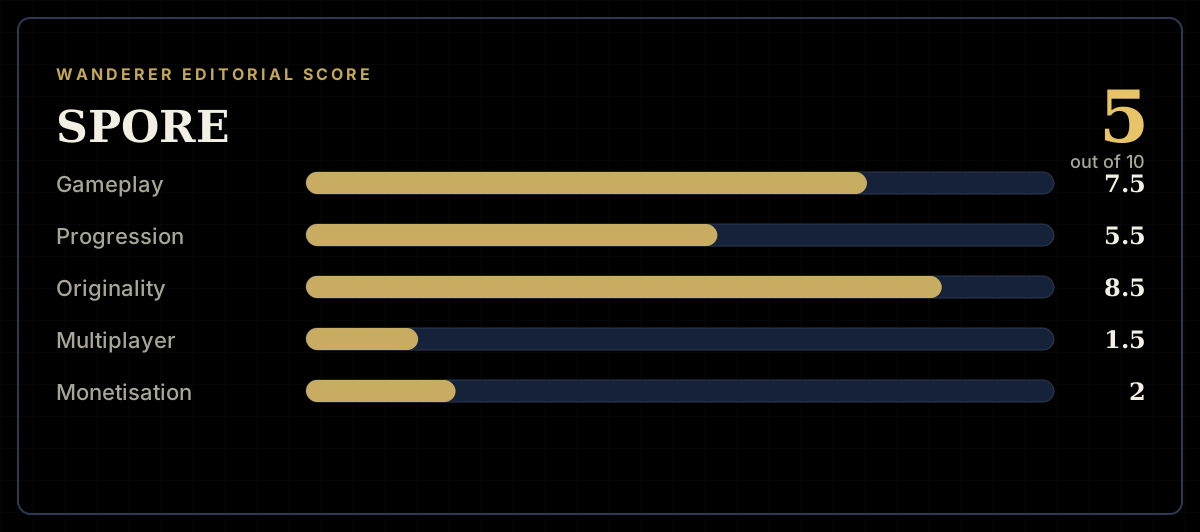
How the review scores each part of the gameWanderer Editorial -
The short versionWanderer Editorial