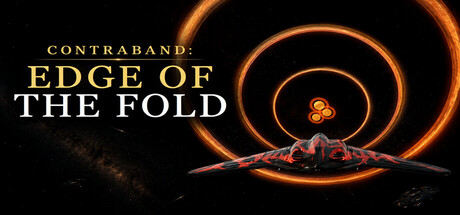
Game review
Contraband: Edge of the Fold
6.6 / 10
- Developer
- Dero Lavigne
- Publisher
- Martinez AI Studios
- Released
- 19 August 2026
- Platforms
- Windows
- Genre
- RPG
Zero Reviews for an Ambitious Branching Space Story
Contraband: Edge of the Fold launched on Steam on 19 August 2026 from developer Dero Lavigne, and at the time of writing it has no user reviews at all. That's a notable gap for a game pitching this much structural ambition: a story-first space game built around branching choices, set on a smuggling frontier where, per the store page, "timelines that don't forget what you did last run" track every contract, negotiation, and betrayal across a full campaign. It's the kind of premise that lives or dies entirely on execution — branching narrative games are easy to promise and hard to deliver well — and a launch with zero outside confirmation means every claim below has to be taken as the developer's own description rather than anything independently verified.
Running Contraband Across a Frontier That Remembers
The core loop, as described on the store page, revolves around picking up cargo of dubious legality and negotiating with factions and individuals who "maybe can't be trusted," with consequences that carry forward and compound across the campaign rather than resetting after each job. That's a meaningfully different structural promise than a typical episodic space-trading game: instead of discrete missions with self-contained outcomes, the pitch is an interconnected record where past choices actively reshape which contracts, characters, and outcomes remain available later. Whether that record-keeping holds up as more than a background flavour text is exactly the kind of claim that needs hours of actual play to confirm, and with no player reviews yet, that confirmation simply doesn't exist. Screenshots reveal considerably more mechanical substance underneath the narrative pitch than the store page's feature list lets on: real-time ship combat with hull and shield bars, a locked-target reticle, a tactical contact report, and weapons that include an armed nuclear option; and a full galaxy map colour-coded into Allied Space, Neutral Hubs, Hostile Territory, and Exotic Sectors, with individual systems carrying their own population, economy type (one hidden station is tagged with a "Black Mkt" economy), security level, and risk rating. That's a materially more developed simulation layer — closer to a lightweight space-4X with a branching story draped over it — than "story-first" alone would suggest, and it raises the stakes on whether the combat and navigation systems are as well-tuned as the writing is claimed to be.
Thirty Endings Across Four Timelines
The most specific and checkable claim on the store page is the ending structure: four major timeline paths, named Sacred, Multiverse, Abandon, and Burn, branching into roughly thirty tracked epilogue variants in total, with the store page explicitly stating "every ending is in the box: no paywalls, no cut content" — a direct anti-DLC-gating claim worth taking at face value until proven otherwise. The game's own 87-entry achievement list backs up a genuinely branching structure in practice, with named milestones like "First Crossroads," "Beyond the Rift," "Elder Sera's Gift," and "Keeper of the Timeline" suggesting distinct narrative junctures and named characters rather than a single linear plot with cosmetic variation at the end. That's a substantial content claim for a single-developer sci-fi narrative game, and having every ending unlocked without additional purchase is a genuinely player-friendly structure if it holds. The game does list one piece of paid add-on content, an original soundtrack sold separately for NZ$7.89, but a soundtrack is exactly the kind of optional extra that doesn't contradict a "no paywalled endings" promise — it's a reassuring sign, rather than a red flag, that the only DLC on offer is music rather than a chunk of the timeline structure being held back.
Kaela, the Onboard AI, and a Redesigned Cockpit
The player's ship comes with an operations character named Kaela, described on the store page as the "ship's operations AI" who "keeps the dock running" while the player handles the moral and narrative decisions — a fictional in-universe character concept rather than any claim about how the game itself was built. A screenshot confirms Kaela has her own dedicated tab in the main interface, alongside separate tabs for status, inventory, missions, the campaign, a "Sacred Timeline" tracker, the galaxy map, achievements, and settings — suggesting she's a persistent, referenced presence across the UI rather than a one-off dialogue character. The store page also describes a "redesigned 4.0 interface," implying this is a later iteration of an existing cockpit design rather than a first attempt, combining a cinematic hangar, a real-time HUD, a pilot dossier, a star map, and station services into what's framed as a single cohesive command deck. The game is also fully bilingual with complete English and Spanish (Latin America) voice acting, and the store page specifically advertises responsive layout support from 16:9 laptops up through 21:9 and 32:9 ultrawide monitors — an unusually wide range of display support to call out explicitly for a game of this scale, and a reasonable one to flag as a positive if a player has that kind of hardware.
Mature Themes Handled With Explicit Care
The developer's own content descriptors are unusually thorough, and worth reporting plainly rather than glossing over: the game includes sci-fi ship combat without graphic gore, but its narrative covers smuggling and other criminal activity, war, death, loss, and morally difficult choices with lasting consequences, alongside some side stories and endings described by the developer as "emotionally dark or unsettling," including ghost-ship scenarios and references to corpses, trauma, and grief. The descriptors also note that some narrative text briefly references self-harm or suicide, including an off-screen character death and a player-choice ending involving self-destruction, stated explicitly not to be shown graphically, and that character designs may include revealing or form-fitting outfits without explicit nudity or sexual content. Laying all of this out via the developer's own age-rating descriptors, rather than either sensationalising or omitting it, is the fairest way to flag that this is not a light or breezy narrative adventure, and prospective buyers sensitive to those specific themes should weigh that before purchase.
Verdict
Contraband: Edge of the Fold makes a genuinely distinctive pitch — a branching sci-fi smuggling narrative with thirty tracked endings across four named timeline paths, all included without paywalling, backed up by an 87-entry achievement list that suggests real structural depth rather than marketing exaggeration. Full bilingual voice acting and unusually wide ultrawide-monitor support round out a package that reads as more considered than the average single-developer narrative game at this price. Whether the moment-to-moment writing and choice consequences actually land, and whether the mature themes the developer has been explicit about are handled with the same care in practice as they are on the store page, remain entirely open questions for a launch that hasn't collected a single player review yet.
Screenshots
-
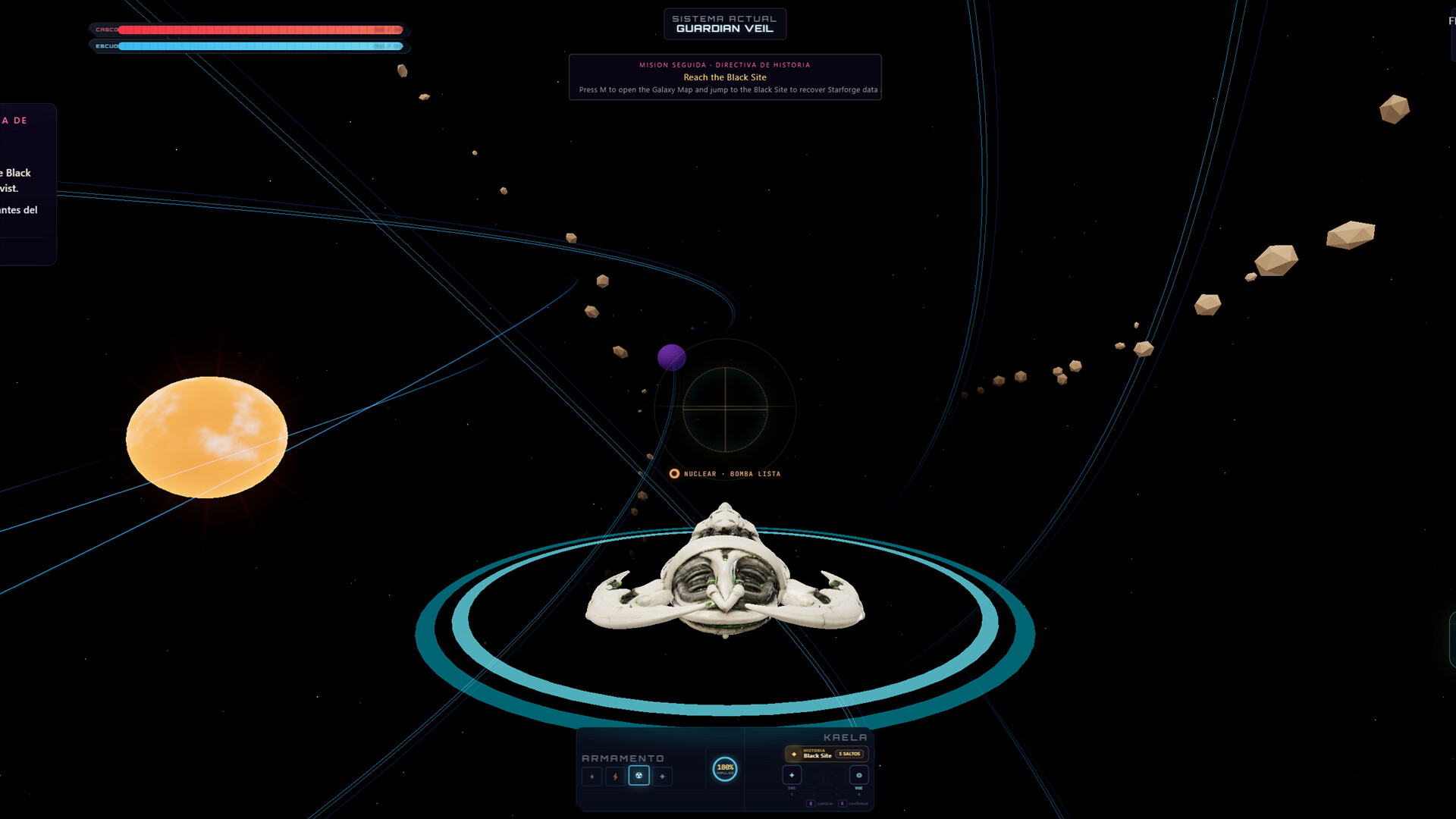
A story objective screen in the Guardian Veil system, with hull/shield bars and weapon loadout visible alongside Kaela's operations panel.Steam store page -
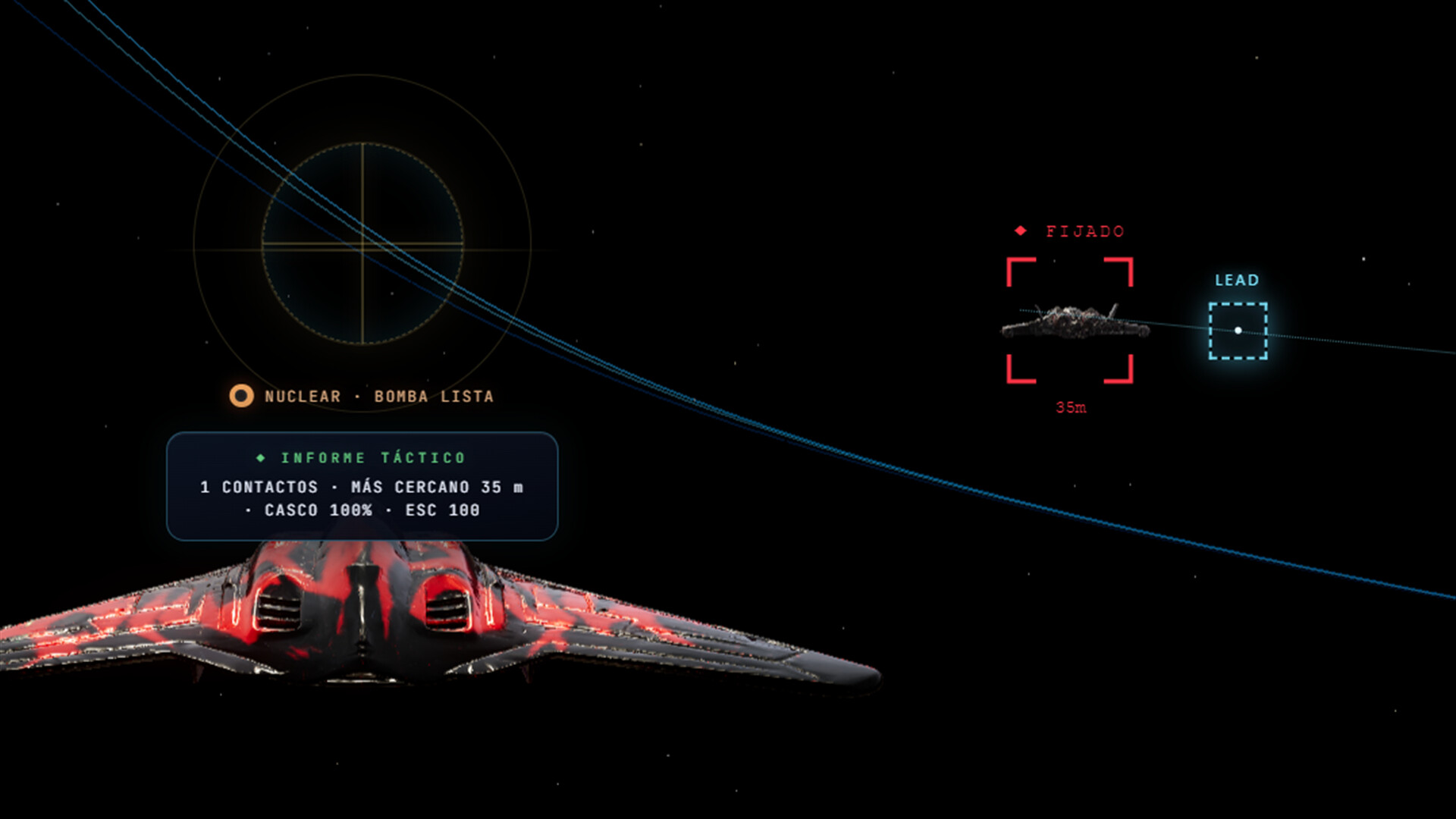
Real-time ship combat, with a locked target, a tactical contact report, and a nuclear weapon flagged as ready to fire.Steam store page -
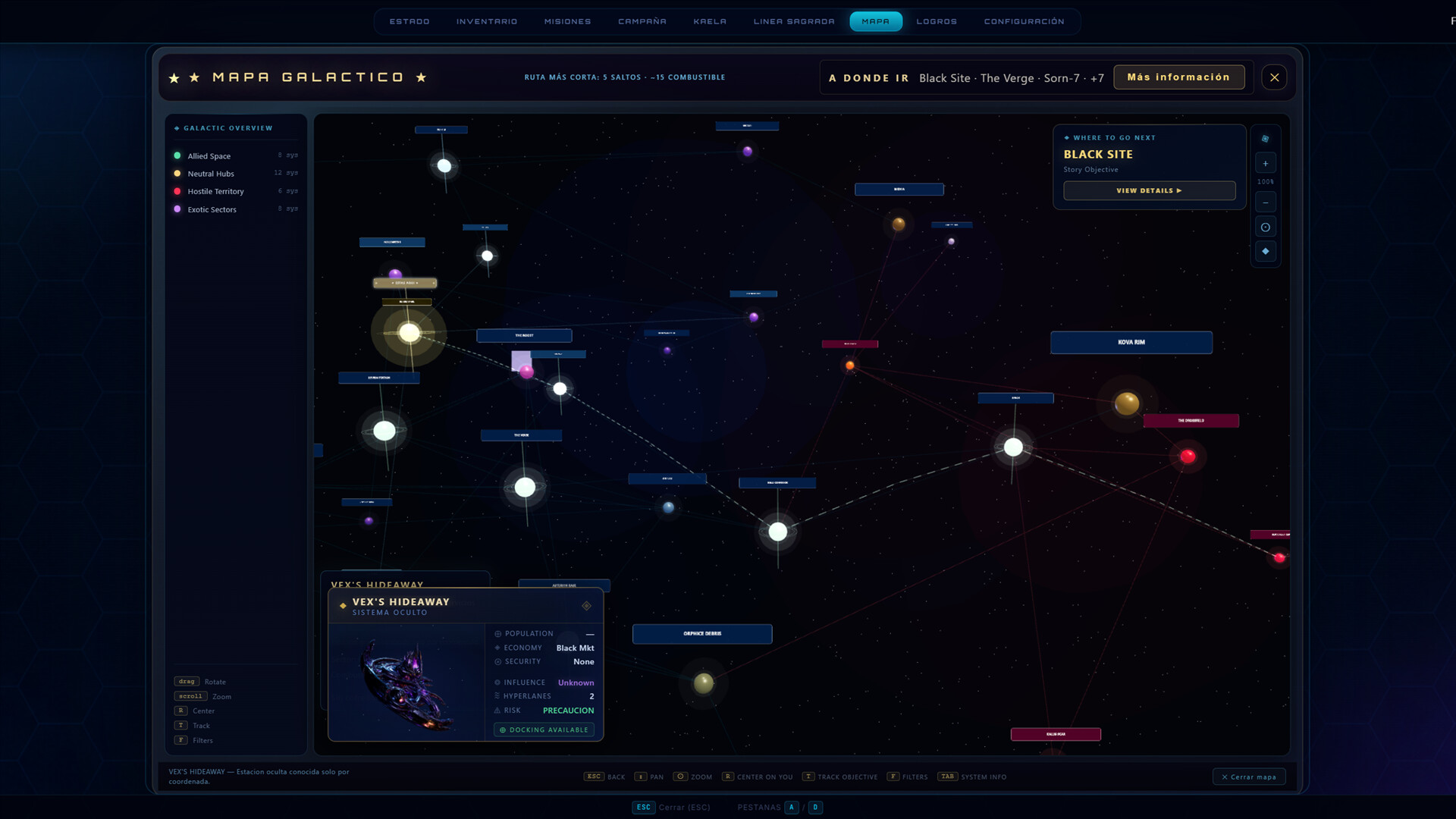
The galaxy map, colour-coded by territory type, with a system info panel detailing population, economy, security, and risk level.Steam store page