
Game review
Aliya: Timelink
6.5 / 10
- Developer
- TDGame Studio
- Publisher
- Anotherindie
- Released
- 25 April 2024
- Platforms
- Windows
- Genre
- Narrative messaging visual novel
- Monetisation
- One-time purchase, no in-game store or additional currency purchases
- Players
- Single-player only
The short version
Aliya: Timelink casts you as an operator who connects, across a thousand years, with Aliya, a girl stranded in space, communicating with her purely through in-game messages that arrive on a real-world delay, whether you're playing or not. It's an unusually bold structural idea for a visual novel, and this review's sample shows it working precisely as intended for a large portion of players, several describing the experience as genuinely, unexpectedly moving in a way few games manage. A comparably substantial and specific minority describes the same waiting mechanic as tedious rather than immersive, compounded by real translation and grammar issues that undercut a story built almost entirely on the quality of its dialogue.
Biggest strengths
- The real-time messaging structure earns genuine, repeated praise as a bold and effective way to build emotional investment, with multiple reviewers describing the experience as unexpectedly moving, including one with nearly 15,000 minutes logged calling it one of the best games they've ever played
- The central premise, connecting across a thousand years with someone stranded in space, is consistently credited as a clever, well-realized hook that justifies its own unusual mechanical choices rather than existing as a gimmick
- Multiple endings genuinely diverge in meaningful ways, and Steam's own achievement data confirms real players reach all five endings in significant, non-trivial numbers rather than defaulting to one dominant outcome
Biggest weaknesses
- A specific, recurring complaint across the negative sample concerns English localization quality, with at least one native-English-speaking reviewer citing outright grammatical issues and dialogue that "doesn't feel natural" with specific quoted examples
- The real-time waiting mechanic that many reviewers praise is, for a comparably sized group, the single biggest source of frustration, with multiple reviewers describing genuine annoyance at waiting real-world hours or days for a response and feeling misled by marketing that undersells the time commitment involved
- Several reviewers report that different dialogue choices during a given playthrough ultimately funnel into the same story beats, describing the illusion of branching choice as thinner than expected
Who it's for: Players drawn to unconventional, narratively daring visual novels who don't mind a slower-paced, real-time structure that asks for patience across days rather than hours, and who can tolerate some rough English localization in exchange for a genuinely different kind of story delivery.
Our recommendation: At its very low price, worth trying for anyone curious about its central conceit — just go in understanding this is a game you check in on over real days, not a single sitting, and that its English translation has real, documented rough edges.
6.5 / 10
Aliya: Timelink asks you to play the part of an operator who makes contact, across a thousand years, with Aliya, a girl stranded alone in space. There are no sprites, no character portraits, no branching dialogue trees rendered in the usual visual-novel style — just a messaging interface, real-time delays between responses, and a story that has to earn every bit of its emotional weight through text alone. This review's sample makes clear that when it works, it works remarkably well; when it doesn't, the reasons are specific and worth understanding before you buy.
A genuinely different kind of emotional payoff
The praise for Aliya's central conceit is some of the most personally invested language in this review's entire sample. "One of the best games ive ever played. Only very few games affected me emotionally but this game affected to so much in ways I never thought of. My heart still feels so heavy after the first ending. Never thought I'd cry my heart out. I really miss her, as if she was real," writes a reviewer with nearly 15,000 minutes logged — a genuinely extraordinary amount of time invested in a narrative messaging game. Another describes the mechanic's emotional logic directly: "It been 4 years since the last time I have a special feeling for someone. This game bring back a feeling of waiting for someone messages that I have lost for so long." A more analytical reviewer frames why the format works on its own terms: "For a game so narratively focused, I'm—ironically—most impressed by the gameplay; or lack thereof. The void in place of CGs, animations, or sprites, hallmarks of VNs, is such a clever way of instilling" the isolation the story is actually about.
When the same waiting mechanic becomes the problem
Set against that praise is an equally specific, credible chorus of frustration built around the exact same design choice. "So. Much. Waiting. I spent so long just waiting for a response, and ended up just wasting my time," one reviewer writes. Another describes feeling misled about the actual time commitment: "This game is really cute and all, but it requires you to play it EVERY DAY. I bought this game thinking it was a cute, casual game that I could play for a bit and then come back to a week or so later." A third, more measured reviewer captures both sides fairly in one review: "The premise is interesting, but the execution of this visual novel falls flat. The real time sync is an interesting idea, but the waiting periods are too varied in length and generally too long to add value to the experience. They can fortunately be" adjusted somewhat, but the core friction remains for players expecting a more conventional pacing.
Translation quality is a real, specific weak point
Because Aliya's entire experience rests on written dialogue, localization quality matters more here than in most games, and this review's sample documents real problems with it. "As a native English speaker, something is just... off about the dialogue. It doesn't feel natural. Sometimes there are outright grammatical issues," one reviewer writes, going on to quote specific broken phrasing from the game's own opening hour. Another sums up the tension concisely: "This is, unfortunately, a great concept held back by a poor English translation. I'll hold off on recommending this until it can get properly TL'd." For a game whose entire value proposition is the quality of a conversation, that's a meaningfully different kind of flaw than a technical bug or pacing complaint — it strikes at the one thing the format has to get right.
A fair complaint about the illusion of choice
A more specific structural criticism comes from reviewers who tried multiple paths through the story looking for real branching variety. "Cool idea to simulate chat-like experience. BUT... it's not like multi-choice story telling. After trying different choices in the chat, they led to the same story line, even tho I chose an" different option each time, one reviewer writes, a complaint echoed by another who describes the experience as reading "a transcript of AI chat-bot RP-ing" rather than a game built around meaningful player agency. That's a fair expectation to flag for buyers specifically drawn in by promises of branching narrative choice rather than a single guided story delivered through an unconventional interface.
What the ending-achievement data actually shows
Steam's own completion figures offer a useful, independent check against the "it's basically one story wearing different endings" critique. Five distinct ending achievements sit at 52.7%, 41.8%, 22.6%, 21.1%, and 17.8% respectively — a genuinely healthy spread showing meaningful numbers of players reaching each of five different conclusions rather than everyone funneling into one dominant path. That doesn't fully resolve the moment-to-moment choice complaint some reviewers raise, but it does confirm the game's overall narrative structure supports real divergence at the macro level, which is a fairer defense of the format than the negative sample's harshest critics allow for.
An exceptionally well-supported release
Whatever criticisms apply to specific mechanics or the translation, this review found no basis whatsoever for concern about ongoing development neglect — quite the opposite. Aliya: Timelink's partner-events feed is remarkably active across more than two years, documenting free content updates, a mobile port, physical merchandise, sales milestones celebrated in the tens of thousands of copies, and, as of 2025, an already-released public demo for a direct sequel, Aliya: TimeLink 2 Dawn. Few small indie visual novels receive this level of sustained, multi-year investment from their developer.
Final verdict
Aliya: Timelink takes a genuine structural risk with its real-time messaging format, and this review's sample shows that risk paying off powerfully for a substantial number of players while creating real, specific frustration for others — frustration compounded by documented translation rough edges that a story this dialogue-dependent can't fully absorb. At its very low price, it's worth trying if the premise intrigues you, provided you go in with patience for its unconventional pacing and realistic expectations about its English localization.
Pros and cons
Pros
- The real-time messaging structure earns genuine, repeated praise as a bold and effective way to build emotional investment, with multiple reviewers describing the experience as unexpectedly moving, including one with nearly 15,000 minutes logged calling it one of the best games they've ever played
- The central premise, connecting across a thousand years with someone stranded in space, is consistently credited as a clever, well-realized hook that justifies its own unusual mechanical choices rather than existing as a gimmick
- Multiple endings genuinely diverge in meaningful ways, and Steam's own achievement data confirms real players reach all five endings in significant, non-trivial numbers rather than defaulting to one dominant outcome
- The very low price makes the experiment easy to justify even for players uncertain whether the real-time waiting mechanic will work for them personally
- Steam's own partner-events feed documents exceptional, sustained multi-year support, including free content updates, a mobile port, physical merchandise, and an already-released demo for a sequel, confirming the developer's deep ongoing investment in the property
Cons
- A specific, recurring complaint across the negative sample concerns English localization quality, with at least one native-English-speaking reviewer citing outright grammatical issues and dialogue that "doesn't feel natural" with specific quoted examples
- The real-time waiting mechanic that many reviewers praise is, for a comparably sized group, the single biggest source of frustration, with multiple reviewers describing genuine annoyance at waiting real-world hours or days for a response and feeling misled by marketing that undersells the time commitment involved
- Several reviewers report that different dialogue choices during a given playthrough ultimately funnel into the same story beats, describing the illusion of branching choice as thinner than expected
- At least one detailed reviewer reports specific endings and story states that "just straight up don't work," raising a legitimate concern about content completeness in the version they played, separate from the broader waiting-mechanic debate
- The core interaction loop is repeatedly described by critics as closer to reading a scripted chat transcript than playing a traditional game, a fair characterization for players expecting more conventional visual-novel presentation with sprites, CGs, or branching gameplay systems
Screenshots
-

Aliya: TimelinkImage: Anotherindie via Steam -

Aliya: TimelinkImage: Anotherindie via Steam -

Aliya: TimelinkImage: Anotherindie via Steam -
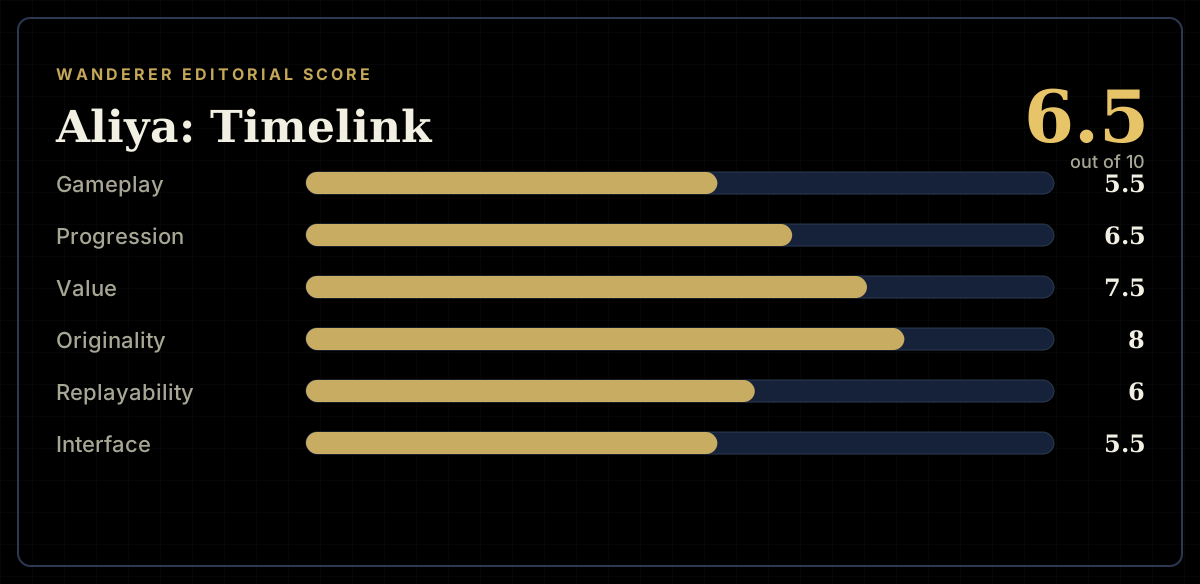
How the review scores each part of the gameWanderer Editorial -
The short versionWanderer Editorial