
Game review
Astrodle
7 / 10
- Developer
- Robin Nicolet
- Publisher
- Robin Nicolet
- Released
- 19 June 2024
- Platforms
- Windows
- Genre
- Incremental space shooter with a finite story campaign
- Monetisation
- One-time purchase, no in-game store or additional currency purchases
- Players
- Single-player only
The short version
Astrodle is an incremental space shooter about blasting zodiac-themed "blobs" for essences, upgrading a ship, and ascending to godhood, and its defining feature is that it stops: both of its modes are built to be completed in roughly six hours each rather than running forever. That design choice is exactly what its Very Positive standing is built on, alongside clean UI and strong visual polish that reviewers repeatedly single out as better than genre norm. The trade-offs are real, though — a vocal minority calls the whole package short for its asking price, several reviewers dispute that "idle" is even the right word given how much active clicking it actually demands, and a small number of late-game achievement conditions are reported as obscure or frustratingly grindy in a game that otherwise prides itself on respecting your time.
Biggest strengths
- Deliberately finite by design — both game modes are built to be fully completed in roughly six hours each, and reviewers who finished the game confirm it delivers content to match that runtime rather than padding or abruptly running out
- Repeatedly praised interface and presentation, with multiple reviewers explicitly contrasting its clean UI and smooth performance against typically cluttered genre norms
- Two structurally different modes — an active, story-driven main campaign and a more passive "Drones Only" mode — give real mechanical variety rather than reusing the same loop twice
Biggest weaknesses
- Several reviewers explicitly argue the game shouldn't be marketed as an idler at all, since progressing at a reasonable pace requires sustained active clicking rather than genuine background idling
- A recurring complaint calls the total package overpriced or "too short" for a paid idle game, given the genre's usual free-to-play, effectively-endless norm
- Steam's own achievement data shows a steep late cliff — thirteen achievements sit between 63.6% and 95.9% completion, but the final two drop to 28-29%, matching reviewer reports of obscure or poorly signposted end-game challenge conditions
Who it's for: Players who want the numbers-go-up satisfaction of an incremental game without the multi-week commitment the genre usually implies, and who don't mind paying up front for something with a defined ending rather than the free-to-play, endless-content norm.
Our recommendation: A confident pick at its discounted price, and still reasonable at full price if a self-contained six-to-twelve-hour incremental with real narrative structure appeals more than an endless one. Go in expecting active engagement rather than true background idling, and don't chase full achievement completion unless obscure late-game conditions don't bother you.
7 / 10
Most incremental games are built to never really end — a rebirth ladder, a prestige loop, a number that keeps climbing past whatever cap the last update added. Astrodle is built the opposite way. Solo developer Robin Nicolet's pitch is a space shooter about blasting zodiac-themed "Blobs" for Essences, upgrading a ship, and working toward literal godhood, structured across two modes each designed to be fully finished in around six hours. That's an unusual promise for the genre to make, and the review sample largely confirms it keeps it — which is also exactly where the sharpest disagreements about the game start.
A shooter that calls itself an idler, and reviewers push back
The store page frames Astrodle as an "incremental space shooter," but its Steam tags include Idler, and several reviewers take issue with that framing directly. One states it plainly: "despite its name, it's not an idle game, it's an incremental game... the progress is fast enough without idling." Another goes further, saying they "wouldn't class it as an idler, even though it was one of the tags and it is in the name," and that an active playstyle "feels way more rewarding" than passive waiting. This isn't a minor semantic gripe — it shapes expectations. A player picking this up expecting a background-idling companion app is likely to find the core loop wants their attention: aiming drones, managing which zodiac essence to prioritise, and reacting to upgrade choices in something closer to a light action game than a fire-and-forget clicker.
The finite design is the strongest idea here, and it mostly lands
Where Astrodle earns its distinctiveness is in refusing the genre's usual open-endedness. The store page addresses this directly — "don't you hate when you can't tell if you have finished an idle game or not?" — and reviewer accounts back up that the promise is kept. Multiple players confirm both modes take roughly six hours each to complete, landing the full experience at ten to twelve hours for a 100% clear, and several explicitly credit the game with pacing that "doesn't just run forever" and "feels like it has content to fill its runtime" rather than stretching thin material to hit an arbitrary playtime target. One reviewer, having completed both modes and gone for full achievements, calls the reward pacing "good, not instantly taking you to the end but also not overstaying its welcome." For a genre built almost entirely around never actually stopping, having a real ending that lands as satisfying rather than abrupt is a genuinely rare thing to pull off, and it's the clearest throughline across the positive reviews.
Two modes, real mechanical variety
The main campaign is the active, story-driven mode, guided by three zodiac-sign characters — Sagittarius, Aquarius and Taurus — who narrate the player's quest toward godhood with dialogue reviewers describe as "somewhat interesting, sometimes funny." Completing it unlocks a second mode built around passive drones rather than direct ship control, described by one reviewer as "the drone only mode was fun" and by another as opening up "into an idler" only after the main campaign is done. That structural split matters more than a simple difficulty-plus mode would: it gives the second half of the experience a genuinely different feel rather than just remixing numbers, which several reviewers cite directly as a reason the ten-to-twelve-hour total runtime doesn't feel repetitive.
Presentation reviewers keep contrasting against the genre
Interface and visual polish come up unprompted in review after review, almost always favourably and almost always in direct comparison to other incremental games. One calls the UI "very clean and attractive unlike many in the genre." Another highlights "very polished visuals and slick UI" that "runs buttery smooth even with so much going on screen." A third praises optimisation specifically, noting "no hint of needlessly spiking CPU/GPU temps yet the game looks really slick." The one recurring knock against presentation is audio: more than one reviewer flags the main music loop as too short and repetitive, with one joking that they "still wanted to turn it off" despite otherwise enjoying the soundtrack's tone.
Value is where opinions split hardest
The clearest fault line in the review sample is price versus length. Several negative reviews focus on this almost exclusively: one calls the game "overpriced, short and too much work for little benefit," arguing it puts more weight on "flashy colourful graphics than actual content." Another, who'd played the free demo first, says that on finishing the full game they were left with "a sense of — that's it?", explicitly flagging that a paid idle game asking for a purchase up front is unusual enough that the shortness stings more than it would in a free-to-play equivalent. This isn't a fringe view — it's the single most repeated criticism in the negative sample — but it sits directly opposite the equally common praise for the game's pacing, which suggests the same design decision (a hard, deliberate stop) reads as either "respectful of my time" or "not enough game for my money" depending on what the reviewer expected walking in. The 50%-off price point observed at the time of this review meaningfully softens that complaint.
The last stretch gets rough
Steam's own achievement data supports a specific, narrower complaint about the tail end of full completion. Thirteen of the game's fifteen tracked achievements sit in a gentle band between 63.6% and 95.9% — consistent with a game whose main content most buyers can realistically finish — but the final two collapse to 28.4% and 29.3%, a steep, isolated cliff rather than a gradual taper. Reviewer accounts explain why: one flags "orange blobs" as "a major pinch point, even when optimizing for them as best I could," and describes story-progression triggers occurring "at three (seemingly) random times" without stated or discoverable conditions. Another names a specific late-game item and resource — "the chaser blade" and "cancer essence" — as the point where the game "just isn't much fun," and a third simply says some challenges "seem impossible" with descriptions that don't clarify what's actually required. None of this affects the core six-to-twelve-hour experience most reviewers describe positively, but it's a real, specific rough patch for anyone chasing full completion rather than just the story ending.
A developer who kept coming back
The Steam partner-events feed for Astrodle shows a healthy, sustained support pattern rather than a launch-and-abandon cycle. Four hotfixes landed within 48 hours of the 19 June 2024 release, addressing whatever broke in the initial rush, followed by a further update pass in July 2024 — and then, notably, another minor update in October 2025, well over a year after launch. One reviewer even references looking forward to "the developers upcoming game slated for... 2027," suggesting Robin Nicolet has stayed visibly active with the community rather than going quiet after the initial support window, a contrast worth naming given how often solo-developer idle games in this lane show the opposite pattern.
Final verdict
Astrodle succeeds at the one thing it explicitly set out to do: it's an incremental game that ends, on purpose, with content built to actually fill the six-to-twelve hours it asks for rather than either running dry early or dragging on past its welcome. That alone makes it worth a look for anyone tired of the genre's usual open-ended treadmill. Weighed against that is a real, unresolved argument among its own reviewers about whether "idle" was ever the right label, a price that a meaningful minority calls too high for the runtime on offer, and a genuinely obscure final stretch of achievement content that turns full completion into a frustration rather than a victory lap. None of that erases the clean presentation or the mechanical variety across its two modes — it just means this is a game best bought on sale, and best enjoyed by treating the credits as the actual ending rather than chasing the last two achievements.
Pros and cons
Pros
- Deliberately finite by design — both game modes are built to be fully completed in roughly six hours each, and reviewers who finished the game confirm it delivers content to match that runtime rather than padding or abruptly running out
- Repeatedly praised interface and presentation, with multiple reviewers explicitly contrasting its clean UI and smooth performance against typically cluttered genre norms
- Two structurally different modes — an active, story-driven main campaign and a more passive "Drones Only" mode — give real mechanical variety rather than reusing the same loop twice
- The developer shipped four hotfixes within 48 hours of the June 2024 launch and returned with a further update in October 2025, over a year later, showing sustained rather than one-and-done support
- Ascension/prestige choices are described by multiple long-session reviewers as meaningful decisions with real trade-offs, rather than filler busywork bolted onto the loop
Cons
- Several reviewers explicitly argue the game shouldn't be marketed as an idler at all, since progressing at a reasonable pace requires sustained active clicking rather than genuine background idling
- A recurring complaint calls the total package overpriced or "too short" for a paid idle game, given the genre's usual free-to-play, effectively-endless norm
- Steam's own achievement data shows a steep late cliff — thirteen achievements sit between 63.6% and 95.9% completion, but the final two drop to 28-29%, matching reviewer reports of obscure or poorly signposted end-game challenge conditions
- Multiple reviewers describe the story mode's ending as disappointing, anticlimactic, or "like a punishment," and at least one suggests the narrative should have been expanded or cut entirely rather than left half-developed
- The main menu music loop is called repetitive by more than one reviewer despite otherwise positive marks for sound and visual presentation
Screenshots
-

AstrodleImage: Robin Nicolet via Steam -

AstrodleImage: Robin Nicolet via Steam -

AstrodleImage: Robin Nicolet via Steam -
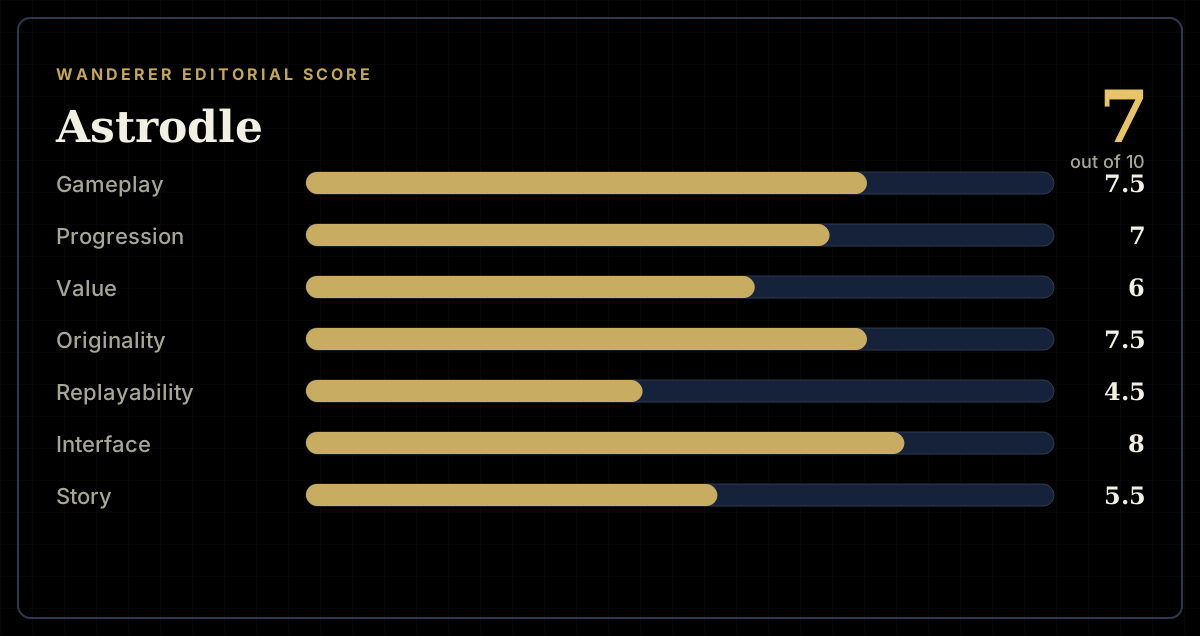
How the review scores each part of the gameWanderer Editorial -
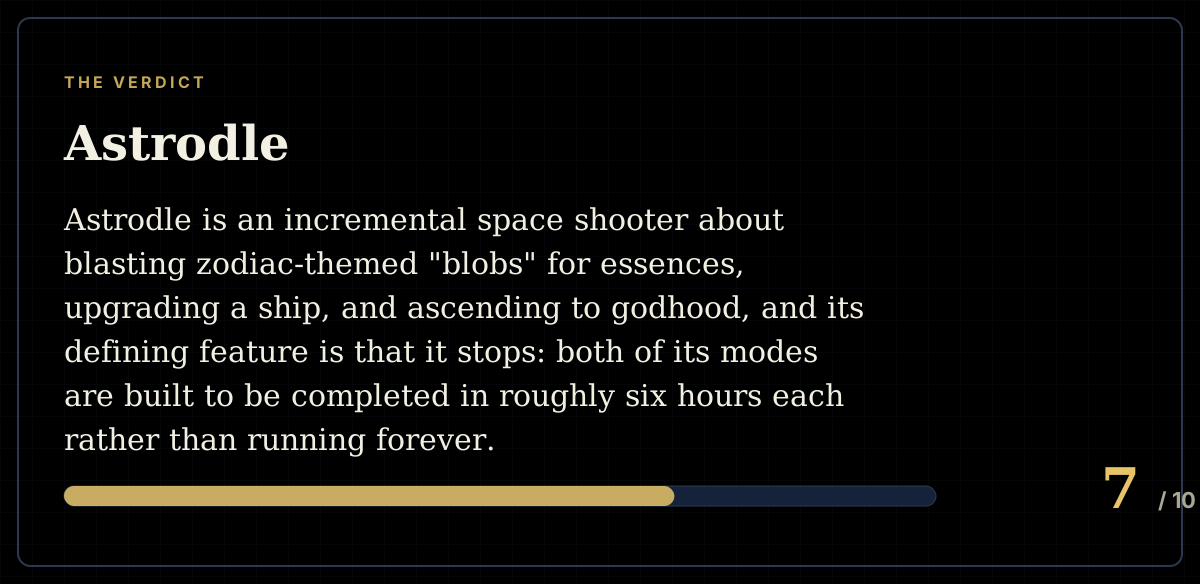
The short versionWanderer Editorial