
Game review
Idle Space Navy
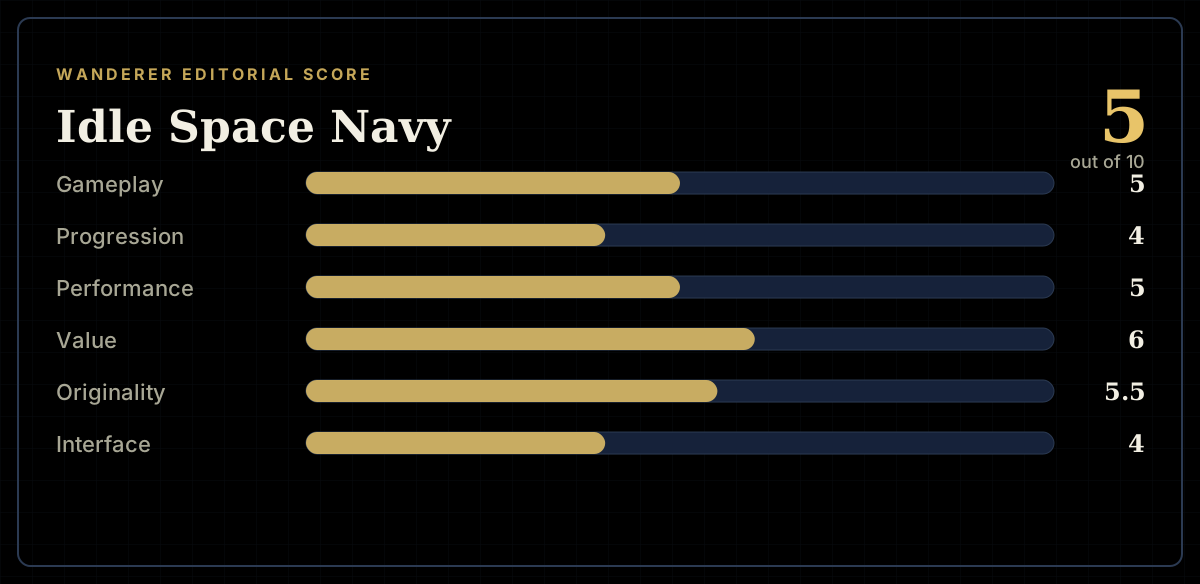
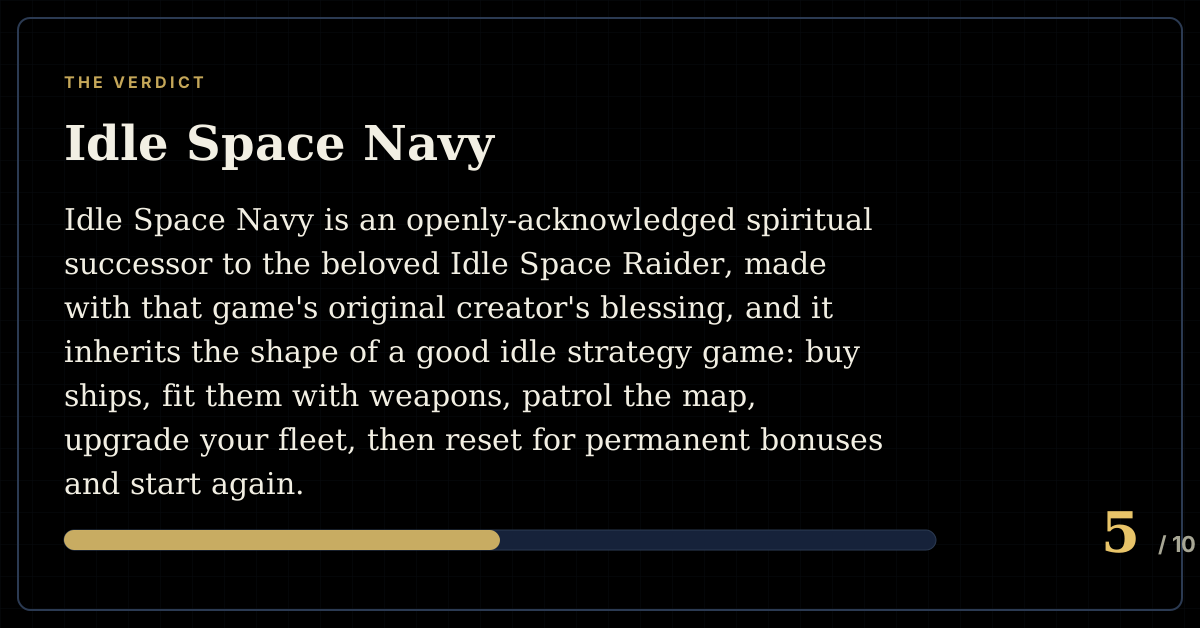
5 / 10
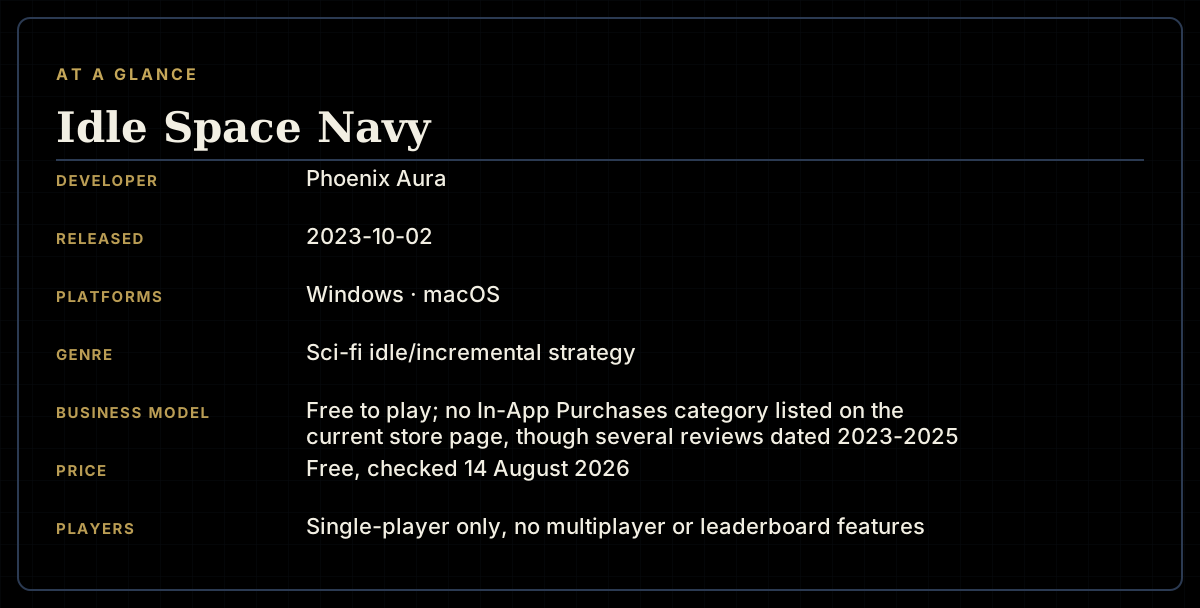
- Developer
- Phoenix Aura
- Publisher
- Phoenix Aura
- Released
- 2 October 2023
- Platforms
- Windows, macOS
- Genre
- Sci-fi idle/incremental strategy
- Monetisation
- Free to play; no In-App Purchases category listed on the current store page, though several reviews dated 2023-2025 describe optional paid options
- Players
- Single-player only, no multiplayer or leaderboard features
The short version
Idle Space Navy is an openly-acknowledged spiritual successor to the beloved Idle Space Raider, made with that game's original creator's blessing, and it inherits the shape of a good idle strategy game: buy ships, fit them with weapons, patrol the map, upgrade your fleet, then reset for permanent bonuses and start again. What it hasn't inherited is a prestige loop that rewards resetting — multiple reviewers, over multiple months, independently report each successive prestige paying out less than the last rather than more, the opposite of what makes an idle game's core hook work. The store page promises your fleet keeps advancing while you're offline; several reviewers across late 2023 and early 2024 say that isn't what they observed. Three years into Early Access, the reception has stayed almost exactly split down the middle the entire time.
Biggest strengths
- Ships have real loadout decisions — seven ship types and ten weapons across three types, fitted individually rather than a single upgrade path
- Made as an authorised spiritual successor to Idle Space Raider and Transport Defender, and several longtime fans of those games say the homage lands
- Multiple reviewers across 2023-2024 describe the developer as actively engaged, responding directly to bug reports and community feedback
Biggest weaknesses
- Multiple reviewers independently report that each successive prestige reset pays out fewer credits than the one before it, the inverse of the escalating-reward loop that normally makes an idle game's reset mechanic worth using
- The store page states plainly that "you keep your fleet advancing even when you're offline," but several reviews dated across late 2023 and early 2024 say they observed no meaningful offline progress at all
- A recurring complaint describes having to manually re-deploy every ship and weapon loadout every few dozen minutes, a maintenance chore that runs against the genre's basic promise of low-touch play
Who it's for: Fans of the Idle Space Raider lineage curious about its authorised successor, and idle-strategy players specifically drawn to a ship-management layer with real fitting and upgrade decisions — provided they're prepared for an unfinished, sparsely-explained Early Access build rather than a polished idler.
Our recommendation: It's free, so the financial risk is zero, but go in with tempered expectations. The core ship-and-weapon fitting idea has real potential, and the developer is reported as responsive to bug reports and feedback, but the reset economy and the offline-progress claim are the two things to test for yourself in the first hour rather than take on faith from the store page.
5 / 10
Idle Space Navy doesn't hide what it's trying to be. Its own store description calls it "a spiritual successor to Idle Space Raider and Transport Defender by Yaroslav 'IDNoise' Nikityshev," made "with their permission" — an unusually direct acknowledgment of its lineage, and one that several longtime players of those earlier games clearly recognise and appreciate. "This is a wonderful homage to ISR," reads one 2023 review, and another simply says "Very similar to ISR as was intended and I played that game a heap." That's a good foundation to build from: patrol space, buy and fit ships with weapons, upgrade a shipyard and foundry, then reset for permanent bonuses through a Laboratory system and go again. Three years into Early Access, though, the reviews that exist — every one of the 58 this game has accumulated across every language, all read for this review — describe a game whose central systems fight against the genre's basic promises rather than delivering on them.
A prestige loop that runs backwards
The most serious and most consistently reported problem is with the reset mechanic itself. In a typical idle game, prestiging is supposed to be a strict upgrade — you sacrifice your current progress for a permanent multiplier that makes every subsequent run faster and more rewarding than the last. One of the earliest substantive reviews, from October 2023, describes exactly the opposite happening: a first prestige after about 30 minutes yielded roughly 95 credits, a second prestige 40 minutes later yielded only about 80 despite having every upgrade maxed, and a third run was already trending the same way when the reviewer stopped. A separate February 2024 review makes the same observation independently, more bluntly: "each reset will net you smaller and smaller returns on every resource, and each run takes longer to get to the same point of your previous run." Two reviewers, four months apart, describing the same specific and unusual failure mode is a strong signal, and it's the kind of thing that undermines the entire reason a prestige system exists in an idle game in the first place.
The offline promise versus what players report
The store page is explicit: "Earn progress to keep your fleet advancing even when you're offline!" is listed as a headline feature. Several reviews contradict that plainly. A Danish-language review from October 2023 states flatly that "there is no offline gain." An English review from March 2024 is more specific, saying the currency you earn while away — described as "time crystals" — doesn't translate into meaningful offline progress, and calls that "nonsensical" for a game marketed as an idler. A third review, from February 2024, hedges more carefully — "I have not seen anything being earned, correct me if I am wrong" — which reads less like certainty and more like a player who genuinely couldn't tell whether offline progress was happening at all, which is arguably just as damning for a feature that's supposed to be one of the genre's core selling points. No review in the corpus confirms offline progress working as advertised. For a game whose entire genre is built around "number goes up while you're not looking," that's a significant gap between the pitch and the reported experience.
Ship fitting is the part that's actually interesting
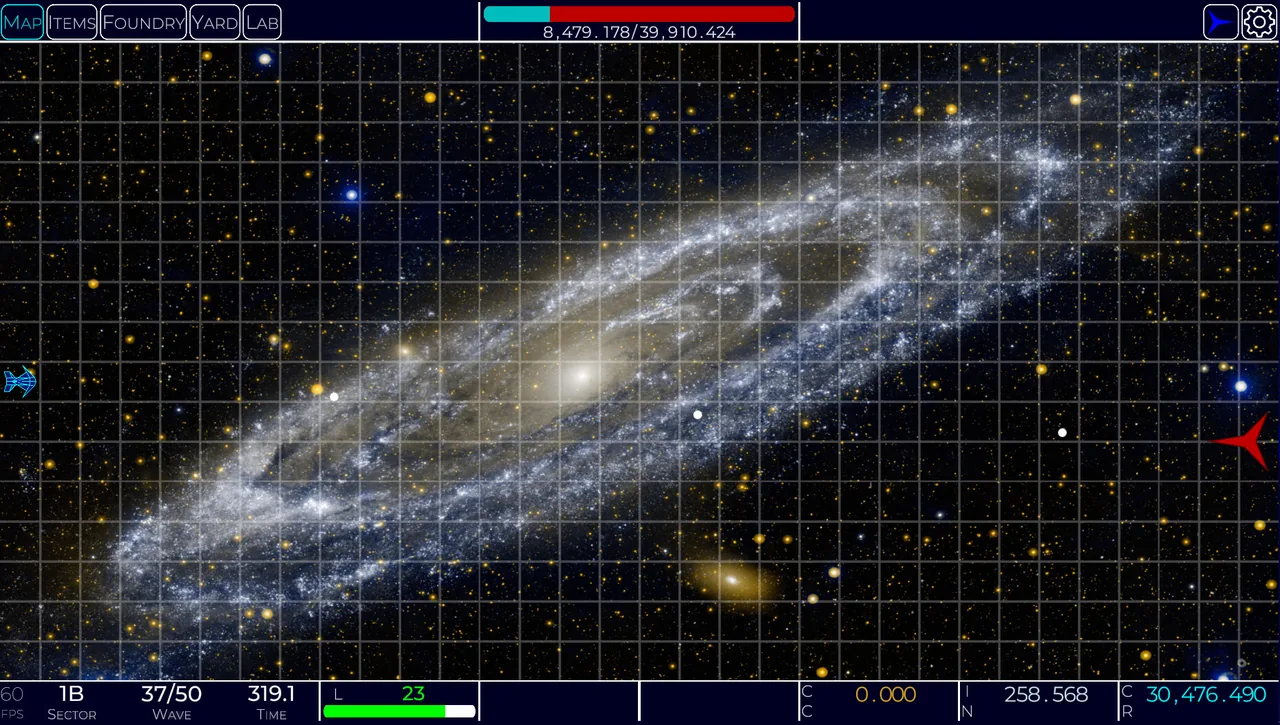
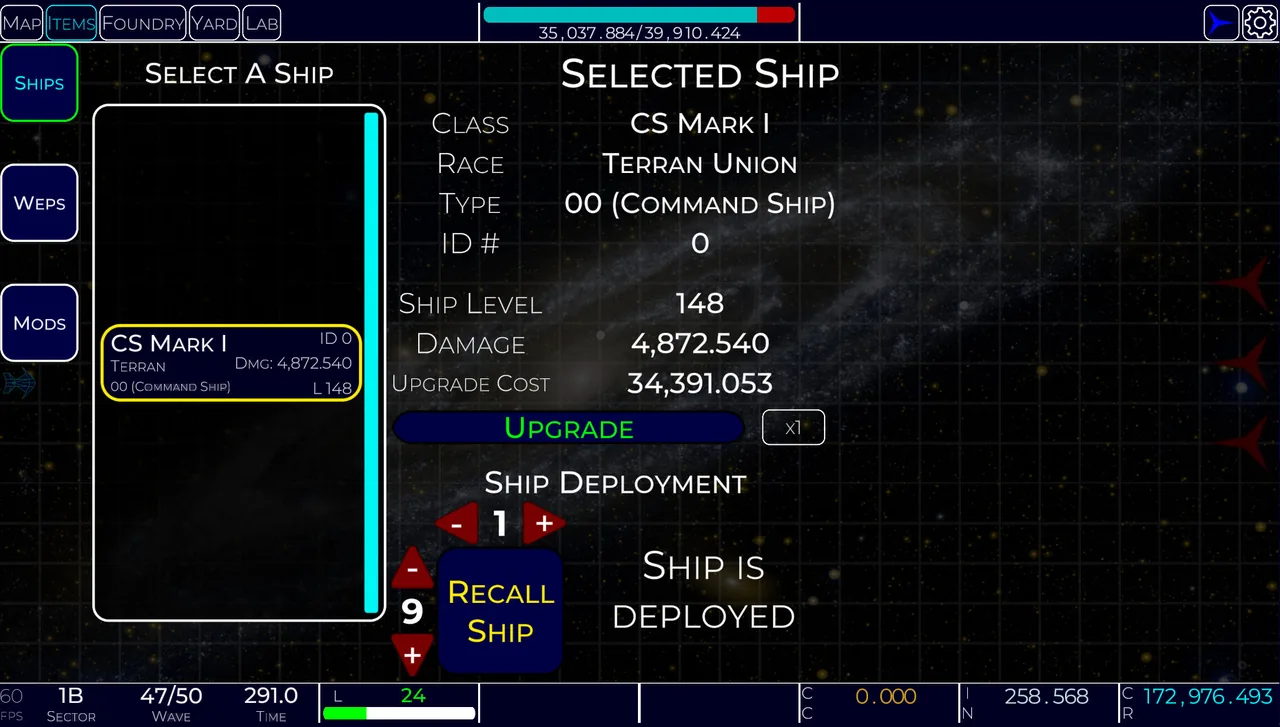
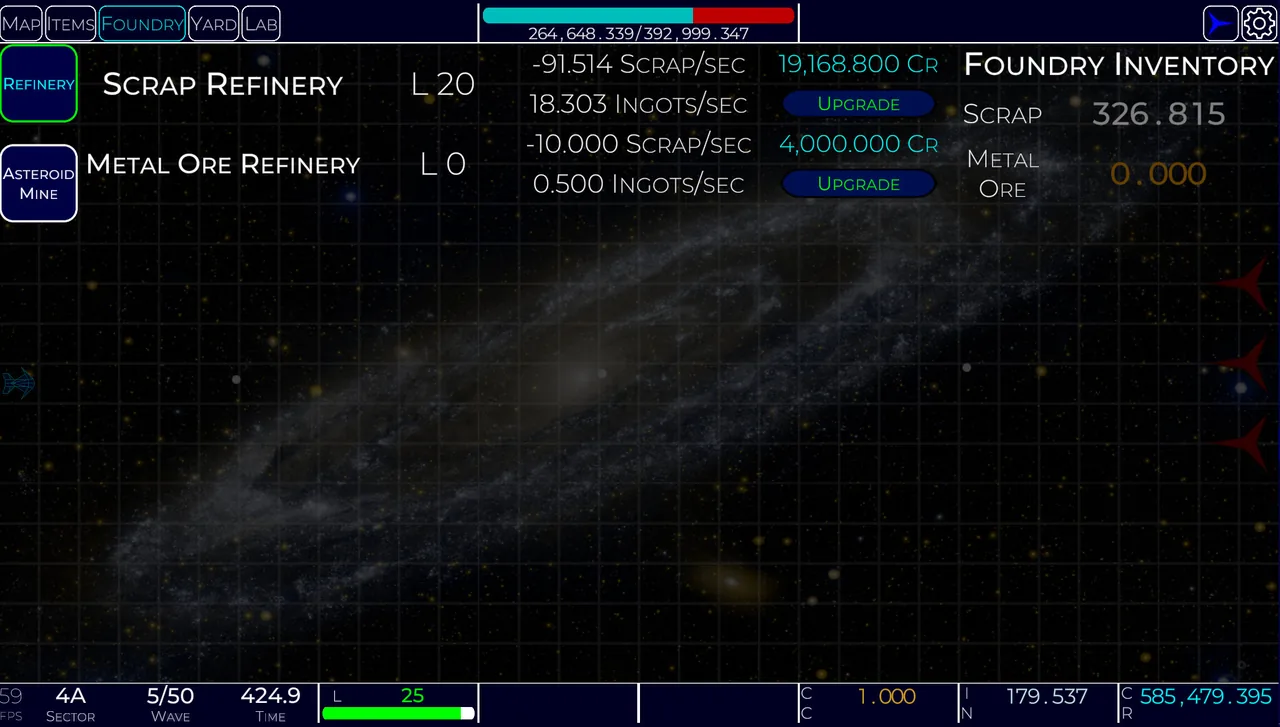
It's worth separating the systems that draw real criticism from the one that seems to work. The ship-and-weapon fitting layer has genuine depth for the format: seven ship types, ten weapons split across three weapon types, a Foundry for refining scrap into metal ingots, and a Shipyard for spending that material on upgrades. The screenshots bear this out — a command ship fitting screen shows per-ship stats (class, race, type, level, damage, upgrade cost) with dedicated deployment controls, and the Foundry screen displays separate refinery production rates for scrap and metal ore with their own upgrade paths. That's a real management layer, not a single button to mash, and it's the part of the game the more patient positive reviews point to when they say it's "worth sticking with" or call it "a decent numbers go up game."
The trouble is that managing that layer becomes a chore rather than a strategic choice, because of a mechanic several reviewers single out independently: ships and their equipped weapons need to be manually re-deployed every few dozen minutes, and one detailed German-language review describes having to re-fit all 16 ships and 16 weapons roughly every 30 to 35 minutes, calling it "100% FRUSTRATION PURE." For a genre whose entire appeal is supposed to be low-touch progress, a maintenance task on that kind of timer is a direct contradiction of what players are buying into.
An interface that hasn't caught up to its own systems
Layered on top of both of those problems is an interface reviewers consistently call obscure. Tooltips are missing for entire systems — one reviewer specifically flags "two thirds of the skills have no explanation to what they effect" — and the tutorial has been reported as actually blocking new players' progress, with a March 2025 review saying they "couldn't get past 'Deploy' first ship section of the tutorial. Broken." Perhaps the most telling complaint, though, is about scale: as you accumulate ships and weapons over a long session, there's no way to sell, discard or filter the ones you no longer need, so your inventory list grows into what one reviewer calls "a 100 items scroll-down list" with no tools to manage it. A May 2024 review adds that a UI update intended to fix the old interface instead made it worse, requiring "about 20x more" clicking just to check basic stats.
A developer who's still in the room, and reviews that haven't moved
What keeps this from reading as an abandoned project is a real, if thin, thread of positive engagement with the developer specifically. "Great Dev, just talk out any problems you have, and they'll listen," reads one review; another notes "dev has been continuing to update which has been welcome," and a third calls the support "very active" and predicts "likely has long life ahead of it." Whether that ongoing effort has actually moved the needle is a separate question the review data can answer plainly: it hasn't, at least not yet. The lifetime split is 48.3% positive across all 58 reviews this game has ever received, and the most recent English-language reviews — as recent as October 2025 — repeat the same complaints made in October 2023, with one from October 2025 stating outright that "the people who left negative comments two years ago pointing out what needed fixing were absolutely right — and the worst part is, nothing has been improved." Whatever patches have shipped in three years of Early Access, they haven't been enough to move sentiment off dead centre.
Final verdict
Idle Space Navy has the right ingredients for a genuinely good sci-fi idler — an authorised connection to a beloved predecessor, a ship-and-weapon fitting system with real decisions in it, and a developer reviewers describe as present and responsive. What it's shipped after three years in Early Access is a prestige loop that several independent reviewers say pays out worse the more you use it, an offline-progression promise the store page makes that reviewers say doesn't hold up, and an interface that hasn't kept pace with its own systems. It's free, so there's no financial argument against trying it, but anyone going in expecting the idle genre's usual "leave it running and come back to more" reward loop should test that assumption for themselves in the first hour rather than take the store page's word for it.
Pros and cons
Pros
- Ships have real loadout decisions — seven ship types and ten weapons across three types, fitted individually rather than a single upgrade path
- Made as an authorised spiritual successor to Idle Space Raider and Transport Defender, and several longtime fans of those games say the homage lands
- Multiple reviewers across 2023-2024 describe the developer as actively engaged, responding directly to bug reports and community feedback
- Free to play with no confirmed In-App Purchase category on the current store listing, a genuinely low-risk way to try a niche idle-strategy hybrid
- Daily login rewards and an automation layer for boosting active ships and shipyard upgrades give it real quality-of-life ambitions even in its current rough state
Cons
- Multiple reviewers independently report that each successive prestige reset pays out fewer credits than the one before it, the inverse of the escalating-reward loop that normally makes an idle game's reset mechanic worth using
- The store page states plainly that "you keep your fleet advancing even when you're offline," but several reviews dated across late 2023 and early 2024 say they observed no meaningful offline progress at all
- A recurring complaint describes having to manually re-deploy every ship and weapon loadout every few dozen minutes, a maintenance chore that runs against the genre's basic promise of low-touch play
- The interface draws sustained criticism for missing tooltips, unexplained mechanics, and an unmanageable, unfilterable list of accumulated ships and weapons with no way to sell or discard the unwanted ones
- Reception has stayed almost exactly split for three years running — 48.3% positive across its full 58-review lifetime history, with no clear upward or downward trend across that period
Screenshots
-
Idle Space NavyImage: Phoenix Aura via Steam -
Idle Space NavyImage: Phoenix Aura via Steam -
Idle Space NavyImage: Phoenix Aura via Steam -
How the review scores each part of the gameWanderer Editorial -
The game at a glanceWanderer Editorial -
The short versionWanderer Editorial