
Game review
NetDive
6.5 / 10
- Developer
- DK Liao
- Publisher
- DK Liao
- Released
- 15 August 2025
- Platforms
- Windows
- Genre
- Incremental, Action, Indie
- Monetisation
- One-time purchase, no DLC or in-game currency
- Players
- Single-player
The short version
NetDive puts you in control of a "sideways heart," the avatar of a forgotten AI algorithm diving through firewalls and killing off geometric shapes to learn, retrain, and grow more capable across repeated prestige runs. Mechanically it sits in the small "shapes game" incremental genre alongside titles like Nodebuster, playable either as active combat or left running passively, and reviewers consistently describe it as a pleasant, short, three-to-five-hour genre entry elevated well above its peers by an unusually earnest and affecting story told through text logs and a final epilogue. Multiple reviewers specifically praise the ending for landing an emotional beat the mechanics alone wouldn't suggest were coming. Set against that praise, one detailed and specific reviewer raises a serious content concern: a piece of in-game "Archive" text that, in their reading, compares real-world war to a technical AI error in a way they argue trivializes mass human death. This review could not independently verify the full context of that specific passage beyond the reviewer's account, and reports it as a single, detailed and serious allegation rather than a settled consensus.
Biggest strengths
- The late-game story, delivered through accumulating text logs and a distinct epilogue, draws consistent and specific praise for landing genuine emotional weight that the moment-to-moment shape-clearing gameplay alone doesn't suggest is coming
- Reviewers specifically credit the game as a standout within the small "shapes game" incremental genre it belongs to, naming it favourably alongside comparable titles like Nodebuster while noting NetDive is unusual in the subgenre for actually having a story
- The game supports both actively-played combat and a more passive, purely incremental play style, letting players choose their preferred pace without being locked into one mode
Biggest weaknesses
- One detailed, specific reviewer raises a serious content concern about a piece of in-game "Archive" text they say compares real-world war to a technical error in the AI's development, arguing this framing trivializes the deaths of hundreds of thousands or millions of people; this review could not independently verify the full context of that passage beyond the reviewer's own account
- Multiple reviewers note the game's English localization grows noticeably rougher in the epilogue and final stretch, a specific quality dip at precisely the point the story is otherwise praised for landing its strongest emotional beats
- Steam's own achievement data shows a meaningful drop-off at the game's true ending, with the achievement most closely tied to the full epilogue completed by only about a third of players, suggesting a real risk of missing the story's most praised content without deliberate effort
Who it's for: Fans of short, cheap incremental games who specifically value a genuine narrative payoff over deep systemic complexity, and players open to a story that gets philosophically ambitious about AI and humanity in its closing stretch rather than staying purely mechanical throughout.
Our recommendation: Worth the low asking price for a short, well-crafted incremental with a story that earns real emotional investment by its ending — just be aware of one detailed, serious reviewer complaint about specific late-game text before deciding whether its themes are for you.
6.5 / 10
An AI learning what makes a human human
NetDive casts you as a "sideways heart," the avatar of a forgotten algorithm diving through digital firewalls, clearing geometric shapes, and retraining itself with each prestige cycle in pursuit of a single, ambitious goal: understanding what actually makes a human human. It's a small, specific corner of the incremental genre sometimes nicknamed "shapes games" by its own fans, comparable to titles like Nodebuster, and it can be played either as active, controller-friendly combat or left running as a more traditional passive incremental. What sets NetDive apart within that specific niche, according to reviewers who know the genre well, is that it actually has a story worth paying attention to — a distinction multiple reviewers make explicitly when placing it alongside its closest genre peers.
A story that earns its ending
The dominant, most consistent thread of praise in this review's corpus concerns the narrative payoff. Text logs accumulate gradually as you progress, building toward a distinct epilogue that multiple reviewers single out for landing real emotional weight the moment-to-moment gameplay doesn't necessarily foreshadow. One reviewer describes finishing surprised by "more of the story" arriving right as the core loop threatened to grow grindy, while another admits the late material felt "a bit preachy" but still found real value in what the game was reaching for thematically. That's a meaningful achievement for a genre where narrative ambition is rare, and it's clearly the reason this small, cheap release has drawn the specific, detailed engagement it has from its reviewers rather than being treated as a disposable clicker.
A serious complaint about the archive
Set against that praise, one detailed and specific negative review raises a content concern this review takes seriously rather than dismissing. The reviewer describes a piece of in-game "Archive" text, attributed to the developer, that compares real-world war to a technical error in the AI's own development — and argues the comparison, calling that error "far worse" than war, trivializes the deaths of hundreds of thousands or millions of people by placing them on the same scale as an unnoticed software glitch. This review was not able to independently verify the full context of that specific archive passage beyond the reviewer's own account, and treats it accordingly: as a specific, detailed and serious allegation from one player, not an established consensus reflected elsewhere in the review corpus. It's worth flagging clearly for prospective buyers who might find that framing, if accurately described, genuinely objectionable regardless of how isolated the complaint currently is.
Rough edges in the final stretch
A separate, more measured criticism concerns localization quality. Multiple reviewers note the English translation grows noticeably rougher specifically in the epilogue and post-game material, an unlucky coincidence of timing given that's also where the story is otherwise praised most strongly. That's a polish gap worth knowing about going in — the ideas underneath the roughest prose are still landing for most reviewers, but the delivery isn't as smooth as the earlier hours.
What the achievement data confirms about the epilogue
Steam's own achievement data backs up a real risk that reviewers flag anecdotally: the achievement most closely tied to the game's full epilogue sits at just 34.2% completion, a sharp drop from the 79-88% range most earlier achievements sit in. That gap is consistent with at least one reviewer's specific warning to "pay attention to the epilogue if you want the 100%," and with another's account of needing a full restart to catch content missed on a first playthrough. For a game whose strongest praise is specifically about its ending, a completion rate this low on the epilogue-linked achievement suggests a real, structural risk of a meaningful share of buyers missing the game's best material without deliberate effort to seek it out.
Mechanics that serve the story, not the other way around
It's worth being clear-eyed about what NetDive's actual gameplay offers on its own terms, separate from the story wrapped around it. Reviewers consistently describe the upgrade paths as fairly linear and the skill ceiling as modest beyond the earliest hours, with progression largely a matter of clearing the next wave of shapes and reinvesting resources into predictable upgrades rather than making meaningfully distinct strategic choices. That's a fair criticism if judged purely as a systems-driven incremental game, but it also reads as a reasonable design tradeoff given what the game is actually trying to achieve: several reviewers explicitly frame the combat as a vehicle for pacing out the narrative rather than the main attraction in its own right, comparing it favourably to genre entries like Minutescape or Astro Prospector only to note NetDive doesn't ask for anywhere near that level of optimization skill. Judged by that standard, rather than against deeper incremental games it was never trying to compete with, the mechanical simplicity is more of a deliberate choice than an oversight.
A niche worth knowing about
For readers unfamiliar with the specific "shapes game" incremental subgenre NetDive belongs to, it's worth understanding the reference point reviewers keep reaching for. These are small, usually inexpensive incremental games built around geometric enemy waves and prestige-based restarts, prized by a dedicated niche audience less for groundbreaking mechanics and more for tight, replayable pacing and a satisfying sense of escalating power within a short overall runtime. NetDive's specific contribution to that niche, according to its reviewers, is proving the format can carry a genuine narrative arc without sacrificing the pick-up-and-play accessibility the subgenre is built around — a combination its closest peers in the space generally don't attempt.
The verdict
NetDive delivers more than its NZ$4.49 price and modest, familiar shape-clearing mechanics would suggest, earning specific, repeated praise for a story that reviewers say elevates it clearly above its closest genre peers. That story's themes run ambitious enough in their closing stretch to have produced both genuine admiration and, from at least one detailed reviewer, a serious specific objection to how a particular passage frames war — a complaint this review reports honestly without being able to adjudicate it beyond what that one account describes. For a short, cheap incremental with real narrative ambition, that's a worthwhile trade for most players, but go in aware of both the epilogue's easily-missed nature and the one detailed content concern raised against it.
Pros and cons
Pros
- The late-game story, delivered through accumulating text logs and a distinct epilogue, draws consistent and specific praise for landing genuine emotional weight that the moment-to-moment shape-clearing gameplay alone doesn't suggest is coming
- Reviewers specifically credit the game as a standout within the small "shapes game" incremental genre it belongs to, naming it favourably alongside comparable titles like Nodebuster while noting NetDive is unusual in the subgenre for actually having a story
- The game supports both actively-played combat and a more passive, purely incremental play style, letting players choose their preferred pace without being locked into one mode
- A lo-fi soundtrack draws specific, repeated praise for setting a relaxing, chill tone that multiple reviewers credit with helping sustain attention through the game's more repetitive middle stretch
- At NZ$4.49 for a genuinely complete three-to-five-hour experience with a real narrative arc, reviewers consistently frame the price-to-content ratio as excellent value, even among those with mechanical complaints about upgrade depth
Cons
- One detailed, specific reviewer raises a serious content concern about a piece of in-game "Archive" text they say compares real-world war to a technical error in the AI's development, arguing this framing trivializes the deaths of hundreds of thousands or millions of people; this review could not independently verify the full context of that passage beyond the reviewer's own account
- Multiple reviewers note the game's English localization grows noticeably rougher in the epilogue and final stretch, a specific quality dip at precisely the point the story is otherwise praised for landing its strongest emotional beats
- Steam's own achievement data shows a meaningful drop-off at the game's true ending, with the achievement most closely tied to the full epilogue completed by only about a third of players, suggesting a real risk of missing the story's most praised content without deliberate effort
- Upgrade depth and mechanical variety are described by several reviewers as fairly limited and largely linear beyond the earliest hours, meaning the moment-to-moment gameplay is intentionally there to support the story rather than to offer deep systemic mastery in its own right
- At least one reviewer reports the game requires a full restart to pursue remaining achievements if the "right" choices weren't made on a first playthrough, a design choice that adds unwelcome friction for completionists compared to genre peers that allow post-completion cleanup
Screenshots
-

NetDiveImage: DK Liao via Steam -

NetDiveImage: DK Liao via Steam -

NetDiveImage: DK Liao via Steam -
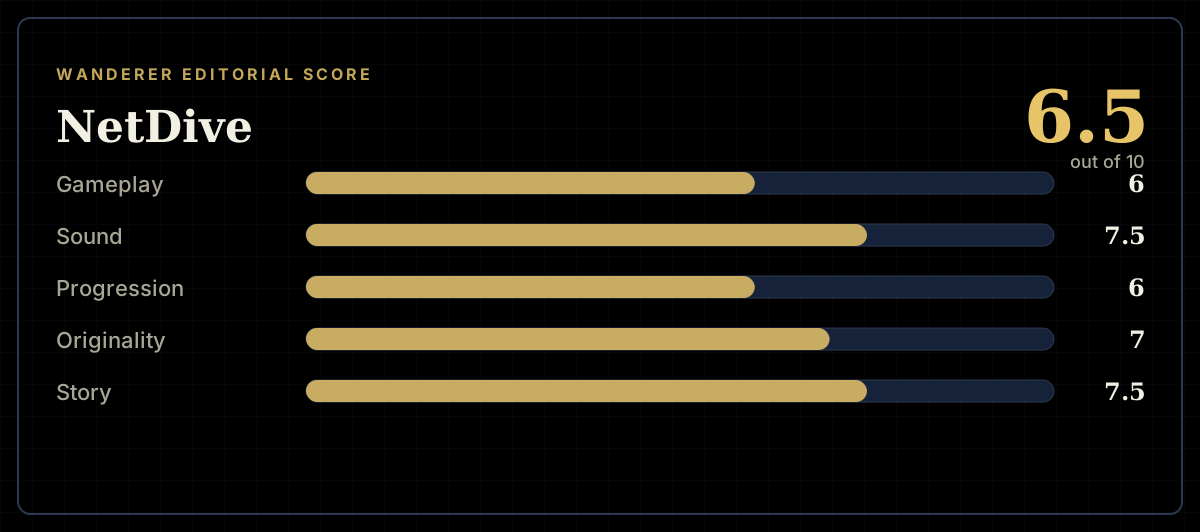
How the review scores each part of the gameWanderer Editorial -
The short versionWanderer Editorial