
Game review
Trainatic
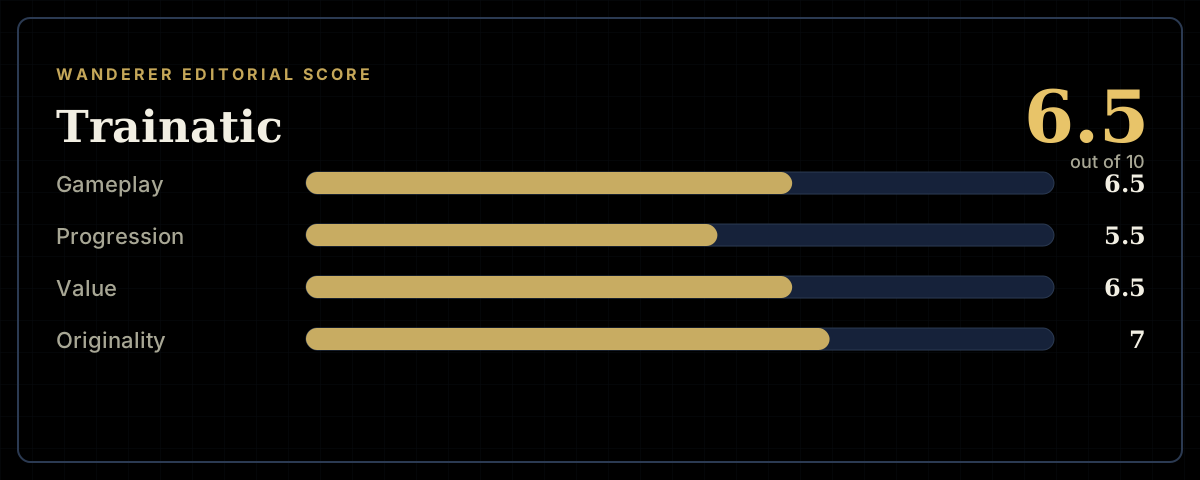
6.5 / 10
- Developer
- Ryan Forrester
- Publisher
- Ryan Forrester
- Released
- 8 September 2025
- Platforms
- Windows
- Genre
- Incremental, Action
- Monetisation
- One-time purchase, no DLC or in-game currency
- Players
- Single-player
The short version
Trainatic starts you with a single small engine struggling to shoot down one tree and ends with a screen-clearing locomotive obliterating an entire asteroid belt, upgrading cars and unlocking synergies along an incremental skill tree the whole way there. Its 1,097-review corpus — the largest of any game covered in this batch — is Very Positive and consistently describes the first one to three hours as genuinely excellent: satisfying, escalating destruction with a real sense of growth. What the same corpus is just as consistent about is what happens after that. Independently and repeatedly, reviewers report that every biome plays out the same beneath a different visual skin, that damage scaling tied to distance travelled makes careful aim increasingly irrelevant, and that a mechanically rich-feeling opening gives way to a back half several reviewers call repetitive backtracking with nothing new to discover.
Biggest strengths
- The opening one to three hours draw close to universal praise, even from reviewers who ultimately land on a negative overall verdict, for a satisfying, escalating power fantasy of a tiny train growing into an unstoppable destructive force
- The core aesthetic and central gimmick — an incremental train blasting through increasingly exotic landscapes toward space — are described as genuinely charming and distinctive rather than a reskin of existing incremental templates
- The game blends active and idle mechanics in a way at least one reviewer specifically calls satisfying: engage directly when you want to, or let it run passively when you need a break, without either mode feeling like an afterthought
Biggest weaknesses
- The single most repeated structural complaint, raised independently by many reviewers, is that every map is functionally identical beneath a different biome skin, with no new stations, sights or mechanical wrinkles differentiating one landscape from the next
- Multiple reviewers separately describe damage scaling tied to distance travelled as trivialising the aiming and targeting that defines the moment-to-moment gameplay in the early hours — by the back half, enough area-of-effect power accumulates that careful play stops mattering
- Several detailed reviews describe the back half specifically as backtracking with reduced challenge rather than new content, with one noting the first weapon type remains the most relevant throughout, undercutting the incentive to experiment with unlocked alternatives
Who it's for: Fans of short, satisfying incremental power fantasies who are happy to treat Trainatic as a three-to-five-hour experience rather than push for full completion — the genre's classic "numbers go up and things explode" appeal is delivered in full during that window. Less of a fit for completionists, several of whom specifically warn that 100% completion is a considerably less enjoyable experience than the main campaign.
Our recommendation: Worth buying at its current discounted price for the opening hours alone, which reviewers across the spectrum agree are genuinely fun — just calibrate your expectations for a short, front-loaded experience rather than a long-tail incremental, and consider stopping once the core loop starts repeating rather than chasing full completion.
6.5 / 10
From a tiny engine to a screen-clearing machine
Trainatic's core promise is delivered honestly in its opening hours: you start as a small, weak train struggling to knock down a single tree, and within a couple of hours of upgrading cars, unlocking synergies and expanding your skill tree, you're obliterating entire landscapes as a genuine locomotive of destruction. Reviewers across the spectrum — including several who ultimately land on a negative overall verdict — single this opening stretch out as some of the most purely satisfying incremental gameplay they've encountered, praising the escalating sense of power and the charm of the central "exploding train" gimmick itself. One reviewer's blunt summary captures the appeal well: "You're a train, you blow stuff up, numbers go up," delivered as a genuine recommendation rather than a dismissal.
The game also earns specific praise for blending active and idle mechanics rather than treating one as an afterthought to the other. You can engage directly with aiming and targeting when you want hands-on play, or let the train run and accumulate resources passively when you need a break — a structural flexibility at least one reviewer specifically calls out as exactly what draws them to games that straddle both modes.
The same map, over and over
Set against that strong opening is a remarkably consistent structural complaint, repeated independently across dozens of reviews rather than concentrated in one detailed outlier: every biome in Trainatic plays out identically beneath a different visual skin. Reviewers report no new stations, no meaningful sights along the track, and no mechanical variation to differentiate a desert level from a forest level from a space level beyond the backdrop changing colour. That's a specific, falsifiable claim rather than vague genre fatigue, and its repetition across so many independently written reviews is what makes it credible as a real pattern rather than one player's unusually harsh read.
A second, equally specific and equally repeated complaint concerns how damage scales. Several reviewers separately describe a system where destructive power scales with distance travelled to the point that, by the back half of a run, enough area-of-effect power has accumulated that careful aiming simply stops mattering — you clear everything on screen regardless of precision. For a game whose early hours are praised specifically for satisfying, engaging destruction, having that engagement mechanically dissolve into irrelevance partway through is a meaningful design regression, not just a difficulty curve smoothing out.
Front-loaded, and reviewers know it
The natural consequence of both complaints is a game reviewers describe as front-loaded: the best material arrives early, and the back half is widely characterised as backtracking with less challenge rather than new content. One detailed reviewer notes the very first weapon type remains the most relevant option for most of the game, undercutting any incentive to experiment with later unlocks. Completionist-minded reviewers are especially pointed about this: one calls the 100% pursuit "terribly boring" despite otherwise rating the base game a 9 out of 10, and jokes that no developer could possibly have fully completed their own achievement list and still enjoyed the experience. Global achievement data is broadly consistent with this shape — 90.3% of players clear the earliest train-size milestone, but only 27.7% reach full completion, a real if not extreme drop matching reviewer accounts of a strong start giving way to diminishing returns.
A demo that oversold the full release
One specific comparison recurs across several reviews and is worth drawing out on its own: multiple players who tried Trainatic's free demo before buying report that the demo itself represents the strongest material the game has to offer, with the paid release adding roughly the same amount of additional content again but delivering it with less challenge and more backtracking than the demo's tight opening slice. That's a notable pattern for a developer to hear, since it suggests the problem isn't a lack of content so much as a lack of escalation — the game doesn't run out of things to show you so much as it runs out of new ways to make those things interesting, front-loading its best ideas into the portion players could already experience for free.
On the technical side, the game is officially listed as unsupported on Steam Deck, though at least one reviewer reports several hours of trouble-free play on the handheld regardless — worth knowing if portable play matters to you, since "Unsupported" on Steam's own compatibility rating doesn't always mean broken in practice, just untested or unoptimised by the developer.
The verdict
Trainatic is, by its own review corpus's near-universal agreement, one of the more purely satisfying incremental openings available at its price — and one of the more disappointing back halves once the map repetition and damage-scaling issues make themselves felt. At least one reviewer notes the developer is actively patching reported issues, which is worth watching if the back-half complaints matter to you, but as it stands the honest recommendation is to enjoy Trainatic for what its first few hours do brilliantly, and to stop chasing completion once the repetition sets in rather than push through to a 100% that its own most dedicated players say isn't worth the effort. Judge it as a single satisfying afternoon rather than a long-term incremental project, and the price of admission is easy to justify — the mistake, based on this review's own audience, is expecting the escalating thrill of hour one to still be there by hour five.
Pros and cons
Pros
- The opening one to three hours draw close to universal praise, even from reviewers who ultimately land on a negative overall verdict, for a satisfying, escalating power fantasy of a tiny train growing into an unstoppable destructive force
- The core aesthetic and central gimmick — an incremental train blasting through increasingly exotic landscapes toward space — are described as genuinely charming and distinctive rather than a reskin of existing incremental templates
- The game blends active and idle mechanics in a way at least one reviewer specifically calls satisfying: engage directly when you want to, or let it run passively when you need a break, without either mode feeling like an afterthought
- It's short enough to respect a player's time for a single playthrough, with multiple reviewers reporting the main campaign completed in roughly a day or in the 3-to-5-hour range, making it a reasonable "one sitting" incremental rather than an open-ended grind
- The developer appears to be actively patching the game post-launch, with at least one reviewer specifically noting that many launch-day issues, including a missing Windows taskbar icon, were addressed and that ongoing patch notes should be checked for the most current state
Cons
- The single most repeated structural complaint, raised independently by many reviewers, is that every map is functionally identical beneath a different biome skin, with no new stations, sights or mechanical wrinkles differentiating one landscape from the next
- Multiple reviewers separately describe damage scaling tied to distance travelled as trivialising the aiming and targeting that defines the moment-to-moment gameplay in the early hours — by the back half, enough area-of-effect power accumulates that careful play stops mattering
- Several detailed reviews describe the back half specifically as backtracking with reduced challenge rather than new content, with one noting the first weapon type remains the most relevant throughout, undercutting the incentive to experiment with unlocked alternatives
- Completionist-focused reviewers are unusually blunt that reaching 100% is a considerably worse experience than simply finishing the main campaign, with one joking that no developer could have 100%'d their own game and still enjoyed it
- Global achievement data shows a real but not extreme drop-off — 90.3% clear the earliest milestone, falling to 27.7% for full completion — broadly consistent with reviewer reports that most players see and enjoy the strong opening before either finishing early or abandoning the back half
Screenshots
-

TrainaticImage: Ryan Forrester via Steam -

TrainaticImage: Ryan Forrester via Steam -

TrainaticImage: Ryan Forrester via Steam -
How the review scores each part of the gameWanderer Editorial -
The short versionWanderer Editorial