
Game review
Fungal Colony Sim 2
6 / 10
- Developer
- Skylor Beck
- Publisher
- Ghost Script Games
- Released
- 11 September 2025
- Platforms
- Windows
- Genre
- Incremental
- Monetisation
- One-time purchase, no DLC or in-game currency
- Players
- Single-player
The short version
You play a retired mushroom farmer called back to duty by a voice from below, sweeping an axe across fungal fields to harvest mushrooms and reinvest them into a growing hivemind. Fungal Colony Sim 2 is developer Skylor Beck's self-described "complete reimagining from the ground up" of an earlier game of the same idea — trading flat sprites for full 3D, cutting down on raw clicking, and adding multiple zones and a bigger upgrade tree. The small but engaged review corpus splits cleanly: several players describe losing 10-plus unplanned hours to its whimsical art and satisfying upgrade rhythm, while an equally specific set of complaints — a punishing early grind, a prestige system some report as under-rewarding or partly broken, and a workaround where circling the mouse beats actually harvesting — describe a game that hasn't quite finished tuning itself.
Biggest strengths
- Reviewers who stuck with it describe genuine, unplanned long-term engagement — one specifically notes intending a quick look and instead logging 10-plus hours, crediting the art, colour work and upgrade animations
- The move to full 3D rendering and a reworked, more "understandable and interactive" upgrade tree is exactly what the developer promised in a from-scratch remake, and reviewers who compare it to the earlier game describe it as a real improvement rather than a reskin
- The developer is reported as fast and responsive to bug reports — one reviewer specifically thanks them for fixing a text bug "extremely quickly," turning an initially broken purchase into a positive account
Biggest weaknesses
- Multiple independent reviewers, including at least one self-described incremental-genre enthusiast writing specifically to explain a thumbs-down, describe the early progression as tedious well past the genre's normal ramp-up, with one calling it stuck "in first gear"
- A specific, checkable workaround shows up independently in two different negative reviews: moving the mouse in circles is reportedly more efficient than actually chopping, which undercuts the core harvesting action the whole game is built around
- At least one reviewer reports the prestige system not applying some of its own bonuses correctly (citing a "minimum axe" upgrade that grants no axe levels), and a separate reviewer independently calls prestige's rewards too small to feel meaningful
Who it's for: Incremental-genre fans with a soft spot for a whimsical, mushroom-themed reskin of the familiar harvest-and-reinvest loop, who don't mind a rough, occasionally tedious opening hour before the systems open up. Less of a fit for anyone who wants the genre's grind curve carefully paced from minute one.
Our recommendation: Worth its NZ$11.79 for genre fans who can push through an admittedly slow start — several reviewers who nearly bounced off the early game report it eventually clicking into something they didn't want to put down. Newcomers to incremental games looking for a gentle on-ramp should look elsewhere first.
6 / 10
From flat sprites to a real third dimension
Fungal Colony Sim 2 is upfront about what it is: developer Skylor Beck's own description calls it "a reimagining of the original using all the skills I've gained in the years since making it." You play a mushroom farmer pulled out of retirement by a mysterious call from underground, and the loop that follows will be instantly familiar to anyone who has touched an incremental game before — harvest a resource, reinvest it into permanent upgrades, unlock new areas that produce new resources, repeat. The pitch for this specific sequel-of-sorts is entirely about production values and feel: full 3D rendering instead of the original's flat, faked-depth sprites, a deliberately reduced amount of raw clicking, and an upgrade tree the developer says was rebuilt to be more understandable and interactive than the first game's.
Reviewers who compare the two versions back this up rather than treating it as marketing copy. The art, colour work and upgrade animations draw specific, repeated praise, and more than one player describes getting pulled in far longer than intended — one reviewer explicitly says they didn't mean to spend 10-plus hours with it, and expects several more before they're done. For a small solo-developer release, that kind of unplanned engagement is a real achievement, and it's the strongest evidence in the corpus that the "reimagining" pitch delivered on its own terms.
A first act that outstays its welcome
Set against that is a specific, recurring complaint about pacing. More than one reviewer — including at least one who identifies as a genre enthusiast writing specifically to justify a negative verdict — says the early progression drags well past what the incremental genre's fans consider a normal ramp-up period, with one describing it as stuck "in first gear" and the grind tipping past "the usual satisfying feedback loop" into outright tedium. That's a meaningful data point precisely because it comes from reviewers who like the genre and were rooting for the game, not from players who bounced off the concept entirely.
More concretely, two independent negative reviews separately report the same specific workaround: moving the mouse in circles harvests more efficiently than actually using the axe-chopping action the game is nominally built around. When two players who don't reference each other's reviews land on the identical exploit-shaped complaint, that's a strong signal of a genuine balance issue rather than one player's misunderstanding of the systems. It also undercuts one of the developer's own stated design goals for this remake — cutting down on the raw clicking that reviewers of the original game apparently disliked — if the fastest route through the new version turns out to be a different repetitive mouse motion rather than a more thoughtful interaction.
What the remake actually changed
It's worth separating the systems that clearly worked from the ones that didn't, because the corpus draws that line fairly cleanly. The move to multiple distinct zones, each yielding new mushroom types as you unlock it, gives the mid-game a sense of place that a single-screen incremental usually lacks, and nobody in the review sample argues against it. The accessibility options are also unusually thorough for a solo-developer release at this price: mouse-only and touch-only control schemes, adjustable input timing and Steam Cloud saves all suggest a developer thinking about who else might want to play, not just the core incremental-genre audience. Against that, one reviewer raises a smaller but concrete presentation complaint — the transition screens are bright enough on an HDR monitor to be genuinely uncomfortable at night, closer to a "flashbang" than a scene change, in their words. It's a fixable issue rather than a structural one, but it's the kind of detail that suggests the visual side of the remake had less late-stage polish passed over it than the mechanical systems did.
Prestige troubles
The other recurring thread concerns the prestige loop meant to give long-term structure to repeat playthroughs. One reviewer reports a specific, testable bug — a "minimum axe" upgrade that is supposed to grant axe levels on prestige but currently doesn't — while a separate reviewer, independently, argues the prestige rewards generally are "only even more small barely noticeable upgrades" that don't justify resetting progress. Global achievement data adds useful context here: most early and mid-tier badges sit in the 48-72% range, a healthy completion rate for an incremental game, but the hardest full-completion badge sits at just 1.8%. That steep a cliff is consistent with a mid-to-late game whose rewards stop keeping pace with its grind, exactly as the critical reviews describe.
None of this appears to be permanent neglect, though. One reviewer specifically thanks the developer for fixing a reported text bug "extremely quickly," which suggests active, responsive maintenance — worth factoring in against the currently-reported balance issues, since a solo developer visibly still working the game is a different proposition from one who has moved on.
The verdict
Fungal Colony Sim 2 is a competently-made, genuinely charming incremental undercut by a first act that its own target audience finds unusually tedious, plus a prestige system that at least some players find buggy or underwhelming. The people who push through both describe real, substantial enjoyment on the other side, and a responsive solo developer is a point in its favour for anyone willing to report what they find. At NZ$11.79 that's a reasonable bet for incremental-genre regulars with some patience, but it's not the game to hand a newcomer looking for the genre's gentlest on-ramp.
Pros and cons
Pros
- Reviewers who stuck with it describe genuine, unplanned long-term engagement — one specifically notes intending a quick look and instead logging 10-plus hours, crediting the art, colour work and upgrade animations
- The move to full 3D rendering and a reworked, more "understandable and interactive" upgrade tree is exactly what the developer promised in a from-scratch remake, and reviewers who compare it to the earlier game describe it as a real improvement rather than a reskin
- The developer is reported as fast and responsive to bug reports — one reviewer specifically thanks them for fixing a text bug "extremely quickly," turning an initially broken purchase into a positive account
- Multiple zones with distinct mushroom types give the mid-game a sense of exploration that a single-screen incremental usually can't offer
- Steam Cloud saves and a genuinely humane accessibility spread (mouse-only or touch-only options, adjustable timing) show real care for players outside the genre's usual hardcore-clicker assumptions
Cons
- Multiple independent reviewers, including at least one self-described incremental-genre enthusiast writing specifically to explain a thumbs-down, describe the early progression as tedious well past the genre's normal ramp-up, with one calling it stuck "in first gear"
- A specific, checkable workaround shows up independently in two different negative reviews: moving the mouse in circles is reportedly more efficient than actually chopping, which undercuts the core harvesting action the whole game is built around
- At least one reviewer reports the prestige system not applying some of its own bonuses correctly (citing a "minimum axe" upgrade that grants no axe levels), and a separate reviewer independently calls prestige's rewards too small to feel meaningful
- The global achievement data shows a familiar incremental drop-off but a steep one: over 60% of players clear the early zone and upgrade milestones, yet only 1.8% reach the hardest full-completion badge, consistent with reviewers who say the mid-to-late grind outlasts its own reward curve
- One reviewer flags the transition screens as uncomfortably bright on an HDR monitor, a small but concrete presentation issue for anyone playing at night
Screenshots
-

Fungal Colony Sim 2Image: Ghost Script Games via Steam -

Fungal Colony Sim 2Image: Ghost Script Games via Steam -

Fungal Colony Sim 2Image: Ghost Script Games via Steam -
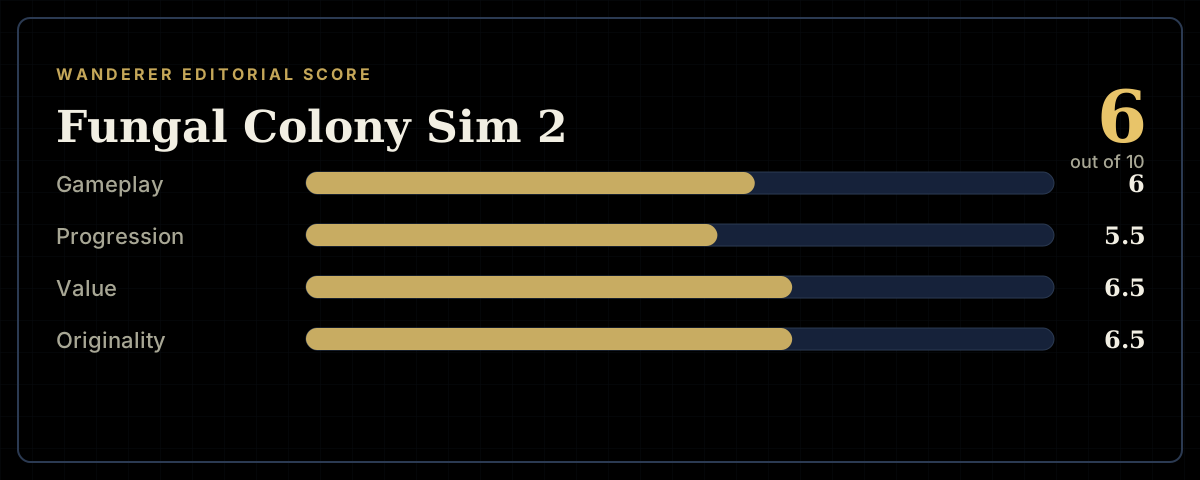
How the review scores each part of the gameWanderer Editorial -
The short versionWanderer Editorial