Game review
Console Kingdom Review
6 / 10
- Developer
- Piece Of Voxel
- Publisher
- Gamesforfarm
- Released
- 16 September 2026
- Platforms
- ["Windows"]
- Genre
- Simulation
A Kingdom Rendered in Text and Console Characters
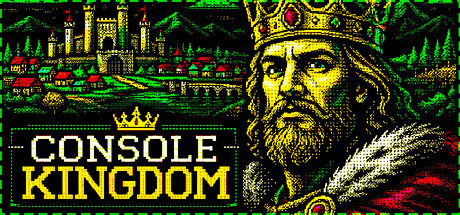
Console Kingdom commits hard to a single visual conceit: everything in its kingdom-management sim — the throne room, the petitioners, the harvest, the war council — is rendered not in pixel art or 3D models but in plain screen characters, the sort of look that would have greeted a player sliding a five-inch floppy disk into an XT clone decades before Steam existed. It's an unusual choice for a 2026 release, and a deliberate one; the store page leans into it as "original game style" rather than apologizing for a limited budget. Underneath that presentation sits a straightforward choice-driven strategy game: pick one of three rulers, then work through a string of daily state problems, each with a handful of responses that trade one resource or virtue for another.
Three Rulers, One Shared Structure
The three playable characters — Alaric the Wise, Magnus the Strong, and Elara the Charming — aren't just cosmetic skins on an identical run. Several reviewers note that certain dialogue options and resolutions are gated to a specific ruler, so a problem Magnus solves by force might only be solvable through negotiation or charm when playing as Elara, and Alaric's wisdom opens a third branch neither of the others can access. That's a sensible way to add replay value to a structure that would otherwise repeat the same daily-event pool run after run. Each in-game day presents a new problem with several possible responses, and the game is explicit about the trade-off built into nearly every choice: raising one stat, whether that's treasury, popularity, military strength, or something else, tends to cost you ground somewhere else. There's no way to please everyone, and the goal is simply survival — rule for as long as possible without triggering the events that end a reign early, whether that's bankruptcy, rebellion, or a coup.
Text-Adventure Bones, Kingdom-Management Skin
Structurally, this sits closer to a text adventure or a choice-based visual novel than to a traditional kingdom-builder like Reigns or Suzerain, and that distinction matters for setting expectations. There's no map to manage, no armies to position, no buildings to construct — the entire game plays out through reading a prompt and picking from a short list of responses, day after day, watching a handful of stat trackers shift in response. Steam Achievements are the only additional structure layered on top of the core loop, presumably tied to reaching specific endings or surviving to certain milestones as each of the three characters. For a dollar, that's a reasonable amount of content, and the two-language support (English and Russian) suggests a small team building for more than just a single home market despite the minimal scope.
An Honest Split in the Reviews Themselves
All seven of Console Kingdom's early reviews are positive, but reading past the thumbs-up reveals a more interesting range of reactions than a 100% score alone would suggest. Several reviewers are straightforwardly enthusiastic, calling it "easy to pick up but hard to put down" and praising the way choices carry real, felt consequences toward multiple distinct endings. But one of the more detailed reviews is candid about the game's limits in a way that's worth quoting directly: after describing the nostalgic pull of the console-text presentation, the reviewer writes that "after ten minutes of nostalgia, you realize the game is actually boring," adding that modern gaming has spoiled most players past the point where this kind of stripped-down experience can hold their attention. That's a positive review by Steam's binary system, but it's functionally a mixed one in substance — someone recommending the game to a specific type of player (nostalgia-driven, tolerant of minimal presentation) while being upfront that it won't land for everyone else. That's a more useful signal than the raw percentage, and it's the kind of nuance worth taking seriously rather than smoothing over.
Charming Novelty, Thin Long-Term Pull
The console-character aesthetic is a genuinely clever hook for a game built around reading text and making choices — it reinforces the "you are interfacing with the machinery of the state" framing better than a conventional fantasy-painted throne room would, and at least two reviewers single out the presentation as the game's most memorable element. But a hook built on novelty runs into the same ceiling every minimalist choice-game eventually hits: once the format stops feeling fresh, what's left has to be the writing and the branching itself, and with a relatively small pool of daily events shared across three characters, repeat playthroughs are likely to surface familiar problems well before all the character-specific branches have been exhausted. Playtimes logged in the reviews cluster mostly under two hours, which tracks with a compact, single-sitting experience rather than a sprawling management sim — appropriate for the asking price, but worth knowing going in if you're expecting kingdom-builder depth rather than a short, text-driven diversion.
Verdict
Console Kingdom is a small, confidently stylized choice game that gets more mileage out of its console-text presentation than its actual branching depth, and its own reviewers are more candid about that gap than the perfect review score suggests. Three characters with genuinely distinct dialogue options give it more replay value than a single-path text adventure, and at well under a dollar it's priced honestly for what it delivers: a short, novel, occasionally clever exercise in stripped-down state management that's more likely to charm for an evening than to hold anyone's attention across multiple playthroughs. Go in expecting a curiosity, not a kingdom-builder, and it's an easy recommendation at this price.
Screenshots
-
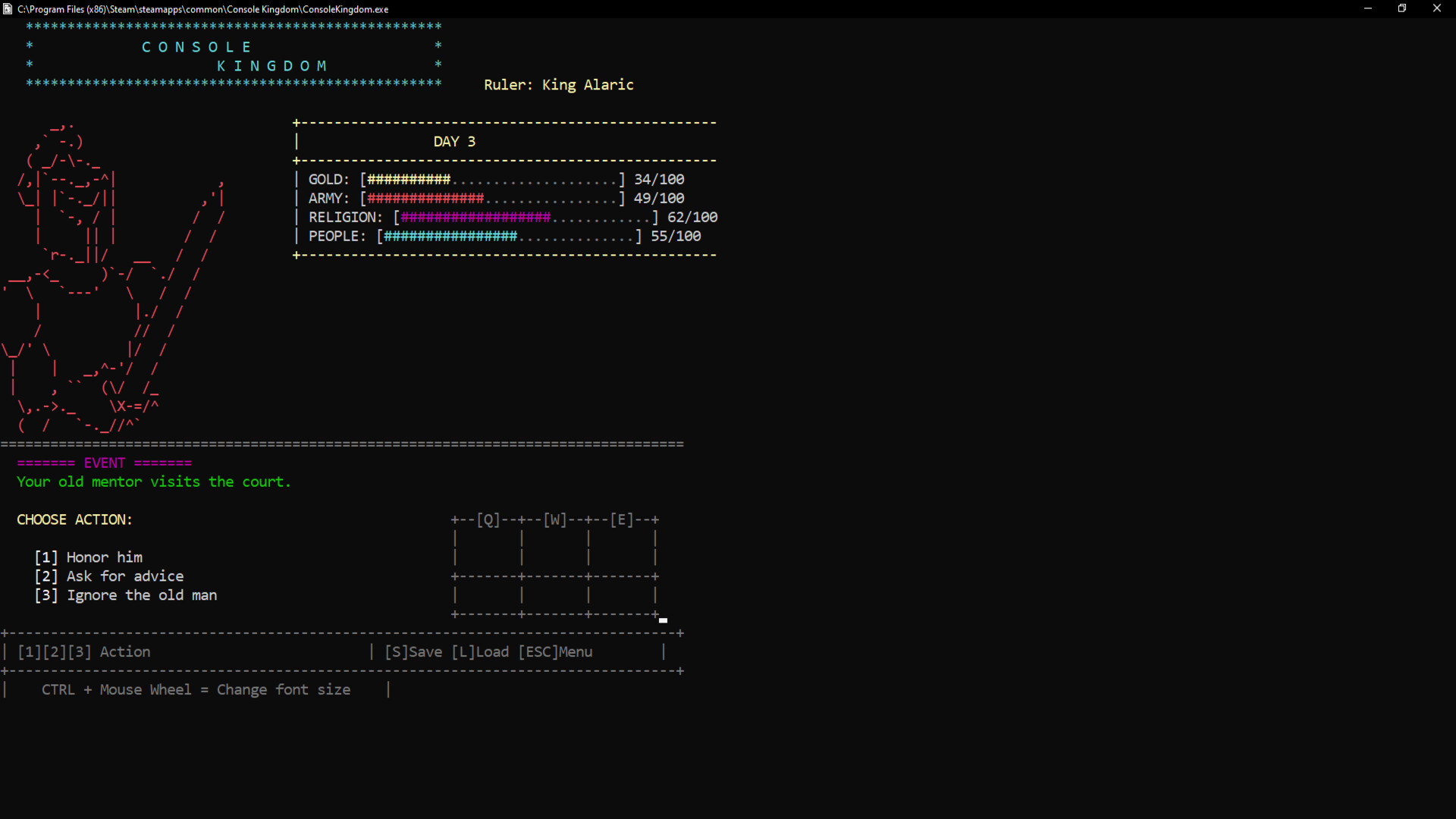
A typical daily event screen — stat bars up top, an ASCII illustration, and a three-way choice with consequences for the kingdom's resources.Image: Gamesforfarm via Steam -
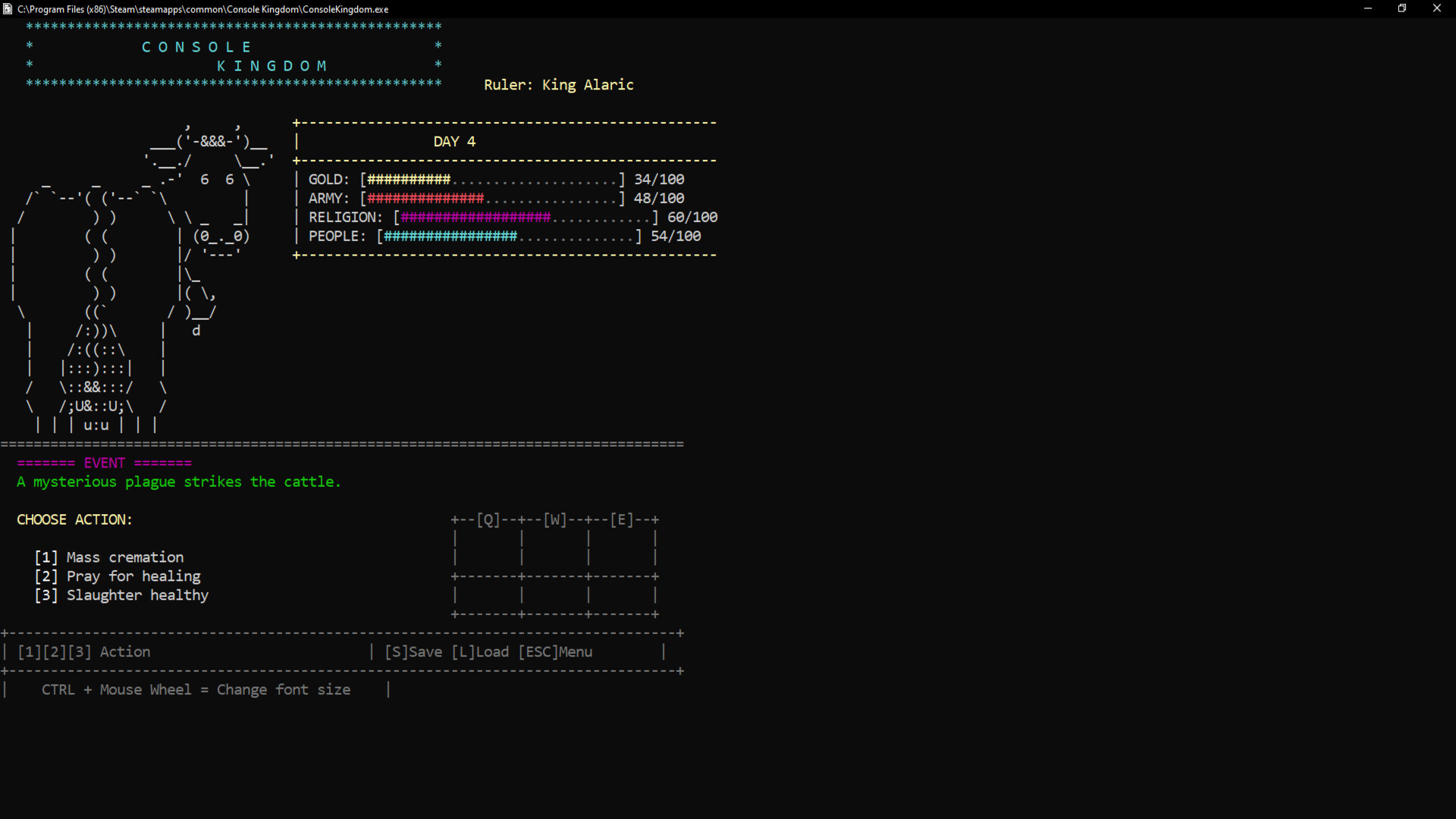
A harsher event: a cattle plague forces a choice between cremation, prayer, or culling the healthy stock.Image: Gamesforfarm via Steam -
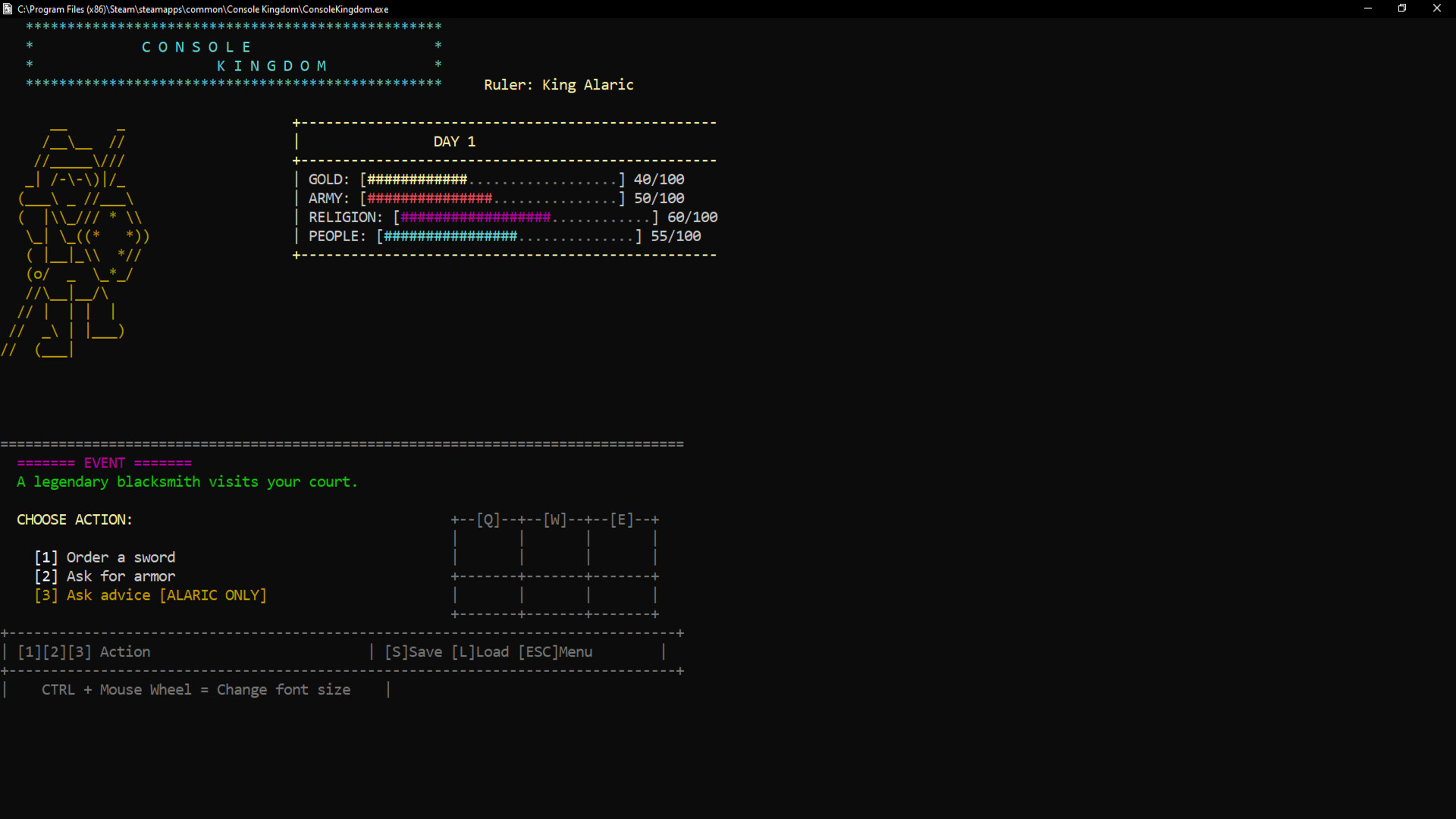
The opening day's event shows one of the character-gated options — 'Ask advice' is flagged as available to Alaric only.Image: Gamesforfarm via Steam