Game review
Zad Archery Review
5.5 / 10
- Developer
- Samharia Studios
- Publisher
- Samharia Studios
- Released
- 1 September 2026
- Platforms
- ["Windows", "Mac", "Linux"]
- Genre
- RPG
An Archer, a Field of Targets, and a Sprawling Web of Upgrades
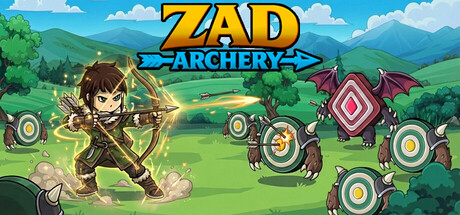
Zad Archery is the latest incremental action RPG from Samharia Studios, a developer with a small back catalogue of similar games already behind them, and it wears that experience in its presentation. The premise is simple: an archer stands in a field, fires arrows at a stream of target-shaped monsters, and collects whatever they drop. From that simple foundation, the game builds outward into an unusually dense web of systems — a large skill tree, five distinct Archer jobs to specialize into, equipment crafting for bows and armor, a separate mining minigame that feeds back into skill upgrades, and additional late-game layers with names like Shaping, Masteries, and Guardian Perks. Reviewers consistently describe the sheer number of interlocking progression systems as the game's main hook, giving players a constant stream of small upgrades and unlocks to chase even once the core act of shooting arrows becomes second nature.
Combat itself is not the point so much as the engine that drives everything else. Waves of enemies fall to auto-attacks and skills, loot piles up, and the player spends most of their actual attention in menus deciding what to upgrade next rather than aiming and firing. Reviewers who came in expecting a more hands-on archery game were sometimes caught off guard by how much of the experience plays itself, but for anyone approaching it as what it actually is — an idle-adjacent incremental RPG — that's the intended shape of the game, and many reviewers say so explicitly in response to early criticism from players who reviewed it more like a reflex-driven action title.
A Satisfying Early Loop That Runs Out of Real Choices
Where Zad Archery lands its strongest praise is in the feel of early-to-mid progression. Reviewers repeatedly describe watching their damage numbers climb, unlocking new skills and specializations, and gradually turning a fragile starting archer into something dramatically more powerful, and several single out the five Archer jobs and the crafting system — which lets players target-farm specific scrolls and apply them to a single piece of gear rather than relying purely on random drops — as genuinely satisfying ways to shape a build. The mining sub-loop, which converts resource gathering into skill-affecting upgrades rather than leaving it as a disconnected side activity, gets similar praise for tying otherwise separate systems together.
That praise comes with a serious and frequently repeated caveat, though: for all the systems on offer, a large share of reviewers say the actual decisions within them are shallow. The skill tree is described as heavily scripted, offering only one or two choices at a time with the stronger option usually obvious, and several reviewers note that different builds — including pet-focused or weapon-focused paths — end up looking and playing almost identically regardless of which upgrades a player prioritizes. One detailed review calls out the total absence of a DPS meter or any real way to compare gear and pet effectiveness, arguing that without that information, "none of the choices matter at all." For a genre whose appeal often rests on meaningful optimization, that's a recurring sticking point even among reviewers who otherwise enjoyed their time with the game.
A Short Game That Splits Its Audience on Length and Price
The single most common criticism, showing up across both positive and negative reviews, is how quickly Zad Archery ends relative to its price. Reviewers commonly report reaching the final boss and unlocking most of the game's systems within three to seven hours, with several noting they finished 100% of the available achievements in that same window. Some reviewers frame this as a feature rather than a flaw — a tight, focused incremental experience they can finish in a sitting or two without the usual genre bloat — and explicitly recommend it as a good value at its asking price. A comparably sized group of reviewers land the opposite way, arguing that free incremental and idle games routinely offer more depth and longer play than a $6.99 game that can be exhausted in an afternoon, with a few pointing to the addition of paid cosmetic DLC at launch as adding insult to injury given how short the core game already is.
The game's "idle" framing is itself a point of friction. Several reviewers report that the archer doesn't automatically advance to the next stage after clearing one, meaning the game can't simply be left running unattended the way many idle games can — contradicting the expectations set by its own store tags and genre framing. A large mid-development "mega update" added an endless mode and rebalanced numbers significantly, which multiple reviewers credit with meaningfully extending the game's lifespan and fixing the abrupt ending several early reviewers complained about. That same update also drew a handful of angry reviews from players who'd built up enormous numbers under the old system and found themselves suddenly much weaker under the new one, and it introduced at least one save-corrupting bug involving invisible gem pickups that a couple of reviewers say left their save unable to progress further.
Colorful Presentation That Turns Into Visual Noise at the Top End
Zad Archery's visual style earns consistent, low-key praise — bright, readable target-monster designs and clean UI in the early game give the whole experience a distinct, approachable personality that several reviewers contrast favorably with drabber genre peers. That readability doesn't hold up all the way through, though. Once a build starts stacking multiple skills, pets, and high attack speed, reviewers describe the screen filling with overlapping numbers, particle effects, and damage text to the point that the actual enemies become hard to see, and more than one reviewer says they simply couldn't tell what was happening on screen at the higher stages. Samharia Studios has responded to this directly, shipping an update adding a "minimal effects" option that at least one reviewer specifically credits as a meaningful quality-of-life improvement, though it isn't clear how widely that option has been adopted or how well it solves the clutter for players deep into the endgame.
Steam Deck support is listed as Playable rather than fully Verified, and reviewers who've tried it note real friction: some interface elements aren't reachable through the default controller layout, text entry can require manually summoning the on-screen keyboard, and certain prompts still display keyboard-and-mouse icons rather than controller equivalents. It's functional on the Deck, in other words, but clearly designed mouse-first, and the genre's heavy reliance on menu navigation makes that mismatch more noticeable than it might be in a faster-paced game.
Verdict
Zad Archery is a competently built incremental RPG whose biggest strength — an unusually large web of interconnected progression systems — doesn't quite deliver on the sense of meaningful choice that a genre built around optimization depends on. The core loop of watching numbers climb and unlocking new mechanics is genuinely satisfying for the first several hours, Samharia Studios has shown a real willingness to patch quickly and expand the game post-launch, and the crafting and mining sub-systems do a good job of making side activities feel connected to the main progression rather than bolted on. But a heavily scripted skill tree with few real decisions, a short overall runtime that a meaningful share of reviewers feel doesn't justify the asking price relative to free competitors in the same genre, an "idle" framing the game doesn't fully live up to, and a late-game visual clutter problem all keep it from clearing the bar its ambitious system list initially promises. Fans of the developer's earlier games and players who specifically want a tight, few-hours-long incremental to finish in a weekend are likely to get their money's worth; anyone expecting deep build variety or dozens of hours of content should wait for a sale or look elsewhere.
Pros:
- A genuinely large, interconnected web of progression systems (skill tree, jobs, crafting, mining, and more)
- Satisfying early-to-mid game power curve with frequent, noticeable upgrades
- Developer has patched quickly, including a major update adding endless mode and rebalancing
- Bright, readable presentation and a distinct visual identity for a busy genre
- Crafting and mining tie meaningfully into combat power rather than feeling like side content
Cons:
- Skill tree and build choices are heavily scripted, with little real room to optimize or diverge
- Very short for the genre — many reviewers finish everything within three to seven hours
- Doesn't fully deliver on its own "idle" framing, requiring manual stage advancement for some players
- Late-game visual clutter from stacked effects can obscure what's actually happening on screen
- A major rebalance update and a save-corrupting bug frustrated some early adopters
Screenshots
-
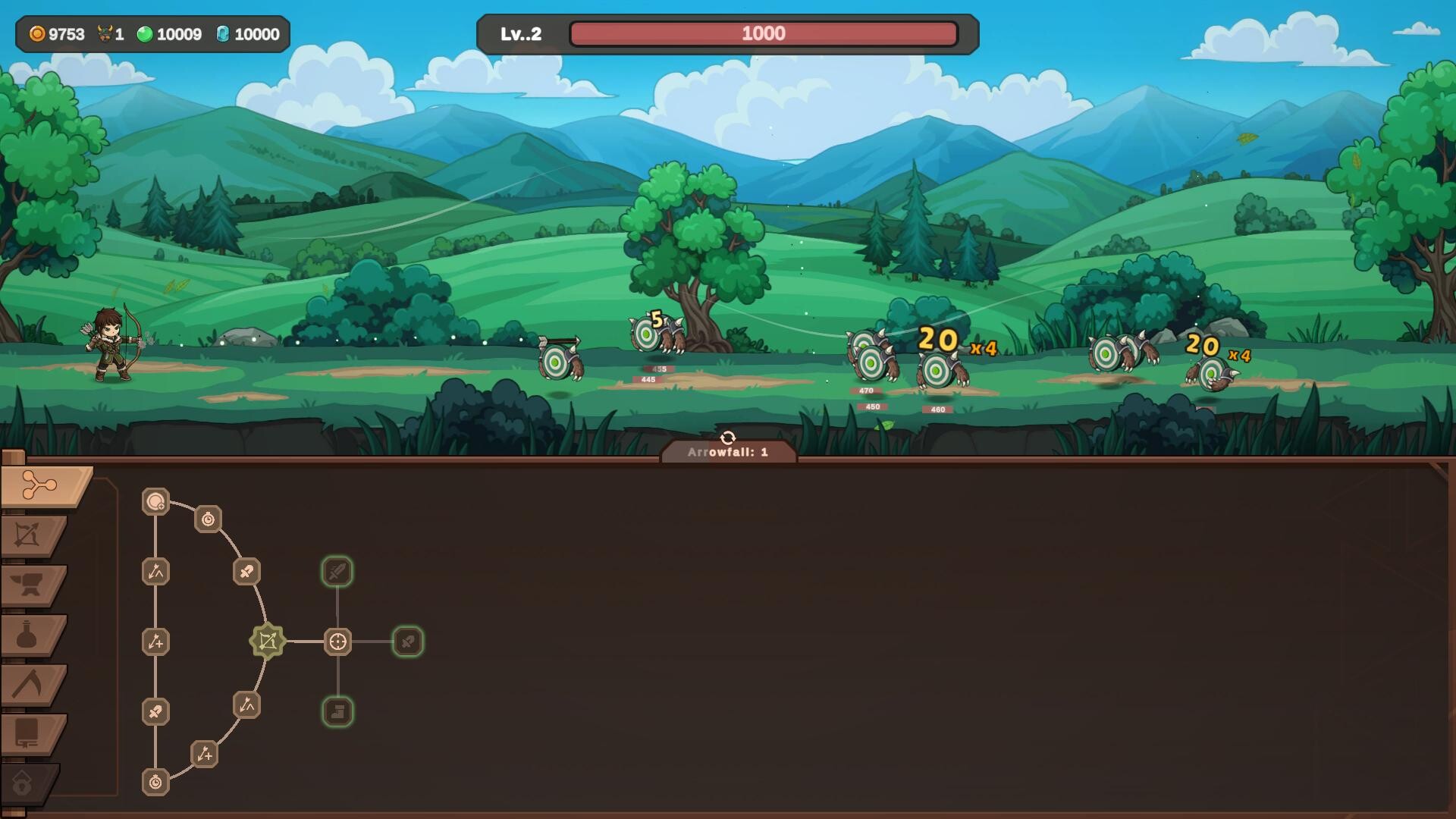
Waves of target-shaped monsters fall to auto-attacks while the skill tree fills the lower half of the screenImage: Samharia Studios -
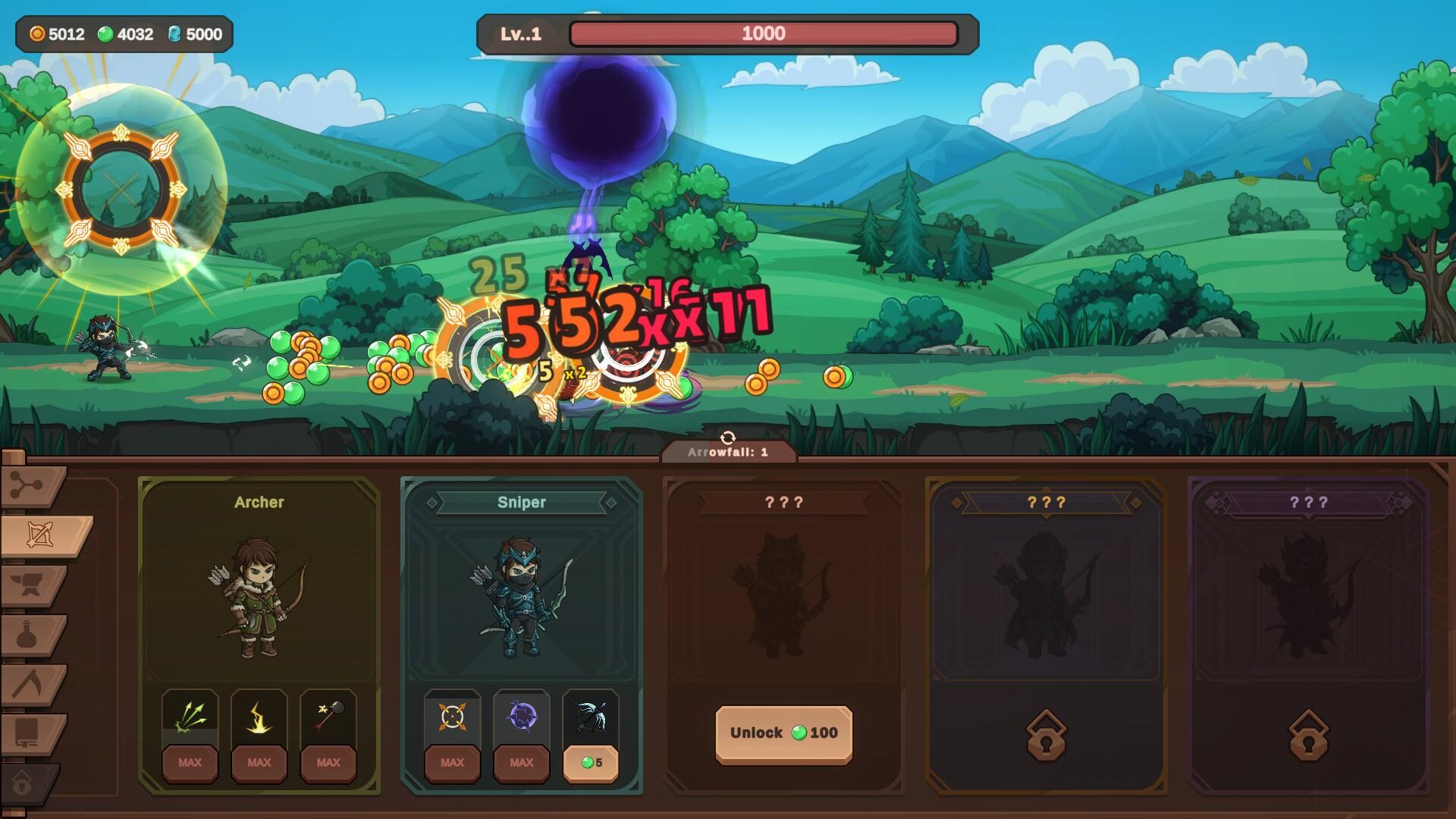
Big damage numbers and loot pile up fast, with the Archer and Sniper job panel shown alongside locked specializationsImage: Samharia Studios -
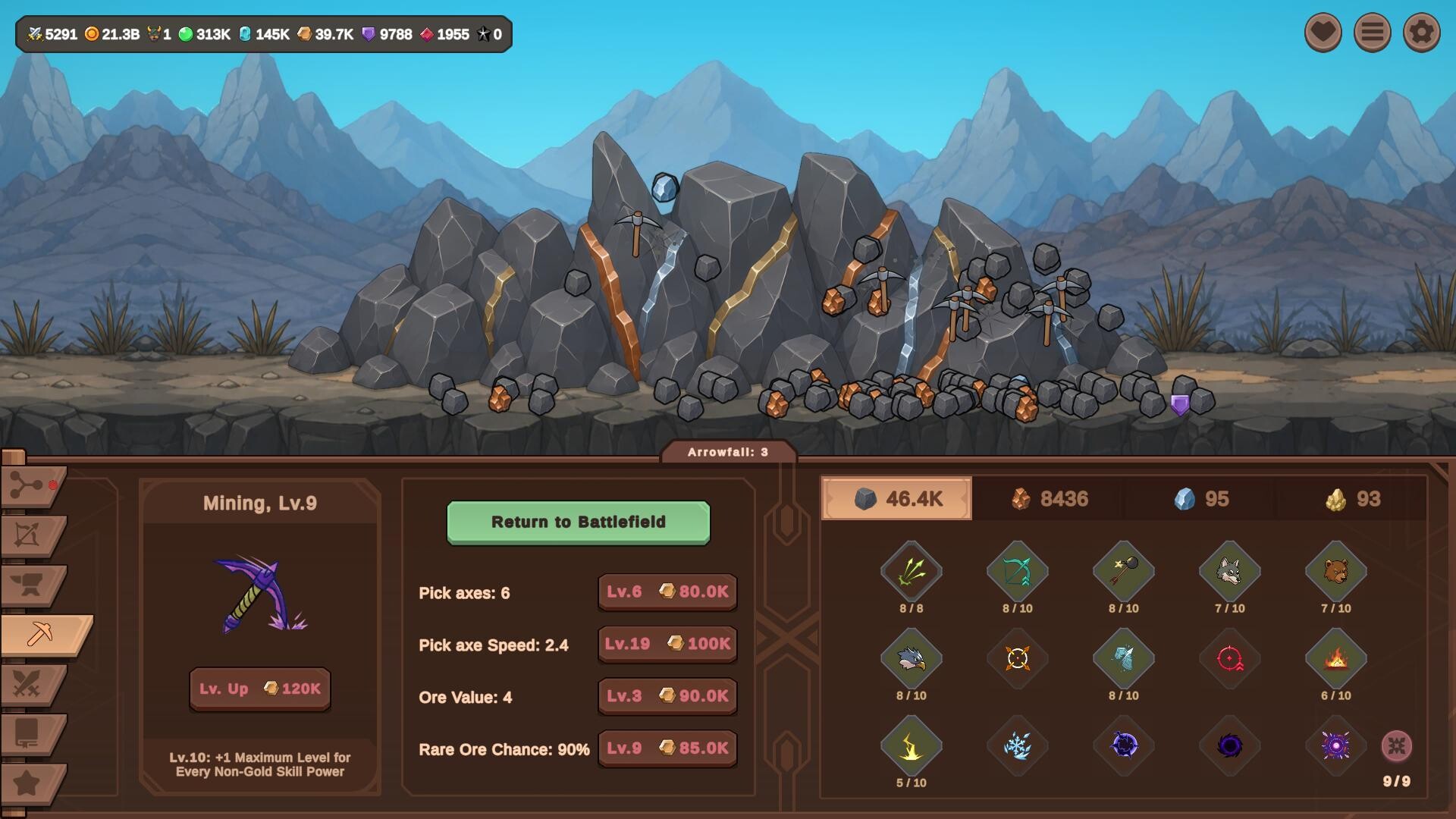
The mining sub-loop feeds directly back into skill upgrades rather than sitting apart from the main gameImage: Samharia Studios -
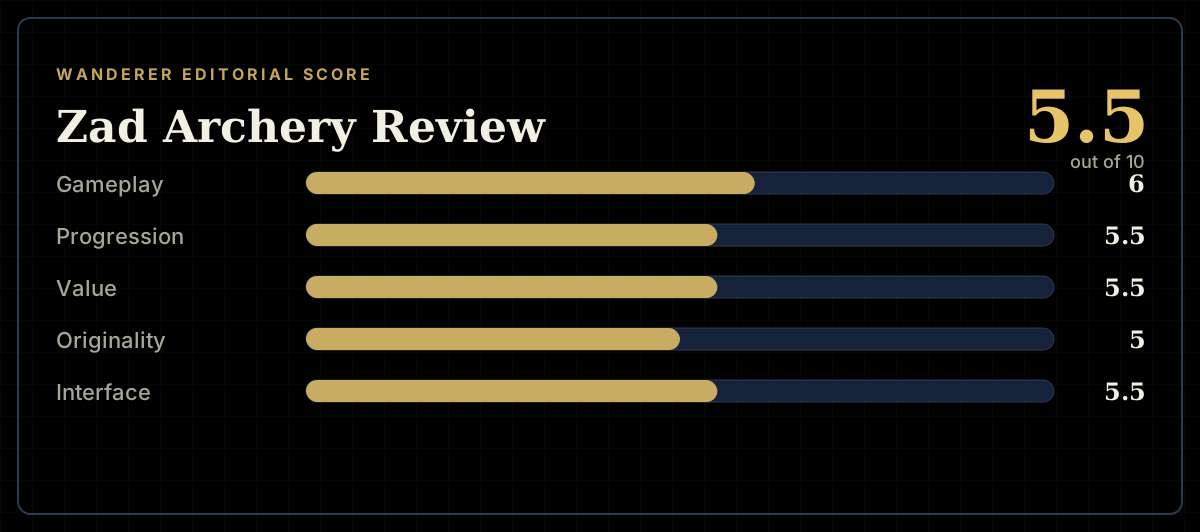
How the review scores each part of the gameWanderer Editorial -
The short versionWanderer Editorial