
Game review
How to Grow Your Sausage Review
6.5 / 10
- Developer
- Little Horror Studios
- Publisher
- Little Horror Studios
- Released
- 14 September 2026
- Platforms
- ["Windows"]
- Genre
- Casual
A Sentient Sausage Takes Over Your Desktop
How to Grow Your Sausage is exactly as tongue-in-cheek as its title suggests: a small desktop widget-game where a sentient sausage hijacks a butcher's mind and grows, quite literally, every time you type a key, click a mouse button, or otherwise interact with your PC. It's the follow-up to Little Horror Studios' earlier hit, a similarly cheekily-titled clicker built around a different piece of anatomy, and reviewers are unanimous that the joke, the art style, and the general silliness carry over intact. One reviewer sums up the whole appeal succinctly, calling it simply "a great spin off," while another notes the game leans into the innuendo hard enough that most of the review pool treats reading between the lines as half the fun.
The pitch is straightforward: leave it running in the corner of your screen, keep doing whatever you were already doing on your computer, and watch the sausage steadily grow, unlocking cosmetic hats, outfits, and permanent upgrades along the way. Reviewers who kept it open during other games, work, or general desktop use describe it as an easy, low-effort background companion that rewards the exact kind of idle inattentiveness the genre is built around.
Typing and Clicking Instead of Idle Ticks
Where this entry actually differs mechanically from its predecessor is the input model. Rather than running mostly on its own like a traditional idle game, How to Grow Your Sausage grows in direct response to your keyboard and mouse activity — meaning it's designed to sit alongside something input-heavy, like a shooter or another game entirely, and passively accumulate progress from inputs you're already making. Reviewers compare the feel to typing-tracker novelties like Bongo Cat, and several specifically appreciate that this design gives the game more active engagement than a purely automated idler, even while it's technically meant to run in the background.
New systems layered on top of that core loop include a prestige mode and time-travel resets, both aimed at giving long-term players a reason to keep coming back once the early upgrade curve flattens out. Reviewers with substantial playtime — several report 500 to nearly 4,000 minutes logged — describe the progression as "well designed" for a game this cheap and disposable-feeling on the surface, with meaningful choices in which meats, grinders, and cleavers to purchase and equip as you push toward bigger numbers.
A Few Rough Edges for a Three-Dollar Joke
The criticism that does surface is narrow but specific. The most substantive complaint comes from a reviewer with over 1,000 minutes played, who argues the "idle" framing is misleading since there are very few moments the game can actually be left alone without input to drive progress, and who also flags that the game doesn't close properly when quit, leaving background processes running. That same reviewer eventually found the friction manageable after picking up a cheap auto-clicker, but it's a real design tension between the game's marketing as something to "let sit" and its actual mechanical reliance on active input.
A couple of smaller quality-of-life complaints round things out: the game window can't be resized smaller, and without the ability to lock its position on screen, it's possible to accidentally drag the window around your desktop while doing other things — a minor but recurring annoyance for a game explicitly designed to run in the background of your other activities. One reviewer also notes the progression can start to feel repetitive once the initial novelty of the upgrade tree wears off, and finds the time-travel prestige reset more frustrating than rewarding in practice.
Cheap, Silly, and Exactly What It Promises to Be
For $3.99, reviewers are broadly forgiving of the rough edges, and the overwhelmingly positive reception (45 of 47 reviews positive at time of writing) reflects a game that isn't promising much beyond a few hours of silly, low-commitment fun — and mostly delivers on that modest promise. Several reviewers who put dozens of hours into the developer's previous game describe this one as a meaningful iteration rather than a lazy reskin, citing more upgrade depth and content early on, even if the always-on automation of the first game is somewhat traded away for the new input-driven hook. It's not a game anyone is likely to mistake for a substantial release, and it isn't trying to be one; it's a cheap, funny novelty that a lot of reviewers seem happy to have had running in a corner of their screen.
Verdict
How to Grow Your Sausage knows precisely what kind of game it is — a silly, innuendo-driven desktop companion clicker that asks almost nothing of you and mostly delivers on its one joke without overstaying its welcome. The shift to an input-driven growth model instead of pure automation is a genuinely interesting twist on the formula, giving it more to do moment-to-moment than its idler predecessor, even if that same shift muddies the "idle" label a little and draws some fair criticism about what "leaving it running" actually means here. Minor window-management annoyances and a repetitive late-game curve keep it from being flawless, but at $3.99 and with reviewers consistently enjoying the joke, this is an easy, low-stakes recommendation for anyone who wants a few silly hours (or a background distraction) for the price of a coffee.
Pros:
- Cheeky, fully-committed comic premise that doesn't wear out its welcome
- Input-driven growth model gives more active engagement than a pure idler
- Genuine progression depth, with prestige and time-travel systems for returning players
- Cosmetic hats and outfits add a light collection layer to the core loop
- Extremely cheap and well-reviewed for what it's trying to be
Cons:
- "Idle" framing is arguably misleading given how input-dependent progress actually is
- Game window can't be resized or locked, leading to accidental dragging
- Doesn't close properly on quit according to at least one reviewer
- Late-game progression and prestige resets can feel repetitive rather than rewarding
- Very thin on substance for players expecting more than a short novelty
Screenshots
-
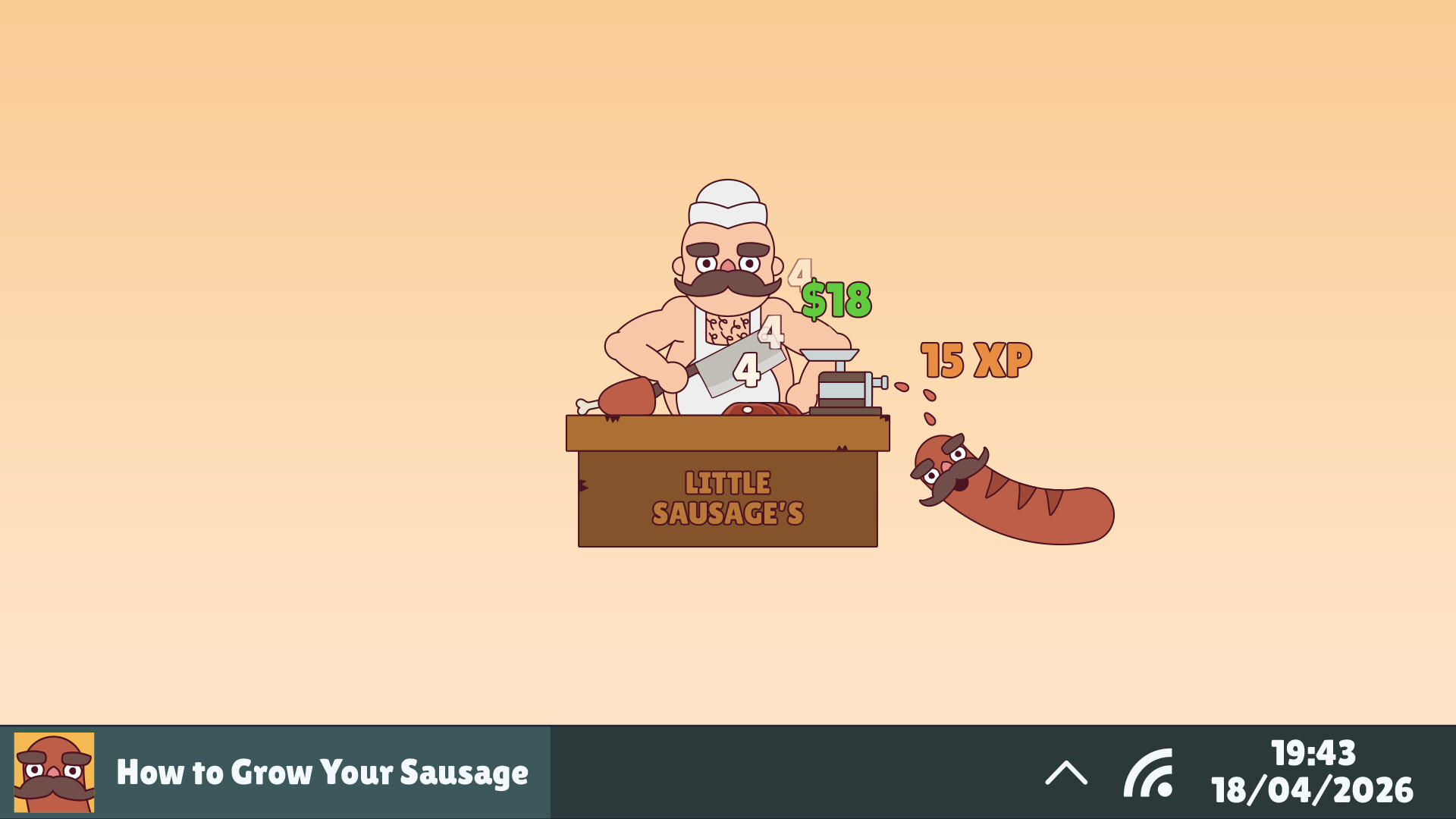
Each input generates money and XP at the sausage stand, feeding straight back into upgradesImage: Little Horror Studios via Steam -
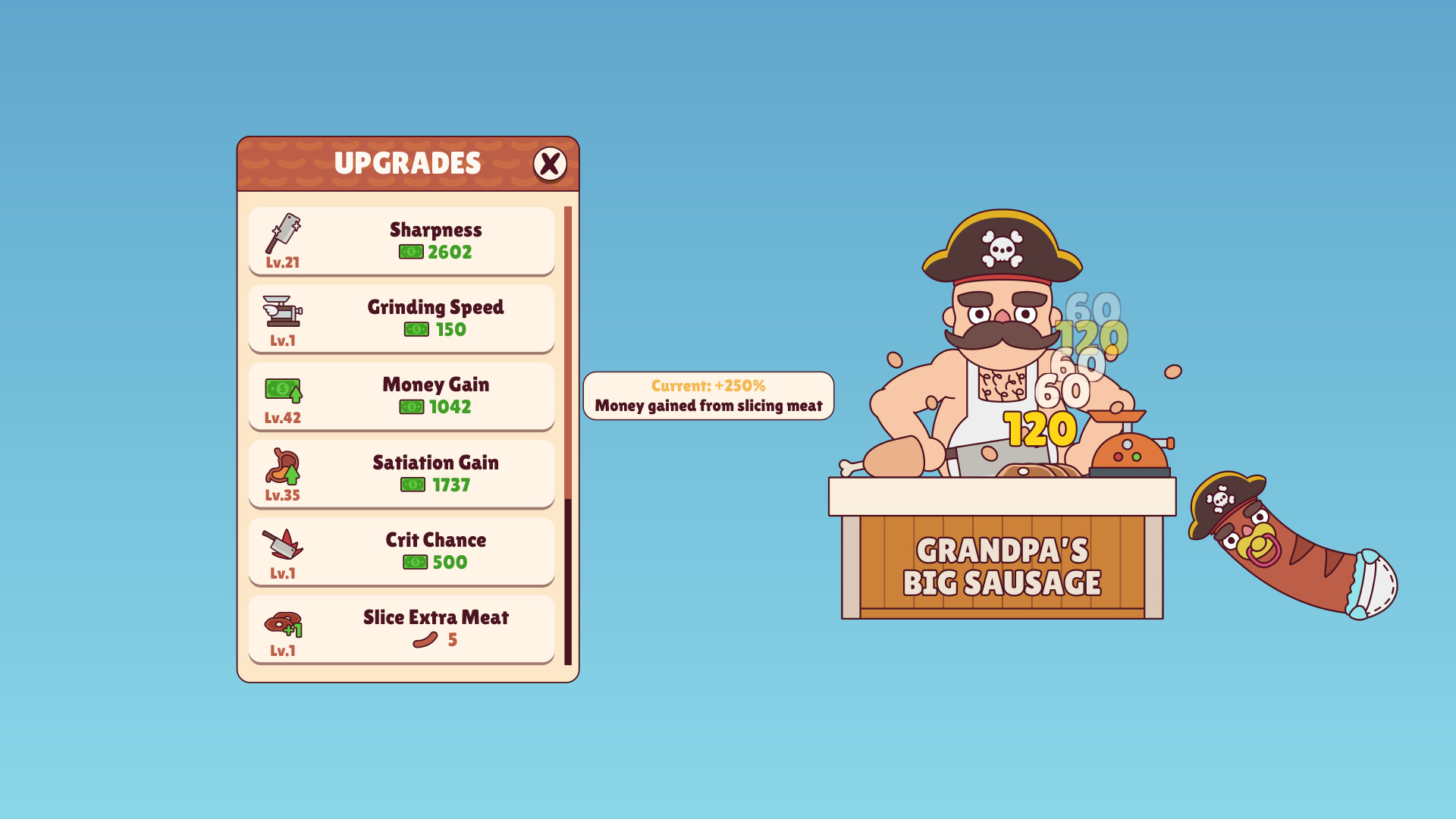
A deep upgrade tree covers sharpness, grinding speed, money gain, and crit chance as the sausage empire expandsImage: Little Horror Studios via Steam -

Late-game systems escalate the joke all the way to world domination, tracking minds controlled by the billionsImage: Little Horror Studios via Steam -
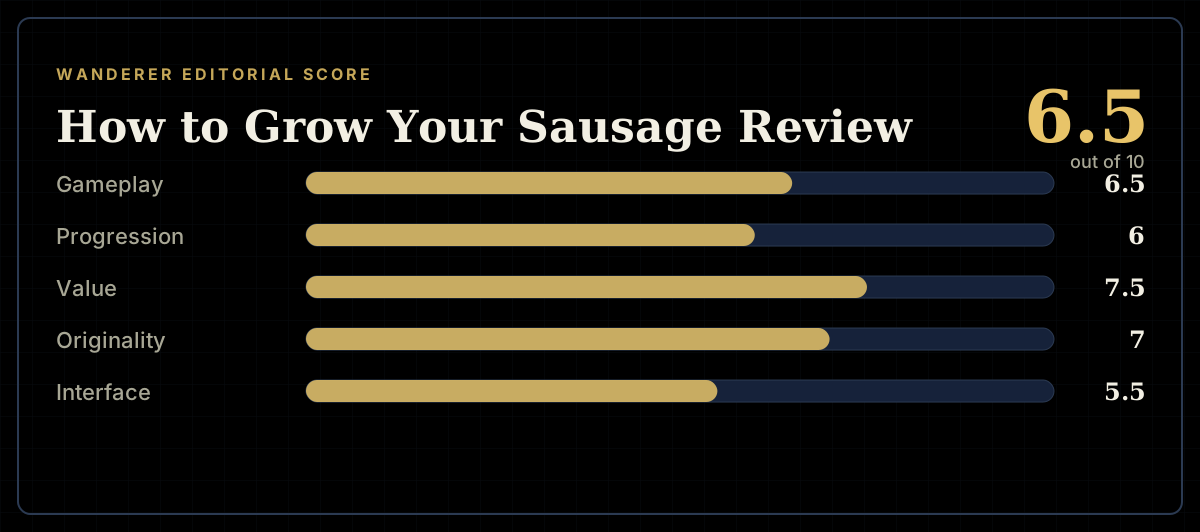
How the review scores each part of the gameWanderer Editorial -
The short versionWanderer Editorial