
Game review
Alembic Review
6.8 / 10
- Developer
- Equious
- Publisher
- The Bueno Interactive
- Released
- 9 September 2026
- Platforms
- ["Windows"]
- Genre
- Simulation
A Falling-Sand Game Built on Real Chemistry, Not Fake Recipes
Alembic takes the familiar falling-sand sandbox genre and grounds it in something most of its peers never bother with: an actual periodic table, where reactions emerge from real chemical and physical properties rather than a hardcoded lookup table of "ingredient A plus ingredient B equals result C." Reviewers describe that distinction as the game's entire draw. One puts it plainly: "No recipes, no 'A + B = C.' Every element has real properties, and reactions come out of what the material is and what you do to it." Another describes starting simple — mixing hydrogen and oxygen into water, carbon and oxygen into carbon dioxide — before finding themselves, minutes later, melting alloys, mixing acids, and discovering compounds they didn't know existed.
That authenticity extends well past basic mixing. Reviewers reference building working galvanic batteries that generate real electricity, synthesizing thermite and other explosive materials, and even triggering nuclear decay and a uranium pile reaching criticality — the kind of chemistry-set experimentation most players would never get to try outside a game, and one reviewer specifically frames the appeal as accidentally learning real science while having fun, calling the game's hand-holding just gentle enough for someone with no chemistry background to still feel in control of what they're doing.
Genuine Systemic Depth for a Five-Dollar Sandbox
What elevates Alembic above a novelty chemistry toy is that its simulation systems actually interconnect. Pipes, fans, filters, and generators all run on the same underlying particle, heat, and pressure simulation as the raw elements themselves, meaning building a working factory setup means physically moving matter and energy through a system rather than dragging discrete items between fixed containers. One reviewer specifically calls this out as the difference between Alembic and mobile-style "beaker" apps they'd played before, noting that in those simpler games the containers themselves are indestructible, while in Alembic every piece of equipment is something the player constructs and can lose to their own experiments.
That scope draws enthusiastic comparisons to genre touchstones like The Powder Toy, with one reviewer describing having waited since childhood for a particle sandbox to meaningfully move the genre forward, and crediting Alembic with doing exactly that. A Simplified Chinese reviewer frames it as an ambitious attempt to recreate the entire periodic table inside a sandbox game, complete with dedicated systems for electricity, radioactive decay, and even simulated biology — an unusually broad design goal for a launch-week indie built by a small team.
International Reception Reveals Real Gaps Alongside the Praise
Alembic's review pool is small but strikingly international, with substantive reviews in English, Simplified Chinese, German, Spanish, Japanese, Polish, and Russian — an unusually wide spread for an indie sandbox this size, and one that suggests real word-of-mouth pull beyond a single English-speaking community. That international attention also surfaces the game's clearest weaknesses more precisely than the enthusiastic English-language reviews alone.
The most detailed critique comes from a Simplified Chinese reviewer who praises the game's ambition while flagging concrete problems: localized text renders subscript numbers as blank placeholder glyphs, so compound formulas like sulfur trioxide display incorrectly on the Chinese client. That same reviewer argues the simulation's actual depth falls short of its apparent scope — many elements exist mostly as background material whose only real function is contributing a differently colored compound, with electrical and radioactive systems limited to a handful of set-piece interactions like arcing, electrolysis, decay, and nuclear detonation rather than a fully open-ended system. They also note UI elements overlapping each other and button logic that sometimes fails or behaves unpredictably. Separately, a Russian reviewer reports the game freezing unpredictably during play — sometimes for a second, sometimes for a couple of minutes — and concludes that, simulation quality aside, the instability isn't worth the asking price for them specifically.
A Fresh Launch, With a Developer Already Patching
Alembic is barely a week old at the time of its review pool, having shipped with a "Pre-launch Acid Update" just before release and a follow-up patch within its first two days on sale — a promising early sign of active support, though not yet enough of a track record to say how quickly the localization and stability complaints will be addressed. Given the game's ambition — an entire periodic table's worth of interacting elements simulated down to heat, pressure, and particle behavior — some early rough edges are close to unavoidable, and reviewers on the whole treat them as growing pains in a genuinely novel simulation rather than a sign of a project that's out of its depth. One reviewer explicitly frames the value proposition around that trajectory, noting the game is well worth its asking price "even when it just released," with the clear expectation that more content and polish will follow.
At $4.99, the bar for what counts as a fair deal is low, and on that measure Alembic clears it easily even with its rough edges — reviewers consistently describe getting real value out of a system this deep and this cheap, treating the current feature set as a strong foundation rather than a finished, padded-out package. Whether that foundation gets built into something closer to the full periodic-table ambition the developer has signaled remains an open question this early into the game's life.
Verdict
Alembic's core idea — a falling-sand sandbox built on genuine chemistry rather than invented recipes — is executed with real conviction, and the interconnected pipe, heat, and pressure systems give it more mechanical depth than its five-dollar price tag suggests. It's held back by a launch-week list of real, specific problems: incomplete localization in at least one language, UI elements that overlap or misbehave, unpredictable freezing reported by at least one player, and a detailed critique arguing the simulation's actual depth doesn't yet match its stated ambition once you look past the flashiest reactions. None of that stops the review pool, spread across seven languages, from recommending it, but it's an early, still-rough version of a genuinely original idea rather than a fully polished one. At $4.99, it's an easy recommendation for anyone who wants to tinker with real chemistry in a sandbox, as long as they're prepared to be an early adopter of a game still finding its footing.
Pros:
- A genuinely novel hook: chemistry that emerges from real element properties rather than fixed recipes
- Interconnected pipe, heat, and pressure systems give real depth to factory-style setups
- Supports advanced experimentation like electrochemistry, thermite, and nuclear criticality
- Strong value at $4.99 for the scope of simulation on offer
- Broad international review pool suggests appeal well beyond a single audience
Cons:
- Localization gaps reported in at least one language, including broken compound-formula text
- A detailed critique argues many elements are shallow "background" content beyond their color
- UI elements reported to overlap, with some button logic behaving unpredictably
- At least one reviewer reports unpredictable freezing during play
- Very new release with a small review pool, so its long-term support trajectory is still unproven
Screenshots
-
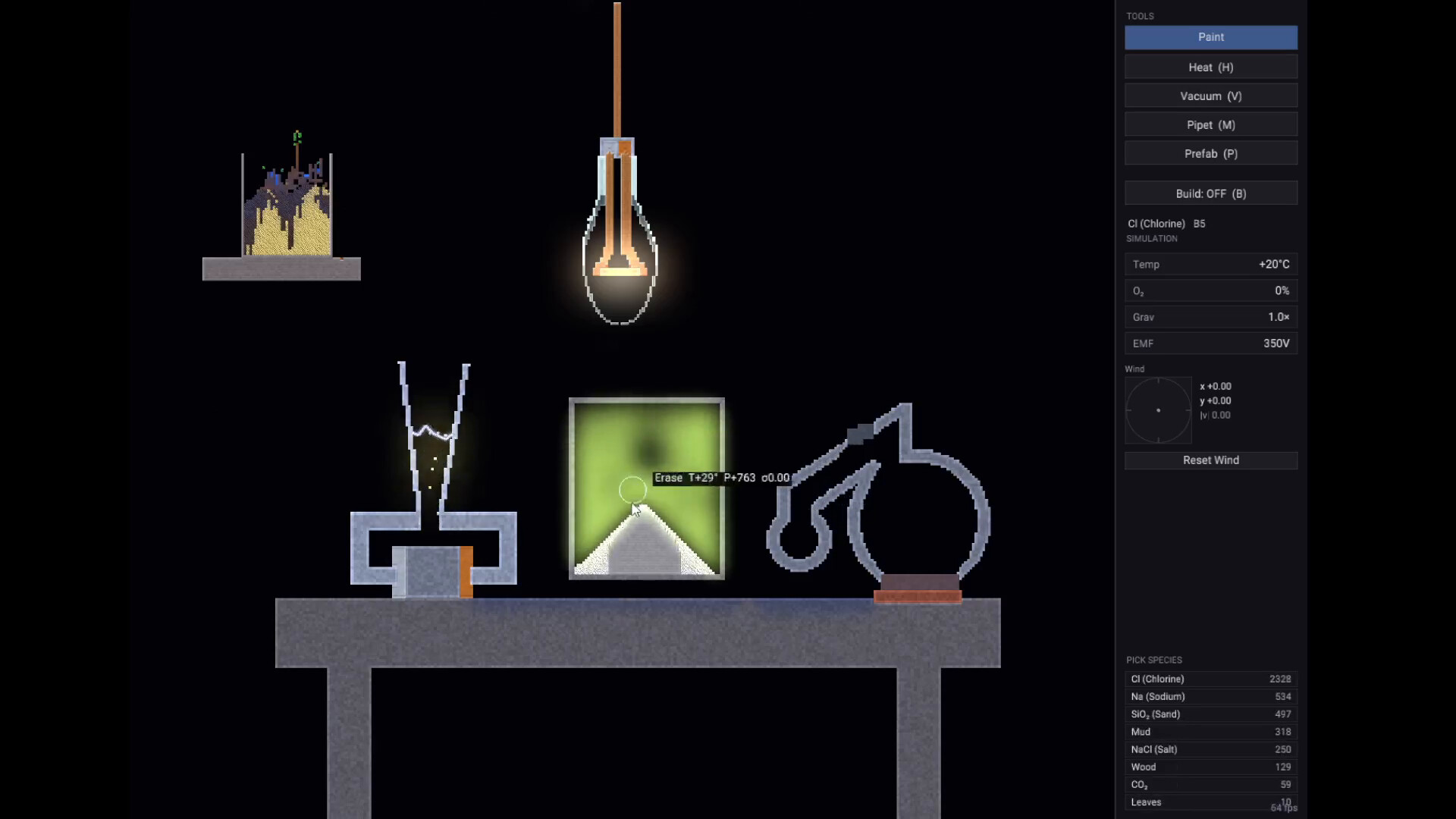
Equipment on the workbench shares the same particle, heat, and pressure simulation as the raw elements themselvesImage: The Bueno Interactive via Steam -
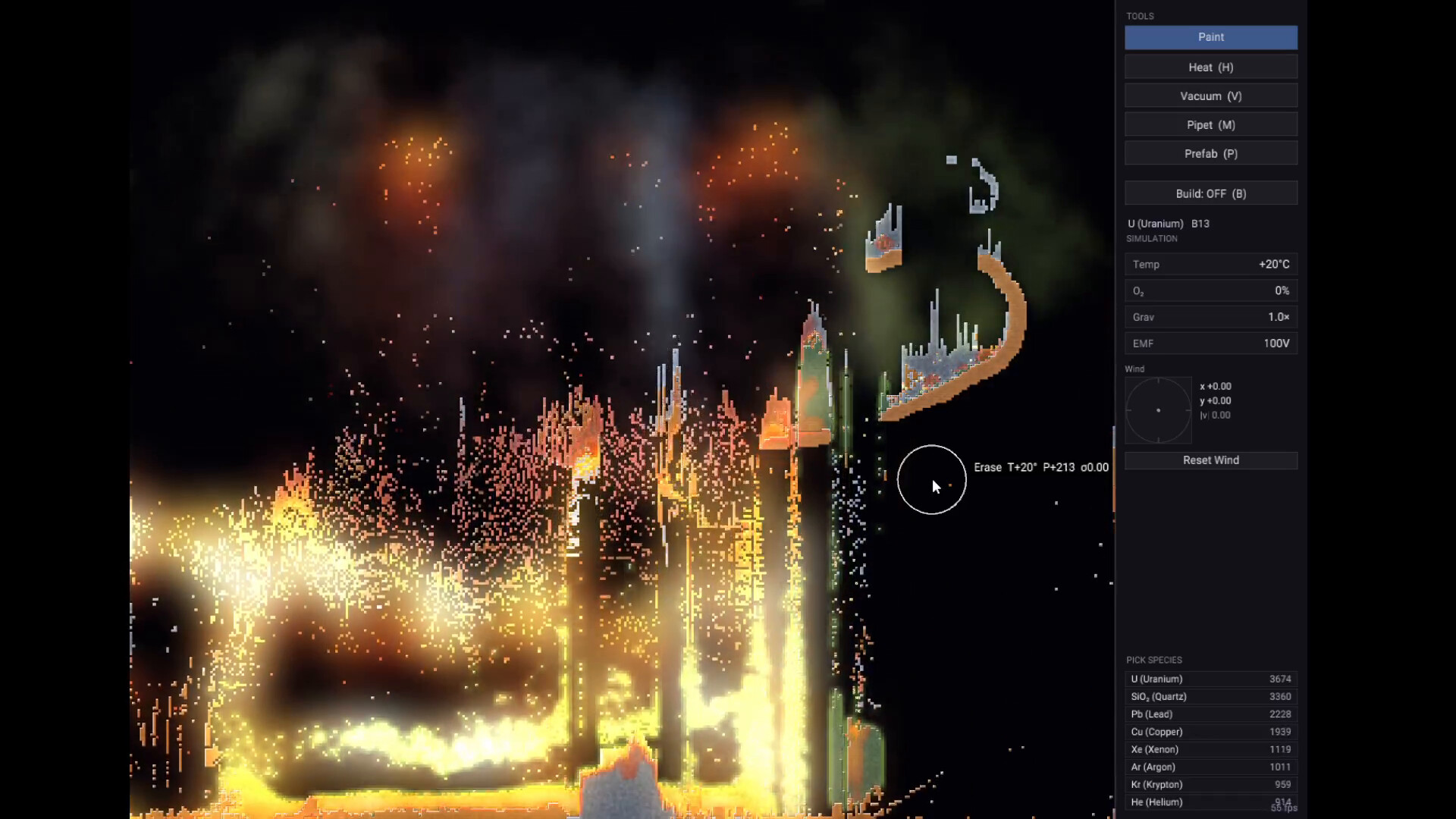
Pushing uranium toward criticality produces exactly the volatile, sparking mess reviewers describe experimenting withImage: The Bueno Interactive via Steam -
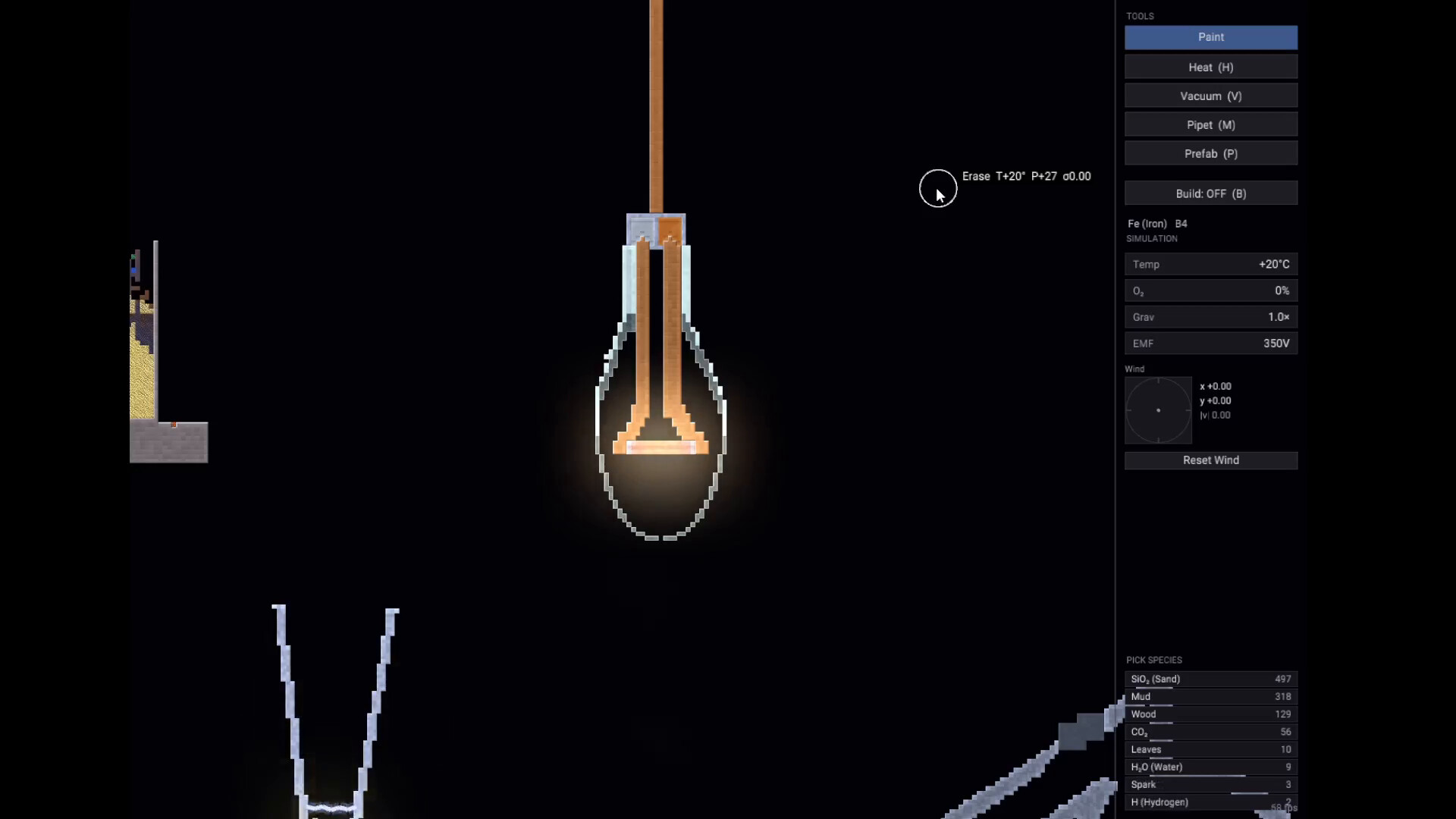
Players can construct working equipment like this lightbulb from raw elements rather than picking it from a menuImage: The Bueno Interactive via Steam -
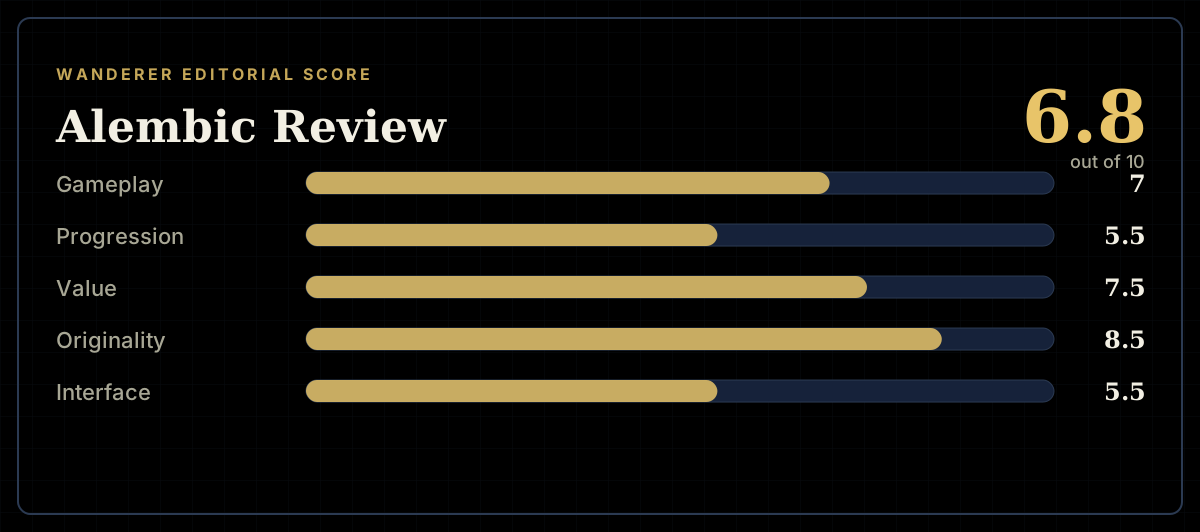
How the review scores each part of the gameWanderer Editorial -
The short versionWanderer Editorial