Game review
Cattopia Review
7 / 10
- Developer
- Timesoft
- Publisher
- Timesoft
- Released
- 4 September 2026
- Platforms
- ["Windows"]
- Genre
- Action
A Grapple-Swing Platformer Built for a Specific, Devoted Audience
Cattopia's entire identity rests on one piece of source material: Umihara Kawase, the cult Japanese fishing-line-grapple platformer series, and reviewers name-drop it constantly, almost as a shorthand for what kind of game this is. One reviewer calls it "a love letter to a set for Umihara Kawase Shun," another names it "worthier Shun successor than Sayonara is by a mile," and a third goes further still, calling it "the best Umihara since Sayonara (and arguably even better)." Players take the fishing-line grapple, swing across sprawling levels, and chain momentum through branching paths toward multiple endings — the exact skeleton of its inspiration, rebuilt with its own level geometry, enemies, and cat-themed cast.
That inspiration comes with an explicit warning built into the review pool itself: this is not a beginner-friendly platformer, and reviewers are upfront about it. One states plainly that the game "expects some familiarity with the Umihara Kawase games so beware this game will pull no punches," while another, writing specifically for newcomers, frames Cattopia as "a good chance" to turn someone into a genre convert precisely because the learning curve rewards patience. The reviewer consensus isn't that the game is inaccessible — it's that it's honest about being hard, and trusts players willing to learn its specific momentum-based movement to find something genuinely rewarding underneath the difficulty.
Mastery-Driven Design That Rewards Deep Investment
Where Cattopia earns its most enthusiastic praise is in how much there is to actually master once the grapple-swing fundamentals click. Reviewers describe a mouse-and-keyboard control scheme as a genuine improvement over classic control conventions from the genre's console roots — one reviewer explicitly warns "do NOT try to play with classic controls," while another highlights being able to aim grapple angles with a mouse as a meaningfully more precise way to interact with the swinging mechanic than a controller allows, particularly on later, faster-paced levels.
Beyond the core swing, reviewers repeatedly cite the game's sheer volume of content: a built-in level editor that supports full custom campaigns with secret routes and multiple endings, a large collectathon layer, extra challenges, RetroAchievements support for players who track achievements outside Steam's own system, and — praised by more than one reviewer as a standout feature — a replay system that lets players watch other players' runs, useful both for competing on best times and for learning routes from better players. One reviewer who put over 1,000 minutes into the game says they've "only scratched the surface" of everything on offer, and a detailed Simplified Chinese review specifically calls out the collection and replay systems as key reasons a genre this demanding stays engaging over a long play session.
Jank and a Punishing Lives System Draw the Sharpest Criticism
Not every reviewer bounces off Cattopia's difficulty cleanly, and the negative reviews in the pool are specific rather than vague. One reviewer who wanted to like the game describes the core movement as inconsistent in ways that feel more like a rough edge than a deliberate design choice, singling out wall climbing, wall jumping, and the grapple ("slingshot") tech itself as unreliable, and noting some in-game achievements are "weirdly cheeseable" while others don't line up cleanly with their RetroAchievements equivalents — evidence, in that reviewer's view, that the underlying physics weren't fully tuned to support the game's own best ideas.
A second negative review targets structural frustration rather than movement feel: Cattopia gates progress behind a limited-lives system, and losing all of them sends players back through the previous ten to twenty levels rather than restarting from where they failed. That reviewer calls the resulting loop "not fun," arguing the difficulty combined with the lives penalty makes the game feel needlessly punishing rather than fairly challenging, and separately notes the production feels "extremely cheap" for what's being asked, pointing out the game appears to be built by one person. The Chinese-language review echoes a smaller, gentler version of the same complaint, describing the grapple's forgiveness window as noticeably stricter than Umihara Kawase's own, requiring more precise timing to catch an edge before sliding off.
A Niche Pick That Knows Exactly What It Is
Cattopia isn't trying to be a mass-market platformer, and its review pool reflects that clearly: this is a game built for people who already love — or are actively looking to fall in love with — a very specific, decades-old style of grapple-swing platforming, and it largely succeeds on those terms. At $7.99, reviewers consistently describe getting an "incredible amount of content" for the price, between the campaign, collectibles, challenges, and level editor, and the presence of a replay system and RetroAchievements integration signals a level of care toward its target community that goes beyond a simple genre homage.
The tradeoff is that the same qualities that make it a standout for genre fans — unforgiving precision platforming, a steep learning curve, and mechanics inherited wholesale from a cult series most players have never touched — are exactly what a general audience is likely to bounce off. The lives-and-checkpoint frustration one reviewer describes, paired with the movement inconsistencies another flags, suggests the game's most punishing moments aren't purely a byproduct of intentional difficulty; some of it reads as unresolved jank that a small, reportedly solo-developed project hasn't fully ironed out yet.
Verdict
Cattopia is a confident, content-rich tribute to Umihara Kawase's grapple-swing platforming, built with real ambition: a big collectathon, a full level editor, replay functionality, and RetroAchievements support wrapped around a movement system that reviewers who click with it call genuinely rewarding and even superior to some entries in its inspiration's own series. It's held back by real, specific rough edges — inconsistent wall-climbing and grapple physics, a punishing lives system that can send players back through a dozen-plus levels on failure, and production values a couple of reviewers call thin for a game this demanding. At Very Positive with an 88% approval rating and a $7.99 price, it's an easy recommendation for players who already love precision grapple platformers or are curious to become one, but players who want their difficulty smoothed by consistent, forgiving mechanics should go in with tempered expectations.
Pros:
- A faithful, well-realized homage to Umihara Kawase's grapple-swing platforming that several genre fans call a worthy or better successor
- A built-in level editor supporting full custom campaigns with secret routes and multiple endings
- Mouse-aimed grapple controls offer more precision than the genre's classic control schemes
- A replay system and RetroAchievements support add real depth for competitive and completionist players
- Strong value at $7.99 given the volume of levels, collectibles, and challenges on offer
Cons:
- Wall climbing, wall jumping, and grapple physics are reported as inconsistent by at least one detailed reviewer
- A limited-lives system can send players back through ten to twenty levels on failure, which one reviewer calls needlessly punishing
- Some in-game achievements are described as inconsistently designed or easily cheesed
- Production values feel thin to at least one reviewer, consistent with a small, reportedly solo-developed project
- The steep learning curve and genre-specific mechanics make it a hard sell outside its target audience
Screenshots
-
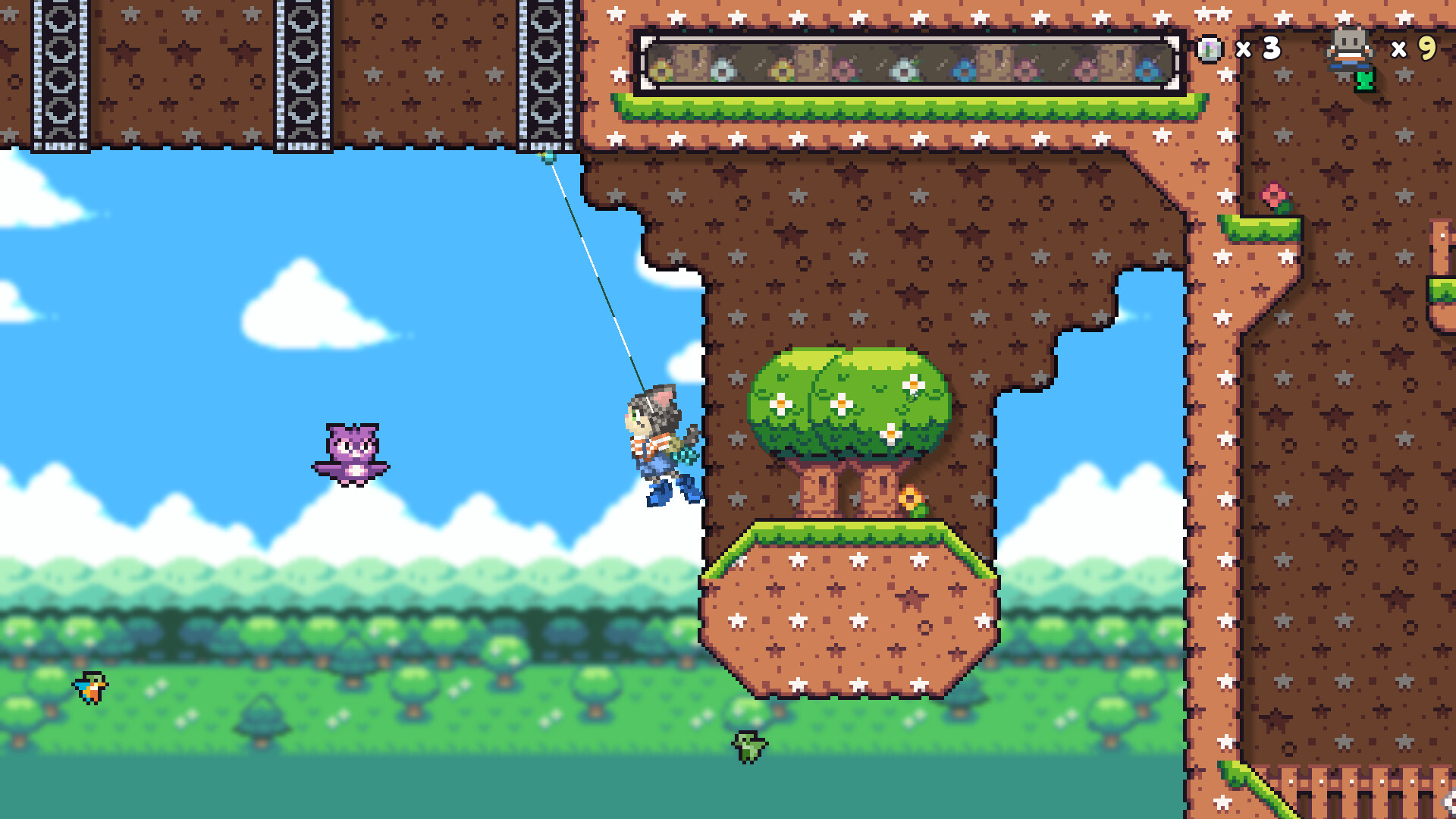
Swinging on the fishing-line grapple past a floating island, with the level's collectible bar tracked along the topImage: Timesoft via Steam -
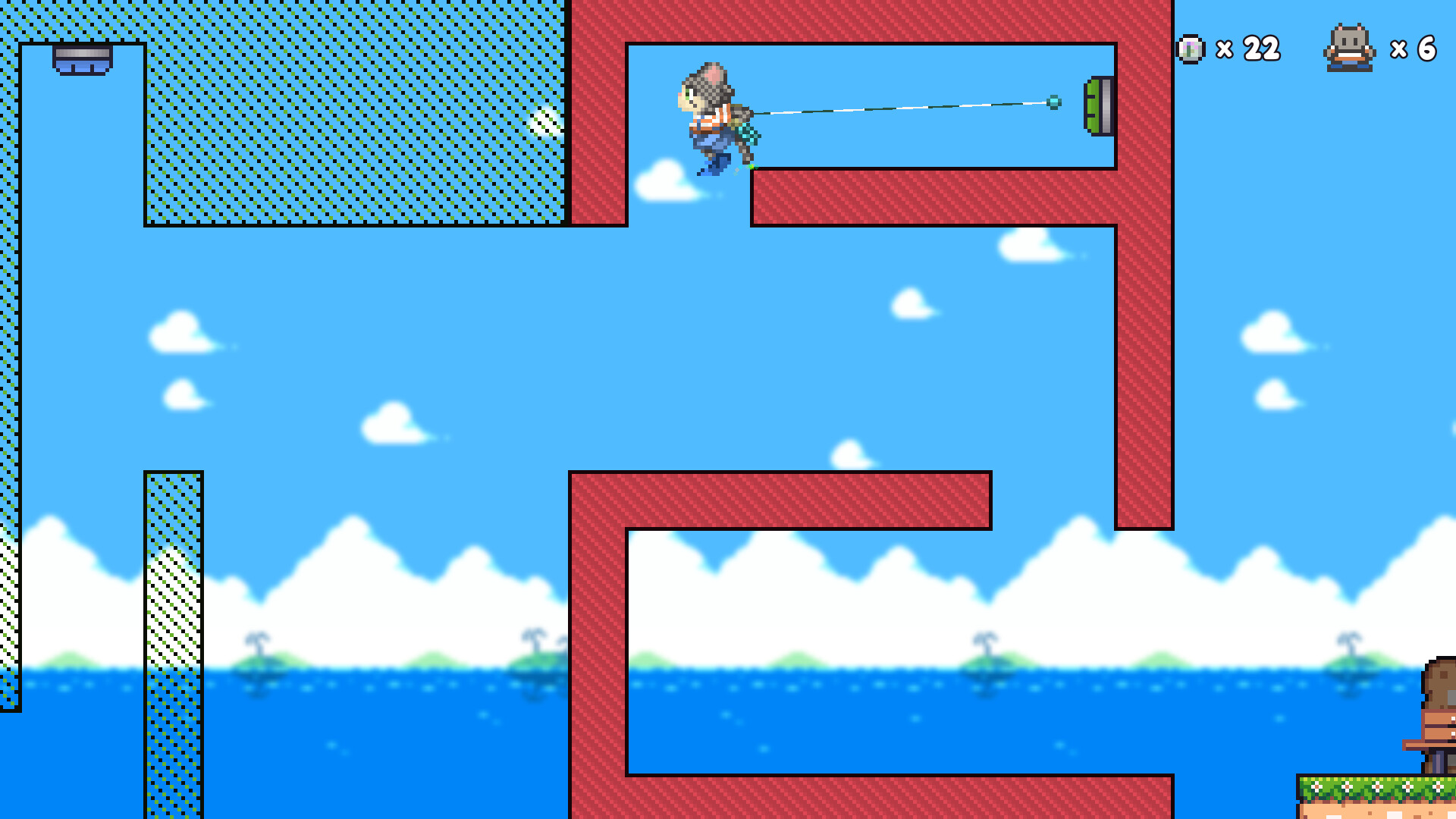
Grapple points let players swing across long gaps over water in the game's outdoor levelsImage: Timesoft via Steam -
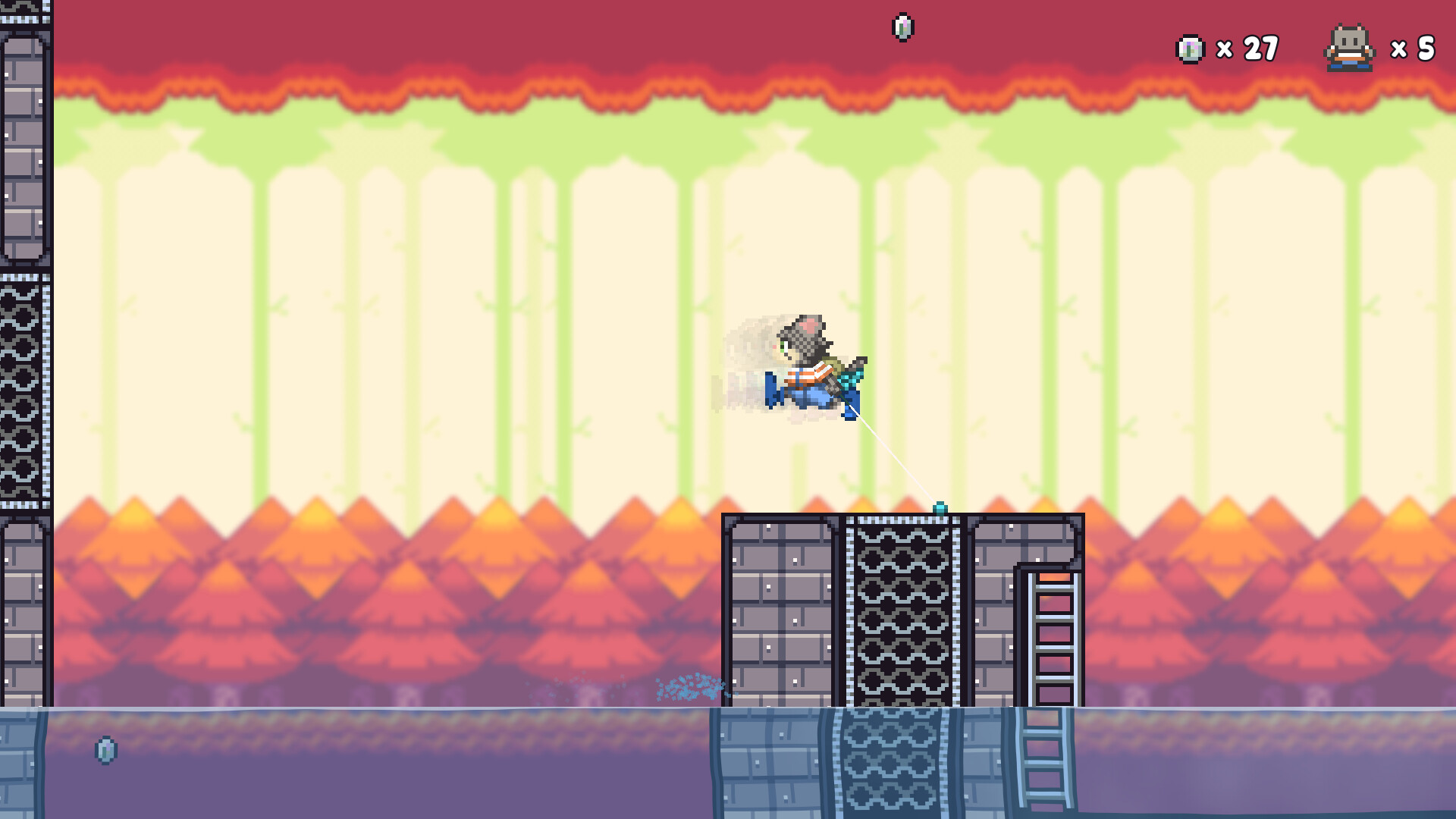
Later levels raise the stakes with lava, spikes, and tighter vertical grapple sequencesImage: Timesoft via Steam