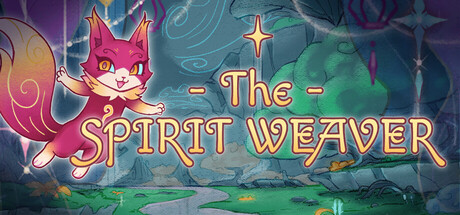
Game review
The Spirit Weaver
6.6 / 10
- Developer
- StarBullet Studio
- Publisher
- GameChanger Studio, CC_Games, Beep Japan Inc.
- Released
- 1 April 2026
- Platforms
- ["Windows"]
- Genre
- Simulation
- Monetisation
- Paid
- Players
- Single-player
The short version
The Spirit Weaver pairs a genuinely fresh idea, tarot readings as a form of grief counselling, with gorgeous hand-drawn art and real emotional depth, but a lack of manual saving and some unintuitive puzzle logic keep it from being the polished gem its premise deserves.
Biggest strengths
- A genuinely fresh premise for the visual novel genre, framing tarot readings as a form of grief counselling for the spirits you meet
- Gorgeous, vibrant hand-drawn art and a distinctive mystical atmosphere across four visually varied spirit realms
- Thoughtfully individualized spirit backstories that explore grief, rage, and self-compassion with real emotional weight
Biggest weaknesses
- No manual saving, forcing reloads from the last auto-save and a full replay of preceding dialogue after any mistake
- Some minigames, particularly the card-opposites pairing and investigation clue system, feel like guessing the developer's intended answer rather than applying coherent tarot logic
- Unlocking all four endings and related achievements demands multiple precise playthroughs, effectively requiring a guide
Who it's for: Visual novel fans drawn to slow, emotionally driven stories and mysticism-adjacent framing, especially anyone curious about tarot symbolism who doesn't mind a game that teaches by feel rather than by the book.
Our recommendation: An easy recommendation at its low price for anyone who likes narrative-first, low-stakes VNs, though achievement hunters and completionists should brace for a frustrating amount of save-scumming.
6.6 / 10
A Tarot Reader in a Realm of Grief
The Spirit Weaver, developed by Indonesia-based StarBullet Studio and published by GameChanger Studio alongside CC_Games and Beep Japan Inc., launched on April 1, 2026 after a Steam Next Fest demo two months earlier. It casts players as Alora, the latest in a line of witches, who is pulled into the Spirit Realm one night to find it under attack from a force called the Entropy, an entity draining other spirits of their energy and erasing their memories of the attack. Guided by three spirit companions, Alora must use tarot readings to help the realm's wounded inhabitants process their grief, anger, and self-doubt while piecing together clues about the Entropy's true identity, all while quietly working through the loss of her own mother.
Reviewers across English and Chinese-language write-ups consistently single out the premise itself as the game's strongest asset: framing tarot not as fortune-telling but as a form of talk therapy for grieving spirits is, by multiple accounts, something genuinely uncommon in the crowded visual novel space, and the four distinct spirit realms, each home to differently themed spirits ranging from animal-like forms to more elemental, humanoid ones, give the writing room to explore a wide range of specific griefs: the guilt of abandoning a companion, the hollow pursuit of substitutes after losing a loved one, and the false belief that compassion is a weakness.
Reading the Cards
Mechanically, each spirit encounter follows a two-stage rhythm. A conversation first reveals the spirit's backstory and the root of their pain, before a tarot reading presents a card, or later a pair of cards, alongside three possible interpretations; picking the one that best resonates with what you've just learned shifts a spirit toward healing, while a poor read can trigger a game over if a run's Reading Score drops too far. A dedicated keywords minigame asks players to match a shown card to its correct meaning under a timer, testing rote memorization of three or four keywords per card, while end-of-chapter investigation puzzles have players sequence cards whose descriptions subtly shift with each attempted order, a clever touch that several reviewers call out as the strongest of the game's puzzle types. A separate card-opposites minigame, pairing cards representing contrasting ideas, fares worse: multiple reviewers describe its correct pairings as unintuitive, feeling more like locating the developer's predetermined answer than applying any consistent tarot logic of their own, a complaint echoed even by an English-language reviewer who bluntly warns that anyone hoping to actually learn tarot from the game will come away disappointed. The final chapter folds every minigame type into a lengthy multi-stage boss encounter, where failing one stage simply shunts the player into a different puzzle type rather than ending the fight outright, at the cost of further Reading Score.
Four Endings, One Missing Save Button
Two tracked stats, a Reading Score for tarot accuracy and an Alignment shaped by narrative dialogue choices ranging from compassionate to self-interested, combine to determine which of four possible endings a playthrough reaches, giving The Spirit Weaver a genuine reason to be played more than once. In practice, though, reviewers describe that replayability as double-edged. The game has no manual save option: players can only continue from an automatically written checkpoint, and several reviews document workaround rituals, exiting to the main menu to note a save's timestamp, or deliberately waiting between saves, just to create a fallback point before a risky choice. Combined with a skip function that can't be limited to only previously read text, and an auto-forward feature that silently disables itself after every choice or scene transition, correcting a single misread tarot card can mean reloading an earlier save and sitting through an entire preceding conversation again. Achievement hunters face the sharpest edge of this: unlocking all four endings requires at least three full playthroughs with carefully balanced stats, several achievements demand a perfect run through every tarot reading, and because some card draws are randomized, reviewers describe relying on a written guide as close to mandatory for full completion.
A Story Worth the Price
Where The Spirit Weaver wins reviewers back is in presentation and value. Its hand-drawn art is repeatedly singled out as some of the best in the genre at this price point, with a warm, storybook-like quality that shifts between muted, cold tones for painful memories and vivid, warm colour as a spirit finds peace. Several Chinese-language reviews note the game's unusually thorough language support, shipping in English, Indonesian, and both Simplified and Traditional Chinese, with one calling out the developer for placing the language selector front and centre rather than burying it in a settings menu. At a modest NZ$5.99 asking price, reviewers consistently describe the amount of story and replay value on offer as a steal, even while acknowledging real shortcomings: the game has no voice acting, its story structure is fundamentally linear beneath the ending-branching stat system, and at least one reviewer describes the overall runtime as extremely short, treating that as a mild blessing given the save-related friction rather than a mark against it.
Verdict
The Spirit Weaver takes a genuinely original angle, tarot readings as grief counselling, and dresses it in some of the most striking hand-drawn art in its price bracket, backed by spirit stories that clearly resonated with reviewers across multiple languages. Its puzzle variety is a mixed bag, with the investigation sequences landing well and the card-opposites minigame feeling arbitrary, and the complete absence of manual saving turns what should be a cozy, low-stakes reading session into an exercise in careful checkpoint management for anyone chasing full completion. Judged purely as a single relaxed playthrough at its asking price, though, it's an easy, inexpensive recommendation for visual novel fans who want something a little more mystical than the genre's usual romance and mystery fare.
Pros and cons
Pros
- A genuinely fresh premise for the visual novel genre, framing tarot readings as a form of grief counselling for the spirits you meet
- Gorgeous, vibrant hand-drawn art and a distinctive mystical atmosphere across four visually varied spirit realms
- Thoughtfully individualized spirit backstories that explore grief, rage, and self-compassion with real emotional weight
Cons
- No manual saving, forcing reloads from the last auto-save and a full replay of preceding dialogue after any mistake
- Some minigames, particularly the card-opposites pairing and investigation clue system, feel like guessing the developer's intended answer rather than applying coherent tarot logic
- Unlocking all four endings and related achievements demands multiple precise playthroughs, effectively requiring a guide
Screenshots
-
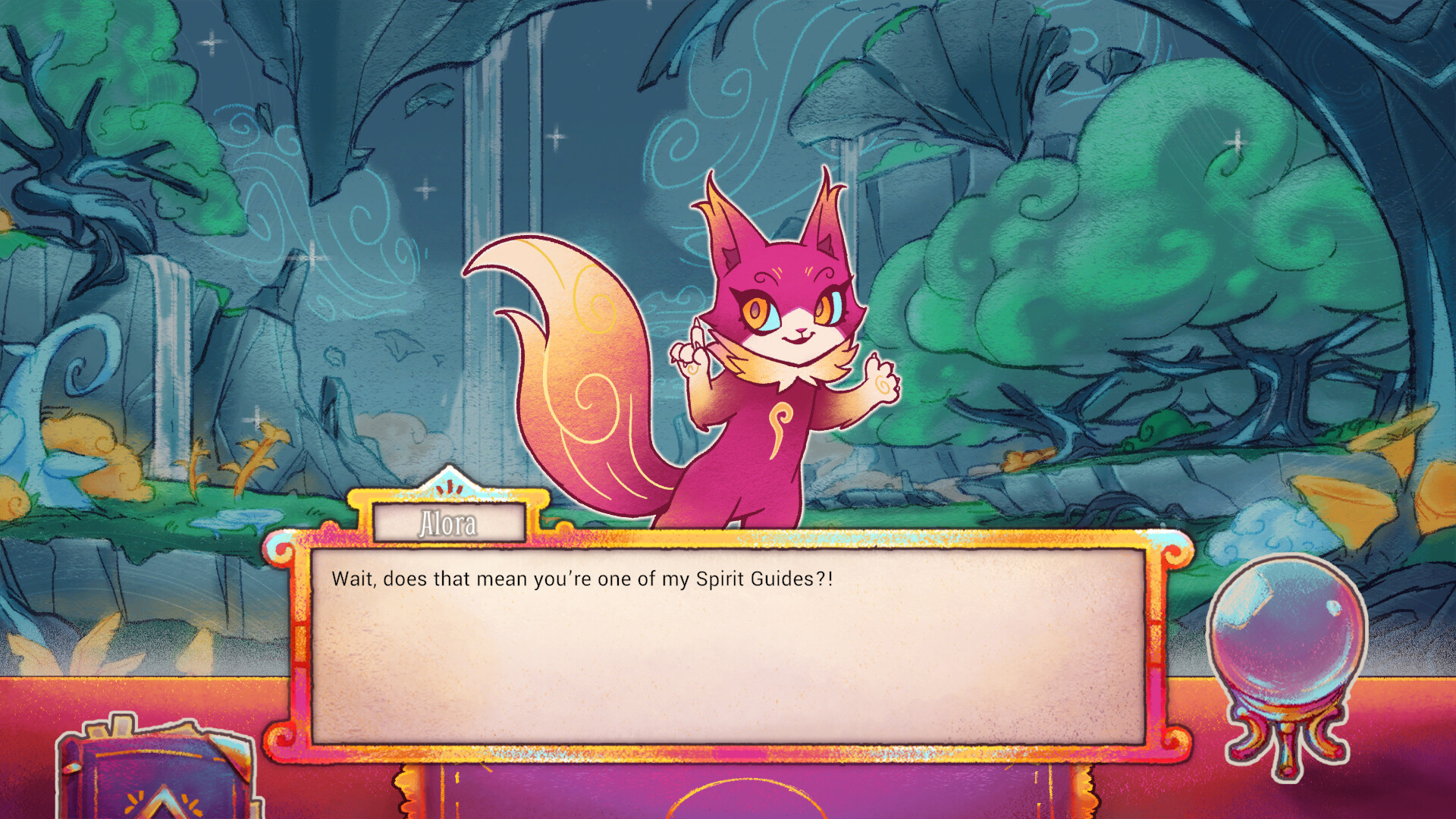
Alora meets her spirit guide Gaby early in the storyStarBullet Studio -
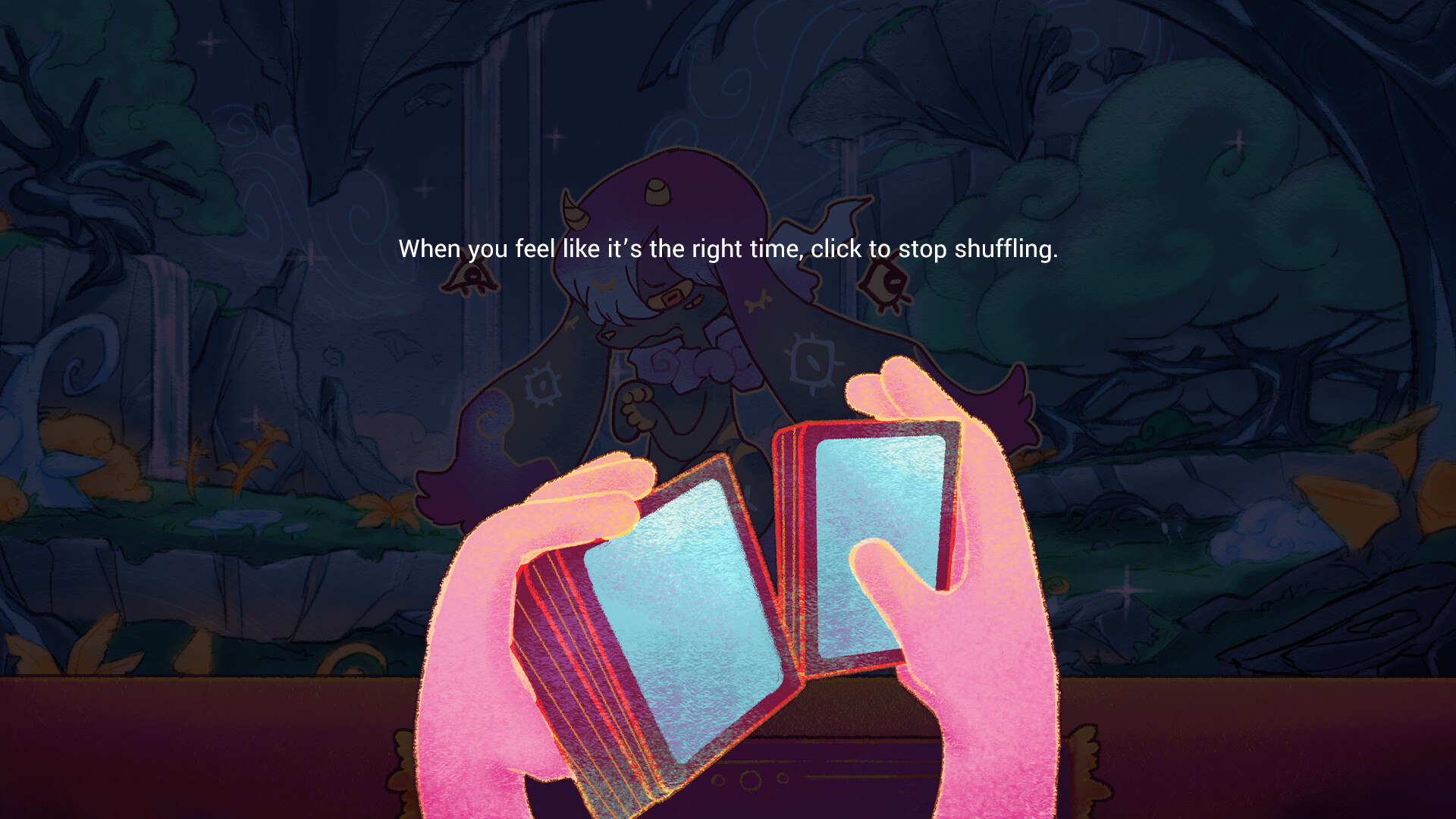
Shuffling the deck before drawing a card for a tarot readingStarBullet Studio -
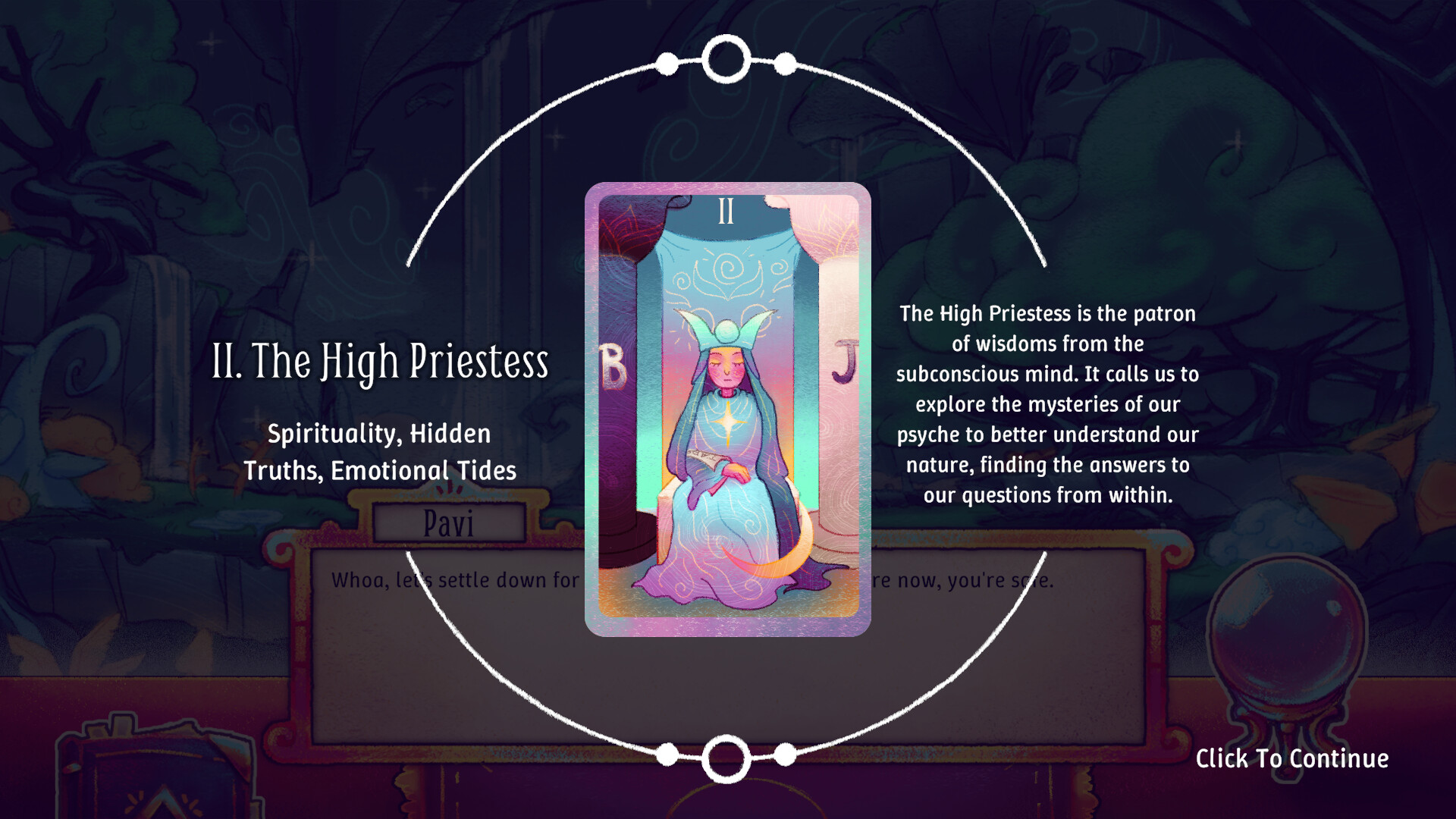
A drawn tarot card shown with its meaning during a reading with the spirit PaviStarBullet Studio -
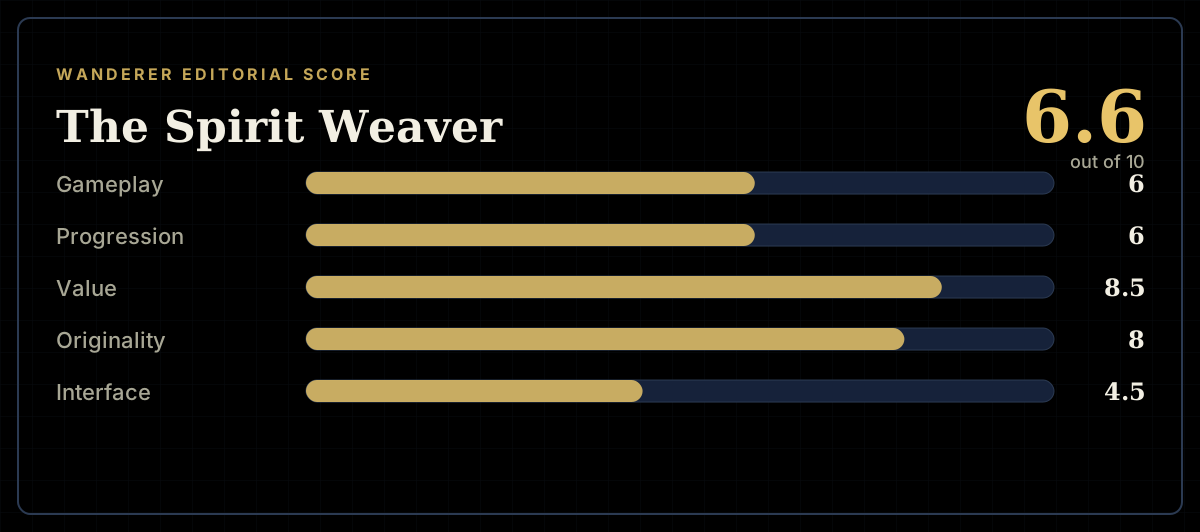
How the review scores each part of the gameWanderer Editorial -
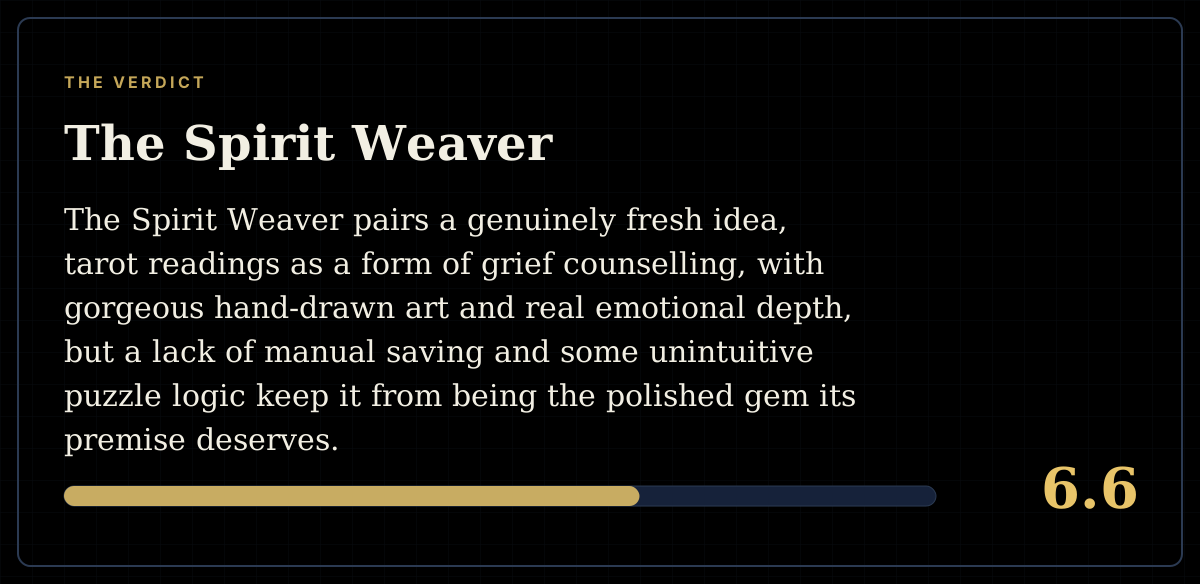
The short versionWanderer Editorial