
Game review
Windowkill
7 / 10
- Developer
- torcado
- Publisher
- torcado
- Released
- 23 February 2024
- Platforms
- Windows
- Genre
- Window-manipulation twin-stick roguelike
- Monetisation
- One-time purchase, no in-game store or additional currency purchases
- Players
- Local co-op supported
The short version
Windowkill's core trick is one this review has genuinely not seen executed anywhere else: the game's actual operating-system window is the play area, and it's constantly, physically closing in on you, forcing you to shoot the edges back open while twin-stick combat unfolds inside a literally shrinking rectangle on your desktop. Reviewers across the entire sample, positive and negative alike, agree the concept is genuinely inventive and well-realised — this isn't a gimmick bolted onto a generic shooter, it's a mechanic the whole game is built around thoughtfully. Where the sample splits is on what happens once that novelty has been fully absorbed: a real, specific, and widely reported cluster of performance issues and outright crashes during longer runs, alongside a smaller enemy and upgrade roster than the concept's creativity might lead you to expect. The solo developer has patched steadily and substantially for over a year, but several of the exact crash reports quoted here were posted well after that patch history began.
Biggest strengths
- The window-shrinking mechanic is repeatedly and specifically praised as genuinely original, with reviewers across the review sample agreeing they haven't seen anything like it, and crediting the game with using real, literal desktop windows rather than a stylised approximation
- Reviewers consistently note the concept works as a genuine gameplay vehicle rather than a shallow gimmick, describing satisfying tension between managing window size, fighting off enemies, and expanding into newly spawned boss windows
- The game supports local co-op and has an active modding scene, including a specifically beloved community mod that adds a cursor-stealing goose, extending the experience well beyond the base package
Biggest weaknesses
- Performance issues and outright crashes during longer or "endless mode" runs are the single most repeated technical complaint, with multiple independent reviewers describing the game slowing to a slideshow or crashing entirely once enough enemies and effects accumulate on screen
- The enemy and upgrade roster is described by several reviewers as smaller than the concept's creativity suggests, with one detailed account counting roughly four boss types and around ten regular enemies total, and upgrades described as too basic to support meaningful build decisions
- The game's difficulty-scaling approach of simply spawning more enemies rather than introducing new mechanics draws specific criticism as the direct cause of the performance problems described above
Who it's for: Fans of twin-stick roguelikes and bullet hells who want something they've genuinely never seen before, and who can tolerate real technical instability during longer, more chaotic runs. Less suited to players seeking deep build variety or a large bestiary to master.
Our recommendation: An easy recommendation at its very low price purely for the novelty and craft of its central idea — this is one of the more genuinely original mechanics in this lane's coverage. Go in aware that crashes during longer runs are a real, documented risk rather than rare bad luck, and that the enemy and upgrade pool is smaller than the concept's inventiveness might suggest.
7 / 10
Windowkill opens with a joke that turns out to be the entire game: something's wrong with the window. Not a window inside the game — the actual application window sitting on your Windows desktop, which starts closing in on itself the moment you begin playing, forcing you to shoot its shrinking edges back open while fending off a twin-stick horde of enemies inside whatever space you've managed to hold onto. It's a genuinely rare thing in a review of this many games: a mechanic this review has not seen attempted anywhere else, executed with enough care that reviewers across the entire sample — including nearly everyone who ultimately doesn't recommend the game — agree the core idea works.
A gimmick that isn't a gimmick
What separates Windowkill from a novelty demo is how thoroughly the review sample confirms the mechanic actually functions as gameplay rather than as a one-time surprise. "This game is INSANE. I thought it was gonna be really gimmicky, and no it's not," one reviewer writes, describing the specific tension of managing window expansion against incoming boss spawns that open entirely new, separate windows on screen. Another puts it succinctly: "this whole windows concept is something I've not seen in any other game and it gets 15/10 in creativity/originality from me in this world with hundreds of thousands of identical games on Steam." Even reviewers who ultimately don't recommend the game go out of their way to credit the concept specifically — "it's incredibly inventive and I kept coming back to it thinking I had to be missing something," one writes, framing their eventual lack of enjoyment as a personal mismatch rather than a flaw in the idea itself.
Where the technical foundation strains under its own concept
The review sample's most consistent and specific complaint concerns performance, and it's directly tied to the game's own difficulty-scaling philosophy. "It quickly succumbs to performance issues and lag, because the way it chooses to scale difficulty is 'spawn more enemies,'" one detailed reviewer writes, and the pattern repeats across many independent accounts of the game slowing to a slideshow or crashing outright during longer "endless mode" runs. This is a real, structural tension: the more successful and prolonged a run becomes, the more the screen fills with enemies and effects, and the more likely the game is to buckle under its own escalating chaos — precisely the moments reviewers describe wanting to enjoy most.
A smaller roster than the concept's ambition suggests
A second, related complaint concerns content depth once the initial novelty settles. "There are only a handful of enemy types (I think 4 boss enemies and 10 or so mobs) and upgrades. The upgrades are so basic that there's no real decision-making," one reviewer writes, and several others separately describe the game growing repetitive once all bosses have been encountered. This is a fair criticism to weigh against the concept's inventiveness — Windowkill clearly spent its design energy on the window mechanic itself, and the more conventional roguelike systems layered around it feel comparatively less developed by comparison.
A developer who has kept building on the idea
To its credit, this review can confirm the developer has maintained a genuinely dense, sustained patch cadence well past launch. The partner-events feed documents a major "v4.0" overhaul in September 2024, adding modding support that has since produced community-made content like a specifically beloved mod adding a cursor-stealing goose, followed by Steam Deck verification around the game's one-year anniversary in February 2025. That's a real, ongoing commitment from a solo developer, though it's worth noting several of the crash reports quoted in this review's negative sample were posted well after this patch history begins, suggesting the core performance issue hasn't been fully resolved despite continued attention.
What the achievement data suggests about depth
Steam's own completion figures back up the sense of a game with a real but modest content ceiling. Early cosmetic-related achievements sit above 50%, but social and multiplayer-tied achievements fall as low as 1.7%, suggesting the local co-op mode in particular sees limited sustained use relative to the solo experience — consistent with reviewer reports of confusion and technical friction around that specific feature.
A quality-of-life gap that's specific to the concept itself
One complaint deserves particular attention because it's unique to this game's premise rather than a generic genre gripe: several reviewers report needing to dig into settings just to alt-tab away or glance at another application normally, something that should arguably be frictionless by default in a game whose entire hook is coexisting with your desktop environment. "You have to change settings to be able to alt tab, or even look at other windows," one reviewer writes, framing it as a basic expectation the game should meet out of the box rather than something requiring manual configuration. For a game this reliant on its relationship with the actual operating system around it, that's a fair and specific piece of friction worth flagging directly, distinct from ordinary performance or content complaints.
Final verdict
Windowkill deserves real credit simply for attempting something this specific and pulling it off: turning your own desktop window into a literal, physical play space is a genuinely rare idea in an oversaturated genre, and the execution backs up the ambition rather than coasting on novelty alone. Real, documented performance problems and a smaller-than-expected enemy roster keep this from being an unqualified triumph, but at its very low price, this is an easy recommendation for anyone curious what a truly original idea in this space looks like — just don't expect the technical foundation to hold up flawlessly once a run gets long and chaotic.
Pros and cons
Pros
- The window-shrinking mechanic is repeatedly and specifically praised as genuinely original, with reviewers across the review sample agreeing they haven't seen anything like it, and crediting the game with using real, literal desktop windows rather than a stylised approximation
- Reviewers consistently note the concept works as a genuine gameplay vehicle rather than a shallow gimmick, describing satisfying tension between managing window size, fighting off enemies, and expanding into newly spawned boss windows
- The game supports local co-op and has an active modding scene, including a specifically beloved community mod that adds a cursor-stealing goose, extending the experience well beyond the base package
- At its very low price, value draws consistent praise, with several reviewers specifically framing the concept alone as worth the asking price regardless of its rough edges
- The developer has sustained a genuinely dense, multi-year update cadence, including a major "v4.0" overhaul, Steam Deck support, and continued balance and stability patches running well over a year past launch
Cons
- Performance issues and outright crashes during longer or "endless mode" runs are the single most repeated technical complaint, with multiple independent reviewers describing the game slowing to a slideshow or crashing entirely once enough enemies and effects accumulate on screen
- The enemy and upgrade roster is described by several reviewers as smaller than the concept's creativity suggests, with one detailed account counting roughly four boss types and around ten regular enemies total, and upgrades described as too basic to support meaningful build decisions
- The game's difficulty-scaling approach of simply spawning more enemies rather than introducing new mechanics draws specific criticism as the direct cause of the performance problems described above
- Multiple reviewers report needing to manually change settings just to alt-tab or view other windows normally, a basic quality-of-life expectation for a game built entirely around window manipulation that several feel should have been the default behaviour
- At least one reviewer reports controller recognition issues and confusion around local co-op requiring separate input methods, a specific and reproducible complaint about the local multiplayer implementation
Screenshots
-

WindowkillImage: torcado via Steam -

WindowkillImage: torcado via Steam -

WindowkillImage: torcado via Steam -
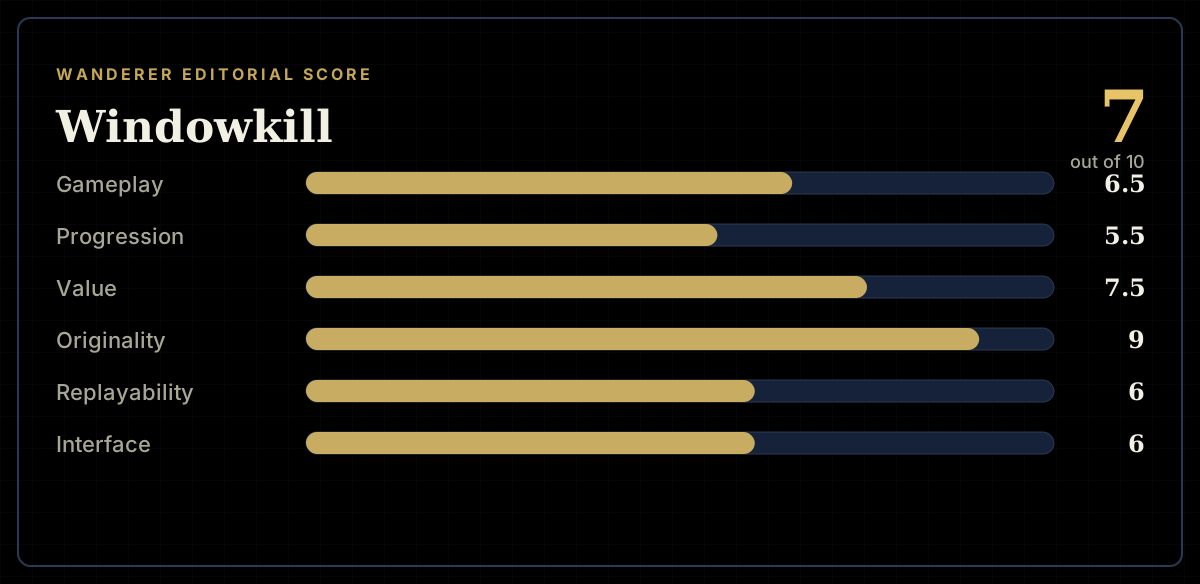
How the review scores each part of the gameWanderer Editorial -
The short versionWanderer Editorial