
Game review
Wilmot's Warehouse
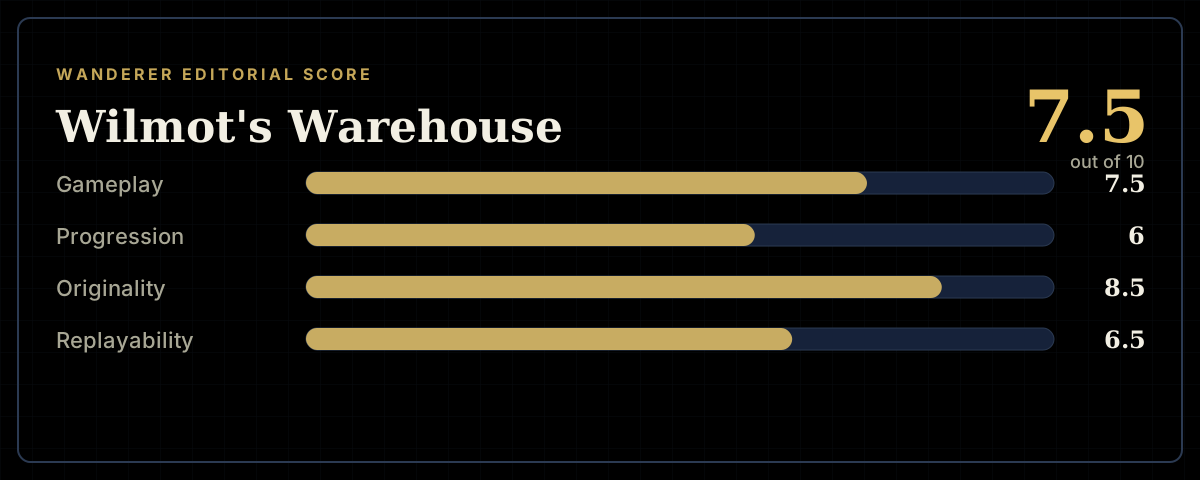
7.5 / 10
- Developer
- Hollow Ponds, Richard Hogg
- Publisher
- Finji
- Released
- 29 August 2019
- Platforms
- Windows
- Genre
- Puzzle
- Monetisation
- Paid, no in-app purchases found
- Players
- false
The short version
Wilmot's Warehouse hands players a small smiley-faced square, an ever-growing stream of wordless icon-based products, and total freedom to arrange a warehouse however makes sense to them personally — then tests that system under real time pressure as orders come in faster than memory can keep up. Its 95.8% positive rating is not exaggerated: this is a small, focused idea executed with rare craft, and its review corpus reads less like typical game criticism and more like a collection of people describing a private, satisfying relationship with their own sense of order.
Biggest strengths
- A genuinely rare, well-executed core idea: arranging over 500 wordless icons into a spatial system that only makes sense to the player who built it, with no "correct" answer imposed by the game
- Real, escalating challenge as new item categories complicate existing organizational logic, forcing players to adapt or rebuild their system over time
- An unusually strong, specific resonance with players who describe themselves as natural organizers, including multiple accounts from autistic reviewers calling it uniquely satisfying compared to other games
Biggest weaknesses
- A detailed, specific critique argues the game has no real penalty for disorganization or ignoring deliveries entirely, meaning the entire point of the game (tidy, efficient sorting) is technically optional rather than required to progress
- Multiple reviewers report the ending arrives abruptly and disappointingly, with no endless mode or way to keep playing once the story concludes, cutting off exactly the kind of open-ended play the core loop is best at
- The core loop's appeal is narrow and specific by design — reviewers are candid that this is "not for everyone," and players without a personal interest in categorization or organization are unlikely to find the same satisfaction
Who it's for: Anyone who enjoys organizing, categorizing, or building personal systems for their own sake — reviewers repeatedly note it resonates especially strongly with autistic players and self-described obsessive organizers.
Our recommendation: An easy recommendation for the specific, personal kind of satisfaction it offers — just don't expect stakes, an endless mode, or a long final act.
7.5 / 10
What it is
Wilmot's Warehouse puts players in charge of a cheerful, faceless-except-for-a-smile square named Wilmot, running a warehouse that receives shipments of wordless icon-based products — volcanoes, sailboats, dinosaurs, tomatoes, and eventually hundreds more — and must fill outgoing orders for those same items on request. The entire game is built around one simple, open-ended task: deciding where in the warehouse each new item type goes, and remembering that decision well enough to retrieve it quickly once an order comes in. One reviewer places it neatly "somewhere between Papers, Please and keeping your desk tidy" — a game about the quiet, personal satisfaction of building and maintaining your own system, then watching that system get stress-tested as the shop floor grows more crowded and complex.
It released on 29 August 2019 at NZD 21.99, developed by Hollow Ponds and Richard Hogg, and published by Finji. Its review corpus, while modest at 427 English-language reviews, sits at one of the most lopsided ratios this lane has documented — 409 positive to just 18 negative, a 95.8% approval rate — and reading through it reveals why: this is a small, tightly-focused idea executed with genuine craft, and it seems to land almost exactly as intended for the audience it's built for.
A deeply personal kind of satisfaction
What distinguishes this corpus from most positive reviews elsewhere isn't just enthusiasm, it's the specificity and personal register of the praise. "Do the volcanoes go next to the mountains, because nature? Or sailboats, because islands? Or dinosaurs, because reasons?" asks one reviewer, capturing precisely the kind of idiosyncratic, self-justified logic the game invites and rewards — there's no correct taxonomy, only the one that makes sense to you and that you can remember under pressure. Another calls it "an obsessive organizer wet dream," comparing the escalating challenge directly to "running an amazon warehouse by yourself." Several reviewers describe genuinely rethinking how they approach categorization and memory as a result of playing, with one going as far as saying "this game broke my brain. This game fixed my brain," crediting it with encouraging "deeper understandings of how I interact with sorting and conceptualization... all through mechanics" rather than through any explicit lesson.
Notably, multiple reviewers specifically identify as autistic and describe the game's appeal in terms distinct from general puzzle-game enjoyment: one writes simply, "I feel like I've been given catnip and have never had so much fun playing a video game in a long time." That's a specific, repeated enough pattern across independent reviews to be worth naming directly rather than treating as incidental — this game appears to resonate especially strongly with players who have a particular relationship with categorization and order, on top of its broader appeal to self-described organizers generally.
Where it falls short
Despite the overwhelming praise, two specific complaints recur with enough detail to take seriously. The first concerns stakes: one of the most-upvoted critical reviews argues plainly that "it makes no difference whether you try hard or do nothing at all," since "there is no penalty for not delivering" and no consequence for "letting incoming products pile up to the roof." For a game whose entire premise is the tension between an orderly system and mounting pressure, the absence of any real cost for abandoning that order is a meaningful design gap — the reviewer notes it's technically possible to complete the game without ever organizing anything at all, which undercuts the central conceit for anyone hoping the sorting itself would be enforced rather than optional.
The second concerns length and structure: multiple reviewers report real disappointment that the game simply ends, with no endless mode or ongoing play option once its story concludes. "Lots of missed potential with no endless mode or any way to keep playing," writes one, calling the abrupt finish a letdown specifically because the core loop is strong enough that players want more of it on their own terms, not because the existing content feels thin.
What the achievement data confirms
The completion curve across Wilmot's Warehouse's 32 achievements supports the idea that the game delivers a real, gradually escalating challenge rather than a flat, unchanging loop. Early milestones tied to story progression (a series of in-game posters) descend smoothly from 72.2% down to 24.6%, while specific item-category "tag" achievements — tied to fully identifying and organizing particular product types — sit much lower, mostly in the 1.7% to 2.9% range. That gap indicates a real depth-versus-breadth structure: most players experience the core story and organizational challenge meaningfully, while a much smaller, more dedicated group pushes into the kind of exhaustive, category-by-category mastery the harshest organizers among its fanbase clearly crave.
Value against a niche but devoted audience
At NZD 21.99, Wilmot's Warehouse asks a fair price for what several reviewers describe as dozens of hours of genuine engagement, though it's worth being upfront that the ceiling on that engagement depends heavily on how much a given player's own brain enjoys the specific act of sorting. This isn't a game with branching narrative content or mechanical variety in the traditional sense to justify a long playtime on those terms — its replay value comes entirely from the player's own evolving relationship with their organizational system, which is either endlessly satisfying or quickly exhausted depending on temperament. The 95.8% approval rating suggests the former is far more common among people who actually buy it than the latter, which tracks with a game whose store page and marketing make its specific, narrow appeal clear well before purchase — this isn't a case of buyers feeling misled about what they were getting, which likely explains why so few of the reviews that exist are negative at all.
Verdict
Wilmot's Warehouse is a small, focused idea — build your own system, then defend it against increasing complexity — executed with a rare, specific kind of craft that resonates unusually deeply with players who share its underlying obsession with order and categorization. A lack of real consequences for disorganization and an abrupt, mode-free ending are genuine, worth-knowing shortcomings, but neither undercuts what the vast majority of this game's own audience clearly found: a satisfying, personal, meditative experience unlike almost anything else in its genre.
Pros and cons
Pros
- A genuinely rare, well-executed core idea: arranging over 500 wordless icons into a spatial system that only makes sense to the player who built it, with no "correct" answer imposed by the game
- Real, escalating challenge as new item categories complicate existing organizational logic, forcing players to adapt or rebuild their system over time
- An unusually strong, specific resonance with players who describe themselves as natural organizers, including multiple accounts from autistic reviewers calling it uniquely satisfying compared to other games
- Genuine, gradual difficulty progression confirmed by a smooth achievement-completion curve, rewarding both casual play and much deeper systematic mastery
Cons
- A detailed, specific critique argues the game has no real penalty for disorganization or ignoring deliveries entirely, meaning the entire point of the game (tidy, efficient sorting) is technically optional rather than required to progress
- Multiple reviewers report the ending arrives abruptly and disappointingly, with no endless mode or way to keep playing once the story concludes, cutting off exactly the kind of open-ended play the core loop is best at
- The core loop's appeal is narrow and specific by design — reviewers are candid that this is "not for everyone," and players without a personal interest in categorization or organization are unlikely to find the same satisfaction
Screenshots
-

Wilmot's WarehouseImage: Finji via Steam -

Wilmot's WarehouseImage: Finji via Steam -

Wilmot's WarehouseImage: Finji via Steam -
How the review scores each part of the gameWanderer Editorial -
The short versionWanderer Editorial