
Game review
Train Valley World
5.5 / 10
- Developer
- Flazm
- Publisher
- tinyBuild
- Released
- 9 August 2024
- Platforms
- Windows
- Genre
- Railway tycoon and logistics management game
- Monetisation
- One-time purchase, no in-game store or additional currency purchases
- Players
- Online multiplayer and level editor with Workshop support
The short version
Train Valley World takes the beloved Train Valley puzzle-and-time-management formula and reworks it into something closer to Railroad Tycoon or Sid Meier's Railroads: route planning, scheduling, and economic management across a global map, rather than the series' original bite-sized level-clearing puzzles. Reviewers are unusually direct that this is close to a different game wearing a familiar name, and the split in this review's sample runs almost entirely along that line — longtime fans expecting more Train Valley 2 feeling genuinely misled by the shift, and players who approach it fresh as a tycoon game finding real, if imperfect, satisfaction in the new format. Compounding that identity mismatch, the developer added a signal system in direct response to fan requests roughly five weeks after launch, and a significant share of reviewers describe that exact system as buggy and poorly explained, turning a feature meant to please critics into a fresh source of frustration.
Biggest strengths
- The pivot toward genuine Railroad Tycoon-style route and schedule management is praised by reviewers who approach the game on its own terms, several specifically preferring the new economic depth over the original series' puzzle format
- The level editor and Steam Workshop integration, added roughly ten weeks after launch, give the game a genuinely active community content pipeline, backed by a dedicated level-design contest the developer ran to encourage participation
- At least one reviewer with over 29,000 minutes logged describes the game as thoroughly enjoyable across a very long campaign, specifically pushing back on negative reviews driven purely by the game not being "Train Valley 3"
Biggest weaknesses
- The single most repeated complaint concerns a fundamental genre mismatch with reviewer expectations, with numerous longtime series fans independently describing the shift away from puzzle-style level design toward tycoon-style management as feeling like a different game entirely rather than a true sequel
- The signal system added specifically in response to fan requests is itself now a major source of complaints, with reviewers describing trains ignoring signals, crashing unpredictably, or failing to reroute correctly even after the feature's introduction
- Multiple reviewers report specific, reproducible bugs including trains spawning out of bounds, stations failing to recognise valid platforms beyond the first, and mission objectives failing to register correctly even after completion requirements are met
Who it's for: Fans of Railroad Tycoon-style economic and logistics management games who don't mind a slower, more abstract pace than the original Train Valley puzzles offered. A poor fit for players specifically hoping for more of the bite-sized, time-pressured level design that made Train Valley 1 and 2 beloved.
Our recommendation: Worth trying if you go in understanding this is a genuine tycoon game rather than a Train Valley sequel in the traditional sense. Longtime series fans should research the format change carefully before buying, since a large share of the disappointment in this review's sample stems directly from that mismatched expectation.
5.5 / 10
Train Valley World carries a name with real weight behind it — the original Train Valley and its sequel built a genuine, devoted following on the strength of bite-sized, time-pressured puzzle levels where a single misrouted train meant watching two locomotives collide. This third entry abandons that specific format almost entirely, replacing it with something closer to a genuine Railroad Tycoon-style economic simulation: route planning, scheduling, and global logistics management rather than tightly designed individual puzzles. This review's sample is unusually clear-eyed about exactly what happened, and the resulting split is one of the cleanest examples of mismatched-expectation friction this lane has documented.
A genuine identity shift, acknowledged directly by both sides
Reviewers on both sides of the recommendation line describe the change in almost identical terms. "This is not Train Valley 3. It's not similar at all, apart from having trains in it. This is much more of a tycoon style game than the previous iterations in this series," one positive reviewer writes, going on to recommend it anyway to fans of the tycoon genre specifically. A critical reviewer reaches the same factual conclusion from the opposite emotional direction: "Train Valley 1 and 2 were puzzle games; Train Valley World is more like a simple Railroad Tycoon game, with some puzzle features... because it leans into the business aspects of a train game so much, it's difficult not to notice its deficiencies compared to more robust Railroad Tycoon-style titles." Both reviewers are describing the same objective reality; they simply disagree about whether that reality is a welcome evolution or a disappointing bait-and-switch.
Fans who feel misled, in detail
The disappointment from longtime series fans is specific rather than vague. "Train Valley hasn't had signaling in the past, instead the trains would wreck... There aren't any stakes. Train Valley 1 and 2 were stressful experiences," one reviewer writes, describing how removing collision risk in favour of an economic layer removed the exact tension that made the earlier games memorable. Another, having genuinely awaited the release, writes: "Having really enjoyed the previous versions I eagerly awaited this release... fundamentally this is a different game and I feel it has strayed too far away from what made TV different." That's a fair, earned disappointment from people with real history with the franchise, not an unreasonable reaction to a game simply being different.
A feature added to please critics that became its own complaint
What makes this review particularly worth documenting is a specific irony this review can confirm directly: the developer added a Signal Mode roughly five weeks after launch, explicitly responding to fan requests for the collision-risk mechanic longtime players were missing. That update should have addressed exactly the "no stakes" complaint above. Instead, a significant share of reviewers describe the resulting system as genuinely broken. "Until they implement 'chain signals', this game is broken. I have yet to finish a level that involves signals because trains are stupid and always block each other and end up crashing," one reviewer writes, and another separately reports trains ignoring signals outright or failing to reroute correctly even after tracks are laid in front of them. The developer listened to the right complaint and, according to a real share of its audience, didn't yet execute the fix well.
Real, specific bugs beyond the signal system
Independent of the signals controversy, reviewers report concrete technical problems: trains spawning out of bounds and rendering entire missions unwinnable, stations failing to recognise any platform beyond the first despite the game explicitly allowing multiple platforms per station, and mission-completion tracking failing to register correctly even when stated objectives are met. These are the kinds of specific, reproducible failures that go beyond a genre mismatch and point at real, unresolved quality issues at launch.
A genuinely enthusiastic minority, taken on its own terms
It would be unfair to this review's sample to treat the disappointed majority as the whole story. "Surprised at the mixed reviews. This is by far the best in the series so far. The new switches update makes this one of my favorite train games," one reviewer writes, and another, with over 29,000 minutes logged, states plainly: "It is a shame that so many people have given this a negative review simply because it isn't Train Valley 3." These aren't naive first-time players — they're reviewers making a deliberate case that judging Train Valley World against its predecessors' format, rather than on its own tycoon-genre terms, is the wrong lens entirely.
A franchise that kept moving forward
This review can confirm the broader Train Valley franchise has remained active well past this specific release: a Japanese Trails expansion for Train Valley 2 and an entirely new prequel title, Train Valley Origins, both arrived in 2025, alongside continued workshop and level-editor support for this game specifically. Whatever this particular entry's reception, the series itself shows no sign of the developer walking away from it.
Final verdict
Train Valley World is a genuine, ambitious reinvention of a beloved formula that succeeds on its own terms as a tycoon-style logistics game for players willing to meet it there, and disappoints a real, vocal share of longtime series fans who expected more of the puzzle-driven format that built the franchise's reputation in the first place. A signal system added specifically to address that disappointment introduces its own, well-documented bugs rather than fully resolving the underlying complaint. Worth trying if the tycoon-genre pivot appeals to you directly; research the format change carefully first if you're coming to this expecting Train Valley 2's specific magic.
Pros and cons
Pros
- The pivot toward genuine Railroad Tycoon-style route and schedule management is praised by reviewers who approach the game on its own terms, several specifically preferring the new economic depth over the original series' puzzle format
- The level editor and Steam Workshop integration, added roughly ten weeks after launch, give the game a genuinely active community content pipeline, backed by a dedicated level-design contest the developer ran to encourage participation
- At least one reviewer with over 29,000 minutes logged describes the game as thoroughly enjoyable across a very long campaign, specifically pushing back on negative reviews driven purely by the game not being "Train Valley 3"
- The developer directly responded to fan feedback requesting a signal system, adding it as a dedicated update roughly five weeks after launch rather than ignoring the request
- The broader franchise has continued receiving support since this release, including a Japanese Trails expansion for Train Valley 2 and a new prequel title, Train Valley Origins, both released in 2025
Cons
- The single most repeated complaint concerns a fundamental genre mismatch with reviewer expectations, with numerous longtime series fans independently describing the shift away from puzzle-style level design toward tycoon-style management as feeling like a different game entirely rather than a true sequel
- The signal system added specifically in response to fan requests is itself now a major source of complaints, with reviewers describing trains ignoring signals, crashing unpredictably, or failing to reroute correctly even after the feature's introduction
- Multiple reviewers report specific, reproducible bugs including trains spawning out of bounds, stations failing to recognise valid platforms beyond the first, and mission objectives failing to register correctly even after completion requirements are met
- Several reviewers describe the game as feeling rushed and incomplete at launch, with specific missing details and quality-of-life features compared to the polish of Train Valley 2
- At least one reviewer reports poor co-op multiplayer stability alongside general bugginess, a specific concern given multiplayer is one of the game's headline new features relative to its predecessors
Screenshots
-

Train Valley WorldImage: tinyBuild via Steam -

Train Valley WorldImage: tinyBuild via Steam -

Train Valley WorldImage: tinyBuild via Steam -
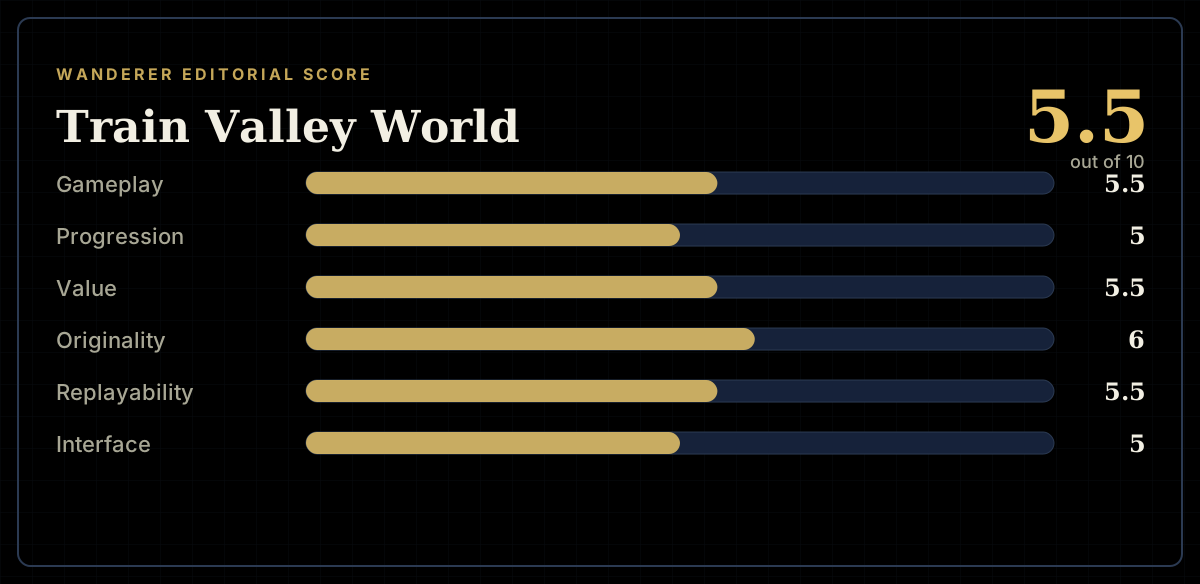
How the review scores each part of the gameWanderer Editorial -
The short versionWanderer Editorial