
Game review
Orebound
5.5 / 10
- Developer
- Emberforge
- Publisher
- Emberforge
- Released
- 24 October 2024
- Platforms
- Windows
- Genre
- First-person voxel mining and factory-automation survival game
- Monetisation
- One-time purchase, no in-game store or additional currency purchases
- Players
- Single-player and online co-op
The short version
Orebound sends you underground as a treasure-hunting dwarf, mixing first-person voxel mining with factory-style automation in a procedurally generated world, and the core hook — dig deep, find ore, automate your way to a bigger operation — clearly works well enough that reviewers routinely put in dozens or hundreds of hours despite marking the game "not recommended." That contradiction runs through the entire review sample: genuine praise for the concept and the satisfying core loop sits right next to detailed, specific complaints about building pieces that won't snap together properly, factory splitters that reset themselves after a reload, and an inventory system reviewers describe as riddled with bugs. The developer has kept the game in active, visible development for nearly two years, including a genuine multiplayer update and several major content waves, which makes this a legitimately evolving Early Access project rather than an abandoned cash-grab — but reviewers who bought in expecting Satisfactory-level polish are, on the whole, still waiting for it.
Biggest strengths
- The core dig-craft-automate loop is repeatedly praised as genuinely satisfying, with reviewers specifically highlighting the ore-locator tool and the escalation from manual mining to full automated factories
- The developer has sustained an unusually dense and visible Early Access update cadence, with over 60 documented posts across nearly two years including major "Anvil Update" content waves, a genuine multiplayer update added in June 2025, and patches as recent as the first week of September 2026
- A full online co-op multiplayer mode was added roughly eight months after launch, directly answering one of the most common early requests in the review sample
Biggest weaknesses
- The single most repeated and specific complaint concerns building and snapping mechanics, with multiple reviewers independently describing foundations and conveyor pieces that fail to lock together cleanly, leaving unfixable gaps in factory lines
- A specific, repeated bug report describes factory splitters resetting to incorrect configurations after logging back in, forcing players to rebuild working setups from scratch
- The inventory system draws detailed, independent bug reports, including quests completing without awarding rewards and item quantities displaying incorrectly or vanishing outright
Who it's for: Automation-genre fans who enjoy watching an Early Access project mature and don't mind rough edges, building bugs, and workarounds in exchange for getting in early on a genuinely promising concept. Less suited to players who want a finished, frictionless factory-building experience right now.
Our recommendation: Worth considering at a discount if you're specifically drawn to the dwarven-automation concept and are comfortable with ongoing Early Access rough edges. Wait for further updates if reliable base-building and a stable inventory system matter more to you than getting in early.
5.5 / 10
Orebound's premise sits at a comfortable intersection of two genres that already have devoted followings: the first-person digging and exploration of a voxel sandbox, and the escalating belts-and-splitters satisfaction of a factory-automation game, filtered through a dwarven fantasy of tunnelling toward a legendary Emberstone. It's a good pitch, and the review sample largely agrees the underlying idea works — reviewers repeatedly describe genuine enjoyment digging down, finding richer ore the deeper they go, and gradually automating what started as manual pickaxe work. What that same review sample spends just as much time describing, in specific and often frustrated detail, is a building and inventory system that still gets in its own way nearly two years into Early Access.
A loop that earns real trust, even from its critics
What's notable about Orebound's negative reviews specifically is how many of them aren't dismissive. "I really want to enjoy this game," one reviewer writes, going on to detail inventory bugs at length rather than walking away — a pattern repeated across the sample, where reviewers who mark the game "not recommended" still describe wanting to come back once specific issues are fixed. One long-session reviewer frames the core loop directly: "build, automate, upgrade, repeat... dig deep and mine the ores for profit," calling it "satisfying as heck" even while cataloguing the game's rough edges elsewhere in the same review. Another, comparing it favourably to genre giants, describes it as what happens "if Minecraft and Deep Rock Galactic had a love child" — high praise for a game still openly labelled Early Access.
The building problem, in specific detail
The most repeated, most detailed complaint in the sample concerns the actual physical act of building. "Blocks wont lock together properly so you end up with gaps in everything that breaks production lines," one reviewer writes, adding that once this happens there's no way to fix an affected setup short of tearing it down. A more systemic account frames it plainly: "Snapping is a mess. There's no way to plan conveyor runs," with a specific request for cleaner curve options for conveyors and pipes that the developer's own update notes had teased without yet delivering in full. Separately, and just as specifically, factory splitters are reported to silently reset to the wrong configuration after logging back in, forcing players to redo working setups from scratch — a bug that strikes directly at the automation half of the game's core promise.
Inventory bugs, and a contentious balance call
A second cluster of complaints centers on the inventory and quest systems, with one reviewer describing quests that complete without awarding their rewards and items that "frequently vanish or display incorrect quantities." Separately, a more pointed complaint concerns a balance change that made resources effectively infinite; one long-session reviewer frames this as the developer "panicking due to low EA sales" and overcorrecting for player complaints at the cost of the game's exploration incentive, arguing it left "a whole map to explore, made pointless." This review cannot independently verify the developer's motivation for that change, but the complaint itself — a specific, testable claim about resource scarcity being removed — is corroborated by the patch history showing exactly this kind of balance-focused update among the events feed's many entries.
Performance and accessibility gaps
Beyond the building and inventory issues, a smaller but consistent cluster of reviews raises technical concerns: noticeable input lag described as "playing the game underwater," inconsistent frame rates, and at least one account of the game being effectively unplayable in a version they encountered. Separately, one reviewer specifically flags an accessibility gap — UI font that is both stylistically inconsistent and too small to scale up, severe enough in their case to prevent finishing the tutorial. None of these are universal complaints across the sample, but their specificity suggests real, reproducible problems rather than isolated hardware issues.
What the achievement data adds
Steam's own completion figures offer some independent texture here. Early combat and cooking milestones sit comfortably above 70%, and the tutorial-completion achievement sits just above 50% — consistent with a game whose opening hours draw people in reasonably well. But the curve falls sharply for anything resembling late-game investment, with several of the rarest unlocks, including repeated equipment-upgrade tiers, sitting below 2%. That's a meaningfully steep drop for a two-year-old Early Access project, and it lines up with the review sample's broader story: a strong opening hook that a real, if shrinking, share of players don't carry through to deeper, more automation-heavy play.
Nearly two years of visible, credible development
Whatever else is true about Orebound's rough edges, this review can confirm directly that Emberforge has not treated Early Access as a launch-and-forget label. The partner-events feed documents more than 60 posts spanning from an August 2024 pre-launch trailer through autosave-related patches dated the first week of September 2026 — a dense, largely uninterrupted cadence including a genuine online co-op multiplayer update in June 2025 and several major "Anvil Update" content waves addressing factory systems, world generation, and enemy AI. That's a credible, still-active development story, not a stalled one, and it puts Orebound's specific bugs in a different light than they'd deserve from a studio that had walked away: these read as issues a still-working team hasn't yet gotten to, rather than ones it has decided not to fix.
Final verdict
Orebound is a promising, still-unfinished automation game whose central idea — dwarven voxel mining escalating into full factory automation — clearly resonates, even with reviewers who can't yet recommend the current build. Its building and inventory systems have specific, repeated, well-documented problems that undercut exactly the kind of long-session automation play the genre is built around, and a contentious resource-balance change has left at least some of its most invested players unhappy with a recent direction. But nearly two years of dense, visible updates, including a genuine multiplayer addition, argue this is a project still actively finding its footing rather than one coasting on an Early Access tag. Go in with patience for building-system jank, and treat this as a bet on where the game is headed rather than a verdict on where it already is.
Pros and cons
Pros
- The core dig-craft-automate loop is repeatedly praised as genuinely satisfying, with reviewers specifically highlighting the ore-locator tool and the escalation from manual mining to full automated factories
- The developer has sustained an unusually dense and visible Early Access update cadence, with over 60 documented posts across nearly two years including major "Anvil Update" content waves, a genuine multiplayer update added in June 2025, and patches as recent as the first week of September 2026
- A full online co-op multiplayer mode was added roughly eight months after launch, directly answering one of the most common early requests in the review sample
- Reviewers with very large playtimes, including several past 4,000 and one past 10,000 minutes, describe the loop as holding their attention far beyond a first impression, even when their overall verdict is critical
- At least one detailed reviewer specifically credits a responsive developer for personally helping resolve issues after a hands-on support interaction, echoing a pattern of genuine post-launch care rather than post-launch neglect
Cons
- The single most repeated and specific complaint concerns building and snapping mechanics, with multiple reviewers independently describing foundations and conveyor pieces that fail to lock together cleanly, leaving unfixable gaps in factory lines
- A specific, repeated bug report describes factory splitters resetting to incorrect configurations after logging back in, forcing players to rebuild working setups from scratch
- The inventory system draws detailed, independent bug reports, including quests completing without awarding rewards and item quantities displaying incorrectly or vanishing outright
- A contentious balance change making resources effectively infinite drew a sharp, detailed complaint from at least one long-session reviewer, who frames it as the developer overcorrecting in response to a vocal minority at the expense of the game's exploration incentive
- Performance and technical stability draw repeated complaints, including reports of noticeable input lag, inconsistent frame rates, and at least one account of the game being effectively unplayable in its then-current state, alongside a specific accessibility complaint about unscalable, hard-to-read UI text
Screenshots
-

OreboundImage: Emberforge via Steam -

OreboundImage: Emberforge via Steam -

OreboundImage: Emberforge via Steam -
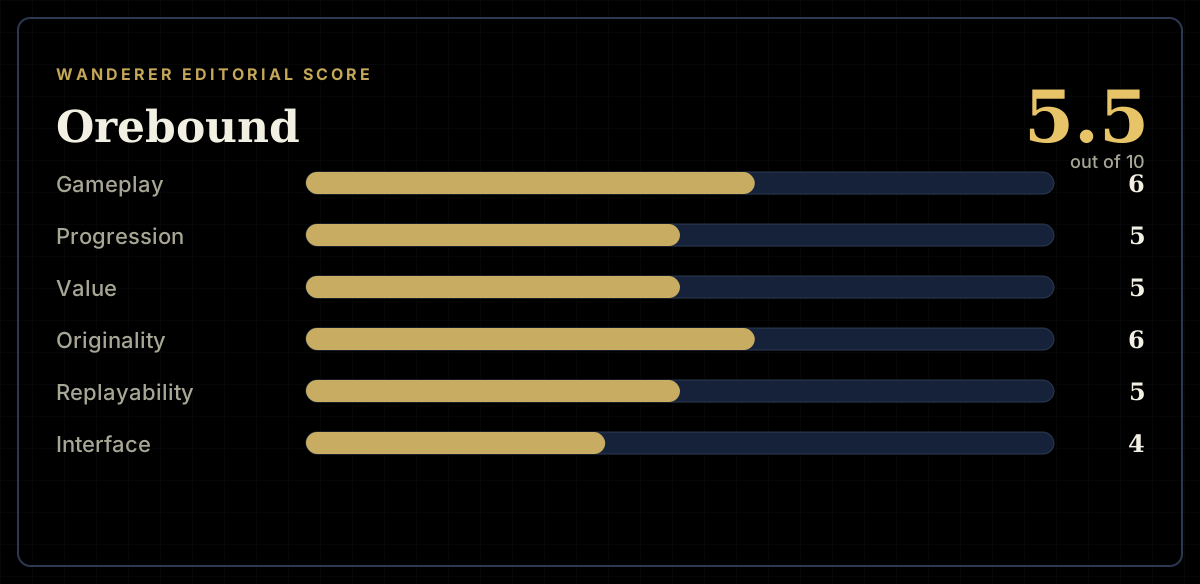
How the review scores each part of the gameWanderer Editorial -
The short versionWanderer Editorial