Game review
Solarpunk
6.5 / 10
- Developer
- Cyberwave
- Publisher
- rokaplay
- Released
- 8 June 2026
- Platforms
- Windows, PlayStation 5, Xbox Series X|S, Nintendo Switch 2
- Genre
- Survival building sim
- Monetisation
- Premium, one-off purchase — no in-game currency or ads; two optional non-gameplay DLCs (a story novella and a companion art book, both delivered as PDFs) sit outside the game itself
- Players
- Online co-op for up to 4 friends, separate inventories per player, drop-in/drop-out
The short version
Solarpunk is a survival game that has quietly amputated the survival. There's no hunger meter ticking down, nothing hostile waiting in the trees, no permadeath clock — just you, a patch of sky-rock, and a wind turbine wired to a battery. For the first several hours that's a genuinely refreshing pitch, and the energy-and-automation loop that replaces the threat is smart enough to carry it.
The trouble is what's left once that loop stops introducing new ideas, which happens well before most players have seen everything the game has to offer. Islands stop giving you reasons to return to them, the tech tree resolves into "one new plant, one new resource, repeat," and there's no story, no boss, no external pressure to replace the survival mechanics it removed. Add a save system with no manual slots, an airship that a lot of players genuinely can't fly without motion sickness, and a spread of crash reports that hasn't fully cleared since launch, and a lovely first weekend curdles into a game that's easy to put down for good around hour fifteen.
Biggest strengths
- The energy system (solar, wind, batteries, wireless power) is legible and satisfying without ever needing a wiki
- Automation drones turn a repetitive gathering loop into a genuinely rewarding mid-game tech unlock
- Base building is flexible enough that screenshots of other players' islands are worth looking up on their own
Biggest weaknesses
- Progression resolves into the same three-step unlock pattern for most of the game, with nothing replacing the tension survival mechanics would normally supply
- Piloting the airship is disorienting for a meaningful share of players, with no clear altitude reference while flying
- Persistent crash reports and fatal errors are common enough in recent Steam feedback to be a pattern, not a fluke
Who it's for: Players who want Stardew Valley's cosiness crossed with Satisfactory's wiring puzzles, and who are happy to treat 10-15 hours of that as the whole experience rather than the opening act.
Our recommendation: Worth it on a sale, or via Xbox Game Pass where it launched day one. At full price, temper expectations for the back half before buying.
6.5 / 10
A survival game that took the survival out
Every marketing beat for Solarpunk leads with the setting — drifting islands, wind turbines, a world that runs on sunlight instead of scarcity — but the more interesting design decision is what the game quietly leaves out. There's no hunger meter. Nothing hunts you. Falling off an island doesn't end your run in any permanent sense. The genre it's filed under, survival, usually means a clock that's always working against you: eat, drink, fight, don't die. Solarpunk keeps the crafting and gathering DNA of that genre and throws away the clock.
That's not a small swap. It's the same question idle-game players ask constantly about their own genre: once you take away the pressure that normally forces engagement, what's actually pulling the player forward? For roughly the first ten hours, Solarpunk answers that question well. You wake up with almost nothing on a remote fragment of sky, and the early loop — punch berries, scavenge scrap, get a wind turbine running, wire it to a battery — has the same dopamine shape as any good survival opener, minus the anxiety of a red hunger bar. It's a smart bit of genre surgery. The problem shows up later, when the game needs something else to replace the pressure it removed, and mostly doesn't have it.
The energy system is the best thing here
Solarpunk's actual hook is its power grid, and it's worth taking seriously on its own terms. Solar panels, wind turbines and water wheels all generate current at different rates depending on weather and time of day, batteries store the surplus, and wireless power lets you skip the tedium of running cable across an island. It's a simplified version of the wiring puzzles that made games like Satisfactory and Factorio compelling, cut down until a player who has never touched a factory game can understand it inside twenty minutes: place a generator, connect a battery, watch the numbers go up. Weather genuinely affects output, so a cloudy stretch means either rationing power or diversifying your generation — a small but real decision loop that rewards planning without punishing you for skipping it.
Automation builds on top of that cleanly. Transport drones eventually take over the gathering tasks that define the early hours, and unlocking that tier of tech is one of the few moments in the back half of the game that feels like a real step change rather than an incremental unlock. Players who stick around for the mid-game consistently point to the drone network as the point where Solarpunk stops being a chore simulator and starts being a game about optimising a small, self-sufficient machine. It's the clearest evidence that the developers understood exactly what they were building — the execution on this one system is genuinely ahead of the rest of the game.
Building, farming, and a world worth decorating
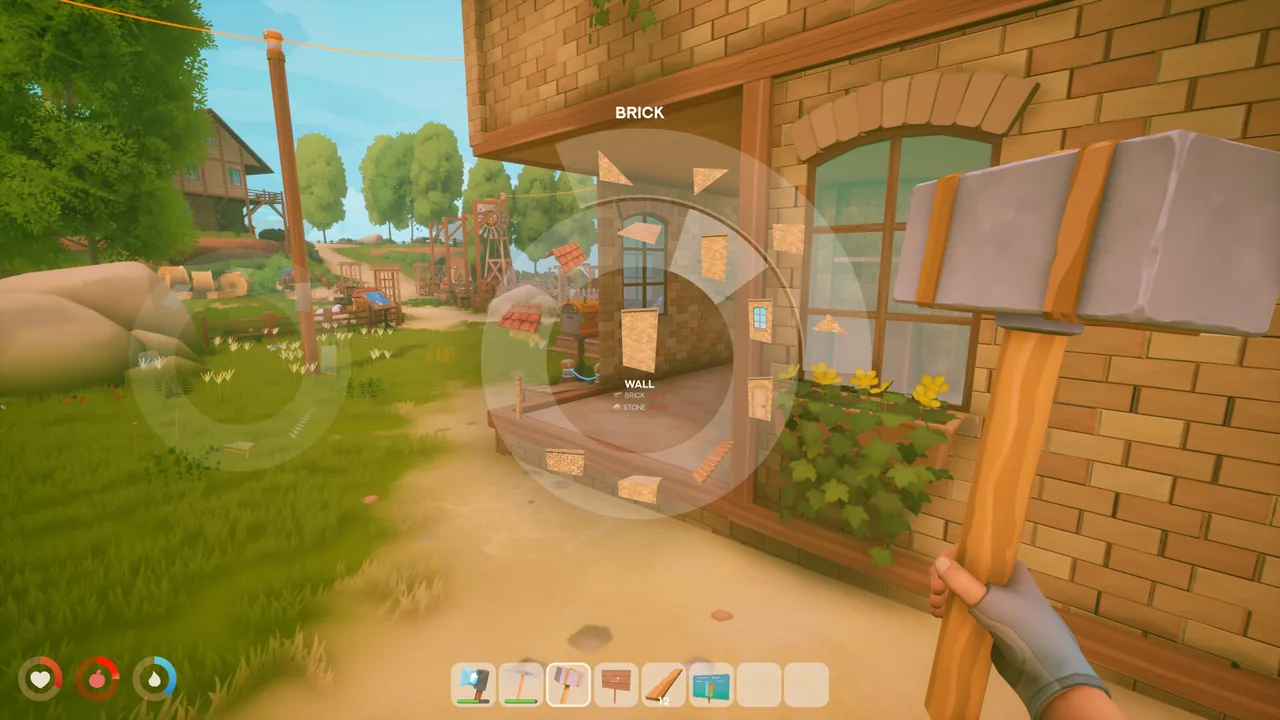
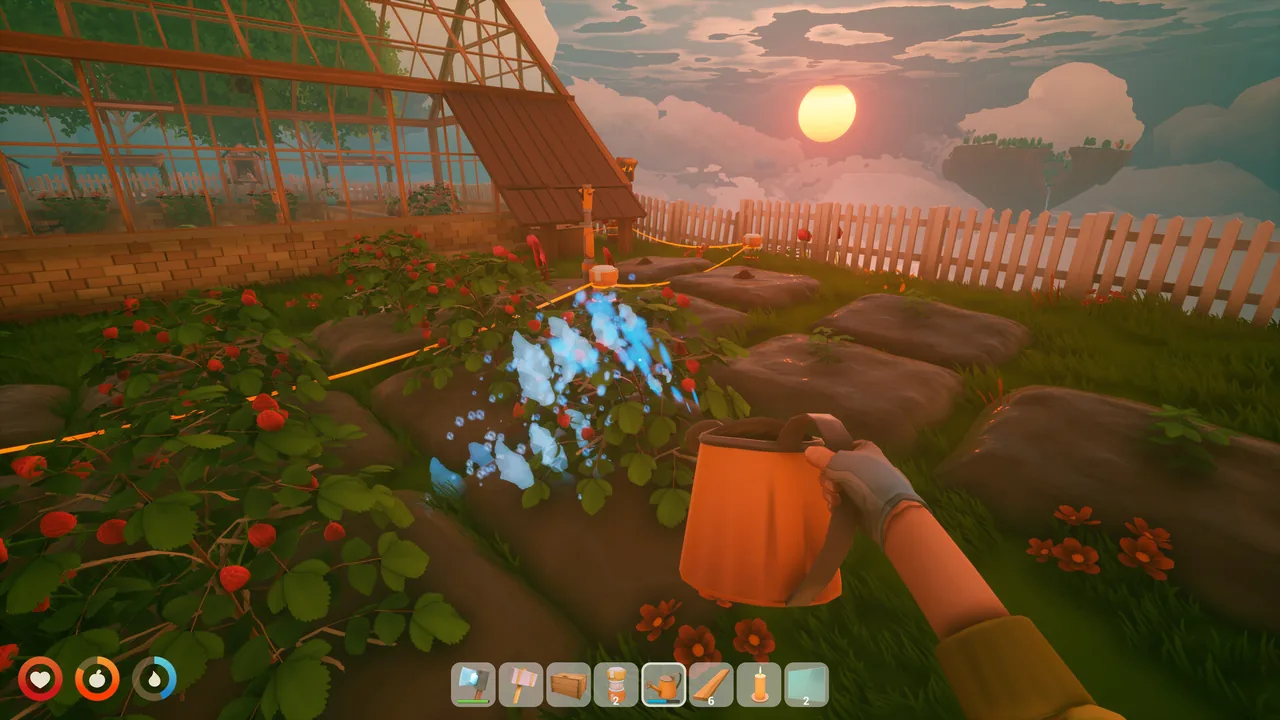
The construction toolkit is generous. Walls, roofs, floors and decorations snap together with enough material variety that two players' bases rarely look alike, and there's a real audience for Solarpunk purely as a cosy building sandbox — pretty enough, forgiving enough, unbothered enough by outside threats to just build the treehouse you always wanted. The farming and animal-husbandry side leans into the game's title more literally than most of its systems: animals aren't slaughtered for meat, they're kept and worked with — pigs dig up truffles if you treat them well, crops get planted and re-harvested rather than stripped once. It's a genuinely different framing for a survival game's food loop, even if a few sharper-eyed reviewers have pointed out the contradiction sitting underneath it: you're still clear-cutting forests and strip-mining ore veins, just with a friendlier coat of paint over the extraction. The "punk" in the name promises a politics the systems don't quite deliver on. That's a fair criticism, though it matters less to most players than whether the loop is fun, and mostly it is — early on.
Visually, the floating islands do a lot of work. Biomes are distinct, lighting sells the golden-hour aesthetic the whole game is built around, and the presentation rarely feels like it's propping up thin content the way the systems underneath sometimes do. It's a legitimately attractive game to screenshot, and that matters more than usual here, since screenshots of other players' bases are doing real work as the game's unofficial advertising.
Where the spine gives out
Here's the actual problem, and it's structural rather than cosmetic. Strip out hunger, combat and a failure state, and a survival game needs something else to keep supplying tension and direction — a story, an escalating threat, a genuinely branching tech tree, or bosses that gate new areas the way Core Keeper or Valheim use them. Solarpunk doesn't really have any of those. Once the opening islands are stripped of their easy resources, the loop settles into a pattern players describe almost identically to each other: research a new energy tier, unlock two new plants and one new mineable resource, repeat. There's no antagonist, no ending in any meaningful sense, and the earlier islands you explored stop mattering the moment their nodes are empty — several of which, inconveniently, don't respawn at all, which has genuinely soft-locked a handful of players who cleared an area too thoroughly before realising they needed it again later.
Fishing is a good small example of the pattern. It's introduced early with the fanfare of a real system, then never develops past "occasionally the fastest way to get a resource you could get elsewhere." That's true of most of the mid-game systems in isolation — individually competent, collectively not building toward anything. Compare this to the genre Wanderer's own readers know best: an idle RPG survives exactly this test by making sure every new tier changes the shape of the decision, not just its numbers. Solarpunk's numbers go up. The decisions mostly don't change.
The airship problem, and the rough edges around it
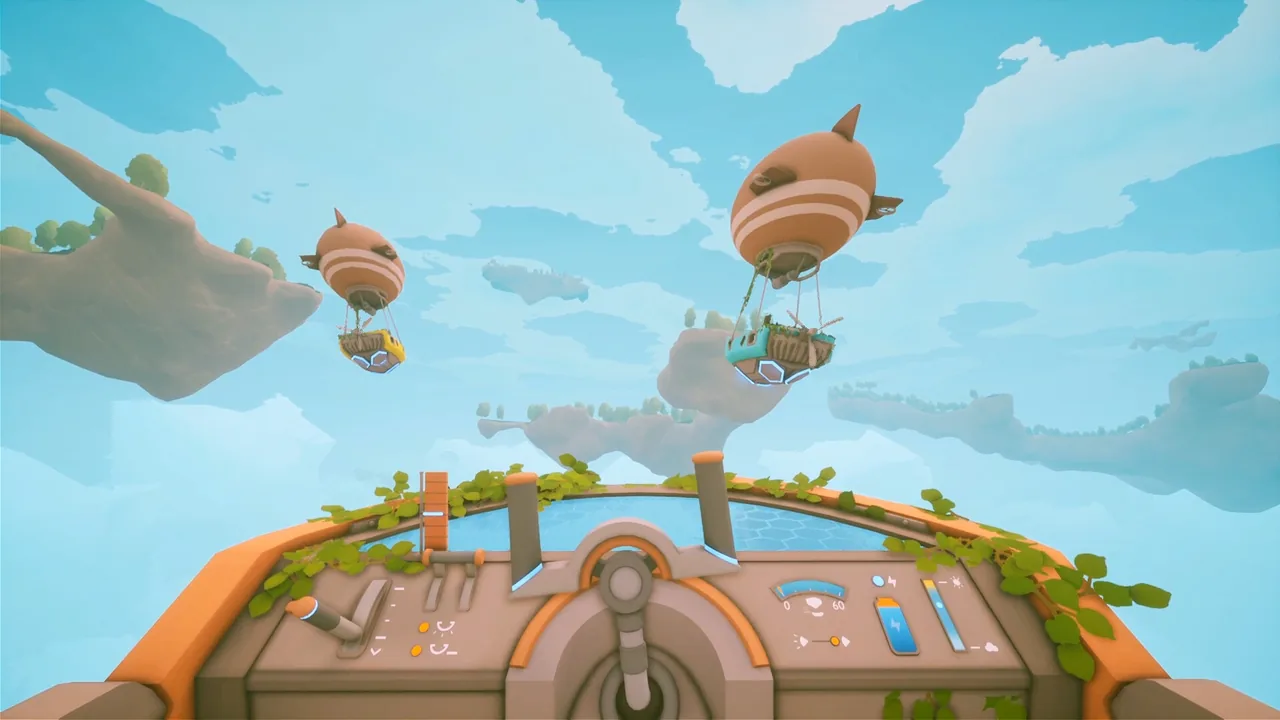
Each player builds their own airship to reach outlying islands, and it's meant to be the game's centrepiece traversal fantasy. In practice, it's the single most common complaint in recent player feedback. There's no reliable visual reference for pitch while flying — several players describe not being able to tell whether they're climbing or diving until they've already crashed into something — and it's serious enough that it's shown up repeatedly as a stated reason for refunding the game outright. A wider camera or a simple attitude indicator would likely fix most of this; as shipped, it's a genuine barrier for a meaningful slice of the audience rather than a minor complaint.
It sits alongside a handful of other rough edges that are hard to excuse in a full release rather than an Early Access build. Fatal crashes and forced restarts show up often enough in recent feedback to look like a real, unresolved issue rather than isolated hardware problems. There's no pause menu — the simulation keeps running while you're in a menu, solo or otherwise — and saving is entirely automatic, with no manual slots to fall back on if something goes wrong. None of these are hard problems to fix in patches, and some may well be gone by the time you read this, but they were common enough at launch to weigh down what is, underneath them, a well-designed core loop.
Co-op
Playing with friends is genuinely one of the better reasons to pick this up — each player keeps their own inventory, and you can either build a shared base or stake out your own corner of the same sky. But multiplayer inherits every one of the single-player issues and adds a few of its own: occasional need to rejoin a session to get moving again, and an "unstuck my airship" recovery feature that can dump a lost ship thousands of metres up and leave you waiting for it to descend. It works, and four friends puttering around adjacent islands is a pleasant way to spend an evening, but it's not the tightly engineered co-op experience the presentation implies.
Value and verdict
At $22.99, Solarpunk isn't an expensive game, and the two optional DLCs — a novella and a companion art book, both plain PDFs with no gameplay attached — are about as low-pressure as monetisation gets in this genre. There's no premium currency, no battle pass, nothing timed. That restraint deserves real credit in a market full of games that nickel-and-dime cosy sandboxes exactly like this one.
The problem is that the price is being asked to cover a game that, by most players' own accounts, runs out of new things to show you somewhere between hour ten and hour twenty — territory usually associated with an Early Access price tag rather than a four-years-in-development 1.0 launch across five platforms. Solarpunk proves the premise works: you genuinely can build a survival game around automation and construction instead of hunger and monsters, and the opening stretch is one of the more purely enjoyable cosy sandbox experiences released this year. It just needed either a longer tail of content or a lower asking price to match what's actually here. Buy it for a relaxed co-op weekend or two, not for the hundred-hour base-building obsession the systems occasionally promise.
Players who want that longer tail of genuinely escalating systems, with progression that keeps reshaping the decision rather than just the numbers, might get more mileage out of something built around persistent, always-advancing progression — which is exactly the gap Wanderer tries to fill for players who'd rather their world kept moving even when they log off.
Pros and cons
Pros
- The energy system (solar, wind, batteries, wireless power) is legible and satisfying without ever needing a wiki
- Automation drones turn a repetitive gathering loop into a genuinely rewarding mid-game tech unlock
- Base building is flexible enough that screenshots of other players' islands are worth looking up on their own
- Removing combat and hunger pressure actually works for the opening hours — it reads as a design choice, not a missing feature
- No premium currency, battle pass or gameplay-gated DLC behind the base purchase
Cons
- Progression resolves into the same three-step unlock pattern for most of the game, with nothing replacing the tension survival mechanics would normally supply
- Piloting the airship is disorienting for a meaningful share of players, with no clear altitude reference while flying
- Persistent crash reports and fatal errors are common enough in recent Steam feedback to be a pattern, not a fluke
- No manual save slots and no pause menu — the world keeps running even in menus
- Some mined and harvested nodes don't respawn, which has soft-locked a handful of players' progress
Screenshots
-
Solarpunk™Image: rokaplay via Steam -
Solarpunk™Image: rokaplay via Steam -
Solarpunk™Image: rokaplay via Steam -
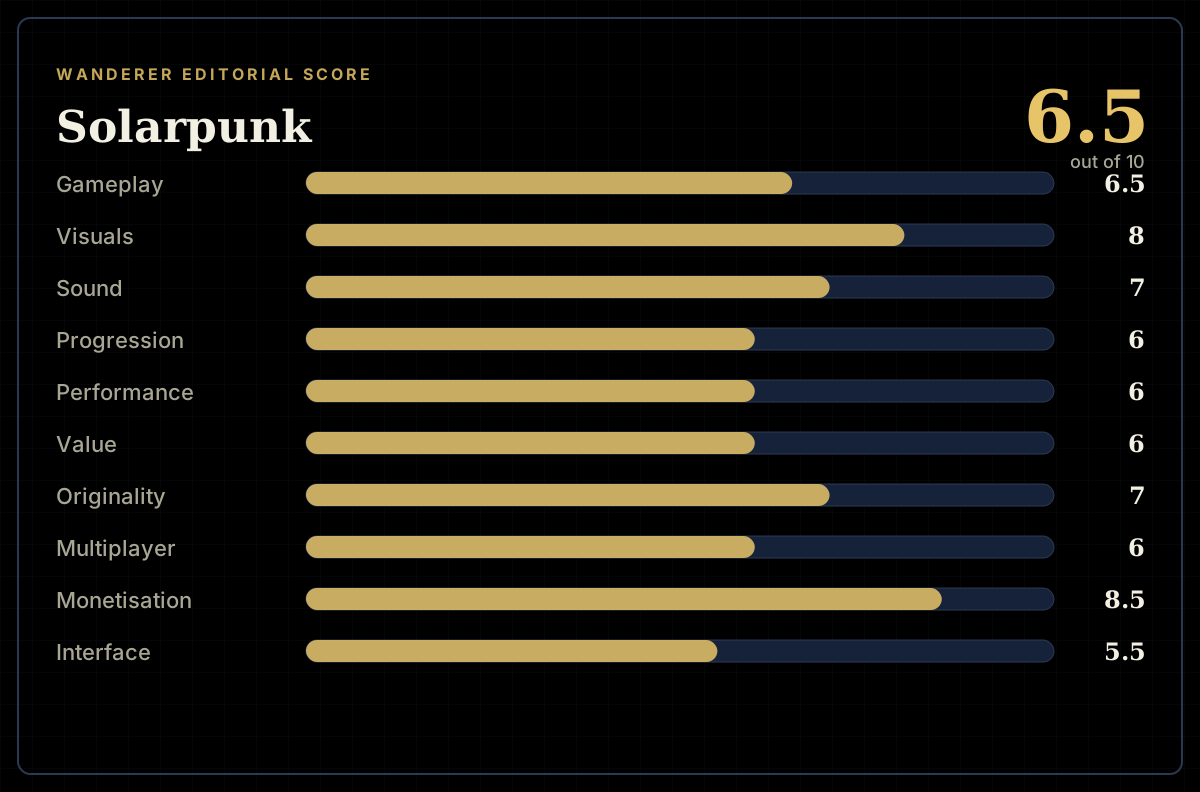
How the review scores each part of the gameWanderer Editorial -
The short versionWanderer Editorial