
Game review
Keep Keepers
6.5 / 10
- Developer
- Thunderrock Innovations
- Publisher
- Thunderrock Innovations
- Released
- 28 October 2024
- Platforms
- Windows
- Genre
- Co-op tower defense with real-time base management
- Monetisation
- One-time purchase, no in-game store or additional currency purchases
- Players
- Online and local co-op for 1-4 players
The short version
Keep Keepers combines the frantic, cramped-kitchen chaos of PlateUp! with tower defense's cannon-and-ammunition strategy: by day, craft weapons and automate an economy of mined resources; by night, defend a keep against waves of enemies with weapons ranging from fiery peppers to boomerang bananas. Reviewers who found it describe the combination as genuinely inspired, several calling it a "diamond in the rough" that deserved far more attention than it got. That enthusiasm is tempered by two serious, well-documented problems: online co-op suffers from severe latency multiple reviewers measure at 500 to 1,000 milliseconds even on strong connections, and the developer's own public events feed confirms what a striking number of reviewers state directly — active support ended roughly seven months after launch, when the studio's public communication shifted to announcing its next game instead.
Biggest strengths
- The core hybrid of real-time kitchen-chaos management and tower defense strategy draws sustained, specific praise as genuinely novel, with reviewers repeatedly calling it "PlateUp! meets tower defense" as both a description and an endorsement
- A wide variety of craftable ammunition and weapon types — including named examples like fiery peppers and boomerang bananas — gives combat real build variety, with different weapon types described as meaningfully altering playstyle rather than functioning as reskins of each other
- Automation systems for the resource economy are specifically praised for offering real depth once unlocked, with multiple reviewers describing satisfaction in optimising conveyor and production chains between combat waves
Biggest weaknesses
- Online co-op is reported by multiple independent reviewers as severely laggy, with specific estimates of 500 to 1,000 milliseconds of delay even between players on strong connections, to the point that at least one reviewer found the game more playable through remote-play streaming than through its actual networked multiplayer
- Several reviewers report specific, reproducible bugs, including a smelter that stops functioning, a bucket-cooling mechanic that reverses instead of completing its intended conversion, and store item upgrades that randomly transform into an unrelated object rather than the expected upgraded version
- The developer's own public events feed confirms a roughly seven-month gap between the last substantive content patch in January 2025 and the announcement of an entirely new game, "Islantiles," in May 2025, directly matching multiple reviewers' claims that the studio abandoned the game to move on to a new project
Who it's for: Groups of friends who love PlateUp!'s real-time chaos and want to see that formula applied to tower defense, and who can either play locally to sidestep the reported netcode issues or tolerate real lag for online sessions.
Our recommendation: Worth playing specifically in local co-op, where the reported issues are least severe, and worth a look solo if the automation-and-defense loop appeals on its own. Treat online multiplayer with real caution given the volume and consistency of lag reports, and don't expect further content or bug fixes given the developer's public pivot to a new project.
6.5 / 10
Keep Keepers pitches itself as "the newest twist on Tower Defense with cooperation and automation," and the specific twist reviewers keep landing on is a comparison that sounds unlikely until you hear it explained: this is PlateUp!'s frantic, cramped-kitchen co-op chaos, reskinned as base defense. By day, players mine resources, craft weapons and ammunition, and set up automation to keep the economy running; by night, those same players scramble between cannons loaded with everything from fiery peppers to boomerang bananas, defending a keep against escalating waves of enemies. Reviewers who found this small release consistently describe the combination as genuinely inspired. What they also describe, in specific and well-corroborated detail, is a game whose developer appears to have stopped supporting it well before most of its remaining problems were addressed.
A combination that shouldn't work, and does
"This game is basically Overcooked, but as a Tower Defense game, which sounds crazy, but it works a lot better than you would think," one reviewer writes, a sentiment echoed almost word-for-word by several others independently reaching for the same comparison. The appeal isn't just novelty for its own sake — reviewers describe real strategic depth in balancing economy against defense, deciding "how much health to sacrifice for economy" as one puts it, or which shop upgrades to prioritise between waves. Weapon variety compounds this: different ammunition types are described as meaningfully altering how a player approaches each night's defense, rather than existing as cosmetic reskins of the same underlying mechanic. One reviewer, self-described as a PlateUp! veteran with over 1,100 hours in that game, says they were drawn in specifically by seeing Keep Keepers pitched as "Plate Up Tower Defense" at an event, and came away not disappointed. Multiple long-session reviewers back that impression up with real hours logged — one past 90, another past 40 — describing it as a new favourite in the genre.
Multiplayer, the game's central pitch, is also its weakest link
Given that Keep Keepers is explicitly designed around co-op play, it's a real problem that online multiplayer draws the sample's most severe and consistent technical complaint. One reviewer quantifies it directly: "I'd estimate a consistent 500ms-1000ms delay," adding that remote-play streaming — effectively one player controlling the game while a second watches and inputs commands over video, rather than true networked play — worked noticeably better than the game's actual online mode. Another reports lag "even on LAN," the connection type that should be least vulnerable to this kind of problem. This is a serious issue for a game whose core identity is built around shared, real-time chaos between friends, and it's reported specifically and repeatedly enough that it reads as a genuine technical shortfall rather than isolated bad luck with individual connections.
Specific bugs, named directly
Beyond networking, several reviewers describe concrete, reproducible bugs rather than vague instability. One lists a smelter that stops working correctly, and a cooling-bucket mechanic that reverses its intended conversion — turning already-processed iron ingots back into raw iron balls instead of completing the intended production chain. A separate reviewer describes store item upgrades transforming into an entirely unrelated object: upgrading a water well, in their account, resulted in an upgraded conveyor belt instead. These are specific enough, and different enough from each other, that they read as real production issues in the underlying systems rather than a single reviewer's confusion about how a mechanic is meant to work.
An abandonment claim this review can confirm directly
The most serious recurring complaint in the sample isn't about a bug at all — it's about the developer's attention. Multiple reviewers state plainly that Thunderrock Innovations stopped supporting the game to work on something new: "less than 6 months after release dev has stopped support to work on a new game instead," reads one; another, more pointed, writes "abandoned in less than a year by the dev so he can make a new game," and a third simply pleads, "finish this game before you make a new one." This review can verify the shape of that claim directly against the developer's own public record. The events feed shows a genuinely active patch cycle through the game's first two-and-a-half months — five numbered patches and a "Drums of Winter" content update by late December 2024 — followed by a final substantive patch in January 2025, a "What's Next?" post that same December, and then, on 7 May 2025, an announcement of the studio's next game, "Islantiles." That's a roughly seven-month gap between meaningful Keep Keepers support and a public pivot to a different project, which lines up closely enough with the reviewers' own timelines that their complaint reads as accurate description rather than exaggerated frustration.
Smaller frictions worth naming
A handful of more conventional complaints round out the sample. Multiple reviewers describe small connecting doorways between rooms as genuinely difficult to navigate reliably, with one recounting a co-op partner losing significant time simply failing to pass through the crafting room's entrance correctly — a specific, fixable interface problem rather than a design philosophy disagreement. Several reviewers also note that individual runs can feel open-ended in an unsatisfying way, without a clear point at which the game declares victory or offers a way to end a session on the player's own terms, turning what should be a triumphant late-game defense into more of an indefinite grind.
Final verdict
Keep Keepers earns the enthusiasm of the players who found it: the PlateUp!-meets-tower-defense premise genuinely works, the weapon and automation systems reward real strategic thought, and long-session reviewers back up the design with hundreds of collective hours of praise. But this is also a small, clear case study in what happens when real, documented technical problems — severe online lag chief among them — meet a developer's public record of moving on to a new project roughly seven months after launch. The foundation here was good enough to deserve more attention than it got, and good enough to still be worth playing today, especially locally with friends where the networking problems are least likely to bite. Just don't buy it expecting further fixes; on the public record, those appear to have stopped a long time ago.
Pros and cons
Pros
- The core hybrid of real-time kitchen-chaos management and tower defense strategy draws sustained, specific praise as genuinely novel, with reviewers repeatedly calling it "PlateUp! meets tower defense" as both a description and an endorsement
- A wide variety of craftable ammunition and weapon types — including named examples like fiery peppers and boomerang bananas — gives combat real build variety, with different weapon types described as meaningfully altering playstyle rather than functioning as reskins of each other
- Automation systems for the resource economy are specifically praised for offering real depth once unlocked, with multiple reviewers describing satisfaction in optimising conveyor and production chains between combat waves
- Long-session reviewers report genuine staying power, including accounts logging over 90 hours and calling the game their new favourite in the genre, a strong signal the core design holds up under sustained play
- The developer shipped a genuinely active patch cadence in the first two-and-a-half months after launch, including five numbered patches and a "Drums of Winter" content update in December 2024, showing real initial commitment before support wound down
Cons
- Online co-op is reported by multiple independent reviewers as severely laggy, with specific estimates of 500 to 1,000 milliseconds of delay even between players on strong connections, to the point that at least one reviewer found the game more playable through remote-play streaming than through its actual networked multiplayer
- Several reviewers report specific, reproducible bugs, including a smelter that stops functioning, a bucket-cooling mechanic that reverses instead of completing its intended conversion, and store item upgrades that randomly transform into an unrelated object rather than the expected upgraded version
- The developer's own public events feed confirms a roughly seven-month gap between the last substantive content patch in January 2025 and the announcement of an entirely new game, "Islantiles," in May 2025, directly matching multiple reviewers' claims that the studio abandoned the game to move on to a new project
- Several reviewers describe individual runs as capable of feeling endless, without a clear way to declare victory or opt out after a chosen number of days, turning what should be a satisfying climax into an open-ended grind
- A specific interface complaint recurs across reviews: small doorways connecting rooms are described as difficult to see and navigate reliably, with one reviewer describing a co-op partner spending significant time simply failing to enter or exit the crafting room correctly
Screenshots
-

Keep KeepersImage: Thunderrock Innovations via Steam -

Keep KeepersImage: Thunderrock Innovations via Steam -

Keep KeepersImage: Thunderrock Innovations via Steam -
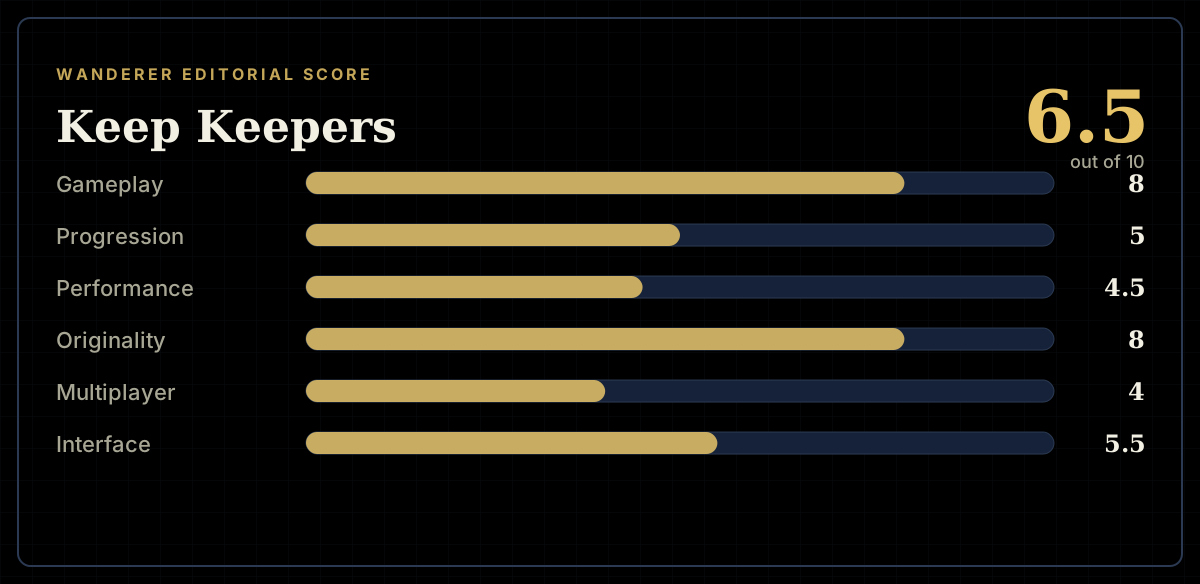
How the review scores each part of the gameWanderer Editorial -
The short versionWanderer Editorial