
Game review
Baba Is You
8.5 / 10
- Developer
- Hempuli Oy
- Publisher
- Hempuli Oy
- Released
- 13 March 2019
- Platforms
- Windows
- Genre
- Puzzle
- Monetisation
- Paid, no in-app purchases found
- Players
- false
The short version
Baba Is You's central idea is one of the genuinely original mechanics in modern puzzle design: the rules governing a level are themselves objects on the grid, and pushing a block reading WALL away from IS and YOU can turn an impassable obstacle into your own avatar mid-puzzle. Its 97.8% positive Steam corpus is a fair reflection of how well that idea is executed, but it isn't flawless — a detailed, well-argued minority, including reviewers with 150-plus hours invested, makes a specific case that its level structure rewards isolated flashes of insight over the steadily scaffolded difficulty that makes puzzle games feel satisfying to master rather than just solve.
Biggest strengths
- A genuinely original core mechanic — the rules of the game are themselves manipulable objects on the board, letting players redefine what counts as a wall, a win condition, or the player character mid-puzzle
- An enormous, consistently inventive puzzle count (226 levels by one reviewer's count) that multiple long-time players say never feels repetitive even dozens of hours in
- Charming, minimalist presentation and music that reviewers across the board describe as disarmingly cute given how mentally punishing the puzzles themselves can be
Biggest weaknesses
- A detailed, high-playtime dissenting review argues the level design rewards a single "eureka" realization per puzzle rather than building solutions from multiple progressively-introduced ideas, making levels feel like isolated insight tests rather than a connected skill progression
- The same critique describes area completion as anti-climactic, since most zones only require a handful of their total levels to be finished, leaving 100%-completion-minded players facing wildly uneven difficulty spikes within the same nominal area
- Multiple reviewers, even enthusiastic ones, describe the game as "mentally taxing" to the point of exhaustion once difficulty ramps up, with little difficulty accommodation for players who aren't naturally strong at lateral-thinking puzzles
Who it's for: Puzzle fans who want a genuinely novel core mechanic and don't mind a level structure built around isolated, sometimes brutal insight-or-nothing challenges rather than smooth difficulty progression.
Our recommendation: An easy recommendation for puzzle genre fans and a strong pick for anyone curious what a truly original mechanic looks like in 2019 — just be ready for real, sometimes punishing difficulty spikes.
8.5 / 10
What it is
Baba Is You's premise is simple to state and genuinely difficult to fully internalize: every level's rules are made of pushable blocks of text reading things like BABA, IS, and YOU, arranged into sentences on the grid itself. Push the YOU block away from BABA and attach it to a different noun, and you're now controlling that object instead. Rearrange WALL IS STOP into WALL IS YOU, and suddenly the obstacle blocking your path is something you can walk as. The entire puzzle-solving process is about editing the laws of physics governing the level, not just navigating within them — a genuinely rare structural idea for a puzzle game, and one Hempuli Oy, the small Finnish studio behind it, executes with remarkable range across the game's full level count (226, by one reviewer's direct count).
It released on 13 March 2019 at NZD 18.49, and its review corpus has grown into one of the largest and most lopsidedly positive this lane has encountered: 12,597 English-language reviews sit at 97.8% positive, an Overwhelmingly Positive rating that's rare even among beloved indie titles. Reading through that corpus in depth confirms the reputation is earned, while also surfacing a smaller but genuinely substantive critical thread worth taking seriously.
Why it's so beloved
The praise across the corpus converges on the same core observation from dozens of independent angles: this game makes players feel simultaneously brilliant and hopeless in a way few puzzle games manage. "Most puzzle games demand you to think 'outside the box.' In Baba is You, there is no box," writes one reviewer, capturing the sentiment that recurs constantly — solutions that seem "impossible" until a single reframing makes them "hiding in plain sight." Reviewers with thousands of hours logged report the game "never manages to feel repetitive," specifically praising how "even late game" it keeps finding "surprising interactions between different elements." Several compare it favourably to genre landmarks — "my favorite puzzle game since The Witness," writes one — and the game's cute, minimalist presentation gets consistent credit for softening what several reviewers describe, in genuinely affectionate terms, as an experience that makes them feel "the dumbest person alive."
The detailed case for real, structural criticism
Beneath the overwhelming praise sits a small but articulate minority making a specific, well-reasoned argument rather than a vague complaint about difficulty. The most detailed critical review in the corpus, from a player who logged somewhere between 150 and 200 hours by their own accounting, argues plainly that "the praise it's gotten is too extreme" and lays out exactly what kind of progression structure they wanted versus what they got. Their ideal: a concept introduced simply, then built upon across subsequent levels, ratcheting up complexity consistently toward a satisfying climax. What they found instead: levels built around realizing a single hidden trick, with little connection to what came before or after — "once you realize the concept, the level is easy... but beforehand, it seems impossible." That reviewer specifically criticises area structure for being anti-climactic, since most zones only demand a fraction of their total levels to progress, leaving completionist-minded players to face wildly uneven optional difficulty spikes for the remainder.
This is a meaningfully different critique from simply "the game is too hard," and it's corroborated by the game's own achievement data: a steep decline from 53.3% completion for an early-area milestone down to just 3.2% for finishing the entire game, with several intermediate achievements clustering in the low single digits. That shape is consistent with a design that front-loads accessible content and then demands increasingly isolated, difficult insights for full completion — exactly the pattern the detailed critical review describes, even if the vast majority of the corpus experiences that same structure as a feature rather than a flaw.
What makes the core mechanic hold up under scrutiny
It's worth dwelling on why the rules-as-objects idea sustains 226 levels without reviewers reporting it running dry, because that longevity is the game's real technical achievement. A weaker version of this concept might introduce a handful of clever rule interactions early and then simply recombine them for the remainder of the game. Reviewers who've played deep into the back half specifically push back against that reading: one, writing from well past the 90-hour mark, reports still finding "surprising interactions between different elements" late into the game, and another compares the experience directly to "debugging some code" — methodically forming hypotheses about how a given level's rule-set behaves, testing them, and revising when they fail. That's a genuinely different cognitive experience from most puzzle games' spatial or logical reasoning, and it's the reason so many reviewers reach for programming or systems-thinking metaphors rather than typical puzzle-game language when describing what makes solving a level satisfying.
Weighing accessibility against ambition
The tension at the heart of this review — overwhelming acclaim against a detailed structural critique — ultimately comes down to what kind of puzzle-solving experience a given player wants. Baba Is You is not interested in holding a player's hand toward a solution through incremental scaffolding; it wants the moment of realization to arrive as a genuine surprise, even if that means some levels sit unsolved for a long time before the necessary insight clicks. For the overwhelming majority of its enormous review corpus, that design choice is precisely the appeal — the eureka moment is the reward, not an obstacle to a reward. But it's a legitimate, honestly-argued position that this trades away the steady, confidence-building sense of mastery that games with more gradual difficulty curves provide, and readers who know they prefer the latter should treat the game's near-perfect review score as a measure of how well it achieves its own specific ambition, not a guarantee that its particular flavour of difficulty will suit every kind of puzzle-game fan equally.
Verdict
Baba Is You earns its reputation as one of 2019's most original and best-loved puzzle games: a genuinely novel core mechanic, executed with more range and craft than almost any other game attempting something similar. The detailed structural critique from its most dedicated dissenters is worth knowing about before diving toward full completion — this isn't a game that guarantees a smooth, evenly-paced climb in difficulty, and its hardest content asks for isolated flashes of insight that won't come on a predictable schedule. For the vast majority of players, per this lane's read of an enormous and remarkably consistent review corpus, that's precisely what makes it worth playing.
Pros and cons
Pros
- A genuinely original core mechanic — the rules of the game are themselves manipulable objects on the board, letting players redefine what counts as a wall, a win condition, or the player character mid-puzzle
- An enormous, consistently inventive puzzle count (226 levels by one reviewer's count) that multiple long-time players say never feels repetitive even dozens of hours in
- Charming, minimalist presentation and music that reviewers across the board describe as disarmingly cute given how mentally punishing the puzzles themselves can be
- Full controller support including modern DualSense/DualShock compatibility and cross-device Remote Play, alongside Steam Cloud saves
Cons
- A detailed, high-playtime dissenting review argues the level design rewards a single "eureka" realization per puzzle rather than building solutions from multiple progressively-introduced ideas, making levels feel like isolated insight tests rather than a connected skill progression
- The same critique describes area completion as anti-climactic, since most zones only require a handful of their total levels to be finished, leaving 100%-completion-minded players facing wildly uneven difficulty spikes within the same nominal area
- Multiple reviewers, even enthusiastic ones, describe the game as "mentally taxing" to the point of exhaustion once difficulty ramps up, with little difficulty accommodation for players who aren't naturally strong at lateral-thinking puzzles
- Achievement data confirms a steep drop-off in completion (from 53.3% for an early milestone down to 3.2% for finishing the whole game), meaning most buyers don't see the back half of the game's content
Screenshots
-

Baba Is YouImage: Hempuli Oy via Steam -

Baba Is YouImage: Hempuli Oy via Steam -

Baba Is YouImage: Hempuli Oy via Steam -
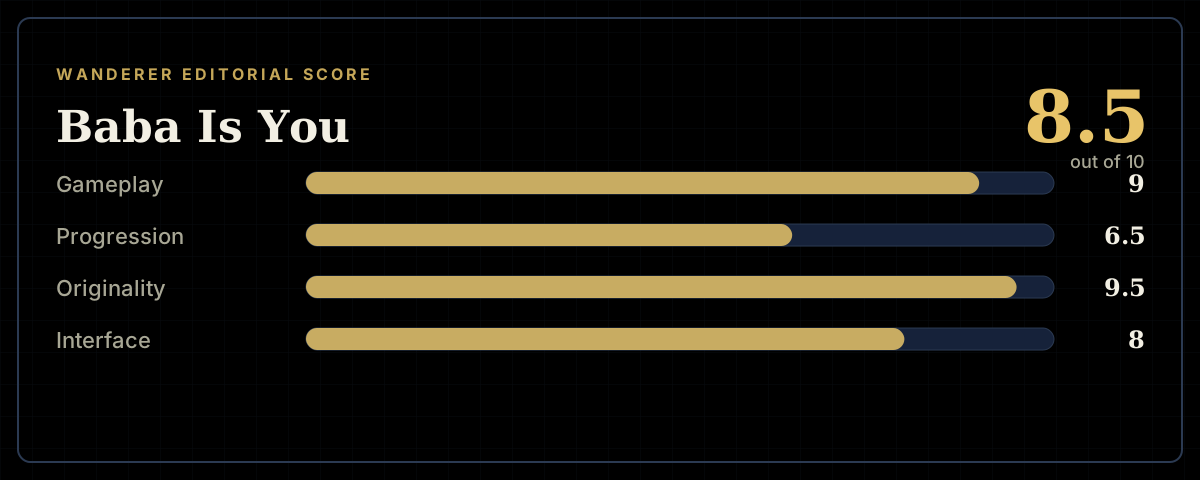
How the review scores each part of the gameWanderer Editorial -
The short versionWanderer Editorial