
Game review
Leap Year
6.5 / 10
- Developer
- Daniel Linssen
- Publisher
- Daniel Linssen, Sokpop Collective
- Released
- 13 June 2024
- Platforms
- Windows
- Genre
- Precision puzzle-platformer
- Monetisation
- One-time purchase, no in-game store or additional currency purchases; a free content update ("March") added post-launch
- Players
- Single-player only
The short version
Leap Year builds its entire design around one deceptively small rule: a full jump generates enough fall damage on landing to kill you outright, forcing players to find every alternative way to gain height and cross gaps in a compact, hand-drawn world hiding twenty-nine calendar pages. This review's sample is unusually clear-eyed about what that premise buys and costs. Reviewers who connect with the knowledge-gated puzzle design — often name-checking Outer Wilds and Fez as spiritual cousins — describe a genuinely clever, well-paced few hours that ends before it wears out its welcome. A substantial and equally articulate minority describes the same jump-is-lethal mechanic and its long respawn sequences as actively unpleasant to interact with, regardless of how clever the underlying idea is, and this review treats that divide as the single most important thing a prospective buyer needs to know going in.
Biggest strengths
- The central subversion of platformer conventions — jumping is dangerous, not safe — earns wide, specific praise as a genuinely novel idea executed with real design discipline, with several reviewers directly comparing the knowledge-gated structure to Outer Wilds and Fez
- The game is consistently praised for ending before it overstays its welcome, with multiple reviewers specifically crediting the tight scope and short runtime as a deliberate strength rather than a shortfall
- The world design supports the mechanic well, rewarding careful observation and experimentation over reflexes, and reviewers on both sides of the fun-vs-frustrating divide agree the underlying concept is clever and well thought through
Biggest weaknesses
- A substantial portion of the negative sample describes the core lethal-jump mechanic as more annoying than clever in actual play, with several reviewers independently using words like "punishing," "annoying," and "infuriating" despite understanding and respecting the design intent
- Slow respawn sequences and checkpoints placed well behind the point of death are a specific, repeated complaint, with multiple reviewers describing being sent back one or two screens after a single mistimed jump
- Excessive backtracking is flagged by several reviewers as the game's weakest structural element, describing repeated returns through already-solved areas to reach new content rather than tightly paced forward progression
Who it's for: Puzzle-minded players who enjoy knowledge-gated, secret-driven progression in the vein of Outer Wilds or Fez, and who don't mind slow, deliberate movement built around a genuinely punishing core mechanic; poor fit for players who primarily want fluid, forgiving platforming.
Our recommendation: Worth its very low price for players drawn to clever, subversive mechanical ideas who can tolerate real friction and repeated failure along the way — but this is a game to sample cautiously if precision-platformer frustration has burned you before, since a meaningful share of this review's sample describes exactly that experience despite loving the underlying concept.
6.5 / 10
Leap Year's store page describes itself, plainly and honestly, as "a clumsy platformer about knowledge and discovery." That single word — clumsy — turns out to be doing a lot of work, and this review's sample reads almost like two separate conversations happening about the same design decision: one group finding it a source of constant delight, another finding it a genuine source of frustration, with remarkably little middle ground between them.
The idea itself is the game's real achievement
Nearly every review in this sample, positive or negative, agrees on what makes Leap Year interesting: a full jump generates enough fall damage on landing to kill you instantly, meaning the entire verb the platforming genre is built around becomes something you must actively avoid rather than lean on. "The player has fall damage. The player can jump, but the jump is just high enough to take fall damage, killing the player instantly. The player must constantly find ways of jumping by landing on higher elevation," one reviewer explains, describing a design built entirely around subverting that one assumption. Several reviewers reach for the same comparisons to describe the resulting structure — "knowledge-gated progression, like Outer Wilds and Fez" — praising a world where understanding a new mechanical trick opens up areas you'd already walked past dozens of times.
When the cleverness lands
For reviewers who click with the premise, the resulting experience earns real, specific affection. "A wonderful little platformer that subverts genre norms around how jumping works to great effect. As with many of the best puzzle games, the mechanics are tightly focused, not overused, and the game ends before it's worn out its welcome," one writes, treating the short runtime as a deliberate, well-judged choice rather than thin content. Another describes the payoff of persistence directly: "Simple, precise, charming, infuriating. Easy until the first real sticking point; after a restart and ten minutes of failure, I... found the next game mechanic, and I was 100% onboard from then on" — a rare review that names the frustration honestly while still landing on the positive side of the divide.
When the same mechanic curdles
The negative sample is just as specific, and just as fair to the game's underlying ambitions, which is what makes it worth taking seriously rather than dismissing as a mismatch of expectations. "It says it right in the store page description: 'clumsy' platformer. I get where the positive reactions are coming from, but it is a finnicky annoying precision platformer first and foremost. One with slow respawn animations and one that regularly puts you back one or two screens," one reviewer writes — not disputing the game's cleverness, but reporting that cleverness didn't translate to fun for them in practice. Another goes further: "the fact that a full jump outright kills and you get sent back to a checkpoint that is pretty far away sometimes was so annoying, so annoying, so annoying. It's a platformer where you get punished for Jumping." A third, more measured: "There were too many rooms where I knew what to do but needed tens of attempts to do it. I did have some fun, but the not-fun outweighed it." What's notable across this whole thread is how many of these reviewers explicitly acknowledge understanding and respecting what the game was going for — this isn't confusion about the premise, it's a considered rejection of how that premise feels to actually play.
Backtracking as the second, quieter complaint
Beneath the headline jump-mechanic divide sits a second, more structural criticism worth separating out: excessive backtracking. "Worst part for every metroidvania, at least for me, is endless backtracking, trying to figure out what to do next, this game is really good at that, making you repeat the same puzzles while you are trying to figure out how to get last number," one reviewer writes. Another calls out the same issue more clinically: "excessive backtracking, a respawn sequence that is just a bit too long." This is a distinct complaint from the fun-or-frustrating jump-mechanic split — even some reviewers who enjoyed the core idea flag backtracking as the game's weakest structural choice, suggesting a compact world stretched slightly further than its content comfortably supports.
What the achievement data adds
Steam's own completion figures offer a useful, independent read on where this divide actually settles for the broader playerbase. Early story and mechanic-introduction achievements sit remarkably high, from 85.7% up to 99.5%, indicating that the overwhelming majority of buyers do get moving, understand the central trick, and make real progress rather than bouncing off immediately. Where the numbers shift dramatically is in the post-launch "March" content and speedrun-oriented challenges, which fall to between 2.6% and 11.7% — a sharp drop-off suggesting that whatever appetite exists for the base game's core loop, it doesn't extend to players wanting more of the same difficulty at greater intensity. That's a reasonable, even healthy pattern for a game whose own reviewers describe its ideal length as short and tightly focused; it also confirms that the expanded content asks for a level of mastery beyond what most of the base audience is chasing.
A confirmed record of ongoing support
This review can also confirm directly that Leap Year wasn't left to fend for itself after launch. The game's partner-events feed documents seven dated patches in the months immediately following the June 2024 release, followed by a free "March" content update and a further patch in March 2025 — a genuinely sustained commitment from a solo developer well beyond the initial launch window, and one that should reassure buyers that reported bugs and balance concerns were being actively addressed rather than ignored.
Final verdict
Leap Year is a genuinely clever, well-supported little platformer built around one of the more interesting mechanical subversions in recent memory, and this review's sample makes clear that whether that subversion delights or frustrates you is close to a coin flip depending on your tolerance for deliberate, punishing precision platforming. At its very low price, it's a fair experiment for puzzle-minded players drawn to knowledge-gated design — just go in aware that a meaningful share of thoughtful, engaged reviewers who understood exactly what the game was trying to do still came away finding it more annoying than fun.
Pros and cons
Pros
- The central subversion of platformer conventions — jumping is dangerous, not safe — earns wide, specific praise as a genuinely novel idea executed with real design discipline, with several reviewers directly comparing the knowledge-gated structure to Outer Wilds and Fez
- The game is consistently praised for ending before it overstays its welcome, with multiple reviewers specifically crediting the tight scope and short runtime as a deliberate strength rather than a shortfall
- The world design supports the mechanic well, rewarding careful observation and experimentation over reflexes, and reviewers on both sides of the fun-vs-frustrating divide agree the underlying concept is clever and well thought through
- Steam's own partner-events feed documents sustained post-launch support, including seven patches through mid-2024 and a further two patches alongside a March 2025 free content expansion, confirming active ongoing care rather than a one-and-done release
- The very low price makes the experiment low-risk even for buyers who ultimately find they're in the "frustrating" camp rather than the "delightful" one
Cons
- A substantial portion of the negative sample describes the core lethal-jump mechanic as more annoying than clever in actual play, with several reviewers independently using words like "punishing," "annoying," and "infuriating" despite understanding and respecting the design intent
- Slow respawn sequences and checkpoints placed well behind the point of death are a specific, repeated complaint, with multiple reviewers describing being sent back one or two screens after a single mistimed jump
- Excessive backtracking is flagged by several reviewers as the game's weakest structural element, describing repeated returns through already-solved areas to reach new content rather than tightly paced forward progression
- At least one reviewer reports a specific art-style-related headache, and separately criticizes a late upside-down gravity-shift section as the game's least enjoyable stretch
- Achievement data shows a steep falloff from the base game's 85-99% completion range down to 2.6-11.7% for the post-launch "March" content and speedrun-style challenges, suggesting the expanded content asks considerably more of players than most are willing to give even among those who finished and enjoyed the base game
Screenshots
-

Leap YearImage: Daniel Linssen via Steam -

Leap YearImage: Daniel Linssen via Steam -

Leap YearImage: Daniel Linssen via Steam -
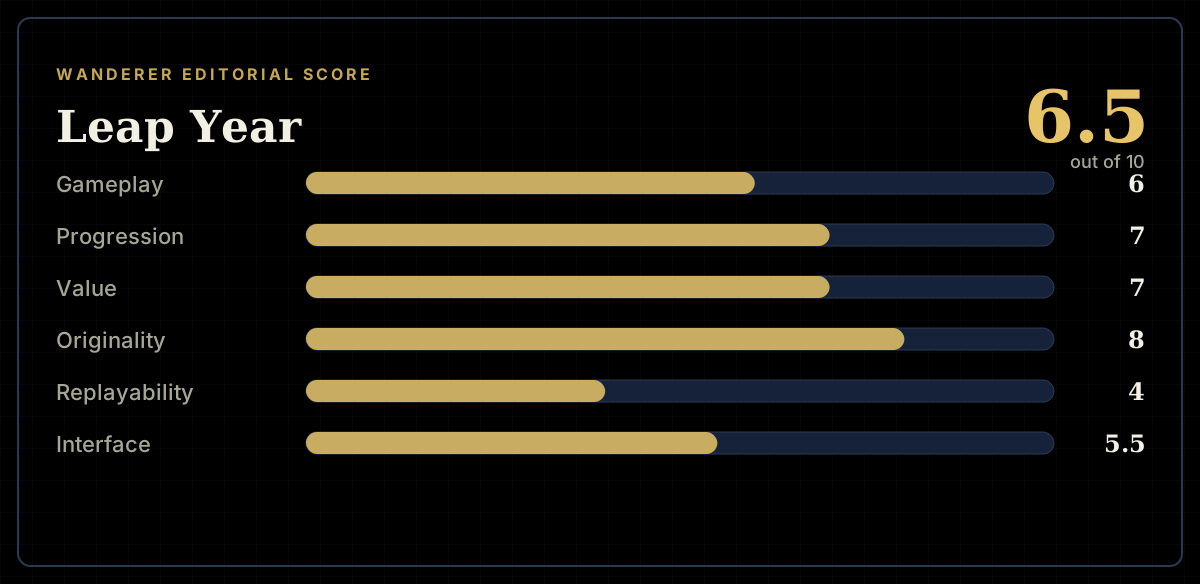
How the review scores each part of the gameWanderer Editorial -
The short versionWanderer Editorial