
Game review
Sonder
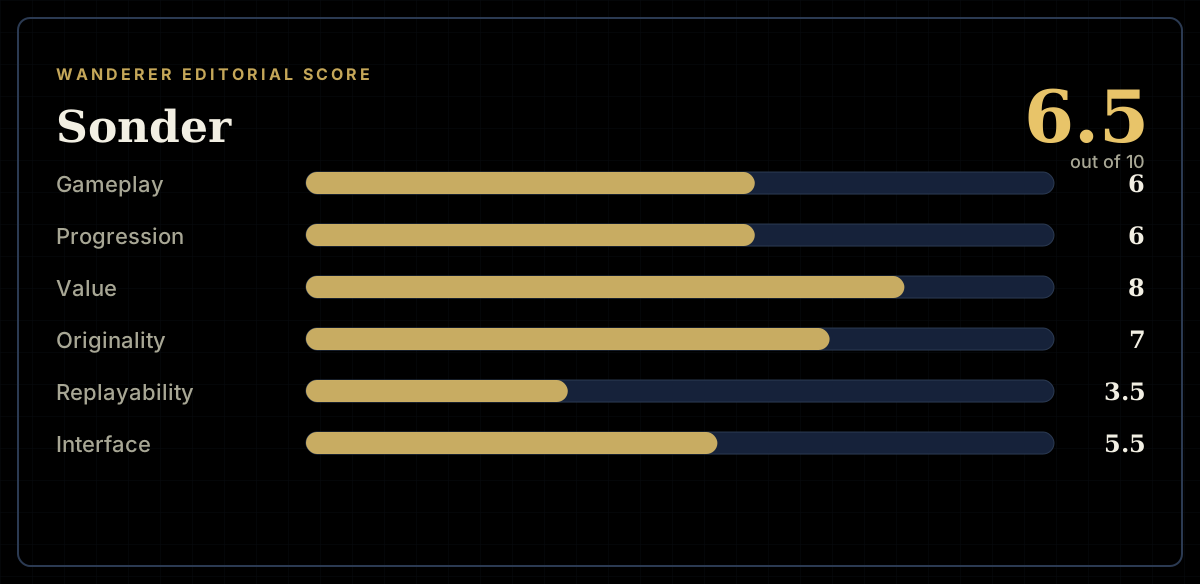
6.5 / 10
- Developer
- Finally Games
- Publisher
- Finally Games
- Released
- 15 February 2024
- Platforms
- Windows
- Genre
- Co-op narrative puzzle-platformer
- Monetisation
- Free to play, no in-game purchases of any kind
- Players
- Two-player local (gamepad required for both players) or online (mouse and keyboard supported) co-op
The short version
Sonder casts two players as a scrapped robot and a disembodied soul who wake up in a fractured dream-world after a mysterious train knocks them out, escaping together through a sequence of cooperative puzzle-platforming rooms where each character's unique abilities are required to let the other progress. Its atmosphere, art direction, and quietly affecting wordless story earn consistent, specific praise across the review sample, and being entirely free removes any real financial risk from trying it. What tempers that praise is an equally consistent set of technical complaints — lag, glitches that can force players to restart entire levels, and unexpectedly heavy hardware demands for a small co-op puzzler — alongside a near-universal observation that the whole experience runs well under an hour.
Biggest strengths
- The atmosphere, art direction, and minimalistic visual style draw consistent, specific praise, with one reviewer directly comparing the experience to "if Portal 2 and Inside had a baby"
- The wordless, emotionally driven story earns genuine affection across the sample, including from reviewers who otherwise found the game rough or broken, with several specifically recommending it be played with a partner or close friend
- Being entirely free removes any financial risk, and multiple reviewers explicitly frame even a technically rough experience as an easy recommendation at that price
Biggest weaknesses
- Performance and optimization complaints are the single most repeated criticism in the negative sample, with multiple reviewers independently describing serious lag, stuttering, and unusually high CPU and GPU load for a small co-op puzzle title, including laptops overheating during play
- Level-breaking bugs appear repeatedly across both positive and negative reviews, including a reported missing platform that forced one pair of players to restart the entire game from the beginning, and reports of the game freezing outright during a later chapter
- The overwhelming consensus, even among enthusiastic reviewers, is that the experience is extremely short, with several reviewers reporting a completion time under 30 minutes and few describing more than an hour or two
Who it's for: Couples, friends, or family members looking for a short, free, emotionally resonant co-op experience to play together in a single sitting, who are willing to tolerate some rough technical edges in exchange for zero financial cost.
Our recommendation: Worth downloading purely because it costs nothing — the atmosphere and story land well enough to justify the half-hour to two hours it takes most players to finish. Go in expecting a rough technical experience on some hardware and a runtime closer to a lunch break than an evening, and you won't be disappointed.
6.5 / 10
Sonder asks two players to become a scrapped robot and a wandering soul who, after being knocked unconscious by a mysterious train, wake up together inside a dreamlike world shaped by their own subconscious. It's free, it's wordless, and it's built entirely around the idea that neither character can get anywhere without the other — a premise this review's sample largely confirms delivers real emotional payoff, wrapped around a technical foundation that many players found considerably rockier than the price tag would suggest.
A short story that lands anyway
The praise for Sonder's atmosphere and narrative is specific and consistent, even from reviewers who otherwise had a rough technical experience. "This game is like if Portal 2 and Inside had a baby. The artstyle, music and atmosphere is absolutely on point," one reviewer writes, a comparison echoed in spirit by several others who single out the minimalist visual design and quiet, dialogue-free storytelling. Another reviewer, more playfully, describes it as "a game that takes the player on an innovative co-op adventure" starring "piss boy and microwave man," while still calling it "a heartwarming... free masterpiece" worth recommending. The throughline across nearly the entire positive sample is that the story's emotional beats, delivered without a single line of text, land more effectively than a game this short and this free has any obligation to manage.
The technical complaints are specific, not vague grumbling
Set against that goodwill is a remarkably consistent set of hands-on technical complaints. "Fans immediately on full speed, computer heating up, a cryptominer would be more performative than this," one reviewer writes, describing being unable to get past the main menu on ordinary hardware. Another reports a genuinely game-breaking bug: "In one level the platform needed to walk at the exit was missing for me, even though for the other player was there, so we had to replay the whole game from start," and separately describes the game freezing three times during a later chapter. These aren't isolated one-off complaints from unlucky players — they recur often enough, across reviewers with a range of hardware, to read as a real and fairly widespread issue rather than a handful of unlucky configurations. Notably, several of the reviewers reporting these problems still recommended the game overall, treating the bugs as a real but forgivable cost given the price.
How short is short
If there's a second consensus running through this review sample almost as strongly as the technical complaints, it's runtime. "You can definitely beat this game together in under 30 mins," one reviewer notes. Another: "It is a short game that can be completed in under 15 mins if you know what you are doing." A third calls it out more critically: "wtf is this short game, no context or nothing, good gameplay but very short." For a paid game, a sub-hour runtime with light replay incentive would be a serious value problem. Free removes most of that sting, but it's worth setting expectations precisely: this is closer to a short film's length than a game session's, and buyers — or rather, downloaders — expecting even a modest two-to-three-hour co-op adventure will find Sonder ends well before that.
What the completion data actually shows
Steam's own achievement figures offer a useful, independent cross-check against the "too short, too buggy to bother" reading of the negative sample. The core game-completion achievement sits at 41.1 percent — a solid figure for any game, and a genuinely strong one for a title that structurally requires two committed people playing together simultaneously to finish at all, a bar plenty of free games with lower friction never clear. Early ability-based milestones sit even higher, at 49.3 percent, suggesting the vast majority of pairs who start together do get moving through the core mechanics without being stopped cold by the bugs the negative sample describes. The lowest-percentage achievements — tied to speedrunning, secret-room discovery, and a 15-minute survival challenge — read as genuine optional side content rather than evidence of a broken critical path, which is consistent with the story itself being reachable even if some of the game's bonus objectives clearly are not for most players.
A claim this review can't verify either way
At least one reviewer goes further than a technical or content complaint, writing bluntly: "i genuinely don't understand what the hell these people see in this game i have to imagine that the Finally games paid off people to rate this game high." That's a serious accusation, and this review takes it seriously enough to note directly — but the reviewer names no specific curator, badge, or linked source, and this review's check of Sonder's partner-events feed returned zero posts of any kind, leaving no independent channel to confirm or refute unusual promotional activity either way. Absent a specific, checkable claim, this reads as one frustrated reviewer's speculation rather than an established pattern, and it shouldn't be weighed the same as a genuinely documented manipulation concern. It's reported here for completeness, not as a verdict.
Weighing combat that doesn't quite fit
A more grounded structural critique comes from a reviewer who specifically flags the game's occasional combat beats as underdeveloped: "there should be fight scenes throughout the game its kinda weird how only like 2 levels have fight sequences... boss battle is wayyyy too easy." That's a fair read of a design choice that seems slightly at odds with the rest of the game's puzzle-platforming identity — the cooperative-ability puzzles are clearly where Sonder's design attention went, and the handful of action sequences feel more like an obligatory genre nod than a fully realized second pillar. Judged purely as a puzzle-platformer, that's a minor blemish; judged against any marketing that leans on action, it's a mismatch worth flagging for buyers who might come in expecting more combat than the game actually delivers.
Final verdict
Sonder is a short, free, and genuinely affecting co-op experience whose atmosphere and wordless story earn real, specific praise, tempered by a widely reported set of performance problems and level-breaking bugs that a small free title arguably shouldn't have shipped with. At zero cost, the calculation is straightforward: even readers who hit the reported bugs are likely to find thirty minutes to two hours of genuine, low-risk charm here, provided they go in with modest hardware expectations and an even more modest runtime expectation.
Pros and cons
Pros
- The atmosphere, art direction, and minimalistic visual style draw consistent, specific praise, with one reviewer directly comparing the experience to "if Portal 2 and Inside had a baby"
- The wordless, emotionally driven story earns genuine affection across the sample, including from reviewers who otherwise found the game rough or broken, with several specifically recommending it be played with a partner or close friend
- Being entirely free removes any financial risk, and multiple reviewers explicitly frame even a technically rough experience as an easy recommendation at that price
- The core cooperative-ability puzzle design, where each character can only progress by relying on the other's distinct powers, is praised as a fun, well-balanced foundation for the objectives it does offer
- Achievement data shows a healthy 41 percent overall completion rate given the game requires a second player to finish at all, suggesting most people who start with a partner do see it through to the end
Cons
- Performance and optimization complaints are the single most repeated criticism in the negative sample, with multiple reviewers independently describing serious lag, stuttering, and unusually high CPU and GPU load for a small co-op puzzle title, including laptops overheating during play
- Level-breaking bugs appear repeatedly across both positive and negative reviews, including a reported missing platform that forced one pair of players to restart the entire game from the beginning, and reports of the game freezing outright during a later chapter
- The overwhelming consensus, even among enthusiastic reviewers, is that the experience is extremely short, with several reviewers reporting a completion time under 30 minutes and few describing more than an hour or two
- Combat and action sequences are singled out by at least one reviewer as underdeveloped and out of place relative to the puzzle-platforming core, appearing in only a couple of levels and adding little
- One reviewer speculates without a named source that the developer may have paid for positive coverage, a specific claim this review could not independently verify and treats as unconfirmed reviewer suspicion rather than established fact
Screenshots
-

SonderImage: Finally Games via Steam -

SonderImage: Finally Games via Steam -

SonderImage: Finally Games via Steam -
How the review scores each part of the gameWanderer Editorial -
The short versionWanderer Editorial