
Game review
Pinball Spire
5.5 / 10
- Developer
- Apparition Games
- Publisher
- indie.io
- Released
- 2 October 2024
- Platforms
- Windows, Nintendo Switch
- Genre
- Pinball-metroidvania hybrid
- Monetisation
- One-time purchase, no in-game store or additional currency purchases
- Players
- Single-player only
The short version
Pinball Spire sends a plucky pinball avatar up a mysterious spire that's suddenly appeared from thin air, navigating a series of connected tables using ability-gated traversal in the loose shape of a metroidvania, but with a crucial twist: losing the ball behind the flippers doesn't end your run, it just costs you time. This review's sample is genuinely fond of that forgiving design and the game's colorful presentation, but is remarkably vocal about two specific, recurring reservations: a large portion of both positive and negative reviewers dispute the game's own "pinballvania" framing as overselling how linear and light on real backtracking it actually is, and an even larger portion describe the roughly two-to-three-hour runtime as poor value at its asking price.
Biggest strengths
- The forgiving, no-fail-state design draws consistent, specific praise as a genuinely welcome subversion of traditional pinball's unforgiving structure, letting players experiment without the usual all-or-nothing pressure
- The art style, atmosphere, and individual table themes earn real, repeated appreciation, with reviewers specifically praising standout areas like a planetary-system room for its visual beauty
- Flipper physics are credited by at least one experienced competitive-pinball player as genuinely faithful to real-world flipper feel for specific maneuvers like post passes and backhand shots
Biggest weaknesses
- A large, detailed portion of the review sample directly disputes the game's own "pinballvania" marketing, describing the actual level structure as almost entirely linear with minimal or token backtracking rather than genuine metroidvania-style exploration
- The single most repeated complaint across the sample concerns value, with multiple reviewers independently reporting completion in under three hours and describing the asking price as too high for that length, several explicitly stating they cannot recommend the game on that basis alone
- At least one experienced competitive-pinball player argues the game's controls don't support core physical pinball techniques like live catching, undermining its appeal to genre purists specifically drawn in by the pinball framing
Who it's for: Fans of light puzzle-adventure games looking for a short, colorful, forgiving pinball-flavored experience, with realistic expectations that this isn't a true metroidvania or a physics-accurate pinball simulator, best purchased on sale.
Our recommendation: A charming, well-supported curiosity best bought at a discount — the two-to-three-hour runtime and the gap between its metroidvania marketing and its mostly linear structure are real, widely-reported value concerns worth weighing before paying full price.
5.5 / 10
A mysterious spire appears out of thin air, and it's up to a small, plucky pinball ball to climb it, bouncing through a connected sequence of themed tables while unlocking abilities that open new paths forward. Pinball Spire brands itself a "pinballvania," and this review's sample takes that word choice seriously enough to argue about it directly and specifically — a genuinely useful sign that reviewers are engaging with what the game actually is rather than dismissing it on vibes.
A genuinely welcome subversion of pinball's usual stakes
The design decision that earns this game its warmest praise is straightforward but effective: losing the ball doesn't end anything. "I particularly enjoyed the art style and challenges of each level, but most importantly the 'forgiving' nature of the game. With most pinball games, once the ball goes past the flippers, it's game over. With the Metroidvania-like design of th[is game, failure just costs you time instead]," one reviewer writes. That reframing lets the game lean into puzzle-like trick shots and exploration without the usual all-or-nothing tension of classic pinball, and reviewers consistently credit the atmosphere and table variety built on top of it — one specifically calling out a "genuinely beautiful" planetary-system room as a visual highlight.
The word "metroidvania" becomes a real point of contention
What's distinctive about this review's sample is how many reviewers, across both positive and negative camps, push back specifically on the game's own genre framing. "It's not a metroidvania. A completely linear game with 1 forced, pointless, and completely linear backtracking segment is not a metroidvania," one reviewer writes bluntly. A positive reviewer makes a more measured version of the same point: "Overall, it's a pretty good game, but I personally wouldn't call it a Metroidvania too much. You do get some abilities to help you progress, but there isn't much traversing between getting the upgrade and then using it." A third reviewer, also ultimately positive, puts it plainly: "Calling this game a metroidvania is rather generous, as it's almost totally linear." This isn't a minor semantic quibble — it speaks directly to what kind of experience buyers should expect walking in, and enough reviewers raise it independently that it reads as an accurate, shared observation rather than one person's pedantry.
The value complaint, stated with real specificity
Beyond the genre-framing dispute, the single most repeated concern in this sample is straightforward math about time versus price. "The devs really cooked with this one... So why a negative review? One, the price. [The asking price] is a tall ask for a game easily cleared so quickly (Under 2 hours for me," one reviewer writes, otherwise full of praise for the presentation. Another agrees with a specific number: "It's fun, but frankly not worth the money for how short it is." A third puts a harsher edge on the same math: "Frustratingly short for the price, with a side salad of zero replayability." Notably, this complaint comes overwhelmingly from reviewers who liked what they played — the issue isn't quality, it's quantity relative to cost, a distinction worth taking seriously rather than folding into a generic "some people didn't like it" summary.
A pinball purist's specific, credentialed dissent
One negative review stands out for bringing genuine domain expertise to bear: "It's immediately obvious to me as someone who spends about ten hours a week playing physical pinball that the designer of this game doesn't play a lot of physical pinball. You can't [catch or control the ball the way real pinball allows]." That's a meaningfully different critique from the general "the controls feel imprecise" complaints elsewhere in the sample — it's a specific claim from an expert player that the game doesn't support techniques central to real pinball skill expression, worth flagging directly for buyers specifically drawn in by pinball authenticity rather than the adventure-game framing.
A direct, documented response to player feedback
This review can confirm the developer didn't ignore the reviewer feedback about missing classic pinball mechanics. The game's partner-events feed documents a specifically titled "Nudge Update," released well after launch and clearly responsive to the kind of complaint one reviewer raises directly: "I honestly think it often comes down to the lack of option to nudge. Too often you're left at the whims of the physics waiting for the ball to come down on the right flipper or spot." That's a concrete, checkable instance of a developer responding to specific community feedback rather than a vague promise of "future improvements."
What the achievement data shows about the difficulty and completion curve
Steam's own completion figures back up the picture of a mostly accessible, largely finishable game with a real but modest depth ceiling. An early ability milestone sits at 94.7%, and even a mid-tier ability achievement sits at a healthy 67%, consistent with most buyers comfortably progressing through the main content. The steepest drop comes at a "ZenLike" completion challenge, sitting at just 3.7% — evidence of genuine optional mastery content for the small minority chasing full completion, even within a game whose main story most reviewers describe as fairly short and linear.
A confirmed record of sustained, responsive support
Whatever this review's value and framing criticisms, they shouldn't be read as evidence of a neglected release. Pinball Spire's partner-events feed documents a genuinely active post-launch history: numerous version patches through late 2024 and 2025, the community-responsive Nudge Update, a New Game Plus mode added specifically to extend replayability, a Nintendo Switch port, and continued promotional activity as recently as a 2027 double-bill announcement. That's a healthy, ongoing commitment from a small studio well past its initial launch window.
Final verdict
Pinball Spire is a charming, well-supported curiosity whose forgiving design and colorful presentation earn genuine affection, tempered by a widely and specifically documented gap between its "pinballvania" marketing and its actual mostly-linear structure, alongside near-universal agreement that its short runtime doesn't comfortably justify its full asking price. Worth a look on sale for players drawn to its unique hybrid concept; pinball purists and buyers expecting a genuine metroidvania should adjust their expectations accordingly.
Pros and cons
Pros
- The forgiving, no-fail-state design draws consistent, specific praise as a genuinely welcome subversion of traditional pinball's unforgiving structure, letting players experiment without the usual all-or-nothing pressure
- The art style, atmosphere, and individual table themes earn real, repeated appreciation, with reviewers specifically praising standout areas like a planetary-system room for its visual beauty
- Flipper physics are credited by at least one experienced competitive-pinball player as genuinely faithful to real-world flipper feel for specific maneuvers like post passes and backhand shots
- Steam's own partner-events feed documents a specific, direct developer response to reviewer feedback, including a dedicated Nudge Update addressing a documented complaint about a missing classic pinball mechanic, alongside a New Game Plus update and a Nintendo Switch port
- The generous ability-based progression system, even when reviewers dispute its metroidvania framing, is credited as a fun and accessible way to add light variety and traversal options to the pinball core
Cons
- A large, detailed portion of the review sample directly disputes the game's own "pinballvania" marketing, describing the actual level structure as almost entirely linear with minimal or token backtracking rather than genuine metroidvania-style exploration
- The single most repeated complaint across the sample concerns value, with multiple reviewers independently reporting completion in under three hours and describing the asking price as too high for that length, several explicitly stating they cannot recommend the game on that basis alone
- At least one experienced competitive-pinball player argues the game's controls don't support core physical pinball techniques like live catching, undermining its appeal to genre purists specifically drawn in by the pinball framing
- Several reviewers describe specific frustration with narrow exit paths that make it easy to get stuck cycling backward through already-completed screens, a navigation complaint distinct from the broader linearity critique
- At least one reviewer reports notably poor performance on Steam Deck, requiring maximum power draw and fan speed to run smoothly despite the game's modest visual scope
Screenshots
-

Pinball SpireImage: indie.io via Steam -

Pinball SpireImage: indie.io via Steam -

Pinball SpireImage: indie.io via Steam -
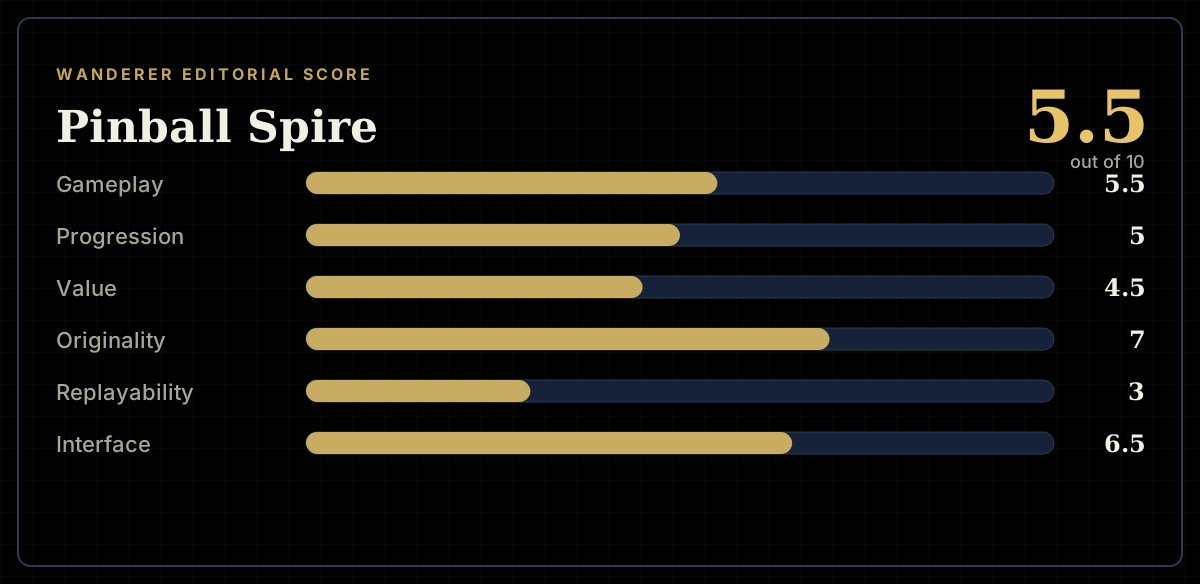
How the review scores each part of the gameWanderer Editorial -
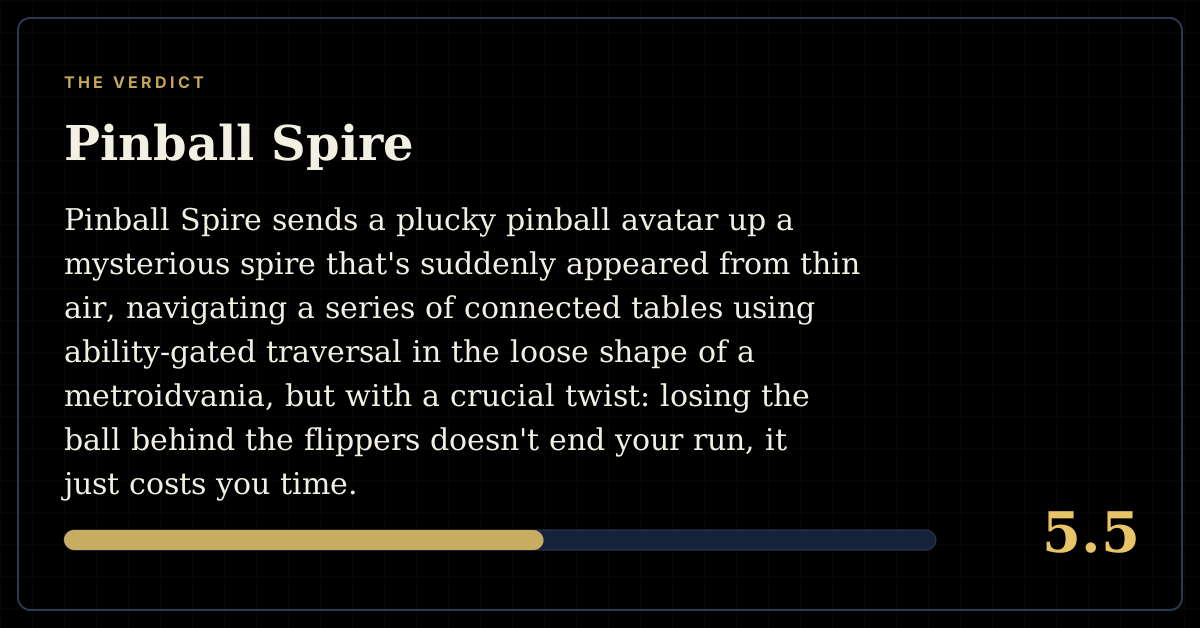
The short versionWanderer Editorial