
Game review
Voyager-19
5.5 / 10
- Developer
- Miziziziz
- Publisher
- Deep Root Interactive
- Released
- 19 May 2024
- Platforms
- Windows
- Genre
- First-person space horror
- Monetisation
- One-time purchase, no in-game store or additional currency purchases
- Players
- Single-player only
The short version
Voyager-19 puts you in control of a slowly failing spacecraft, rationing power between a camera, a radio, and thrusters as you search the depths of space for a science expedition that vanished without a trace. It's a direct, openly acknowledged homage to Iron Lung, and this review's sample shows nearly universal agreement on that comparison, positive and negative reviewers alike. What they disagree on is whether the homage succeeds: a genuine core of atmosphere and a handful of effective scares are widely credited, but the dominant pattern across this sample is that the tension the game builds in its first ten to fifteen minutes gives way to repetitive, tedious power management that undercuts rather than sustains the dread it's clearly aiming for.
Biggest strengths
- The atmosphere, sound design, and radio-wave audio in particular draw specific, genuine praise, with reviewers noting real research clearly went into making the in-game transmissions sound authentic
- The opening minutes of the game are widely credited with real, effective tension and a handful of reviewers describe genuine jump-scares landing well
- The decaying-ship concept, where your control interface and visual clarity degrade as you play, is praised by multiple reviewers as a clever, thematically appropriate mechanical hook even by critics who otherwise found the game's execution lacking
Biggest weaknesses
- The single most repeated complaint across this review's sample is that tension and interest fade steadily as the game progresses, with reviewers describing the back half as tedious and repetitive rather than building toward a sustained sense of dread
- A large majority of both positive and negative reviewers directly compare the game unfavorably to Iron Lung, describing it as an homage that borrows the formula's beats without matching its execution or sense of clunky, unsettling immersion
- Several reviewers describe the ending as lackluster or confusing relative to the buildup, with at least one reviewer reporting they didn't realize the game had actually ended until checking an outside guide
Who it's for: Fans of minimalist, resource-management horror games like Iron Lung looking for a short, cheap space-set variation on that formula, with tempered expectations that this entry doesn't reach the same level of sustained tension.
Our recommendation: Worth its very low price for a single, roughly hour-long sitting if the concept intrigues you — just go in with modest expectations, since this review's sample shows most players finding the middle stretch drags well before the atmospheric ending arrives.
5.5 / 10
Voyager-19 puts you in the seat of a battered spacecraft, decades into a search for the Magella Science Expedition, a manned mission to distant star systems that vanished after failing to establish communication. You'll ration limited power between a slow-display camera, a radio for catching transmissions, and thrusters for navigation, all while your ship's failing systems degrade around you. It's an openly acknowledged descendant of Iron Lung's minimalist survival-horror template, and this review's sample is unusually unified in naming that lineage directly — the disagreement is entirely about whether Voyager-19 lives up to it.
A genuinely strong opening
Nearly every review in this sample, whatever its final verdict, credits the game's first act. "First I want to say I love a lot of the ideas and concepts of this game. I really appreciate the amount of research put in to make the radio sounds as realistic as possible. Also, the scares in this game really did get me. Its extremely atmospheric and it really makes you feel lost in space," one reviewer writes. Another, playing specifically for the dread rather than the mechanics, reports real success: "I'm desensitized to scary games but this one had me squirming around in my seat and getting anxious as the game progressed." The decaying-interface concept earns its own specific praise too — losing visual clarity and control fidelity as your ship deteriorates is repeatedly called a smart, thematically coherent hook, even by reviewers who ultimately found the broader execution lacking.
Where nearly everyone agrees it loses steam
The dominant pattern in this sample, cutting across both positive and negative reviews, is that whatever tension the opening builds doesn't sustain itself. "By the time the horror started to reveal itself any potential fear i would've felt was replaced with frustration and boredom, because this game's idea of scaling difficulty is just making everything take more time," one reviewer writes. Another agrees almost precisely: "interesting at first but its just tedious as time goes on. The more you go on the less playable it is due to the screen being so distorted." A third distills the arc concisely: "At first I was expecting a good cosmic horror, and I got it… at the beginning. But as time went on the game became more and more boring, the suspense just faded away." This pattern recurs often enough — across reviewers who otherwise clearly wanted to like the game — that it reads as the defining structural weakness rather than a subjective mismatch of taste.
The Iron Lung comparison, made explicit by nearly everyone
What makes this review's sample distinctive is how directly and constantly it invokes one specific reference point. "It's impossible to review this game without mentioning Iron Lung, most of the beats are lifted directly from it," one reviewer writes bluntly. A positive reviewer makes the same comparison while still landing on a recommendation: "Voyager-19 is a clone of the game Iron Lung but instead of being in a submarine you're in a spaceship. It doesn't work nearly as well or is as nearly as creepy or interesting as Iron Lung. That said I still found the experience interesting." A third, more forgiving: "I recommend this game, It is definitely an Iron lung clone. Though it is made in genuine appreciation." That range — from "clone, and a lesser one" to "clone, but affectionately made" — captures the sample's central tension well: this is a game whose entire genre lineage is worn openly, and whether that's a fair or unfair standard to hold it to depends heavily on how much credit you give homage versus originality.
A specific complaint about the ending
Beyond pacing, several reviewers flag the conclusion itself as a letdown relative to the atmosphere built beforehand. "The game is extremely short, and the ending is lackluster. In fact I didn't even know the game had ended until i was looking up a guide to see if I was just stuck," one reviewer writes — a fair, concrete criticism distinct from the broader pacing complaint, since it points to a specific moment where the game's minimalist presentation works against clarity rather than mood. Another reviewer who loved Iron Lung specifically expresses disappointment that Voyager-19's take on a similar structure doesn't culminate in anything comparably memorable.
What the achievement data (doesn't) show
Notably, Voyager-19 has no tracked achievements at all in Steam's system — consistent with its minimalist, single-path design and short runtime, and a reminder that this is a small, tightly scoped experience rather than one built around extensive completionist content. That absence isn't itself a red flag; it simply confirms the game is exactly as compact as its reviewers describe.
A confirmed record of ongoing support
Despite its short length and modest scope, this review found real evidence of sustained developer investment. Voyager-19's partner-events feed documents two bug-fix patches in the weeks after its May 2024 launch, a considerably later 2026 update adding mod support and Steam Workshop integration, and a 2027 addition of Turkish, Spanish, and Indonesian fan translations. That's a genuinely active, multi-year commitment to a five-dollar horror game well beyond what its short runtime might suggest it deserves.
Final verdict
Voyager-19 is an honest, openly acknowledged homage to Iron Lung that captures real atmosphere and a handful of effective scares in its opening minutes, but a broad, consistent portion of this review's sample found the tension it builds doesn't survive contact with its repetitive power-management busywork or its underwhelming ending. At its very low price, it's a reasonable one-sitting curiosity for genre fans with modest expectations — just don't expect it to match the game it's so visibly indebted to.
Pros and cons
Pros
- The atmosphere, sound design, and radio-wave audio in particular draw specific, genuine praise, with reviewers noting real research clearly went into making the in-game transmissions sound authentic
- The opening minutes of the game are widely credited with real, effective tension and a handful of reviewers describe genuine jump-scares landing well
- The decaying-ship concept, where your control interface and visual clarity degrade as you play, is praised by multiple reviewers as a clever, thematically appropriate mechanical hook even by critics who otherwise found the game's execution lacking
- The very low price makes it an easy, low-risk purchase for a roughly hour-long horror experience, and several reviewers explicitly frame it as good value on those terms alone
- Steam's own partner-events feed confirms the developer continued supporting the game well past launch, adding mod support and Workshop integration and multiple new community-driven translations years after release
Cons
- The single most repeated complaint across this review's sample is that tension and interest fade steadily as the game progresses, with reviewers describing the back half as tedious and repetitive rather than building toward a sustained sense of dread
- A large majority of both positive and negative reviewers directly compare the game unfavorably to Iron Lung, describing it as an homage that borrows the formula's beats without matching its execution or sense of clunky, unsettling immersion
- Several reviewers describe the ending as lackluster or confusing relative to the buildup, with at least one reviewer reporting they didn't realize the game had actually ended until checking an outside guide
- The power-management mechanic that initially reads as clever is criticized by multiple reviewers as overused, requiring repetitive menu-switching that becomes frustrating busywork rather than sustaining tension as the game continues
- At least one reviewer reports the game failing to render entirely on their system, producing a black screen on a new game start, a concrete technical failure distinct from the broader pacing criticism
Screenshots
-

Voyager-19Image: Deep Root Interactive via Steam -

Voyager-19Image: Deep Root Interactive via Steam -

Voyager-19Image: Deep Root Interactive via Steam -
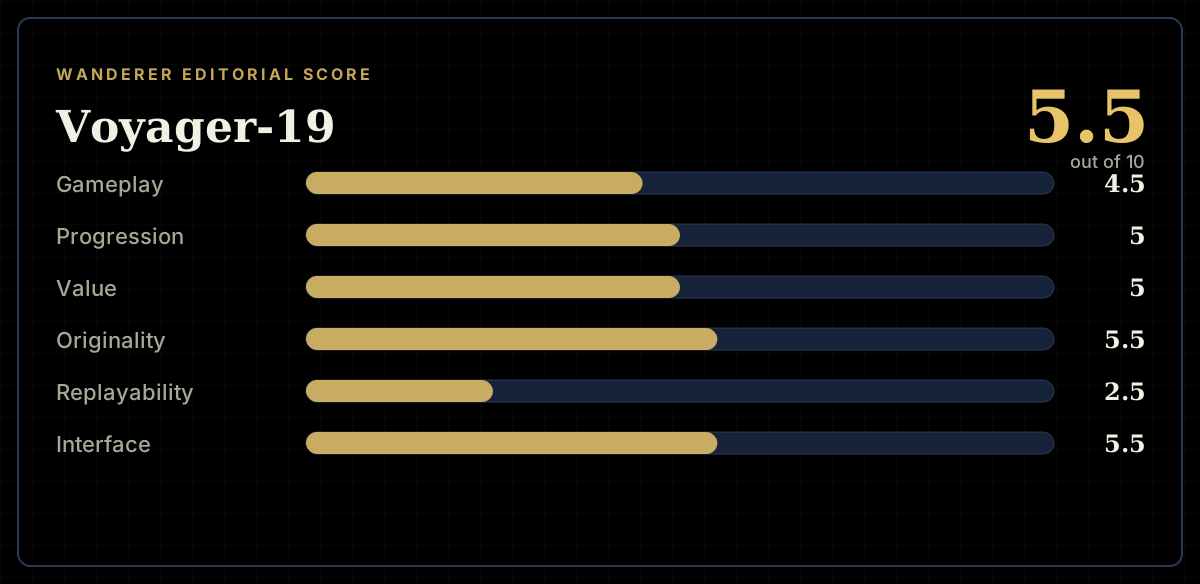
How the review scores each part of the gameWanderer Editorial -
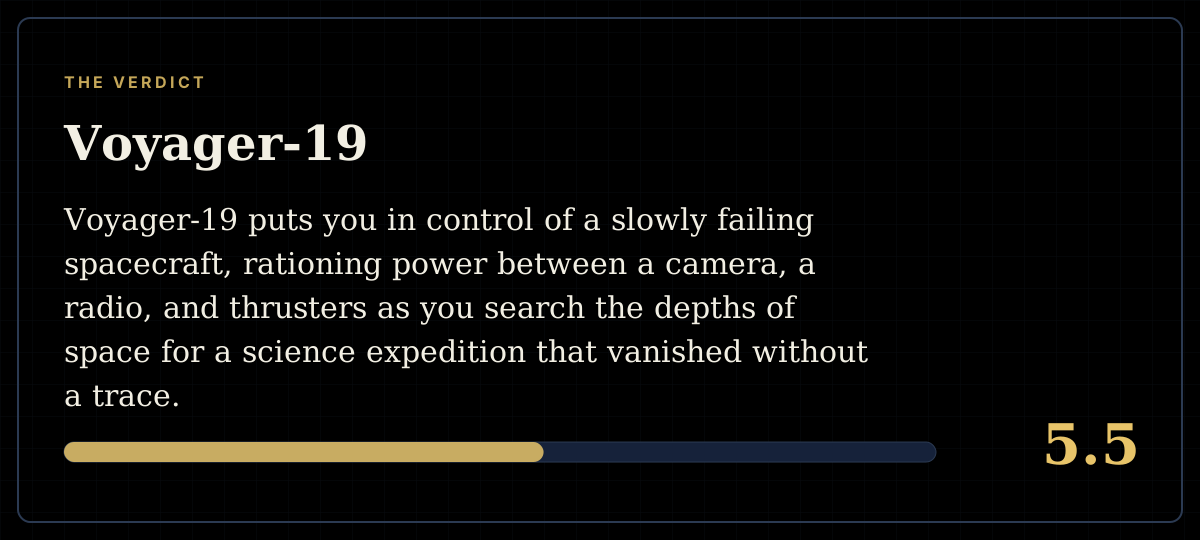
The short versionWanderer Editorial