
Game review
Sword of the Sea
6.5 / 10
- Developer
- Giant Squid
- Publisher
- Giant Squid
- Released
- 19 August 2025
- Platforms
- Windows
- Genre
- Adventure, Exploration
- Monetisation
- One-time purchase, no DLC or in-game currency
- Players
- Single-player
The short version
Sword of the Sea sends a resurrected Wraith surfing across dunes and restored waters on a hoversword that moves like a skateboard, snowboard and surfboard fused into one, in a wordless, dialogue-free world from Matt Nava and Giant Squid — the team behind Journey, ABZÛ and The Pathless. The pedigree shows: reviewers repeatedly describe it as a spiritual sibling to those earlier games, praising the movement feel, the music and the meditative, story-through-imagery approach the studio is known for. What an unusually large share of that same admiring audience is equally insistent about is a serious launch-week performance problem — choppy, unstable frame rates reported even on capable hardware like an RTX 3080, severe enough that multiple reviewers who clearly love the game are explicitly recommending others wait for a patch rather than buy immediately. A second, smaller but real complaint concerns length: several reviewers report finishing the entire game in under three hours at a NZ$43.59 price point.
Biggest strengths
- The movement itself draws outstanding, specific praise — the hoversword's blend of skateboarding, snowboarding and surfing feels genuinely novel within the studio's own body of work, with reviewers calling it both exhilarating and meditative depending on pace
- The wordless, dialogue-free storytelling approach lands for the large majority of reviewers, several of whom specifically compare the emotional effect to Journey and this year's acclaimed animated film Flow, crediting the visual-only narrative with real impact despite (or because of) its silence
- Music and art direction draw near-universal praise even from the game's harshest critics, with the shifting, wave-like desert-to-ocean environments singled out as some of the studio's most visually striking work yet
Biggest weaknesses
- An unusually large and consistent share of the review corpus reports serious performance and frame-pacing problems at launch, with reports of instability persisting even on capable hardware like an RTX 3080 and remaining unresolved across different graphics settings — a significant issue for a game whose entire appeal rests on smooth, flow-state movement
- Multiple reviewers explicitly recommend other buyers wait for a patch before purchasing, a specific and actionable piece of advice rather than a vague complaint, and one that recurs independently across many different accounts
- Several reviewers report finishing the entire game in under three hours — one specifically clocks in at 2 hours 47 minutes — and argue that length doesn't justify the NZ$43.59 asking price regardless of the quality of what's there
Who it's for: Fans of Giant Squid's earlier work and of short, wordless, atmosphere-first "art games" in the Journey lineage, who are prepared to wait for performance patches or accept choppy visuals in exchange for early access to the experience. Less of a fit for anyone who needs a long campaign for their money, or who can't tolerate technical rough edges in a genre built around smooth, meditative movement.
Our recommendation: Wait for a performance patch unless you're comfortable with reported frame-rate instability even on strong hardware — the movement, music and visual design are worth experiencing once the technical issues are addressed, but buying at launch risks undermining exactly the smooth, flow-state feeling the whole game is built around.
6.5 / 10
A hoversword across an ocean of sand
Sword of the Sea's premise is simple and immediately legible without a single line of dialogue: a resurrected Wraith rides a hoversword — equal parts skateboard, snowboard and surfboard — across shifting deserts and glacial mountains, gradually transforming the arid landscape back into glistening water as an ancient, buried sea returns to the world. That wordless approach to storytelling is exactly the register Matt Nava and Giant Squid built their reputation on with Journey and ABZÛ, and reviewers overwhelmingly say this entry earns its place alongside those predecessors — the movement itself draws the strongest praise in the entire corpus, with reviewers describing pulling off flips, grabs and wall-rides across dunes and halfpipe-like ruins as both exhilarating and, paradoxically, meditative depending on how fast you choose to move.
A performance problem too widespread to ignore
Set against that acclaim is a technical story too consistent to treat as isolated hardware trouble. An unusually large share of the review corpus — appearing in both explicitly negative reviews and inside otherwise glowing positive ones — reports serious frame-pacing and stability problems, with multiple reviewers specifically naming capable, modern GPUs like the RTX 3080 as insufficient for a smooth experience regardless of graphics settings chosen. That's a genuinely damaging problem for this specific game in a way it might not be for others: the entire appeal of Sword of the Sea rests on fluid, flow-state momentum, and reviewers are explicit that choppy playback undermines exactly that feeling. Several reviewers go further than simply complaining — they explicitly recommend other prospective buyers wait for a patch before purchasing, a specific, actionable piece of advice that recurs independently across many different accounts rather than coming from one unusually affected player. Steam Deck owners report the problem is especially pronounced on handheld hardware, a disappointing result for a game whose meditative pacing would otherwise suit portable play well.
Short, and not cheap
A second, smaller complaint concerns length relative to price. Multiple reviewers report finishing the entire game in under three hours — one clocks in precisely at 2 hours 47 minutes — and argue that a NZ$43.59 asking price is difficult to justify for an experience that short, regardless of its quality. This isn't a universal complaint; several reviewers who took their time exploring each environment describe feeling satisfied with the length for what the game is trying to achieve. But it's raised often enough, including by reviewers who otherwise rate the game highly, to be a real factor in the value calculation rather than a minority nitpick.
A smaller, more specific critique comes from longtime fans of the studio's earlier catalogue: a detailed minority argues Sword of the Sea plays it safer than Journey, ABZÛ or The Pathless, one reviewer specifically describing the design choices as "Easy Mode" relative to what came before. That's a harder claim for a broader audience to evaluate without direct familiarity with those earlier games, but it's worth noting as a specific, informed critique rather than generic disappointment.
Standing alongside Journey and ABZÛ
The comparisons reviewers reach for aren't casual name-dropping — they're specific and considered. One reviewer frames an annual craving for exactly this kind of game, naming last year's Jusant as the prior entry in a personal tradition before crediting Sword of the Sea as this year's answer: "no cutscenes, no dialogue," just gliding through non-verbal storytelling "like it's a beautiful dream you don't want to wake up from." Another draws a more topical parallel to Flow, the acclaimed 2025 animated film about animals surviving a rising flood without a word of dialogue between them, suggesting Sword of the Sea is tapping into a wider cultural moment for wordless, atmosphere-first storytelling rather than working in isolation. That kind of cross-medium comparison is a meaningfully stronger endorsement than simple genre praise — reviewers are placing this game alongside work they consider among the best non-verbal storytelling of the year, not just the best in its own niche.
The restoration theme itself — transforming a barren, sand-buried world back into glistening water as you progress — gives the wordless narrative a clear emotional throughline even without any explicit text, and reviewers consistently describe understanding the story's shape and stakes purely through the changing environment around them. That's a difficult trick to pull off well, and it's the clearest throughline connecting this entry to Journey and ABZÛ's own reputations for environmental storytelling done right.
The verdict
Sword of the Sea delivers exactly the kind of wordless, painterly, movement-driven experience Giant Squid's reputation promises, and the praise for its art, music and hoversword feel is both broad and specific enough to trust. What keeps this review from a stronger recommendation is a performance problem too widespread, too consistently reported by hardware that should easily handle a stylised, non-photorealistic game like this, to treat as an edge case — and a short runtime that a meaningful share of buyers feel doesn't match the asking price. The most honest advice this review can offer, echoing many of the game's own admirers: wait for the technical issues to be patched, then experience what by most accounts is a genuinely worthwhile few hours in Giant Squid's most visually ambitious world yet — one that a growing number of reviewers are already placing alongside the year's best wordless storytelling, technical hiccups and all — provided the studio gets those hiccups sorted before too much of that goodwill erodes.
Pros and cons
Pros
- The movement itself draws outstanding, specific praise — the hoversword's blend of skateboarding, snowboarding and surfing feels genuinely novel within the studio's own body of work, with reviewers calling it both exhilarating and meditative depending on pace
- The wordless, dialogue-free storytelling approach lands for the large majority of reviewers, several of whom specifically compare the emotional effect to Journey and this year's acclaimed animated film Flow, crediting the visual-only narrative with real impact despite (or because of) its silence
- Music and art direction draw near-universal praise even from the game's harshest critics, with the shifting, wave-like desert-to-ocean environments singled out as some of the studio's most visually striking work yet
- Full controller haptic feedback support, including DualSense-specific implementation, is specifically praised by reviewers who tried it, adding a tactile dimension to the surfing feel
- Reviewers who bought in already aware of the performance issues and adjusted their expectations accordingly still describe the underlying experience as worth having, suggesting the problems are fixable rather than fundamental to the design
Cons
- An unusually large and consistent share of the review corpus reports serious performance and frame-pacing problems at launch, with reports of instability persisting even on capable hardware like an RTX 3080 and remaining unresolved across different graphics settings — a significant issue for a game whose entire appeal rests on smooth, flow-state movement
- Multiple reviewers explicitly recommend other buyers wait for a patch before purchasing, a specific and actionable piece of advice rather than a vague complaint, and one that recurs independently across many different accounts
- Several reviewers report finishing the entire game in under three hours — one specifically clocks in at 2 hours 47 minutes — and argue that length doesn't justify the NZ$43.59 asking price regardless of the quality of what's there
- A smaller but detailed minority of longtime Giant Squid fans argue this entry plays it safer than the studio's earlier work, describing the design as comparatively "Easy Mode" relative to Journey, ABZÛ and The Pathless
- Steam Deck players report the performance problems are particularly pronounced on handheld hardware, with one reviewer specifically calling out a game that should have been a great fit for the platform instead running poorly on it
Screenshots
-

Sword of the SeaImage: Giant Squid via Steam -

Sword of the SeaImage: Giant Squid via Steam -

Sword of the SeaImage: Giant Squid via Steam -
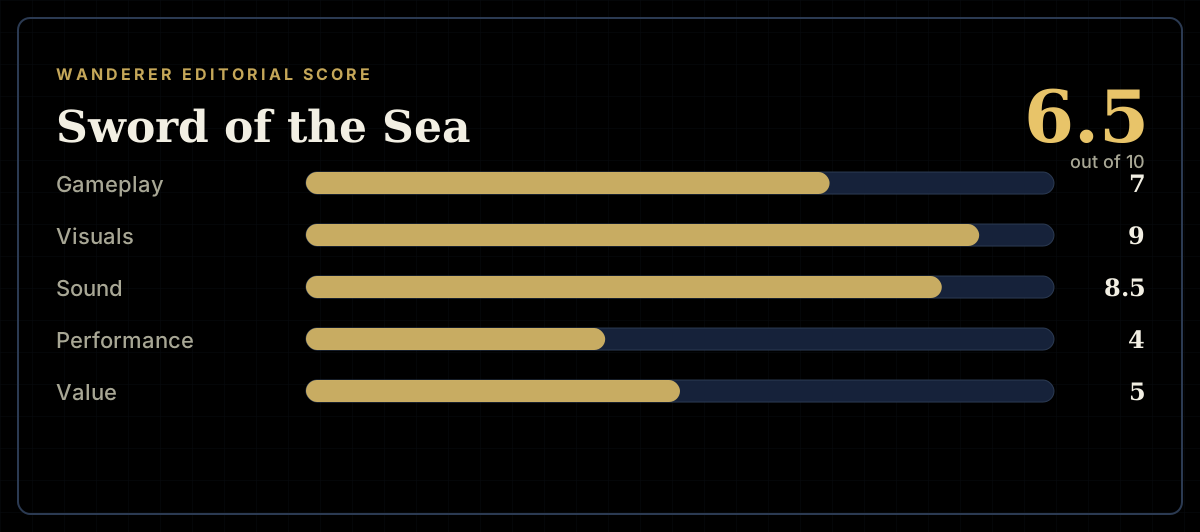
How the review scores each part of the gameWanderer Editorial -
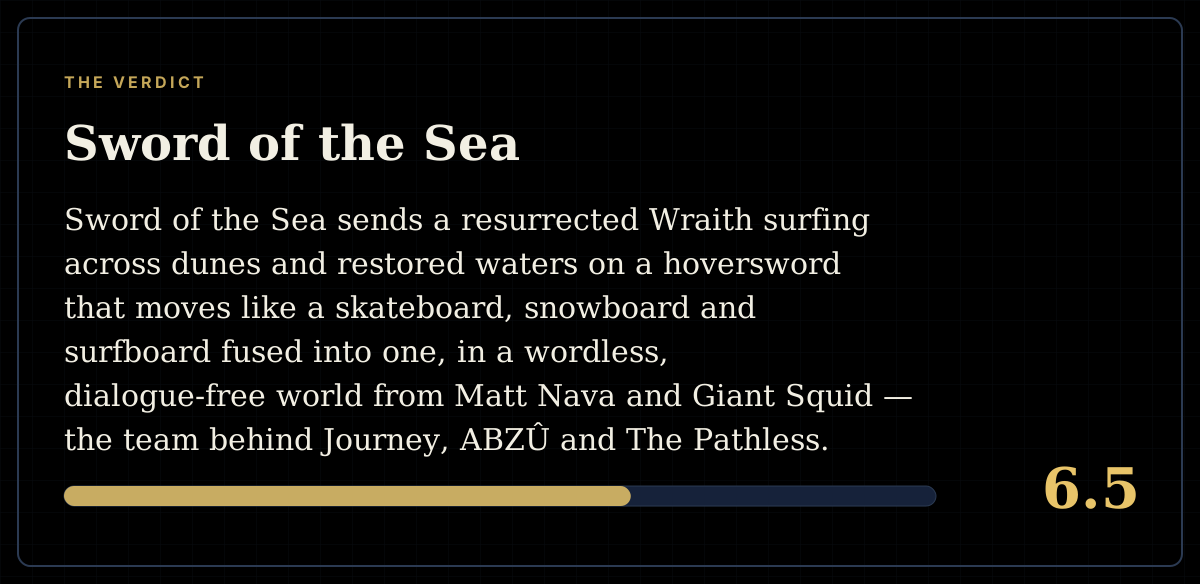
The short versionWanderer Editorial