
Game review
Herdling
6.5 / 10
- Developer
- Okomotive
- Publisher
- Panic
- Released
- 21 August 2025
- Platforms
- Windows
- Genre
- Adventure, Atmospheric
- Monetisation
- One-time purchase, no DLC or in-game currency
- Players
- Single-player
The short version
Herdling sends you and a herd of creatures called Calicorns up a mountain path through fog-wreathed forests, snowy plateaus and forgotten valleys, guiding them past eerie dangers and light environmental puzzles toward a mystery at the summit, entirely without dialogue. It's from Okomotive, the studio behind the acclaimed FAR series, published by Panic, the studio behind Firewatch, and the presentation lands exactly as that pedigree would suggest — an adaptive orchestral soundtrack and striking alpine art direction draw close to universal, often deeply personal praise. What a substantial, detailed share of the same review corpus argues is that the actual herding gameplay stays essentially unchanged from the first thirty minutes through to the credits, delivering roughly three hours of content for a price several reviewers explicitly say belongs closer to $10-15, with more than one describing the experience as an interesting concept the developers "didn't know what to do with" once the initial idea was established.
Biggest strengths
- The adaptive orchestral soundtrack draws exceptional, specific praise, with reviewers noting individual tracks shift based on play style and environment, and multiple describing it among the best game scores they've heard recently
- Visual art direction and creature design for the Calicorns themselves earn consistent, often emotionally invested praise, with reviewers describing genuine attachment to individual herd members they've named and grown fond of over a single playthrough
- At least one reviewer describes playing through a genuinely difficult personal circumstance and finding real comfort in the game's gentle, undemanding pace — a testament to the specific emotional register the atmosphere and pacing achieve for at least some of its audience
Biggest weaknesses
- A large, detailed share of reviewers — including self-described fans of the developer's earlier FAR games — report the core herding gameplay barely evolving past what's shown in the first thirty minutes, with the central challenge remaining "drive the herd forward" without meaningful new wrinkles introduced across the remaining chapters
- The price draws sustained, specific criticism relative to content: multiple reviewers explicitly argue NZ$37.49 for roughly three hours of largely static gameplay depth should instead sit closer to $10-15, several saying they enjoyed their time but still can't recommend buying at the current price
- The Journey comparison, while intended as a compliment by many reviewers, is used by others as the basis for a specific critique — that Herdling borrows Journey's tone and structure without finding its own equivalent hook, leaving several reviewers feeling the concept was never fully developed beyond its opening pitch
Who it's for: Fans of short, wordless, atmosphere-first adventures in the Journey lineage who prioritise mood, music and visual craft over evolving mechanics, and who are comfortable paying a premium price for a brief but polished experience. Less of a fit for anyone wanting the puzzle depth or environmental storytelling of Okomotive's earlier FAR games, which several reviewers say this entry doesn't match.
Our recommendation: Beautiful and genuinely moving for the right player, but wait for a discount — the game's own fondest reviewers are remarkably consistent that its current price outpaces both its length and its mechanical depth, even when they don't regret the time they spent with it.
6.5 / 10
Up the mountain, wordlessly
Herdling's premise is simple and immediately legible without a word of dialogue: guide a herd of creatures called Calicorns up an alpine path, through fog-wreathed forests and snowy plateaus, toward a mystery waiting at the summit. It comes from Okomotive, the developer behind the acclaimed FAR series, published by Panic — the same studio behind Firewatch — and that pedigree shows most clearly in the presentation. An adaptive orchestral score, which reviewers note shifts based on your playstyle and current environment, draws exceptional and specific praise, with multiple reviewers naming it among the best game music they've heard in recent memory. The Calicorns themselves earn real affection too, with reviewers describing naming individual herd members and genuinely caring what happens to them over the course of a single playthrough — no small feat for a cast that never speaks a line of dialogue.
When the concept stops developing
Where a substantial and detailed share of the review corpus pushes back is on how much the actual gameplay changes over that playthrough. Multiple reviewers, including several who identify themselves as existing fans of Okomotive's earlier FAR games, report that the core herding challenge — driving your creatures forward, navigating around obstacles — barely evolves past what's established in the first thirty minutes. One reviewer frames the disappointment precisely: "The initial concept is neat and feels very original but then it feels like they didn't know what to do with it so they just made it like Journey." That comparison shows up throughout the corpus in both complimentary and critical framings — for reviewers who love Journey's tone and pacing, the comparison is the highest praise available; for others, it reads as evidence Herdling borrowed a structure without finding an equally compelling hook of its own.
A price the game's own fans keep pushing back on
The most concrete, actionable complaint concerns value. At NZ$37.49 for what most reviewers clock at around three hours, multiple detailed reviews explicitly argue the price should sit closer to $10-15, with several stating plainly that they enjoyed their time but still can't recommend buying at the current asking price. That's a notably specific and consistent piece of consumer guidance rather than vague dissatisfaction — reviewers aren't disputing whether the experience is well-made, they're disputing whether three hours of largely unchanging gameplay depth justifies a price closer to a full-length game's typical range.
Real, if isolated, technical problems
Beyond pacing and price, a smaller number of reviewers report concrete technical issues worth flagging plainly. One details a specific, reproducible bug: fog obscuring a required item behind a statue near the game's final camp, compounded by an aggressive auto-save system that preserved the stuck state and forced a full restart rather than allowing recovery. Separately, multiple reviewers report performance issues and lag even on capable hardware, with one specifically naming an RTX 3090 as insufficient for consistently smooth play — a real problem for a game whose entire appeal rests on unbroken atmospheric immersion.
The stampede sequences, and what they're missing
The store page specifically highlights "exhilarating stampede sequences" as a key feature, and these faster, more kinetic moments are where reviewers describe Herdling at its most alive — a rush of speed and momentum that briefly departs from the otherwise measured, contemplative pace of the rest of the game. Reviewers who mention these sequences generally do so positively, treating them as a welcome change of tempo. The complaint about static gameplay isn't that these moments don't work, but that they don't build on each other or escalate across the game's roughly seven chapters — a stampede late in the game plays out much like one from the earlier stretches, without new hazards or wrinkles compounding the challenge the way a more mechanically ambitious game might structure its back half.
Measured against FAR
Comparisons to Okomotive's earlier FAR series recur constantly, and they're worth taking seriously given how many reviewers bring genuine prior experience with those games to their assessment of this one. The consistent verdict is that FAR's environmental puzzles and sense of discovery ran deeper, with Herdling's puzzle content specifically described as simpler and less frequent by reviewers who compare the two directly. That's not necessarily a criticism of Herdling in isolation — a herding adventure and a vehicle-salvage puzzle game are different enough premises that a direct mechanical comparison only goes so far — but it does inform why longtime fans of the studio's prior work describe feeling a specific kind of disappointment that a newcomer to Okomotive's catalogue wouldn't necessarily share. Expectations set by a beloved developer's back catalogue are a real, if unavoidable, part of how this particular game is being judged by a meaningful share of its audience.
The verdict
Herdling delivers real, often deeply personal emotional impact through its music, creature design and alpine atmosphere, and that's not a small achievement — one reviewer's account of finding comfort in the game during a genuinely difficult family circumstance is worth taking seriously as evidence of what the presentation can accomplish. But its own most thoughtful reviewers, including devoted fans of the developer's earlier work, are remarkably consistent that the gameplay underneath doesn't grow across its short runtime, and that the current price doesn't match what three hours of largely static mechanics deliver. This is a genuinely lovely experience worth having — just wait for it to come down in price before you have it.
Pros and cons
Pros
- The adaptive orchestral soundtrack draws exceptional, specific praise, with reviewers noting individual tracks shift based on play style and environment, and multiple describing it among the best game scores they've heard recently
- Visual art direction and creature design for the Calicorns themselves earn consistent, often emotionally invested praise, with reviewers describing genuine attachment to individual herd members they've named and grown fond of over a single playthrough
- At least one reviewer describes playing through a genuinely difficult personal circumstance and finding real comfort in the game's gentle, undemanding pace — a testament to the specific emotional register the atmosphere and pacing achieve for at least some of its audience
- Small, thoughtful design touches draw disproportionate goodwill, including default audio settings that don't blast players with loud menu music on first launch, and an optional immortality setting for the Calicorns that several reviewers specifically flag as an important accessibility and comfort choice
- The roughly three-hour length is framed by several reviewers as appropriately matched to the gameplay's simplicity rather than needlessly padded, arguing a game this atmospherically focused benefits from stopping before its systems could wear thin
Cons
- A large, detailed share of reviewers — including self-described fans of the developer's earlier FAR games — report the core herding gameplay barely evolving past what's shown in the first thirty minutes, with the central challenge remaining "drive the herd forward" without meaningful new wrinkles introduced across the remaining chapters
- The price draws sustained, specific criticism relative to content: multiple reviewers explicitly argue NZ$37.49 for roughly three hours of largely static gameplay depth should instead sit closer to $10-15, several saying they enjoyed their time but still can't recommend buying at the current price
- The Journey comparison, while intended as a compliment by many reviewers, is used by others as the basis for a specific critique — that Herdling borrows Journey's tone and structure without finding its own equivalent hook, leaving several reviewers feeling the concept was never fully developed beyond its opening pitch
- At least one reviewer reports a specific, reproducible pathing bug involving fog obscuring a required item behind a statue near the final camp, compounded by an aggressive auto-save system that preserved the stuck state and forced a restart rather than allowing recovery
- Multiple reviewers report performance issues and lag even on strong hardware, with one specifically citing an RTX 3090 as insufficient for consistently smooth play, undercutting the atmospheric immersion the presentation is built around
Screenshots
-

HerdlingImage: Panic via Steam -

HerdlingImage: Panic via Steam -

HerdlingImage: Panic via Steam -
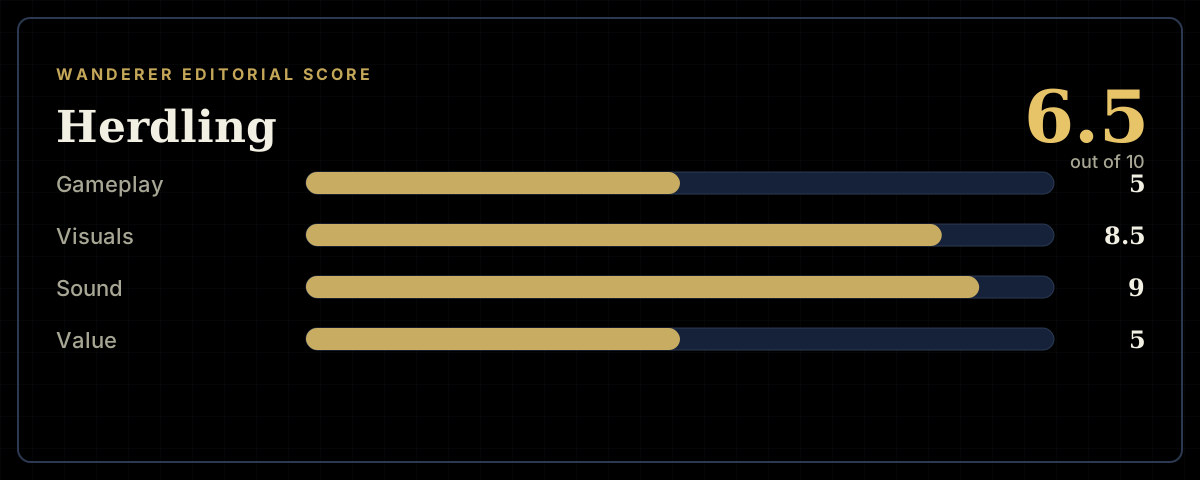
How the review scores each part of the gameWanderer Editorial -
The short versionWanderer Editorial