
Game review
Grunn
6.5 / 10
- Developer
- Sokpop Collective, Tom van den Boogaart
- Publisher
- Sokpop Collective
- Released
- 4 October 2024
- Platforms
- Windows
- Genre
- First-person mystery / cozy horror
- Monetisation
- One-time purchase, no in-game store or additional currency purchases
- Players
- Single-player only
The short version
Grunn hires you for a simple weekend gardening job — trim the grass, water the flowers, tidy up — before revealing that the property's absent owner, the off-limits house, and the reserved townsfolk nearby are hiding something considerably stranger. Structured around repeated runs where dying or reaching one of several endings sends you back to the start with only your accumulated knowledge carried forward, the game invites constant comparison to Outer Wilds, and this review's sample shows that comparison cuts both ways: reviewers who embrace the format describe a genuinely memorable, atmospheric puzzle box worth losing sleep over, while a substantial and specific portion of the negative sample argues the comparison sets up expectations the game's looser, occasionally arbitrary failure states and repeated mundane chores don't actually meet.
Biggest strengths
- The atmosphere and tonal blend of cozy gardening work and creeping horror earns wide, specific praise, with multiple reviewers describing the shift from mundane chores to unsettling discovery as genuinely well-executed
- The knowledge-gated structure, where later runs benefit from information rather than items or stats, draws direct and enthusiastic comparisons to Outer Wilds and Myst from reviewers who clearly know the format well and consider Grunn a worthy entry in it
- Multiple reviewers describe genuine emotional resonance in the mundane gardening tasks themselves, with at least one directly connecting the experience to real memories of family and place
Biggest weaknesses
- A specific, detailed portion of the negative sample directly disputes the Outer Wilds comparison, arguing that where Outer Wilds telegraphs danger through consistent, learnable rules, Grunn's failure states feel arbitrary and unfair, with one reviewer describing dying to "a ghost thing" while simply walking down a hallway with no clear warning
- The loop's core friction point is that death or a "game over" ending resets not just knowledge-gated puzzle progress but also already-completed mundane chores like cutting grass, a design choice several reviewers single out as turning an interesting mechanic into repetitive busywork
- Multiple reviewers describe reaching a point where they stopped caring to find the true ending among eleven possible outcomes, citing fatigue with the repeated setup phase rather than any lost interest in the mystery itself
Who it's for: Fans of knowledge-gated "loop and learn" mystery games like Outer Wilds or Myst who don't mind some genuine horror-adjacent tension and repeated restarts, and who are willing to tolerate a looser, less mechanically rigorous version of that format than the comparison implies.
Our recommendation: Worth playing blind if the loop-and-discover format appeals to you, but go in expecting a shorter, rougher-edged experience than the Outer Wilds comparisons suggest — and be ready for the gardening chores to become a genuine chore themselves once you're restarting for the fourth or fifth time.
6.5 / 10
Grunn starts you off with the most mundane job imaginable: a gardener hired for a weekend of maintenance in the Dutch countryside, trimming grass, watering flowers, picking up trash. It doesn't stay mundane for long. Some of the owner's tools are mysteriously missing, the owner themselves is nowhere to be found, their house is off-limits, and the small nearby town holds reserved, secretive residents who might know more than they let on. What follows is a knowledge-gated loop structure where death or reaching one of several endings sends you back to the start, retaining only what you've learned — and this review's sample is unusually clear about exactly where that structure succeeds and where it starts to strain.
An atmosphere reviewers keep coming back to
The tonal blend at the heart of Grunn — cozy garden chores shading into genuine unease — earns consistent, specific praise. "This game is truly a vibe, the 'horror' aspect is fun and well done, but something about just working in the garden made me nostalgic from working on my grandma's garden," one reviewer writes, describing an emotional register the game reaches that few horror-adjacent titles attempt. Another, more experienced with the genre, frames the achievement clearly: "If you've played so-called 'knowledgevania' games like Outer Wilds or Myst... and wondered 'can this format translate' to a smaller, stranger scale — Grunn answers that question convincingly for a lot of players." A reviewer with 1,427 minutes logged doesn't hedge at all: "An instant classic indie gem. This game is simply fantastic and I recommend it wholeheartedly."
The comparison that both makes and complicates the game's reputation
Outer Wilds comparisons appear in nearly every review in this sample, positive and negative alike, and that ubiquity is itself part of the story. Where positive reviewers treat the comparison as earned — "Similar to my favourite game of all time (Outer Wilds) in the sense that progression happens through what you know," one writes — a specific, detailed portion of the negative sample argues the comparison actively works against the game by setting expectations it doesn't meet. "This game is absolutely NOT like Outer Wilds. Puzzles are tedious and illogical, endings are boring and let you learn nothing," one reviewer writes bluntly. Another gets specific about exactly where the comparison breaks down: "Outer Wilds had some logic to it on what was obviously dangerous or a bad idea for you to do but in Grunn you'll just die because you walked down a hallway and get done in by ghost thing for [seemingly no reason]." That's a genuinely useful distinction for prospective buyers — the games share a structural skeleton, but reviewers who came in expecting Outer Wilds's rigorous, learnable rule-set describe a rougher, less consistent version of that promise.
When the loop turns into busywork
The second major thread in the negative sample is more concrete and, in some ways, more damning: the restart cost isn't just knowledge-neutral, it's chore-costly. "I really really wanted to like this game but the dying and have to recut all that damn grass before I can actually engage with the story really kills it for me," one reviewer writes. Another describes the fatigue directly: "Started out very fun, but quickly became too much like a chore when you were wasting 15-30 minutes each time just to try something that led nowhere." A third makes the mechanical complaint explicit: "if the game wouldn't make you start over everytime you get to 1 of the many endings this game would have been fun. Now it's tedious, repetitive and grindy." This is a distinct, specific criticism from the Outer Wilds-comparison debate — it's not about whether the puzzle logic is fair, but about whether the cost of retrying it repeatedly is proportionate to what you learn from each attempt, and a meaningful share of this sample says it isn't.
A caveat about the horror itself
One reviewer flags a mismatch between reputation and reality worth passing on directly: "I played it due to another review saying you can play it without touching the horror elements and can just treat it like a gardening game. That's a lie, the horror elements are baked into the game at certain points and if you want to progress, you'll have to" engage with them regardless of preference. A separate reviewer criticizes the horror's execution specifically, describing it as devolving "very quickly into sudden loud noise jumpscares" rather than sustained atmospheric dread. Buyers hoping for a purely cozy gardening experience with horror as an optional garnish should know that isn't accurate — the unsettling elements are load-bearing, not skippable.
What the achievement data confirms
Steam's own completion figures line up closely with the reviewer-described pattern of early enthusiasm fading against restart fatigue. An early milestone sits at a strong 91.3%, with several mid-progression achievements still comfortably above 50%, indicating most buyers do get meaningfully into the mystery. But several late-game achievements — presumably tied to specific, harder-to-reach endings among the game's eleven possible outcomes — sit under 9%, a steep enough drop to corroborate the negative sample's core complaint: a real minority of even engaged players ultimately decide the specific true ending isn't worth the repeated setup cost required to reach it.
A confirmed, orderly development history
This review found no basis for concern about the game being abandoned or rushed. Grunn's partner-events feed shows a clean, complete arc: a public demo roughly four months before launch, a well-announced release date, launch day itself, one documented bug-fix patch shortly after, and — well over a year later — a demo announcement for the developer's next project, Grail. That's a normal, healthy lifecycle for a small game from a small studio, with nothing suggesting the negative sample's frustrations stem from an unfinished or neglected release.
Final verdict
Grunn is a genuinely atmospheric, well-supported knowledge-gated mystery that earns real comparisons to genre landmarks like Outer Wilds, even as a substantial and articulate portion of its audience makes a fair case that those comparisons oversell how consistent and fair its puzzle logic actually is. Go in for the atmosphere and the strangeness of the premise, temper expectations around how tightly the failure states are tuned, and be prepared for the restart cost to wear thin if you're chasing the true ending among its eleven possible endings.
Pros and cons
Pros
- The atmosphere and tonal blend of cozy gardening work and creeping horror earns wide, specific praise, with multiple reviewers describing the shift from mundane chores to unsettling discovery as genuinely well-executed
- The knowledge-gated structure, where later runs benefit from information rather than items or stats, draws direct and enthusiastic comparisons to Outer Wilds and Myst from reviewers who clearly know the format well and consider Grunn a worthy entry in it
- Multiple reviewers describe genuine emotional resonance in the mundane gardening tasks themselves, with at least one directly connecting the experience to real memories of family and place
- The developer, Sokpop Collective, delivered a complete, orderly support arc — a public demo, a clean launch, one documented bug-fix patch, and a healthy transition to their next project — with no gaps suggesting neglect
- The low price and short overall runtime make it an accessible, low-risk way to sample the knowledge-gated mystery format for players who haven't tried the genre before
Cons
- A specific, detailed portion of the negative sample directly disputes the Outer Wilds comparison, arguing that where Outer Wilds telegraphs danger through consistent, learnable rules, Grunn's failure states feel arbitrary and unfair, with one reviewer describing dying to "a ghost thing" while simply walking down a hallway with no clear warning
- The loop's core friction point is that death or a "game over" ending resets not just knowledge-gated puzzle progress but also already-completed mundane chores like cutting grass, a design choice several reviewers single out as turning an interesting mechanic into repetitive busywork
- Multiple reviewers describe reaching a point where they stopped caring to find the true ending among eleven possible outcomes, citing fatigue with the repeated setup phase rather than any lost interest in the mystery itself
- At least one reviewer reports the horror elements as unavoidable jump-scare noise rather than sustained dread, specifically disputing marketing or reviewer claims that the horror can be sidestepped by treating it purely as a gardening game
- Achievement data shows a steep falloff from 91.3% for early content down to under 9% for several late-game achievements, corroborating widespread reviewer reports that most players see the game's opening hours but a comparatively small fraction push through repeated restarts to its true ending
Screenshots
-

GrunnImage: Sokpop Collective via Steam -

GrunnImage: Sokpop Collective via Steam -

GrunnImage: Sokpop Collective via Steam -
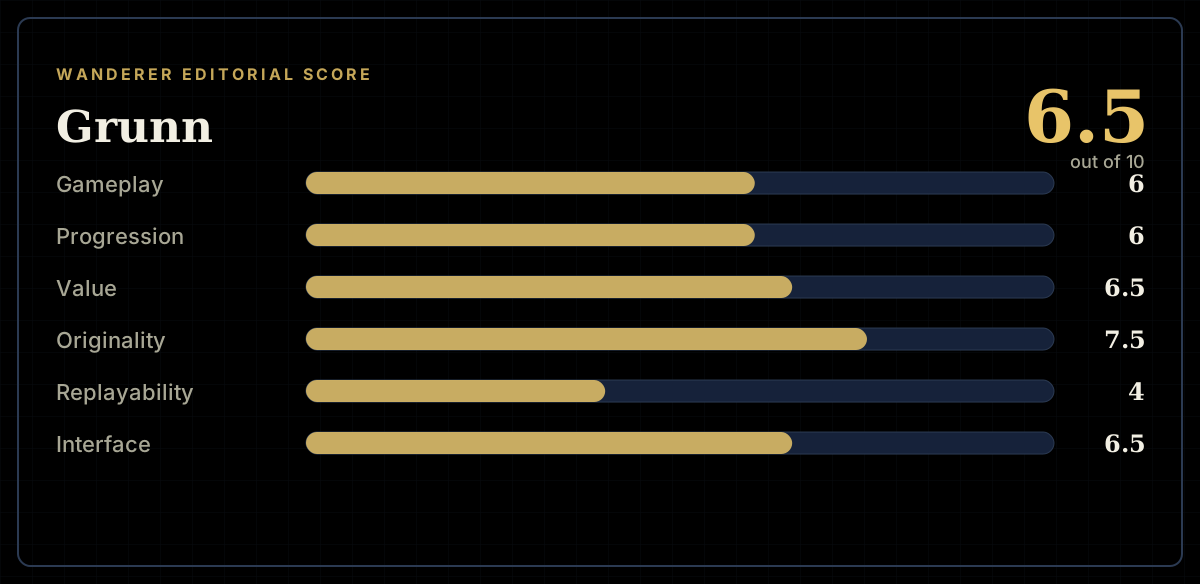
How the review scores each part of the gameWanderer Editorial -
The short versionWanderer Editorial