
Game review
Utopia Must Fall
6.5 / 10
- Developer
- Pixeljam
- Publisher
- Pixeljam
- Released
- 9 September 2024
- Platforms
- Windows, macOS
- Genre
- Base-defense arcade roguelite
- Monetisation
- One-time purchase, no DLC or microtransactions during Early Access
- Players
- Single-player only
The short version
Utopia Must Fall reimagines Missile Command as a synthwave-scored, vector-graphics roguelite, tasking players with defending a single city from escalating waves of alien attackers across a run of in-game days. This review's sample is close to unanimous in praising the game's look, feel, and moment-to-moment satisfaction, frequently compared favourably to the roguelike shooter Nova Drift. Set against that is an unusually consistent, specific negative-review theme: a linear upgrade tree with little build synergy, a difficulty curve several reviewers describe as scaling through raw enemy health rather than interesting new challenges, and — as an actively updated Early Access title — a current content ceiling reachable within just a handful of hours.
Biggest strengths
- The vector-art visual style, synthwave soundtrack, and overall moment-to-moment "feel" of play earn close to unanimous praise across this review's sample, with multiple reviewers comparing it favourably to classic arcade cabinets
- Steam's own partner-events feed confirms an unusually active, sustained Early Access update cadence, including a named "Quality Of Life Update," an "Industrial Update," and "The Escalation Update," continuing well over a year past initial launch
- The game earned an IGF Award nomination, confirmed directly via the developer's own partner-events post, a notable, checkable mark of industry recognition for an Early Access title
Biggest weaknesses
- A large, specific, and repeated negative-review theme criticizes the upgrade system as hyper-linear, with reviewers naming a near-total absence of cross-category synergy compared to genre touchstone Nova Drift, leaving every run's build feeling similar regardless of choices made
- Multiple reviewers independently describe difficulty scaling through raw enemy health increases ("bullet sponges") rather than more interesting mechanical challenges, creating a sharp difficulty wall in the second and third in-game weeks
- Global achievement data shows a steep completion cliff consistent with this specific reviewer complaint — the most-earned achievement sits at 64.4%, while most others fall below 30%, several under 10%
Who it's for: Fans of retro arcade aesthetics and score-attack roguelites like Nova Drift or Vampire Survivors looking for a short, atmospheric session rather than a deep, long-term build-crafting experience; players wanting extensive build diversity or permanent meta-progression should wait for further Early Access updates.
Our recommendation: Worth picking up now for the presentation and short-session arcade thrill alone, with the understanding that its current Early Access depth is genuinely thin — check the version history before buying if build variety and long-term progression matter to you.
6.5 / 10
Utopia Must Fall drops players into a single, simple task: keep humanity's last city standing against wave after wave of alien attackers, armed with an expanding arsenal of turrets, shields, and railguns rendered in gorgeous, glowing vector art. This review's sample confirms that premise lands beautifully on a moment-to-moment level — and identifies a large, specific, and unusually consistent set of complaints about what happens once the initial thrill wears off.
A near-unanimous aesthetic triumph
Reviewers across this sample reach for the same comparisons and the same enthusiasm. "UMF is like a game from another dimension where arcades still rule the video game world and vector screens never went out of style," one writes. Another distills the pitch precisely: "30% Missile Command + 30% Space Invaders + 20% Asteroids + 20% Rogue-like progression = Utopia Must Fall." A third calls it simply "a thing of beauty. Bleak, terrible beauty. Pristine neon beauty." That praise for feel and atmosphere is close to universal across the sample, even among reviewers who go on to recommend against buying.
The dominant complaint: a linear tree with no synergy
Set against that presentation, this review's negative sample converges repeatedly on a specific, mechanically detailed criticism: the upgrade system lacks meaningful interaction between choices. "The upgrades are very linear, by which I mean you get one upgrade, then you get another that makes that one better... but synergies are nowhere to be found," one reviewer writes, adding that upgrades are "color coded by which group they fall into... and there is practically no interaction at all between the groups." Another reviewer makes the same point through direct genre comparison: "this dev could learn a lot from how Nova Drift handles difficulty and build diversity." That comparison to Nova Drift recurs across multiple independent reviews, suggesting reviewers are measuring this game against a specific, shared genre benchmark rather than applying a vague standard.
Difficulty that scales through health, not challenge
A second, equally specific complaint concerns how the game gets harder. "While later days introduce more complex enemies and send more enemies at once, enemy health increases rapidly. It seems to be the main form of difficulty scaling," one reviewer writes, describing how "an enemy wave that could be killed as they enter the screen requires two passes with the main weapon" within the first in-game week. Another reviewer offers a detailed, quantified account of exactly where this wall appears: noting the most commonly earned achievement (defeating the first boss) sits far above the achievement for defeating the second boss, and arguing the jump between the two represents a difficulty spike disproportionate to the content between them. This review's own check of Steam's achievement data corroborates that shape directly — completion rates fall from 64.4% for the top achievement to under 30% for the great majority of the remaining thirty, a steep cliff consistent with what these reviewers describe.
No permanent progression, and a short current ceiling
Several reviewers raise a related structural gap: nothing carries over between runs. "I love the game's look, but I wish there was some permanent progression," one writes, while another states it more forcefully: "This game desperately needs metaprogression. Otherwise, its just a boring 15 minutes total game." Multiple reviewers who reached what the game currently treats as an end state report doing so within one to four hours of play, with one explicitly weighing that against the asking price: "You can reach 'end game' in about 4 hours and that's it... the price they ask for the content you get is not worth it at all."
What the update record confirms
Steam's own partner-events feed shows this is not a stalled or abandoned Early Access project — quite the opposite. Twenty-eight documented posts show a genuinely active, named-update cadence (an "Industrial Update," a "Quality Of Life Update," "The Escalation Update") continuing well into 2026, alongside a confirmed IGF Award nomination and a disclosed price increase tied to added content. That directly supports the read that this is a game still being actively shaped rather than a shipped-and-forgotten shell — though it also means several of the specific complaints raised in this review's sample, particularly around upgrade synergy and meta-progression, may already be shifting by the time a given reader checks the current build.
A veteran studio's track record
Pixeljam is a long-running indie studio best known for Dino Run and its sequel, and several reviewers explicitly frame their trust in the current build through that history, expressing confidence the team will keep iterating in good faith even where the current build falls short. That context matters for weighing the negative-review complaints here: the partner-events feed's own "Post-Launch Report / Future Plans" post and repeated named-update cadence suggest a studio actively responding to exactly the kind of feedback catalogued in this review's negative sample, rather than one that has moved on or stopped listening.
Final verdict
Utopia Must Fall succeeds completely on atmosphere, and this review's sample confirms its vector-art presentation and core moment-to-moment feel earn some of the most consistent praise seen across comparable titles. But a large, specific, and remarkably aligned negative-review consensus — a linear upgrade tree without synergy, health-driven difficulty spikes, and no permanent progression — describes real, structural gaps rather than surface-level nitpicks. Given the confirmed, active pace of Early Access development, this is a reasonable buy now for the atmosphere alone, with the expectation that its current depth is thin and evolving rather than final.
Pros and cons
Pros
- The vector-art visual style, synthwave soundtrack, and overall moment-to-moment "feel" of play earn close to unanimous praise across this review's sample, with multiple reviewers comparing it favourably to classic arcade cabinets
- Steam's own partner-events feed confirms an unusually active, sustained Early Access update cadence, including a named "Quality Of Life Update," an "Industrial Update," and "The Escalation Update," continuing well over a year past initial launch
- The game earned an IGF Award nomination, confirmed directly via the developer's own partner-events post, a notable, checkable mark of industry recognition for an Early Access title
- Several reviewers specifically praise the enemy design and moment-to-moment engagement in the early stretch of a run, describing genuinely satisfying tension in the "protect the one city" core premise
- The lack of any DLC or microtransactions during Early Access, with the full upgrade set included in the base purchase, is a point several reviewers note approvingly compared to genre peers
Cons
- A large, specific, and repeated negative-review theme criticizes the upgrade system as hyper-linear, with reviewers naming a near-total absence of cross-category synergy compared to genre touchstone Nova Drift, leaving every run's build feeling similar regardless of choices made
- Multiple reviewers independently describe difficulty scaling through raw enemy health increases ("bullet sponges") rather than more interesting mechanical challenges, creating a sharp difficulty wall in the second and third in-game weeks
- Global achievement data shows a steep completion cliff consistent with this specific reviewer complaint — the most-earned achievement sits at 64.4%, while most others fall below 30%, several under 10%
- Reviewers report there is currently no permanent meta-progression between runs, meaning a failed run offers no lasting reward beyond restarting from scratch, a structural gap several call out as the single biggest missing piece
- Multiple reviewers who reached what the game currently treats as an "end game" report doing so in as little as one to four hours, with one specifically stating "the price they ask for the content you get is not worth it" at the current stage of Early Access
Screenshots
-

Utopia Must FallImage: Pixeljam via Steam -

Utopia Must FallImage: Pixeljam via Steam -

Utopia Must FallImage: Pixeljam via Steam -
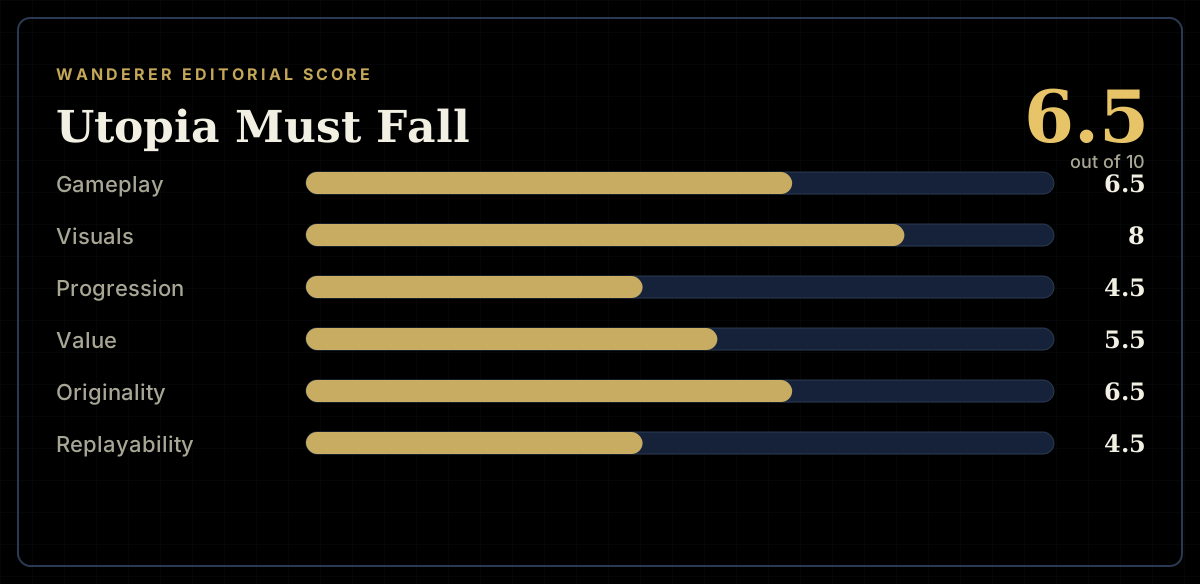
How the review scores each part of the gameWanderer Editorial -
The short versionWanderer Editorial