
Game review
Upload Labs
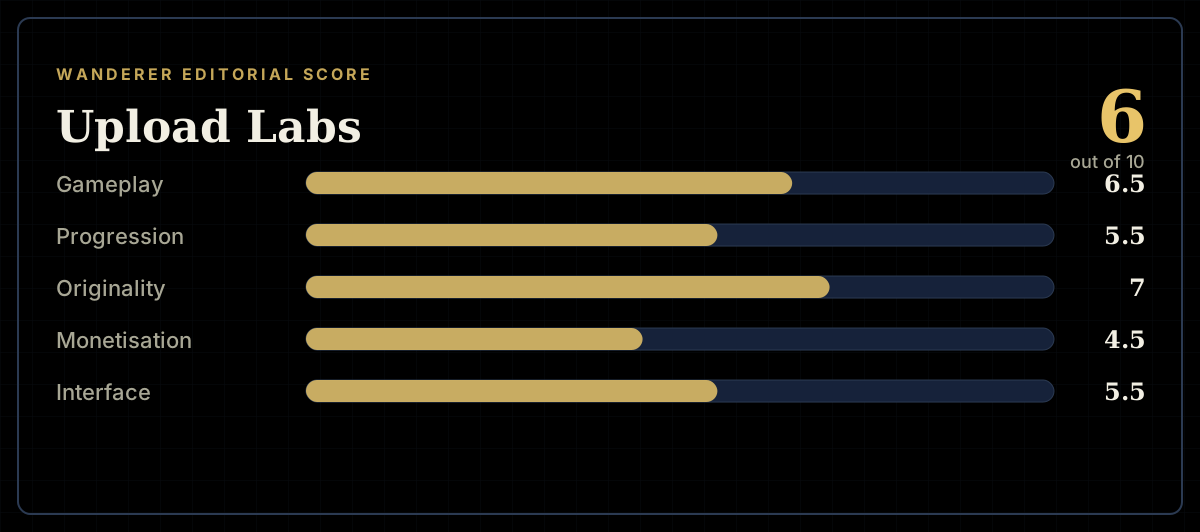
6 / 10
- Developer
- EnigmaDev Studios
- Publisher
- EnigmaDev Studios
- Released
- 3 October 2025
- Platforms
- Windows
- Genre
- Idle, Simulation, Automation
- Monetisation
- Free to play, with optional premium currency and cosmetic/QoL purchases
- Players
- Single-player
The short version
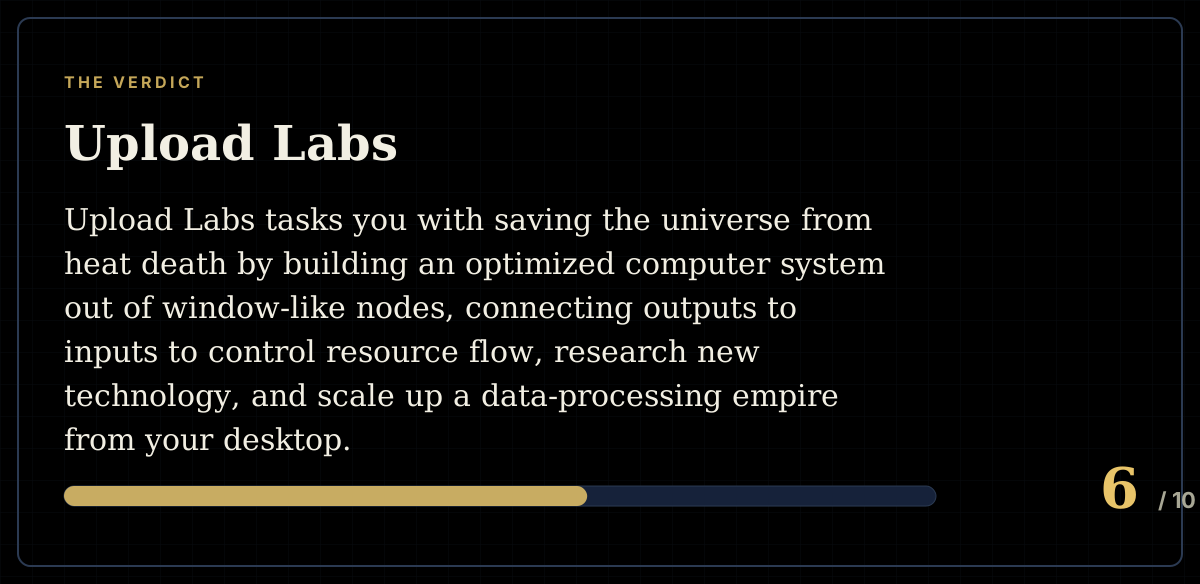
Upload Labs tasks you with saving the universe from heat death by building an optimized computer system out of window-like nodes, connecting outputs to inputs to control resource flow, research new technology, and scale up a data-processing empire from your desktop. It's free to play, with cross-progression to mobile, and its core loop generates a strikingly consistent reaction across thousands of reviews: multiple separate reviewers describe uninstalling the game "for my own good" after single 11-to-15-hour sessions, a level of specific, repeated self-reported compulsion that's rare even among idle games built to be engaging. Set against that is real controversy around a major 2.0 update that a substantial and specific share of reviewers say reset meaningful progress, scrapped some of the best earlier upgrades, and noticeably increased both grind and monetisation pressure. A separate, specific and repeatedly-reported design flaw — no undo button in a drag-and-connect sandbox — has cost at least two detailed reviewers many hours of careful progress to a single misclick.
Biggest strengths
- The core loop generates an unusually specific and consistent self-reported compulsion across the review corpus, with multiple separate reviewers independently describing uninstalling the game after single sessions lasting 11 to 15 hours because they recognised the time sink as unhealthy
- The node-based system genuinely rewards deliberate optimization and ratio-planning for players willing to dig in, with at least one detailed reviewer specifically praising the layered, parallel upgrade trees that give the player "something else to do" across multiple systems simultaneously rather than a single linear path
- Free-to-play cross-progression between PC and mobile lets players continue an idle build across devices without losing progress, a meaningful convenience feature for a game explicitly designed to be checked in on throughout the day
Biggest weaknesses
- A major 2.0 update is the single most consistent and detailed complaint in the corpus, with multiple reviewers reporting it reset meaningful account progress, scrapped some of the strongest earlier upgrades, pushed the game's prestige mechanic much further back, and substantially increased both grind and monetisation pressure compared to the version they originally fell in love with
- The game's own drag-and-connect sandbox interface lacks an undo function, and at least two detailed reviewers report losing many hours of carefully built progress to a single accidental misclick or misplaced node connection, with one specifically calling the omission unacceptable for a sandbox built around precise system design
- A detailed, experienced reviewer argues the "automation" framing in the game's marketing oversells what's actually possible mechanically, describing the real optimal strategy as concentrating output into a single best-performing unit rather than genuinely scaling a diversified production system the way comparable automation games allow
Who it's for: Fans of node-based automation and optimization games who want a free, deep, and genuinely compelling time sink, and who are comfortable navigating a free-to-play monetisation model that draws real, specific criticism from a meaningful share of its own dedicated players. Less of a fit for players specifically burned before by "genre-bait" marketing, given a detailed complaint that the "automation" framing oversells how much genuine factory-style scaling is actually possible.
Our recommendation: Worth trying since it's free, and the addictive core loop is real and well-corroborated — but go in with your expectations calibrated by the 2.0 monetisation controversy and the missing undo button, and consider manually backing up your build before making major changes.
6 / 10
Building a system to outlast the heat death of the universe
Upload Labs hands you a lofty goal wrapped in a familiar idle-game structure: save the universe from inevitable heat death by designing an optimized computer system, one window-like node at a time. Outputs connect to inputs, data flows through research pipelines, and every new technology unlocked through the game's scanning and research mechanics opens further optimization possibilities. It's free to play with cross-progression to mobile, and it belongs to the node-based automation subgenre popularized by games like Factorio, translated here into a much smaller-scale, browser-adjacent idle format rather than a full 3D factory sim.
A specific, repeated kind of compulsion
What stands out most clearly across this game's enormous review corpus isn't any single mechanic, but a strikingly consistent, self-reported reaction to how compelling the core loop is. Multiple, entirely independent reviewers describe near-identical experiences: playing for 11 to 15 hours in a single overnight sitting, realizing it was 8am, and uninstalling the game specifically to protect their own time. That's a rare, specific pattern to see recur word-for-word across unrelated reviewers rather than generic "very addictive" praise, and it speaks to a genuinely well-tuned moment-to-moment loop underneath everything else this review raises concerns about.
The 2.0 controversy
The single most detailed and consistent complaint in the corpus concerns a major version 2.0 update. Multiple reviewers who clearly loved the original version describe the update resetting meaningful progress, scrapping some of the strongest earlier upgrades, pushing the prestige mechanic much further back in the progression curve, and substantially raising both the grind required and the monetisation pressure applied along the way. One reviewer frames the core objection precisely: "he didn't have to kill the progression," arguing the added monetisation could have arrived without gutting what made the earlier version rewarding. Another specifically criticizes the developer for "treating updates like it's early access even though it's not flagged as such" after a save-affecting update, a fair point about setting expectations correctly for a title marketed as a finished 1.0 release rather than an ongoing early-access experiment.
No undo button in a precision sandbox
A separate, more purely mechanical complaint concerns a specific missing feature: the drag-and-connect node interface has no undo function. At least two detailed reviewers report losing substantial progress — one specifically citing roughly nine hours of accumulated afk-clock building — to a single misclick or accidentally dragged node connection. For a sandbox explicitly built around the careful, precise design of interconnected systems, the absence of a basic safety net this fundamental is a significant, specific design gap rather than a matter of taste, and it's compounded by at least one account describing the existence of a schematics-saving feature that isn't clearly surfaced to players who'd want to use it preventatively.
Is it really an automation game?
A more conceptual criticism comes from experienced automation-genre players who argue the "automation" framing oversells what's mechanically possible. One detailed, highly-voted reviewer describes the optimal strategy as concentrating all production into a single best-performing unit rather than genuinely scaling a diversified system, arguing this makes the game "an idle game like Cookie Clicker loosely disguised as a factory game" rather than a true automation title with meaningful scaling decisions. That's a specific, informed critique from within the target genre audience rather than a generic complaint, and it's worth flagging clearly for players coming in expecting Factorio-style depth rather than idle-game pacing wrapped in automation-genre visuals.
What the achievement data confirms
Steam's global achievement percentages back up a genuinely steep late-game drop-off. Early achievements like the first successful upload sit around 82% completion, but the deepest, most demanding achievements — full optimization, full boosting, and reaching what the game calls "time traveler" status — fall to just 3.2-6.1%. That's consistent with the reviewer accounts of the 2.0 update dramatically extending the grind required to reach late-game milestones, and it suggests the substantial time investment multiple reviewers describe pursuing full completion genuinely does require the kind of extended, patient engagement those specific accounts describe.
Not everyone agrees it's exploitative
It's worth noting real pushback within the corpus against the P2W and monetisation criticisms. At least one reviewer specifically and directly disputes the negative reviews, reporting they reached 100% completion in around 60 hours without spending any real money, and argues much of the criticism comes from players who simply don't enjoy idle games as a genre rather than from a genuinely broken monetisation model. That's a fair point to weigh against the 2.0 controversy above — the update clearly made progression slower and monetisation more visible, but "slower" and "impossible without paying" are different claims, and the corpus contains credible accounts of both being closer to true than either extreme.
The verdict
Upload Labs earns its enormous, mostly positive review count through a genuinely compelling core loop that reviewers describe experiencing almost as a minor personal hazard, a rare and specific kind of praise for an idle game to receive this consistently. Where it loses ground is real and specific: a 2.0 update that a substantial share of its own longtime fans say damaged the experience they originally fell in love with, a missing undo button that has cost detailed reviewers real hours of progress, and legitimate debate about whether its automation-genre framing matches what the game actually delivers mechanically. It's free, so the risk of trying it is low — just go in with your expectations calibrated by the version-2.0 controversy rather than by the glowing, pre-update reviews still visible in the corpus's total count.
Pros and cons
Pros
- The core loop generates an unusually specific and consistent self-reported compulsion across the review corpus, with multiple separate reviewers independently describing uninstalling the game after single sessions lasting 11 to 15 hours because they recognised the time sink as unhealthy
- The node-based system genuinely rewards deliberate optimization and ratio-planning for players willing to dig in, with at least one detailed reviewer specifically praising the layered, parallel upgrade trees that give the player "something else to do" across multiple systems simultaneously rather than a single linear path
- Free-to-play cross-progression between PC and mobile lets players continue an idle build across devices without losing progress, a meaningful convenience feature for a game explicitly designed to be checked in on throughout the day
- At least one experienced reviewer specifically pushes back on the widespread pay-to-win criticism, reporting they reached full 100% completion in roughly 60 hours without spending any real money on the premium Tokens currency
- Accessibility options including adjustable text size, colour alternatives, and Steam Cloud saves are present from launch, a reasonable baseline for a free game built around long, repeated play sessions
Cons
- A major 2.0 update is the single most consistent and detailed complaint in the corpus, with multiple reviewers reporting it reset meaningful account progress, scrapped some of the strongest earlier upgrades, pushed the game's prestige mechanic much further back, and substantially increased both grind and monetisation pressure compared to the version they originally fell in love with
- The game's own drag-and-connect sandbox interface lacks an undo function, and at least two detailed reviewers report losing many hours of carefully built progress to a single accidental misclick or misplaced node connection, with one specifically calling the omission unacceptable for a sandbox built around precise system design
- A detailed, experienced reviewer argues the "automation" framing in the game's marketing oversells what's actually possible mechanically, describing the real optimal strategy as concentrating output into a single best-performing unit rather than genuinely scaling a diversified production system the way comparable automation games allow
- Specific monetisation complaints recur around cosmetic and quality-of-life features placed behind a premium currency paywall, with one reviewer specifically objecting to node colour-customization, an organizational tool rather than a pure cosmetic, being monetised rather than offered as a standard update
- At least one reviewer raises a specific privacy concern about the game requesting microphone access, without further detail on why a system-management idler would need it; this review could not independently verify the purpose or scope of that permission request beyond the reviewer's own account
Screenshots
-

Upload LabsImage: EnigmaDev Studios via Steam -

Upload LabsImage: EnigmaDev Studios via Steam -

Upload LabsImage: EnigmaDev Studios via Steam -
How the review scores each part of the gameWanderer Editorial -
The short versionWanderer Editorial