
Game review
Tyrion Cuthbert: Attorney of the Arcane
7.5 / 10
- Developer
- Diamondhenge Entertainment
- Publisher
- Diamondhenge Entertainment
- Released
- 23 June 2023
- Platforms
- Windows
- Genre
- Fantasy Courtroom Visual Novel
- Monetisation
- One-time premium purchase; a massive free content update overhauled the base game in 2026, with the original version preserved as free DLC for players who prefer it
- Players
- Single-player only; no online, co-op or PvP modes
The short version
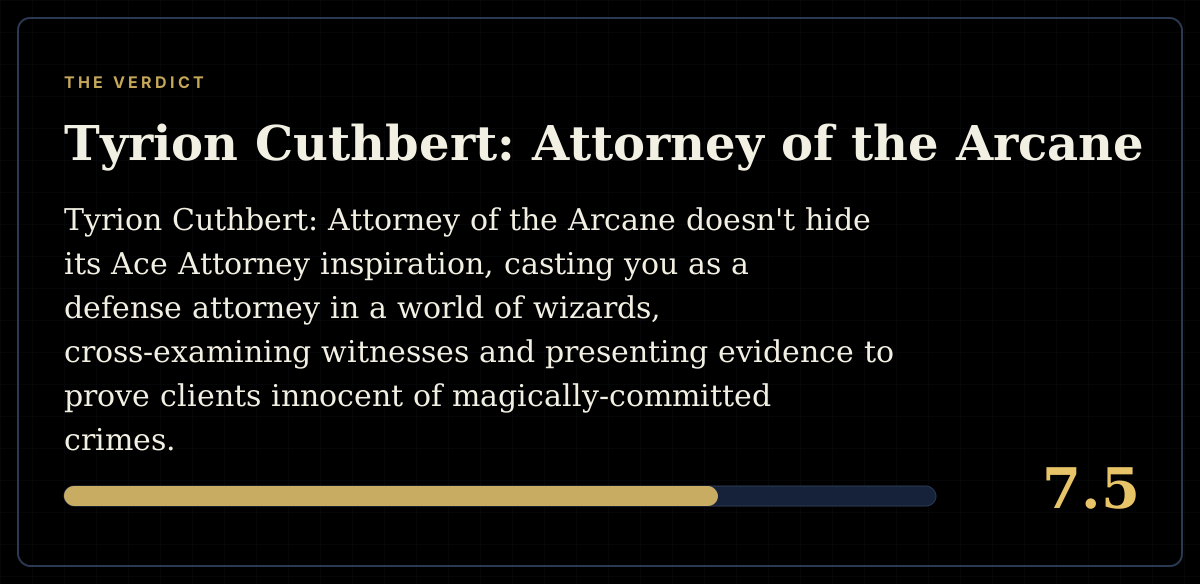
Tyrion Cuthbert: Attorney of the Arcane doesn't hide its Ace Attorney inspiration, casting you as a defense attorney in a world of wizards, cross-examining witnesses and presenting evidence to prove clients innocent of magically-committed crimes. Reviewers, many of them longtime Ace Attorney fans, consistently praise the creative use of its fantasy setting — divination magic, a mind-reading "Eye of Horus" mechanic, and magical tomes woven directly into the detective gameplay — and credit several of its five cases with genuinely well-crafted mystery design.
What kept the reception from being uniformly glowing at launch was a real, specific gap between ambition and polish: amateurish writing, uneven mystery difficulty across cases, and a final case many reviewers describe as ending abruptly enough to raise real questions about development troubles. This review's research confirms the developer took that feedback seriously and literally: after years of incremental patches, a massive January 2026 update rewrote dialogue, overhauled Case 3's mystery, and restructured story beats across the game — while transparently preserving the original 2023 version as free DLC for players who prefer it.
Biggest strengths
- Creative, well-integrated use of its fantasy setting, including divination magic and a mind-reading mechanic that expand what a detective courtroom game can do beyond what Ace Attorney itself can attempt
- Several genuinely well-crafted mystery cases, with reviewers experienced in the genre singling out specific cases as matching the best pacing and intricacy the Ace Attorney trilogy has to offer
- Logically consistent contradiction-based gameplay that several reviewers say improves on Ace Attorney's occasionally frustrating leaps in logic, making cases feel fairer to solve
Biggest weaknesses
- The original 2023 release drew consistent criticism for amateurish, "fanfic-tier" writing, with grammatical errors and pacing issues that reviewers attributed clearly to a small, inexperienced team
- Mystery difficulty is reported as inconsistent across cases, with some contradictions criticized as too simplistic and obvious relative to the genre's usual standard
- The original final case was widely described as ending abruptly in a way that broke narrative immersion, a specific complaint the developer's own later communications acknowledge as valid
Who it's for: Ace Attorney fans and mystery visual novel enthusiasts specifically, willing to accept an amateur passion-project feel in exchange for genuine creativity within the fantasy courtroom format. Less suited to anyone who needs polished, professional-grade writing throughout.
Our recommendation: A genuinely worthwhile pickup for Ace Attorney fans today, especially given the substantial rework its most criticized elements have received since launch — a rare case of a small studio taking years of community feedback seriously and acting on it in full.
7.5 / 10
Tyrion Cuthbert: Attorney of the Arcane wears its inspiration proudly: cross-examining witnesses, presenting contradictory evidence, and defending clients accused of impossible crimes are all lifted directly from Ace Attorney's playbook, transplanted into a world where the crimes are committed with magic instead of mundane means. Reviewers, many of them lifelong fans of that franchise, consistently describe the fantasy setting as genuinely well-used rather than a simple reskin, and the game's Overwhelmingly Positive reception reflects real, specific creative achievement — even as its launch-era rough edges drew equally specific, well-founded criticism.
The game unfolds across five distinct cases, each introducing new characters, magical mechanics and courtroom stakes as the overarching plot builds toward its conclusion.
A fantasy setting used with real creativity
The strongest, most consistent praise concerns how the game's magic system integrates directly into its detective gameplay. Divination magic, magical tomes cross-referenced as evidence, and a mind-reading "Eye of Horus" mechanic give reviewers real new tools beyond what Ace Attorney's more grounded setting allows, and several detailed reviews — including from players with extensive history across the entire Ace Attorney series — single out specific cases, particularly the fourth and fifth, as matching the pacing and intricacy of the genre's best work. Multiple reviewers also credit the game with more logically consistent contradictions than Ace Attorney itself sometimes offers, describing fewer of the frustrating, "out there" logical leaps that occasionally plague that series.
Writing reviewers call amateur, with real love behind it
Set against that creative praise, the original release drew consistent, specific criticism for its writing quality. Reviewers describe grammatical errors, awkward pacing, and dialogue reviewers characterize as "good-fanfic-tier" — amateurish, but clearly made with real affection for the format. Mystery difficulty draws a related, more structural complaint: several reviewers describe specific cases, particularly the second and third, as hyper-simplistic and predictable compared to the layered contradictions genre veterans expect, with some evidence differences described as requiring nothing more than basic reading comprehension to spot.
A final case reviewers say ended too soon
The most serious specific complaint concerns the game's original final case, which multiple reviewers describe ending abruptly in a way that broke their suspension of disbelief, several openly speculating about what happened during the game's development to cause such a rushed conclusion. That's a serious structural criticism distinct from the writing-quality complaints above, since it points to a case that reviewers felt was genuinely well-conceived but insufficiently realized by the time of release.
A transparent, years-long response confirmed directly
What sets Tyrion Cuthbert apart from many similarly-received small-studio releases is how directly and honestly the developer eventually addressed these complaints. Checking the public patch record confirms sustained, incremental work from launch onward — dozens of patches fixing typos and plot inconsistencies individually — culminating in a massive content update released in January 2026, roughly two and a half years after launch. That update's own announcement is candid about its scope and its limits: it explicitly lists rewritten dialogue, a "complete overhaul of the mystery in Case 3," and restructured story beats across multiple cases, while the developer states plainly, "I haven't solved every issue raised" — a notably honest framing rather than an overselling of the fix. Remarkably, the original 2023 version remains available as free DLC for players who prefer the earlier experience, a transparent choice this lane hasn't seen replicated elsewhere.
What wasn't found addressed
Not every specific complaint maps onto a confirmed fix. At least one reviewer describes frequent, strong screen shake effects causing genuine physical discomfort during play, and this review's research found no patch note explicitly addressing that accessibility concern across the sampled history. Buyers sensitive to screen shake should verify current settings options directly before purchasing rather than assuming the issue has been resolved.
What the achievement data suggests
Global achievement figures show a fairly gentle decline typical of a story-driven visual novel rather than a mechanically demanding game, from 71.2% of the playerbase completing the first case down to 50.9% completing the fifth and final one — a comparatively forgiving curve suggesting most players who start the game do see it through to its conclusion.
A defense attorney with a magical toolkit
The setting's central conceit — a courtroom where defense hinges on understanding how specific spells and rituals actually function — gives the game's investigation phases a genuinely different texture from typical detective fiction. Reviewers describe real satisfaction piecing together how a given magical effect could or couldn't have caused a crime scene's specific details, treating the game's invented magic system less as window dressing and more as a functional, internally consistent set of rules the player has to learn and apply, not unlike solving a puzzle with its own specific logic.
Smaller complaints that round out the picture
Beyond the headline issues, several smaller but consistently repeated complaints round out how reviewers describe the original experience. Romance subplots woven into certain cases draw specific criticism as forced or poorly written, with at least one reviewer describing actively skipping through those scenes as quickly as possible. Evidence management draws a related, more mechanical complaint: later cases in particular pile on large amounts of evidence that ultimately goes unused, making the process of sorting through the "Present" evidence system feel tedious rather than strategically meaningful, since there's rarely a clear signal for which items actually matter to a given contradiction.
Where it lands
Tyrion Cuthbert: Attorney of the Arcane earns its warm reception through genuine creative ambition within a beloved format, and its launch-era writing and pacing weaknesses were real, specific, and fairly criticized. What elevates this beyond a typical amateur homage is the developer's sustained, transparent, years-long response — a comprehensive rework that directly targets the exact complaints reviewers raised, delivered with unusual honesty about what it does and doesn't fix. For Ace Attorney fans specifically, this remains a genuinely worthwhile, creatively distinctive pickup.
Pros and cons
Pros
- Creative, well-integrated use of its fantasy setting, including divination magic and a mind-reading mechanic that expand what a detective courtroom game can do beyond what Ace Attorney itself can attempt
- Several genuinely well-crafted mystery cases, with reviewers experienced in the genre singling out specific cases as matching the best pacing and intricacy the Ace Attorney trilogy has to offer
- Logically consistent contradiction-based gameplay that several reviewers say improves on Ace Attorney's occasionally frustrating leaps in logic, making cases feel fairer to solve
- A genuinely exceptional, transparent post-launch support record, culminating in a massive 2026 overhaul that rewrote dialogue, restructured cases and revised character art based directly on years of community feedback
- Strong, well-implemented music throughout, drawing consistent praise even from reviewers critical of other aspects of the writing
Cons
- The original 2023 release drew consistent criticism for amateurish, "fanfic-tier" writing, with grammatical errors and pacing issues that reviewers attributed clearly to a small, inexperienced team
- Mystery difficulty is reported as inconsistent across cases, with some contradictions criticized as too simplistic and obvious relative to the genre's usual standard
- The original final case was widely described as ending abruptly in a way that broke narrative immersion, a specific complaint the developer's own later communications acknowledge as valid
- At least one reviewer reports frequent, strong screen shake effects causing genuine discomfort; this review's research found no confirmed patch addressing that specific complaint
- Excessive, mostly-unused evidence in later cases draws criticism for making evidence management tedious rather than meaningfully strategic
Screenshots
-

Tyrion Cuthbert: Attorney of the ArcaneImage: Diamondhenge Entertainment via Steam -

Tyrion Cuthbert: Attorney of the ArcaneImage: Diamondhenge Entertainment via Steam -

Tyrion Cuthbert: Attorney of the ArcaneImage: Diamondhenge Entertainment via Steam -
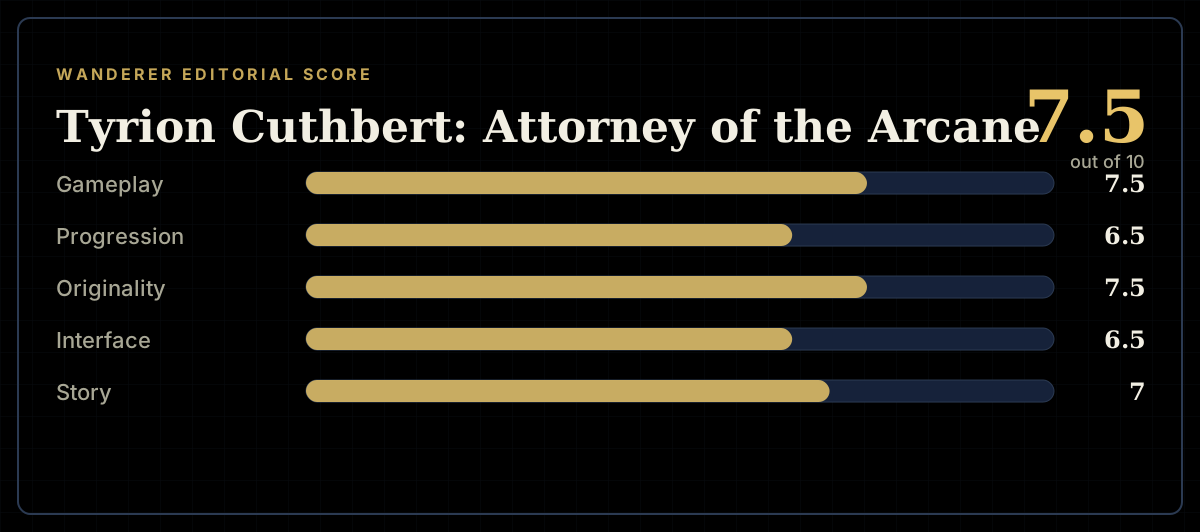
How the review scores each part of the gameWanderer Editorial -
The short versionWanderer Editorial