
Game review
Celeste
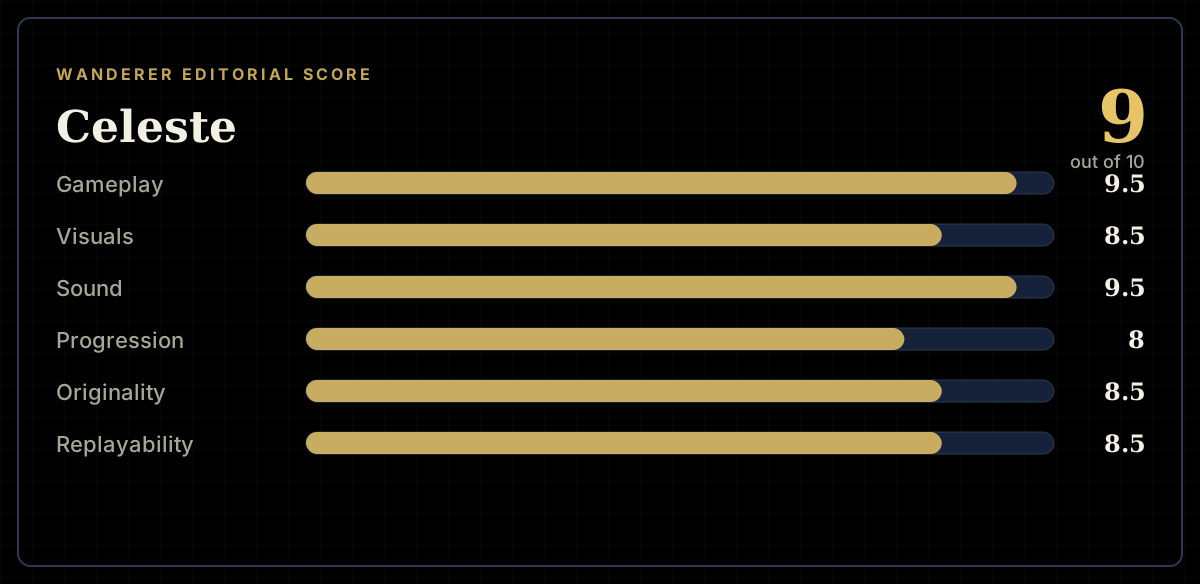
9 / 10
- Developer
- Maddy Makes Games Inc.
- Publisher
- Maddy Makes Games Inc.
- Released
- 25 January 2018
- Platforms
- Windows, macOS, Linux
- Genre
- Precision Platformer
- Monetisation
- One-time purchase, NZ$29.99. No microtransactions. The Farewell chapter is free.
- Players
- Single-player only
The short version
Celeste is widely regarded as one of the best precision platformers ever made, and 97.4% positive across 145,195 reviews backs that up — tight, expressive movement built around a single dash, level design that teaches its own rules with almost no wasted screens, and a genuinely moving story about anxiety and self-doubt told through the climbing itself rather than around it. It's also, honestly, one of the harder mainstream indie games of its era, and the negative-review corpus is refreshingly upfront about exactly that rather than hiding it.
The single most-upvoted negative review in the game's history isn't really about difficulty at all — it's a specific, well-founded accessibility complaint about a missing colourblind mode that makes one stage impossible for some players. That's a real gap in a game otherwise praised, repeatedly and by name, for one of the best Assist Mode implementations in the genre.
Biggest strengths
- Movement built around one deceptively simple dash mechanic that the level design expands on with real inventiveness for its entire length
- An Assist Mode that lets players adjust game speed, stamina and invincibility individually, repeatedly singled out by name as one of the best accessibility implementations in the genre
- A genuinely well-integrated story about anxiety and self-acceptance that reviewers across every year of the sample describe as moving without feeling heavy-handed
Biggest weaknesses
- The base difficulty is genuinely demanding, and the negative-review corpus is full of players who describe real enjoyment of the mechanics undercut by frustration at the death count, especially from the midpoint onward
- The single most-upvoted negative review in the game's history documents a specific, well-founded accessibility gap — no colourblind mode, and at least one stage reported as effectively unbeatable as a result
- Some reviewers find backtracking puzzle sections, which require returning to an earlier part of a room to solve a later part, more tedious than difficult
Who it's for: Platformer fans who want to be tested, and anyone curious about a genuinely well-told story about mental health that never once feels like it's lecturing you. The built-in Assist Mode makes this playable for a much wider range of skill levels than the base difficulty suggests — use it without guilt if the core game isn't clicking.
Our recommendation: Buy it, and don't be too proud to turn on Assist Mode if the precision platforming starts to feel like more frustration than fun — several of the most-cited positive reviews in this game's history are from players who only finished it because that option existed, and the developers built it to be used, not just offered. If you're colourblind, be aware that at least one documented stage is reported as effectively unbeatable without external help, since no in-game colourblind mode exists.
9 / 10
Celeste tells the story of Madeline climbing a mountain while working through anxiety and self-doubt, and it tells that story almost entirely through the climbing itself — the game rarely stops moving to explain what it's about, because the platforming already is the metaphor. Eight years and 145,195 reviews later, that idea has aged into one of the most respected entries in its genre, and the review corpus is unusually candid about exactly where it's demanding and exactly where it falls short.
A dash, and everything built around it
The entire moveset is small: jump, climb, and one air dash that recharges on touching ground or a wall. Nearly every one of the game's hundreds of screens is a puzzle built entirely from what that one dash can do, and the level design's real achievement is how far it stretches such a simple verb without the mechanic ever feeling exhausted. One reviewer compares learning it to programming — "you start off slow... a few levels later and oh, they weren't kidding" — which captures the curve accurately: gentle at first, then honest about how hard precision platforming at this level actually is.
The difficulty, reported straight
This is the part Celeste's own reviewers are unusually forthright about. Positive and negative reviews alike describe genuine frustration with the difficulty spike from around the midpoint onward — not as a hidden flaw, but as an accurate description of what you're signing up for. "I hate playing this very good game," reads one negative review with real affection buried in it, going on to describe adoring the puzzle design while finding the demanded precision "unsatisfyingly frustrating." That specific shape — genuine respect for the craft, genuine trouble with the execution — recurs constantly and is worth taking at face value rather than dismissing as a skill complaint. This is a hard game, by design, and not everyone who loves what it's trying to do will love playing it.
That's exactly what Assist Mode exists to solve, and the corpus credits it directly. One of the most-upvoted positive reviews in the game's history is written by a self-described bad-at-games player who needed 91 hours and Assist Mode to finish it, and calls that option the reason the game became special to them rather than a compromise. Multiple reviewers across the sample specifically praise the granularity — adjustable game speed, stamina and invincibility set independently rather than one blunt toggle — as best-in-class for the genre.
A real, specific accessibility gap
Here's the finding worth leading with, because it's the single most-upvoted negative review in Celeste's entire history and it deserves to be reported plainly rather than buried: there is no in-game colourblind mode, and the reviewer states directly that this makes a specific stage impossible to complete. That's not a difficulty complaint dressed up as an accessibility one — it's a distinct, well-founded gap sitting inside a game otherwise widely praised for exactly this kind of accommodation. Assist Mode solves the challenge-curve problem for a huge range of players; it doesn't solve this one, and it's worth knowing going in if colour differentiation affects how you play.
Where the completion data lands
The achievement curve traces a coherent shape: early chapters sit between 50% and 71% completion, meaning most buyers get well into the story. The hardest content — the free Farewell epilogue chapter and the optional Golden Strawberry and C-Side challenge tiers built for players chasing mastery — falls to between 6.5% and 10%, the expected long tail for a game whose true difficulty ceiling is reserved for a self-selecting minority rather than the story most players actually experience.
9 out of 10. Celeste's reputation as a modern platforming landmark holds up under scrutiny — the movement is exceptional, the story is genuinely well told rather than merely well-intentioned, and its Assist Mode remains a real model for how to make a hard game welcoming without diluting it for players who want the full challenge. It loses a fraction of a point not to the difficulty, which is honestly presented and well-supported by design choices like Assist Mode, but to the specific, documented colourblind-accessibility gap its own top review identifies — a real shortfall inside a game that gets nearly everything else about accessibility right.
Pros and cons
Pros
- Movement built around one deceptively simple dash mechanic that the level design expands on with real inventiveness for its entire length
- An Assist Mode that lets players adjust game speed, stamina and invincibility individually, repeatedly singled out by name as one of the best accessibility implementations in the genre
- A genuinely well-integrated story about anxiety and self-acceptance that reviewers across every year of the sample describe as moving without feeling heavy-handed
- A widely loved soundtrack and pixel art style that hold up years later
- Continued long-term support and cultural relevance — a free N64-style tribute version for its 6th anniversary, an enormous community mod scene, and ongoing recognition in LGBT+ game coverage
Cons
- The base difficulty is genuinely demanding, and the negative-review corpus is full of players who describe real enjoyment of the mechanics undercut by frustration at the death count, especially from the midpoint onward
- The single most-upvoted negative review in the game's history documents a specific, well-founded accessibility gap — no colourblind mode, and at least one stage reported as effectively unbeatable as a result
- Some reviewers find backtracking puzzle sections, which require returning to an earlier part of a room to solve a later part, more tedious than difficult
- A handful of long-time players note the developer's much-anticipated next game, Earthblade, was cancelled in January 2025 after five years in development, which colours the studio's near-term future beyond Celeste itself
Screenshots
-
CelesteImage: Maddy Makes Games Inc. via Steam -
CelesteImage: Maddy Makes Games Inc. via Steam -
CelesteImage: Maddy Makes Games Inc. via Steam -
How the review scores each part of the gameWanderer Editorial -
The short versionWanderer Editorial