Game review
A Little Perspective Review
8.5 / 10
- Developer
- Tad Cordle
- Publisher
- Tad Cordle
- Released
- 3 April 2026
- Platforms
- ["Windows", "macOS", "Linux"]
- Genre
- Puzzle
A Sokoban Game That Rewrites The Rules Of What You Can See
A Little Perspective, a solo project from developer Tad Cordle, released on Steam on April 3, 2026, at $14.99. It's a grid-based puzzle game built around a single, deceptively simple law: objects that aren't visible on screen effectively don't exist, so rotating the camera to hide or reveal a wall, a box, or a pit changes what's physically possible to do. Across the 36 English reviews read in full here, well past this review's minimum sample, out of an all-language pool of 51 reviews sitting at 98% positive, "Very Positive," the pool is about as one-sided as review pools get: 35 of the 36 recommend it, many in openly enthusiastic terms.
Reviewers Keep Reaching For The Genre's Best Comparisons, And Meaning It
The recurring shorthand across this pool is to place A Little Perspective alongside puzzle games widely considered genre landmarks. "Very similar to Portal's puzzle design," wrote one reviewer, while others compared it to Monument Valley, Patrick's Parabox, and, most often, Baba Is You. "For me, A Little Perspective scratches the same itch as Baba is You, one of my favorite puzzlers of all time: approachable and yet challenging," wrote another. One reviewer went further, drawing a specific distinction: "Compared to Monument Valley, which is closer to an interactive art gallery, A Little Perspective is a solid puzzle game that explores perspective trickery far beyond mere apparent adjacencies." These aren't throwaway compliments; reviewers consistently frame the perspective-visibility mechanic as a genuinely new idea rather than a fresh coat of paint on sokoban-style box-pushing, and credit the game with building an entire, escalating curriculum out of it without needing to bolt on unrelated systems.
A Narrated Story Told Almost Entirely Outside The Puzzles Themselves
Threaded between levels is a voice-over narrative that multiple reviewers singled out as an unexpected highlight. "There is also a story that happens via short voice messages at the start of each level, and I'm surprised how much I was into it," wrote one reviewer, while another specifically warned against skipping it: "if you're thinking of muting the voice over, think again! I thought it was annoying at first, but I'm glad I didn't mute it because of something that happens later on." A third reviewer called the story "very poignant in this day and age" without elaborating, wary of spoilers, a caution echoed by several others who deliberately kept their reviews vague about where the narrative goes. The consistent thread is that the story sits outside the puzzle mechanics rather than being explained by them, and reviewers treat that separation as a deliberate, effective choice rather than a mismatch.
The Game Looks Short, But Reviewers Keep Insisting It Isn't
Several reviewers flag a specific expectation mismatch worth calling out directly: the "main" campaign runs a manageable four to six hours for most players, but multiple reviewers independently describe a much larger tail of extra content, secret areas, bonus "scrapped" levels, and a deep meta-layer of hidden discoveries. "This game looks short, but if you think you're near the end... you're not. And when you think you're near the end the second time... you're not," wrote one reviewer. Another called it having "the best meta in any puzzle game I've ever seen or played and it's not even close" after "accidentally discovering a secret" that "made my head explode." One reviewer who logged over 1,700 minutes still described having "a lot to see," and a completionist who cleared all 60-plus core puzzles plus the secret sets and bonus levels still called the full package "difficult" rather than padded. For a $14.99 puzzle game, that combination of a tight core campaign and a substantial, optional secret layer is repeatedly cited as unusually generous.
One Detailed Dissent: The Core Trick Runs Out Of Room To Surprise
Sitting against 35 positive reviews is a single, unusually detailed negative one worth taking seriously rather than dismissing as an outlier. That reviewer, who completed the game across 60 solved puzzles, rated the difficulty three stars out of ten but the quality four out of ten, writing: "Of the 60 I solved... 1 of them I would say is excellent, and the rest all ranged from 'ok, that's cool I guess' to 'no, I don't want to solve another maze.'" Their core complaint is that once a player fully internalizes exactly how the visibility mechanic governs movement, the puzzles stop feeling like discoveries and start feeling like mechanical execution of a known rule. It's a specific, well-argued position, and it's notable that even the pool's most enthusiastic reviewers implicitly engage with a version of the same tension, several describe the game's difficulty as coming less from raw puzzle complexity and more from the disorientation of learning to think in the game's terms in the first place, which is exactly the effect the negative reviewer says wears off once mastered.
A Small Studio That Visibly Listens, According To Its Own Players
A specific, corroborating detail surfaces in more than one review: the developer's responsiveness to player feedback after launch. "Had a wonderful interaction with the creator on social media where I mentioned wanting to play it but having some issues with the grain/shader that the game has by default, within a day or two the option to remove the shader was added," wrote one reviewer, thanking the developer for "caring about accessibility." Reviewers also note native Steam Deck support and controller-friendly diagonal movement as deliberate, well-executed accessibility choices rather than afterthoughts, with one reviewer specifically recommending a controller over WASD for the game's diagonal camera rotations.
Verdict
A Little Perspective takes a single visibility-based twist on sokoban and cube-rolling puzzles and builds an entire, escalating puzzle game out of it convincingly enough that reviewers keep reaching for Portal, Baba Is You, and Monument Valley to describe it, and largely mean the comparison as a compliment rather than hype. Its narrated story, generous secret content, and a developer who visibly responds to accessibility feedback all extend a genuine, hard-earned goodwill across almost the entire review pool. The one detailed dissenting voice raises a fair point that the core mechanic's novelty can fade into rote execution once fully learned, worth weighing for puzzle veterans who tire quickly of a single trick, but it's a minority view against an otherwise remarkably consistent chorus. At $14.99, this is an easy recommendation for puzzle fans who want their preconceptions challenged, and a game that rewards sticking around well past the point where you think you've seen everything it has to offer.
Screenshots
-
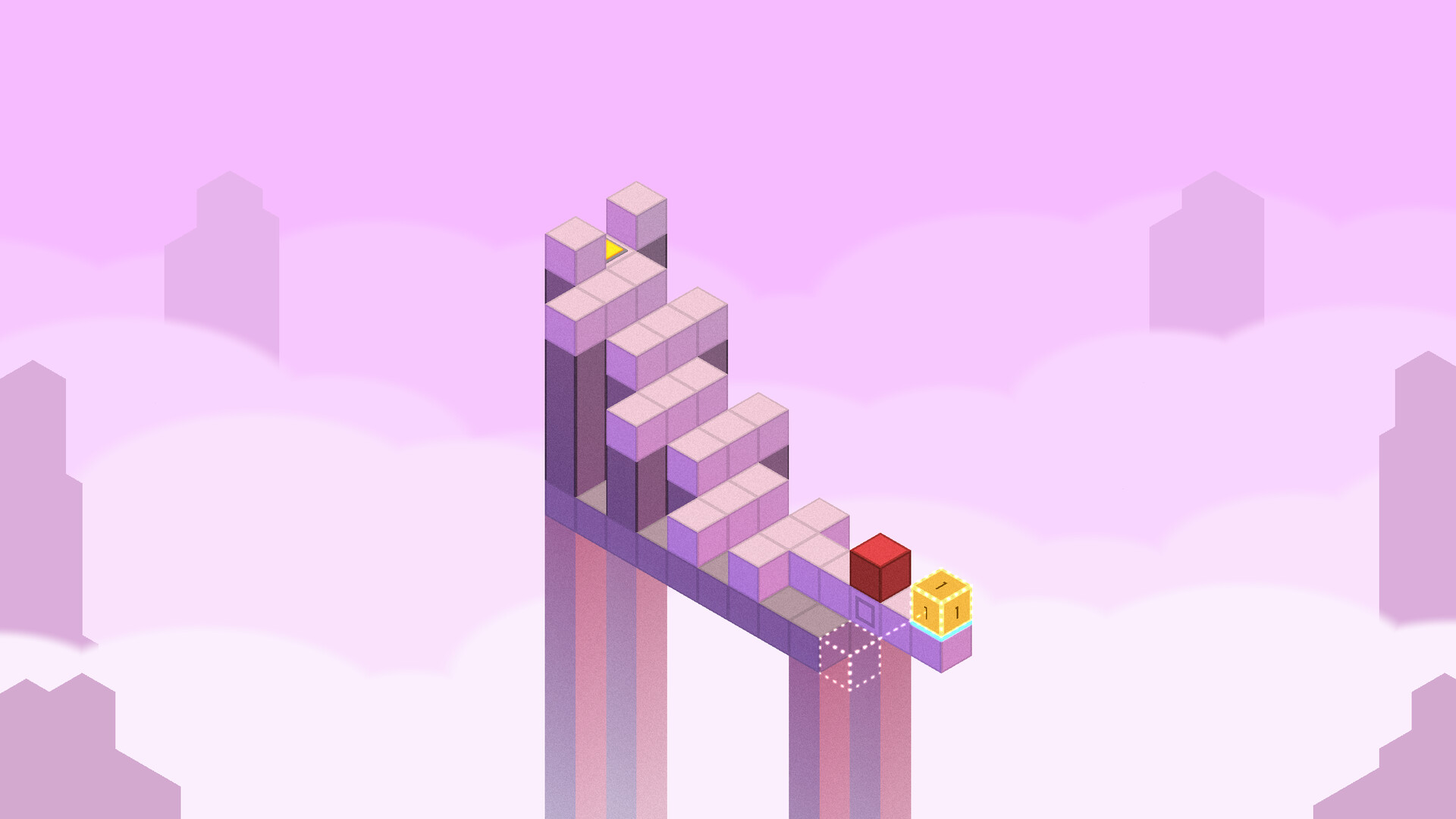
A staircase puzzle set against the game's soft pastel skyboxes, where the camera angle itself decides which steps are actually climbable.Image: Tad Cordle via Steam -
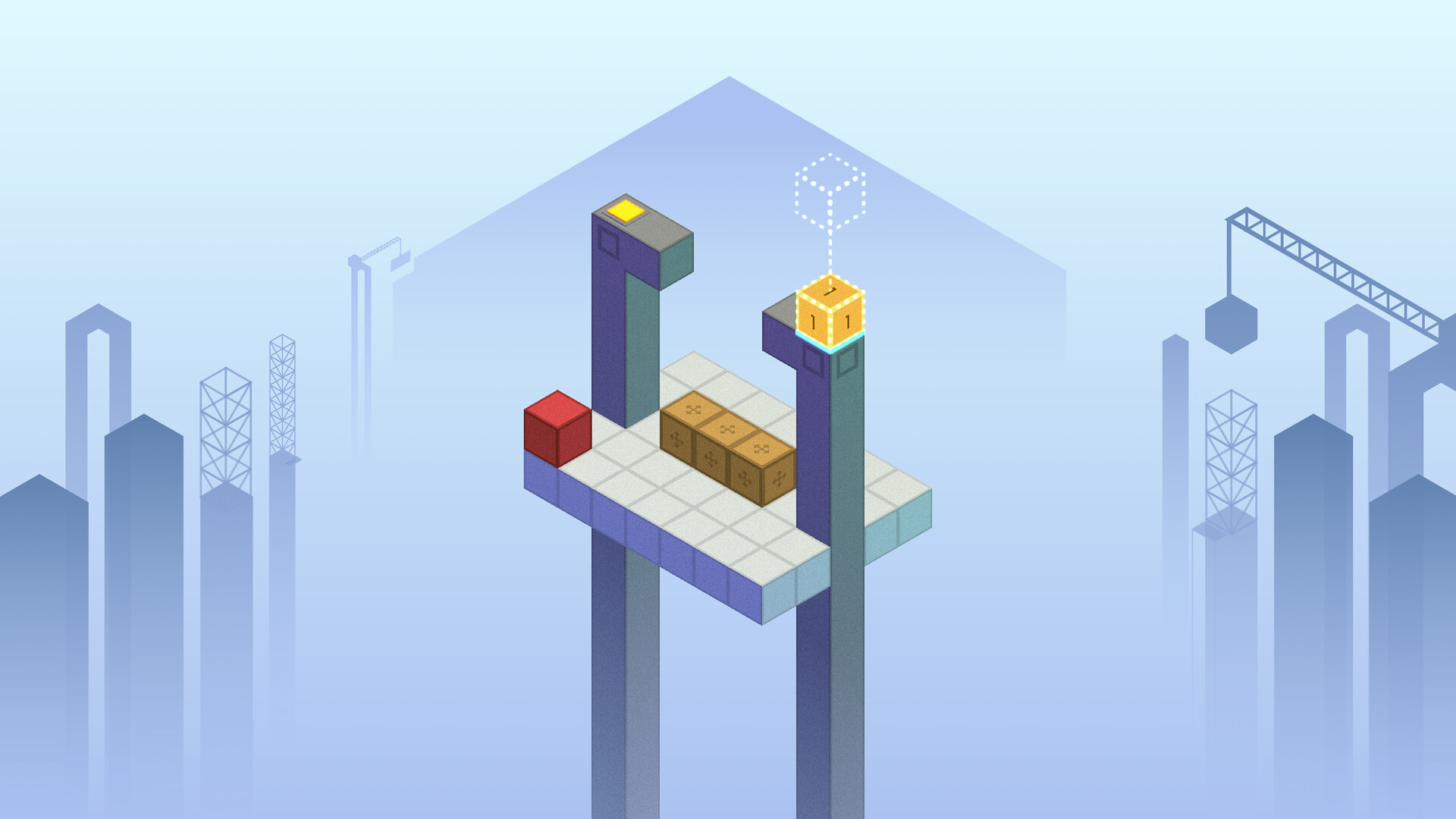
One of the game's box-pushing puzzles, framed against a distant, half-transparent city skyline that hints at the wider mystery outside the puzzle rooms.Image: Tad Cordle via Steam -

A later, more elaborate chamber where wireframe outlines trace exactly how a moved cube reappears once it re-enters view, the visibility rule made visible.Image: Tad Cordle via Steam