
Game review
Hollow Knight
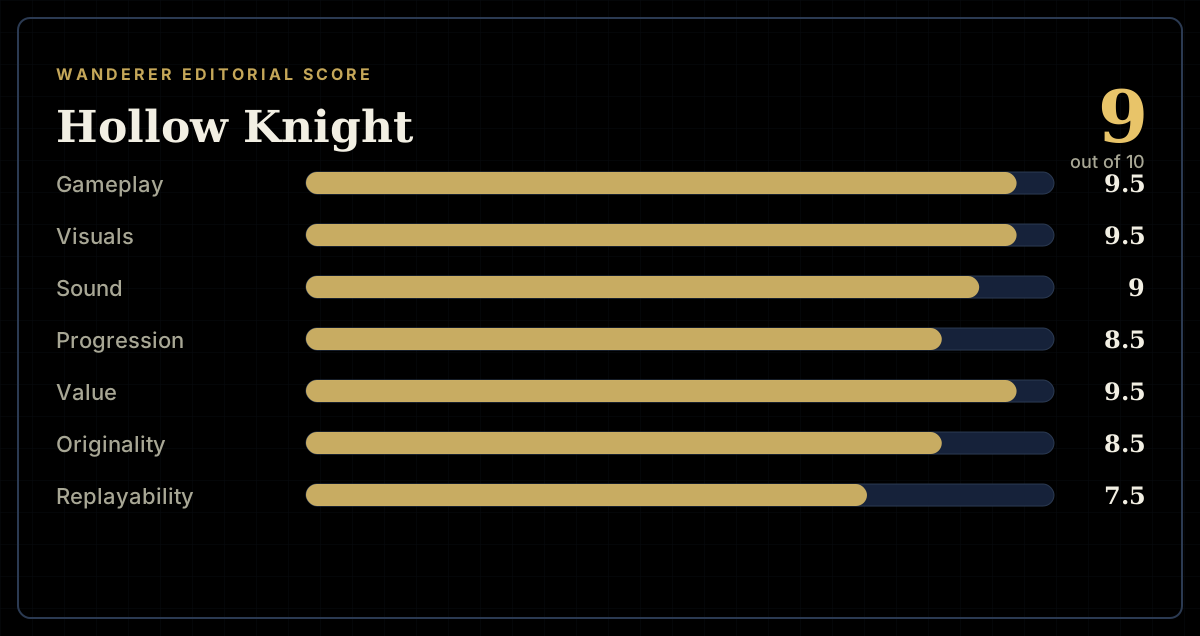
9 / 10
- Developer
- Team Cherry
- Publisher
- Team Cherry
- Released
- 24 February 2017
- Platforms
- Windows, macOS, Linux
- Genre
- Metroidvania
- Monetisation
- One-time purchase at NZ$21.99. Two free DLC packs (Lifeblood, Godmaster). No microtransactions.
- Players
- Single-player only
The short version
Hollow Knight earned the reputation it still trades on: a hand-drawn, interconnected kingdom, precise and demanding combat, and boss design that treats every fight as a puzzle you solve with your reflexes. At NZ$21.99 for 30+ hours plus two free expansions, it remains one of the strongest value propositions on Steam.
The one honest complaint has followed it since launch and never gone away: Hallownest is huge, fast travel is sparse, and a wrong turn can mean a long walk back. That friction is the price of the game's best trick — a world that rewards memorising it — and whether it's worth paying depends entirely on your patience for retracing your steps.
Biggest strengths
- Combat is tight and demanding, with a nail-and-dash toolkit that keeps expanding for 20+ hours
- Hand-drawn art and Christopher Larkin's score hold up nine years later without qualification
- Boss design treats every major fight as a distinct puzzle rather than a bigger health bar
Biggest weaknesses
- Backtracking and navigation friction is the single most consistent complaint across nine years of reviews, not a launch-era fossil
- Fast travel (Stag Stations) is sparse and geographically limited for a large chunk of the early-to-mid game
- No in-game map until you buy one from Cornifer's shop connection per area, and it doesn't self-mark your position without a separate charm
Who it's for: Players who want a real metroidvania — one continuous map, permanent unlocks that open new routes, and boss fights that punish carelessness rather than gear checks. Less suited to anyone who wants a hand-held quest marker or resents backtracking on principle.
Our recommendation: Buy it before Silksong, not instead of it — this is the foundation the sequel builds on, and the two read very differently once you've played both. Use the Stag Stations and bench network as soon as they open rather than fighting the map on foot, and don't feel obliged to 100% it; the story completes long before the Steel Soul and Pantheon challenges start demanding mastery runs.
9 / 10
Silksong is already reviewed in this library, and reviewing it first was the wrong order — the 2017 original that made a seven-year wait feel earned was never in here. That gap gets closed now.
Beneath the fading town of Dirtmouth sits Hallownest, a ruined insect kingdom, and Hollow Knight drops you into it with a nail, a handful of charm slots and no map. What happens next is the template every modern metroidvania since has been measured against, this website's Silksong review included.
What it gets right
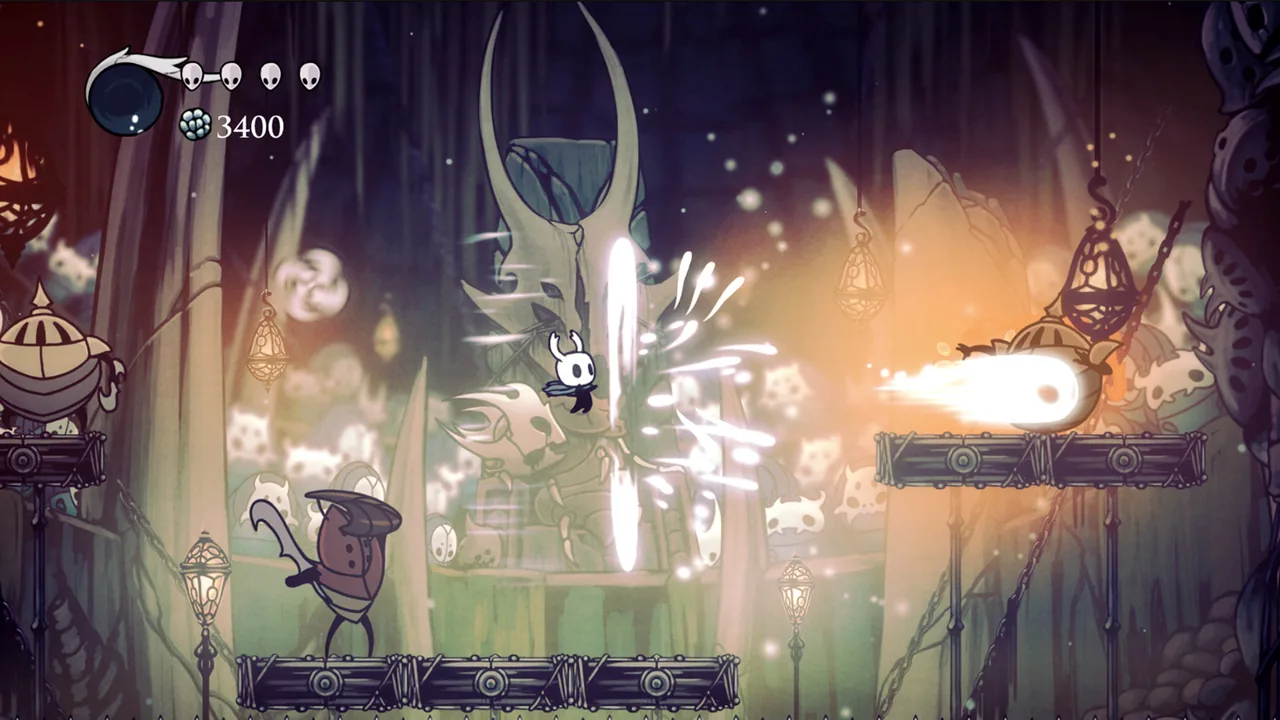
Combat that keeps growing. The nail swing you start with is functional; by the midgame you're dashing, wall-jumping, double-jumping and slamming downward through enemies you couldn't have touched an hour earlier. None of it is handed to you for free — every new tool is found in the world or bought from an NPC, and the game trusts you to notice where an old dead end suddenly opens.
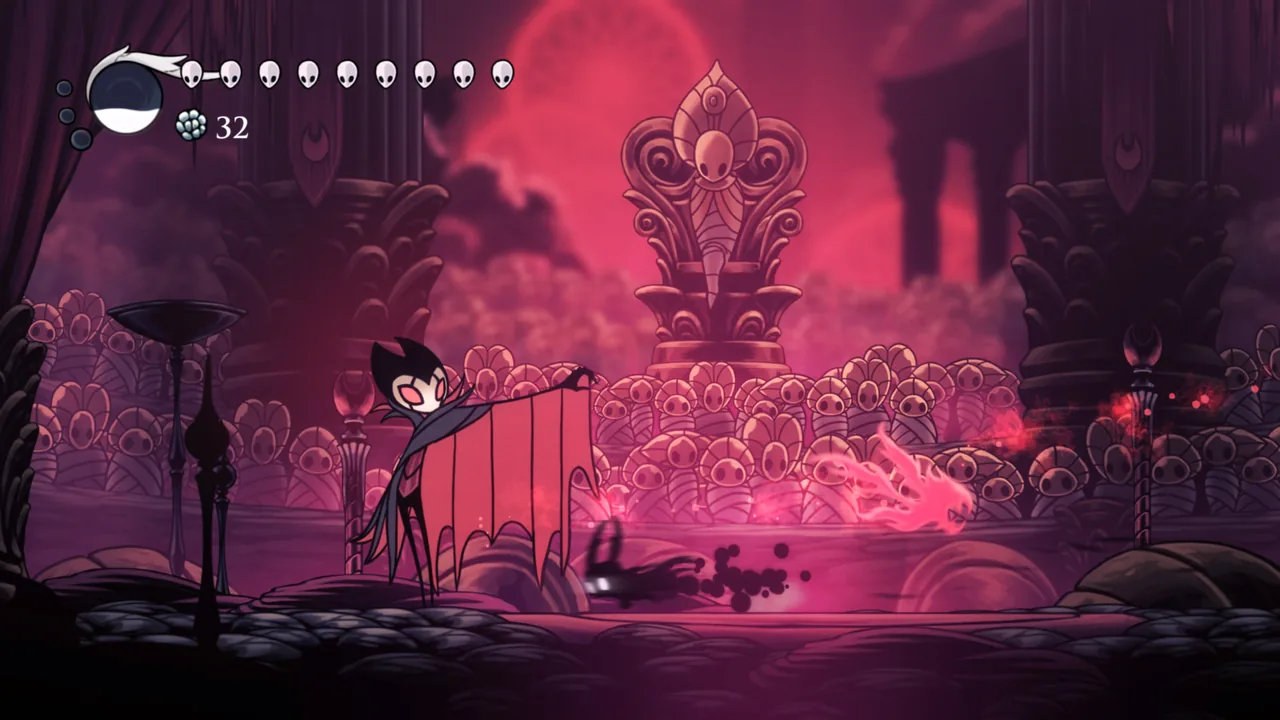
Bosses as puzzles. Hollow Knight's 30-odd boss fights are built on pattern recognition, not attrition. The Mantis Lords, Hornet, Soul Master, Watcher Knights — each one teaches a specific skill through repeated failure, then the next fight assumes you learned it. It's a genuinely different design philosophy from padding a health bar, and it's the reason the fights are still being discussed nine years on.
An enormous amount of game for the price. NZ$21.99 buys 30+ hours to reach the credits, more to chase any of the four endings, and Team Cherry folded two full expansions — Lifeblood and Godmaster — into the base purchase after launch rather than selling them separately. Judged purely on hours-per-dollar, this remains one of the best deals on Steam.
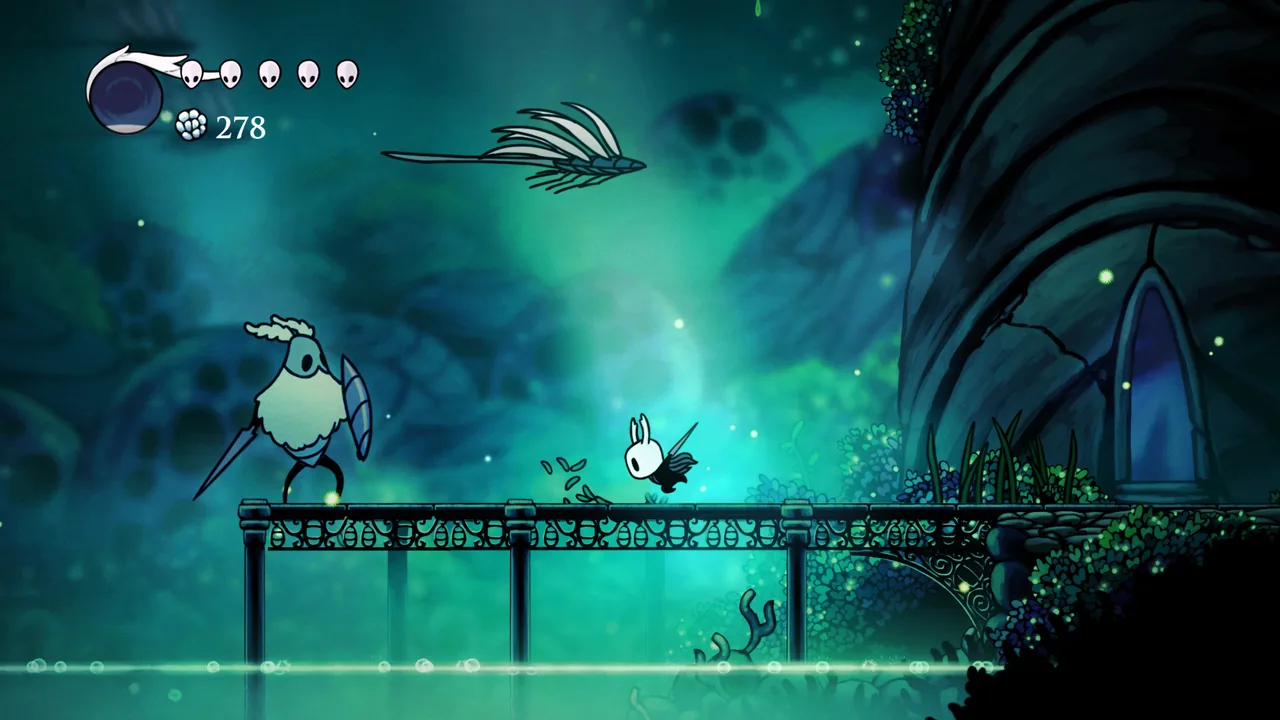
Art and sound that haven't aged. Every enemy and NPC is hand-animated frame by frame, the parallax backgrounds give the caverns real depth, and Christopher Larkin's score is doing as much emotional work as the writing. None of this reads as a 2017 game running on borrowed time.
The complaint that never left
Read the negative reviews in order — 11 from 2017, single digits most years since, 21 so far in 2026 — and the same objection recurs with almost no variation: the world is enormous, fast travel is limited, and getting lost means a long walk back through areas you've already cleared. That's not a launch-week problem that faded as patches landed. It has stayed remarkably steady across nine years, which means it isn't a bug being reported — it's a design choice a meaningful slice of players never make peace with.
It's worth being precise about who is writing these complaints, because it changes how much weight they deserve. The 100 most-helpful negative reviews, read across their full history, have a median logged playtime of 26 hours at the point of writing, and only two of the hundred had played under two hours. These aren't drive-by reviews from people who bounced off the tutorial — the most-upvoted negative, with 798 votes, explicitly says the reviewer played on for "about" a long stretch before giving up, and several others describe finishing the game and still filing the complaint afterward. This is a considered objection from invested players, not review-bombing, and the shape of it is consistent: Stag Stations are too far apart, the in-game map has to be bought per-area from Cornifer before it exists at all, and there's no built-in position marker without dedicating a charm slot to one. Even the game's most-upvoted negative review, sitting at 798 votes off six hours of playtime, is calm about it rather than furious — the reviewer describes wandering for about 45 minutes looking for their next goal before quitting, and is upfront that the genre, not a broken game, was the mismatch.
The other side of that same design is Hallownest's biggest strength. Because there's no waypoint system doing the thinking for you, actually learning the map — which tunnel connects to which, where the shortcut you unlocked three hours ago leads — becomes part of the game's satisfaction. Whether that trade is worth making is close to the whole review in miniature.
How steep the endgame gets
Hollow Knight's difficulty curve is not flat, and the achievement data shows exactly where it bends. Early, structural milestones — equipping your first charm, beating the False Knight, one of the game's first real boss checks — sit at 77% and 71% of the player base. By the far end of the curve, the numbers collapse: Steel Soul Mode completion (the permadeath run) sits at 3.9%, the hardest of the four endings at 5.3%, and the game's toughest speedrun and completion achievements cluster in the same single-digit range.
None of that should be read as padding or a game that quietly gives up on players, the way a late-added achievement system sometimes distorts this kind of curve elsewhere. Hollow Knight shipped with achievements from day one, and the drop-off maps cleanly onto content that was always meant to be optional and brutal: Steel Soul is permadeath by design, and the Pantheon of Hallownest — the superboss gauntlet added with Godmaster — is built for players who already beat the base game and want something harder. The story completes for the overwhelming majority of buyers; the single-digit numbers describe a self-selected sliver chasing mastery on top of that, not a game that loses most of its audience partway through.
Where it sits next to Silksong
Read this one first if you can, because Silksong assumes the vocabulary Hollow Knight teaches — the charm system, the nail-and-soul economy, the shape of a Team Cherry boss fight — and moves faster through all of it once you already know the grammar. The original is slower, more sparsely populated and, in the specific way that draws the recurring complaint, less generous with fast travel than its sequel turned out to be. That's not a flaw so much as a first draft of ideas the studio would refine, and it's still the better place to start than jumping into the harder, faster sequel cold.
9 out of 10. Hollow Knight is a genuine benchmark — a complete, hand-crafted world with combat and boss design that still holds up against everything it inspired, sold at a price that makes the comparison almost unfair. It loses a point, not to the backtracking complaint directly, but to what sits underneath it: Hallownest asks for real patience with its geography, and the review corpus shows that asking is answered less often as time goes on rather than more. For anyone willing to learn the map instead of being shown it, this remains essential.
Pros and cons
Pros
- Combat is tight and demanding, with a nail-and-dash toolkit that keeps expanding for 20+ hours
- Hand-drawn art and Christopher Larkin's score hold up nine years later without qualification
- Boss design treats every major fight as a distinct puzzle rather than a bigger health bar
- Two free expansions (Lifeblood, Godmaster) added a boss, tuning passes and endgame content at no extra cost
- NZ$21.99 for 30+ hours is exceptional value even before the free content is counted
- 555,000+ reviews at 97% positive, sustained essentially unchanged since 2017
Cons
- Backtracking and navigation friction is the single most consistent complaint across nine years of reviews, not a launch-era fossil
- Fast travel (Stag Stations) is sparse and geographically limited for a large chunk of the early-to-mid game
- No in-game map until you buy one from Cornifer's shop connection per area, and it doesn't self-mark your position without a separate charm
- Steel Soul (permadeath) and the Pantheon of Hallownest superbosses are genuinely brutal, which some players read as excessive rather than optional
- Achievement completion falls off a cliff on postgame content: over 70% for early milestones, under 8% for the hardest endings and permadeath completion
Screenshots
-
Hollow KnightImage: Team Cherry via Steam -
Hollow KnightImage: Team Cherry via Steam -
Hollow KnightImage: Team Cherry via Steam -
How the review scores each part of the gameWanderer Editorial -
The short versionWanderer Editorial