
Game review
True Fear: Forsaken Souls Part 3
6 / 10
- Developer
- Goblinz Enterprises Ltd
- Publisher
- The Digital Lounge
- Released
- 21 April 2025
- Platforms
- Windows
- Genre
- Adventure, Casual
- Players
- Single-player
The short version
Biggest strengths
- Gorgeous, richly detailed art and atmosphere fully consistent with what made the earlier entries in this long-running series so well regarded
- Strong, varied puzzle design that reviewers say fully evolved past the series' hidden-object-game origins into a genuine adventure-game experience
- Several genuinely effective, well-crafted scares that land even for reviewers otherwise disappointed by the story
Biggest weaknesses
- A dominant, heavily corroborated complaint that the story ignores or directly contradicts plot threads set up by the previous entry's ending, disappointing fans who waited over seven years for this conclusion
- Multiple detailed reviewers describe the narrative as feeling rushed or incoherent relative to the length of the wait, with at least one specific twist widely criticized as an unsatisfying resolution
- The overall trilogy conclusion divides even fans of the earlier games, with several longtime players saying they now prefer to treat the series as ending after the second entry
6 / 10
Seven years in the making, for a divided reception
True Fear: Forsaken Souls Part 3 closes out a psychological horror point-and-click trilogy that began as a hidden-object game and evolved, across two well-regarded prior entries, into something closer to a full narrative adventure. Based on the available English-language review sample of 261 reviews — 236 positive, 25 negative, landing at an overall Very Positive rating — the wait for this conclusion was a long one, and that gap between expectation and delivery shapes nearly every review in this sample, positive and negative alike. "So here we are. After 7 long years this story finally reached its end. Was it good? Did it meet the expectations?" one reviewer opens, framing the entire review around that central tension before landing on a broadly positive verdict.
What every reviewer agrees on, regardless of their feelings about the story, is the craft on display in the game's presentation. "This game was absolutely worth the wait, this trilogy combined makes the best hidden object/point-and-click game I've ever played, and I play a LOT of those. Full of beautiful locations, incredible characters, good scares, and twists that I didn't see coming," one enthusiastic reviewer writes. A separate reviewer specifically credits the series' evolution away from its genre origins: "True Fear is one of the best point-and-click games I've played. While they started as a HOG, the second and third games turned into an adventure." Another reviewer makes the same point even more emphatically: "It is beautiful, intelligent, point and click heaven. It is NOT a hidden object game. There are NO piles of junk to sift through. Rather, it is a classic point and click."
A story reviewers say abandons its own setup
The single most consistent, most damaging complaint in this review sample concerns narrative continuity — specifically, a widely shared feeling that this final entry doesn't follow through on what the second game explicitly set up. "This game took a lot out of me. After playing through the other two games multiple times, I was excited to see where the story went from the second game. And the answer is... it didn't. I will try to keep the spoilers to a minimum, but while the first two games seemed to form a coherent story, we don't see anything that was promised in the ending to 2," the most heavily upvoted negative review states. A separate reviewer describes an identical sense of disconnection: "I do not say this lightly as I loved the first two games so much that I have them on several platforms... I'm so confused as to how we got from the ending of part 2 to part 3."
That specific complaint — not that the story is simply bad, but that it fails to follow the trail its own predecessor laid down — recurs with striking consistency across nearly every detailed critical review. "For starters, it feels like this game completely ignores the 2nd game's ending, because we somehow went from Holly traveling back into the past at the asylum to her being at the school she and both her sisters went to when they were younger. The jump doesn't make sense," one reviewer writes, while another frames the same problem in terms of wasted narrative investment: "They just build very complex world... and they throw up to the bin in part 3... Like nothing... I'm disappointed." A separate reviewer specifically criticizes the game's central twist as an unsatisfying resolution to years of built-up mystery: "It's like watching an amazing horror movie and in the end... in the end it was just in their head. Utter disappointment and lets down the first two amazing games."
Not every fan agrees, and the puzzles land regardless
It's worth stating directly that this criticism, while dominant and specific, isn't universal — a meaningful share of the positive review sample explicitly acknowledges the story's divisive direction while still recommending the game on the strength of everything around it. "An appropriate ending for an excellent trilogy of modern HOG-puzzle games. I truly believe this is very likely the best saga of this genre... While I didn't particularly like the direction the story ultimately took, a mere matter of taste, it's not something I haven't seen before and I usually feel this way, regardless of how well it's done, I can 100% appreciate" the broader achievement, one reviewer writes, drawing a clear line between personal narrative taste and overall craft assessment. A separate reviewer offers a similarly balanced take specifically calling out the game's ambition even where it stumbles: "The third chapter does have a couple of hits and misses. The mysterious aura is amazing and I love the cinematics. There is a giant twist, which I won't reveal here, that probably nobody sees coming. Looking back, that might could have been streamlined a little bit better. Overall, for 10 euro, it's a great game."
Puzzle design draws essentially no criticism across the entire sample, positive or negative — even the harshest critical reviews concede the mechanical experience remains strong. "The art is amazing as usual and the puzzles are fun. But I'm just very disappointed in it as the final installment to a years long trilogy," one detailed critical review states, explicitly isolating the story as the sole point of failure rather than the game's underlying systems.
What the achievement data suggests about engagement
The achievement data offers a useful supporting picture of how this review sample's story complaints translate into actual play patterns. Across 33 total achievements, straightforward story and puzzle-completion milestones sit comfortably in the 84-95% range, while dedicated no-hint and expert-mode completionist achievements fall to between 8% and 22%. That's a real, wide spread consistent with a game whose core content is broadly completed by nearly everyone who buys it, with a smaller, more dedicated tier pursuing full mastery — a pattern that doesn't itself confirm or refute the story complaints, but does support the picture of a game whose puzzle-and-completion structure remains solid and engaging regardless of how any individual player feels about where the narrative ultimately goes.
Where this leaves it
True Fear: Forsaken Souls Part 3 delivers exactly the visual and puzzle-design craft longtime fans of this series have come to expect, wrapped around a story conclusion that a large, specific, and consistent share of its reviewers feel abandons or contradicts the narrative threads its own predecessor spent an entire game establishing. That's a genuine, well-documented disappointment for a trilogy finale seven years in the making, though it's tempered by a meaningful contingent of fans willing to separate their feelings about the story's direction from their appreciation of everything else the game does well. Recommended for series fans specifically drawn to the atmosphere and puzzle craft, with realistic expectations set around a genuinely divisive narrative conclusion rather than the clean resolution many were hoping for after such a long wait.
Pros and cons
Pros
- Gorgeous, richly detailed art and atmosphere fully consistent with what made the earlier entries in this long-running series so well regarded
- Strong, varied puzzle design that reviewers say fully evolved past the series' hidden-object-game origins into a genuine adventure-game experience
- Several genuinely effective, well-crafted scares that land even for reviewers otherwise disappointed by the story
- A wide, 33-achievement structure confirming real completionist depth, including dedicated no-hint and expert-mode challenges for series veterans
Cons
- A dominant, heavily corroborated complaint that the story ignores or directly contradicts plot threads set up by the previous entry's ending, disappointing fans who waited over seven years for this conclusion
- Multiple detailed reviewers describe the narrative as feeling rushed or incoherent relative to the length of the wait, with at least one specific twist widely criticized as an unsatisfying resolution
- The overall trilogy conclusion divides even fans of the earlier games, with several longtime players saying they now prefer to treat the series as ending after the second entry
- Some reviewers report specific bugs affecting how earlier story elements carry forward into this final chapter
Screenshots
-

True Fear: Forsaken Souls Part 3Image: The Digital Lounge via Steam -

True Fear: Forsaken Souls Part 3Image: The Digital Lounge via Steam -

True Fear: Forsaken Souls Part 3Image: The Digital Lounge via Steam -
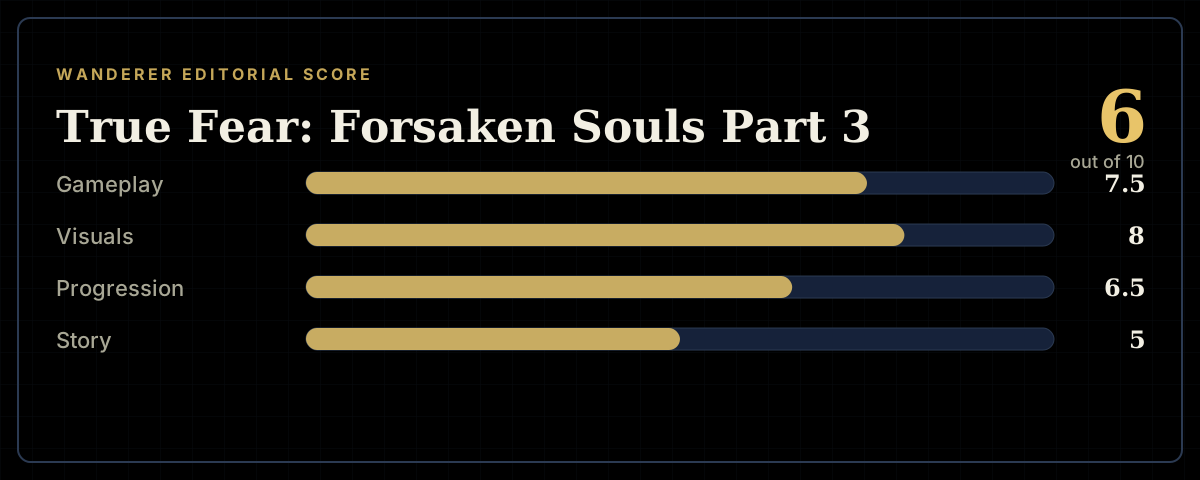
How the review scores each part of the gameWanderer Editorial -
The short versionWanderer Editorial