
Game review
Blair Witch
6 / 10
- Developer
- Bloober Team SA
- Publisher
- Bloober Team NA
- Released
- 30 August 2019
- Platforms
- Windows
- Genre
- Adventure
- Monetisation
- Paid, no in-app purchases found
- Players
- false
The short version
Blair Witch follows Ellis, a veteran and ex-police officer, into the Black Hills Forest two years after the events of the original film, searching for a missing boy while his own trauma bleeds into the woods around him. Its atmosphere, found-footage-inspired camcorder mechanics, and a widely adored companion dog named Bullet earn consistent, specific praise. But a dominant, repeated complaint describes the final stretch as a repetitive, disorienting slog that trades sustained tension for padding, landing on an ending most reviewers call a genuine letdown after the buildup.
Biggest strengths
- Genuinely strong atmosphere and found-footage-inspired presentation that reviewers consistently credit with recreating the original film's dread, aided by camcorder mechanics and detailed environmental sound design
- Bullet, the player's companion dog, draws overwhelming, specific affection across the review corpus and is confirmed by achievement data as a mechanic nearly every player engages with (over three-quarters of owners have the pet-the-dog achievement)
- A real attempt at a psychologically complex protagonist, with Ellis's own trauma and backstory woven directly into the forest's supernatural elements rather than kept separate from them
Biggest weaknesses
- A dominant, widely repeated complaint that the back portion of the game becomes repetitive and padded, built around disorienting backtracking loops rather than escalating tension
- Monster and jump-scare encounters are frequently described as more "BOO" than genuinely frightening, undercutting the horror atmosphere the rest of the presentation works hard to build
- The ending is widely called anticlimactic and unsatisfying relative to the buildup, a complaint that recurs across reviews written at very different points in the game's post-launch life
Who it's for: Story-driven psychological horror fans who value atmosphere and a strong central relationship (with Bullet) over sustained scares or mechanically demanding gameplay.
Our recommendation: Worth it at a discount for the atmosphere, story and Bullet alone — go in expecting a slower, more repetitive back half than the opening hours promise.
6 / 10
What it is
Blair Witch, developed by Bloober Team (Layers of Fear, Observer), is set two years after the events of The Blair Witch Project, casting the player as Ellis — a veteran and former police officer carrying his own unresolved trauma — searching the Black Hills Forest for a missing boy named Peter. The game leans directly on the source film's found-footage identity: a handheld camcorder is a core mechanic throughout, used to review footage and manipulate the environment in ways tied to the forest's supernatural logic, while the dense, disorienting woods and detailed environmental sound design work to recreate the same dread that made the original 1999 film effective on a fraction of its budget. A companion dog named Bullet, who can be commanded to scout ahead or called back for comfort, sits alongside Ellis for most of the journey — and by a wide margin, is the single element of the game reviewers mention most consistently and most warmly.
It released on 30 August 2019 at a list price of NZD 36.99, and its 3,003-review English corpus sits at a solid Mostly Positive (2,338 to 665) — a score that, on reading the corpus in depth, reflects a genuine and specific structural problem in the back half of the game rather than a simple mixed reception to the concept itself.
Where it succeeds
The atmosphere and central relationship draw consistent, specific praise across the corpus. "The game's strongest recreation of the movie is undoubtedly its atmosphere," writes one reviewer, citing "the dark forest, flashlight, old-school camcorder, and excellent environmental sound design" as genuinely successful at channeling the found-footage aesthetic into an interactive space. Bullet draws affection from nearly every reviewer who mentions him, in terms far warmer than most game companions receive: "I love Bullet so cute," reads one typically brief but sincere endorsement, and the achievement data backs up how central he is to the actual experience — over three-quarters of players have triggered the pet-the-dog achievement, confirming this isn't a minor optional flourish but something close to a universal touchpoint. Reviewers who engage with the story in depth also credit the game for tying Ellis's personal trauma directly into the forest's supernatural effects, rather than treating psychological backstory and horror set-pieces as separate layers.
Where it falls apart
The complaint that recurs most consistently, across reviews written at very different points in the game's life, concerns pacing and structure in the back stretch. "The first two hours are fun but after that it's the same thing over and over again," writes one reviewer, a sentiment echoed by another who calls the mid-to-late game "kind of a spooky walking simulator" for its first 70%, before the remainder leans on repetition rather than escalation. A specific technical complaint about the monster encounters compounds this: rather than sustaining dread, several reviewers describe enemy appearances as cheap "BOO" jump scares with "goofy looking" creature designs that undercut the atmospheric groundwork built up over the preceding hours.
The ending draws particularly consistent disappointment. One reviewer, playing alongside their daughter, reports the "ending was lacking, and not really a surprise" despite otherwise enjoying the journey enough to give the game a fair 7 out of 10. Given the game's branching-ending structure, that's a meaningful data point: even players who reach an ending through genuine engagement rather than rushing report it failing to land, suggesting the issue may be more about how the climax is paced and delivered than which specific ending a player happens to reach.
A fairer reading than the score alone suggests
It's worth noting that this corpus contains a real, detailed contingent of reviewers actively pushing back against reflexive dismissals of the game, which is worth taking seriously rather than reading past. One reviewer, describing taking real time with the game specifically to give it "a fair review," explicitly states that "a lot of reviews here" don't do the game justice and urges prospective buyers to read carefully before dismissing it based on quick, negative first impressions. That's a meaningfully different kind of defence than simple fandom — it's an argument that some of the criticism circulating around the game undersells genuine strengths in its storytelling and atmosphere by focusing too narrowly on its pacing problems. Weighing that alongside the structural complaints above, the fairest overall reading is that Blair Witch is a game whose first two-thirds are considerably stronger than its back third, and reviewers who disengage or rush through the later repetitive sections are likely to walk away with a harsher impression than the game's best moments actually deserve.
What the camcorder mechanic adds, and where it falls short
The found-footage camcorder isn't just an aesthetic flourish — it functions as an actual puzzle and progression mechanic, letting Ellis review recorded footage to find manipulable details in the environment tied to the forest's supernatural rules. When this system is used well, in the game's stronger opening stretch, it ties the found-footage premise directly into interactive gameplay rather than leaving it as set dressing, which is a genuinely clever piece of design specific to this IP rather than a generic horror mechanic reused from elsewhere. The complaint from several reviewers is less that the mechanic itself is poorly designed and more that its novelty wears thin through repeated, similar-feeling puzzle sequences in the back half, echoing the broader pacing complaint rather than constituting a separate issue.
Verdict
Blair Witch succeeds at exactly what its premise promises in its strongest moments — a dense, dread-soaked recreation of found-footage horror, anchored by a psychologically complicated protagonist and, unexpectedly, one of the more beloved companion animals in recent horror gaming. Its back half's repetitive structure and a widely-panned ending are real, consistently documented problems rather than a vocal minority's complaint, and they're worth weighing seriously against the genuinely strong opening hours. Best approached at a discount, with realistic expectations that the game's second half doesn't sustain what its first half builds.
Pros and cons
Pros
- Genuinely strong atmosphere and found-footage-inspired presentation that reviewers consistently credit with recreating the original film's dread, aided by camcorder mechanics and detailed environmental sound design
- Bullet, the player's companion dog, draws overwhelming, specific affection across the review corpus and is confirmed by achievement data as a mechanic nearly every player engages with (over three-quarters of owners have the pet-the-dog achievement)
- A real attempt at a psychologically complex protagonist, with Ellis's own trauma and backstory woven directly into the forest's supernatural elements rather than kept separate from them
- Multiple branching endings, giving the game more structural ambition at its conclusion than a single linear horror walkthrough
Cons
- A dominant, widely repeated complaint that the back portion of the game becomes repetitive and padded, built around disorienting backtracking loops rather than escalating tension
- Monster and jump-scare encounters are frequently described as more "BOO" than genuinely frightening, undercutting the horror atmosphere the rest of the presentation works hard to build
- The ending is widely called anticlimactic and unsatisfying relative to the buildup, a complaint that recurs across reviews written at very different points in the game's post-launch life
- At least one detailed reviewer reports performance and optimisation issues even on capable hardware
- Achievement data shows full-collection and one specific ending-related achievement sitting under 3%, reflecting how few players engage with the game's more thorough or alternate-path content
Screenshots
-

Blair WitchImage: Bloober Team NA via Steam -

Blair WitchImage: Bloober Team NA via Steam -

Blair WitchImage: Bloober Team NA via Steam -
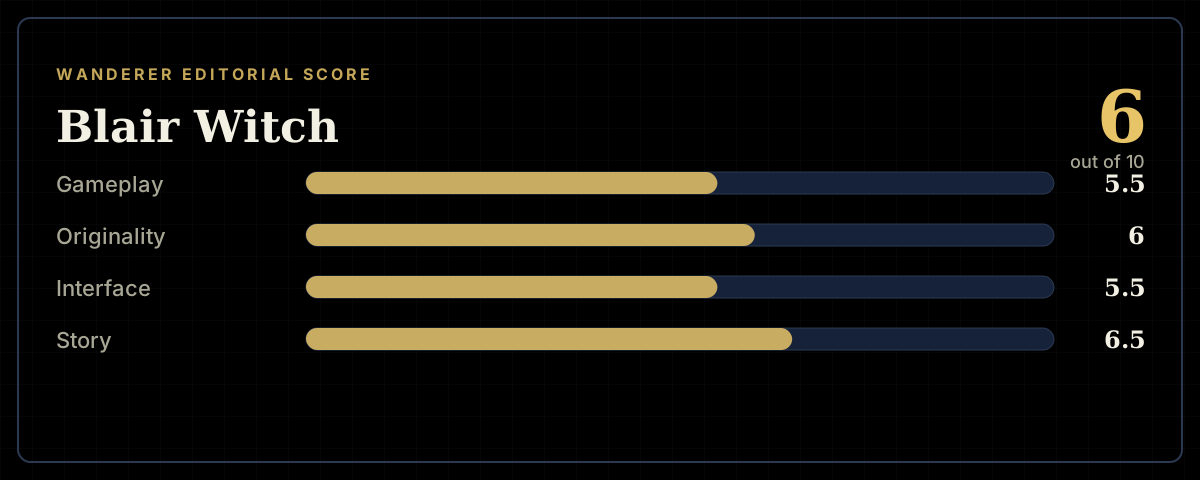
How the review scores each part of the gameWanderer Editorial -
The short versionWanderer Editorial