
Game review
Tower Dominion
6.5 / 10
- Developer
- Parallel 45 Games
- Publisher
- Parallel 45 Games
- Released
- 7 May 2025
- Platforms
- Windows
- Genre
- Strategy
- Players
- Single-player
The short version
Biggest strengths
- A genuinely distinctive path-design mechanic letting players shape the enemy route with directional and elevation tiles, adding real strategic layering on top of standard tower-defense placement
- Three well-differentiated factions with distinct commanders and unlock trees that reviewers consistently praise for variety
- Widely and specifically compared favourably to genre touchstone Rogue Tower, with reviewers calling it a more polished, fleshed-out take on that formula
Biggest weaknesses
- A heavily upvoted cluster of detailed negative reviews consistently identifies RNG as the dominant factor in match outcomes, describing runs that go from cruising to sudden unwinnable difficulty spikes with little player agency to prevent it
- Multiple independent reviewers report the exact same failure pattern — a run coasting comfortably through wave 29-30 before dying almost instantly at wave 31-32 — a specific, reproducible balance complaint rather than a vague difficulty gripe
- Once top difficulty is cleared and all commanders unlocked, several reviewers report the game becoming stale and same-feeling within just a few hours, with achievement data showing a relatively narrow, moderate completion spread consistent with that account
6.5 / 10
Designing the maze yourself, not just defending it
Tower Dominion takes the standard tower-defense formula and hands players an unusually large amount of control over the battlefield itself: rather than defending a fixed lane, you actively shape the enemy path using directional and elevation tiles, choosing where chokepoints form and how terrain advantages stack. One detailed review captures the pitch precisely: "Tower Dominion stands out by allowing players to design the enemy's path, including directional tiles and elevation changes, adding a strategic layer to the traditional tower defense mechanics. Players can choose from three distinct factions. Each faction offers unique leaders with different abilities, enhancing replayability." That's a genuinely meaningful structural addition to a genre that often treats map layout as fixed scenery, and based on the available English-language review sample of 2,722 reviews — 2,350 positive, 372 negative, landing at an overall Very Positive rating — it's clearly resonated with a large tower-defense audience.
The genre comparison reviewers reach for most often is Rogue Tower, and it's consistently favourable. "Really solid and charming tower defence game. Like Rogue Tower but way more polished and fleshed out, with a lot of variation between factions, commanders, buildings and doctrines," one reviewer writes, a sentiment echoed by another who specifically credits the demo for winning them over ahead of the full release: "I spent a huge amount of time on the demo, and the full game is even more expansive and fun than I'd hoped with a lot of different replayability." A separate reviewer who says they don't even normally like the genre describes an unexpectedly strong hook: "It's a fantastic roguelite tower defense that just gets it. No bloated tutorials, no 20-minute cutscenes about ancient tower lore, no nonsense. You jump in, you get it, you play."
A loud, detailed, and specific negative minority
What sets this review sample apart from a simple "mostly positive with the usual grumbling" pattern is how detailed and specific the negative reviews are, several drawing hundreds of upvotes despite being outnumbered roughly six to one by positive reviews. The most upvoted negative review — 259 votes — opens with a pointed observation about a recurring pattern in the review section itself: "Yet another review from some dude who played the game for dozens of hours and in the end said 'yeah this isn't fun.' That's a very bad trend to see. This could be a really awesome game. That's why I played for so many hours. But I don't have confidence it will get fixed. There are many elements of the game that just aren't fun. There are too many meaningless gameplay decisions. Too much RNG." That specific framing — genuinely enjoying enough of the game to sink real time into it, while still concluding it isn't fun on balance — recurs across nearly every detailed critical review in the sample.
A separate, extremely heavily upvoted review (6,091 votes) reaches a similar conclusion from the perspective of someone who fully completed the game's toughest content: "This is a fine Tower Defense but it lacks interesting depth. The final difficulty is so hard that it is almost unwinnable on certain characters without cheese strategies - and I'm a pretty good gamer. I platinumed this on the hardest difficulty and would not recommend it." That's a notable, specific data point — not a reviewer bouncing off difficulty early, but one who pushed all the way through and still landed on a negative verdict because of how that difficulty is structured.
The wave-31 problem, reported independently and repeatedly
The single most concrete, reproducible complaint in the entire sample concerns a specific difficulty cliff late in runs, and it's reported by multiple reviewers independently using almost identical language. "I've had a few runs in a row now where I get to level 29 or 30 with no problem, not a single enemy damaging my command center. And then die within seconds on level 31," one reviewer writes. A separate reviewer describes the exact same pattern at the exact same point in a run: "wave 31 they don't even get close. wave 32, nothing dies and I lose. Really good game underneath multiple really strange balance and enemy scaling, lack of stat transparency of and upgrade options before buying a tower and lack of target prioritization as camo towers keep letting camo enemies through." When two reviewers independently pinpoint the same wave number as the moment a comfortable run becomes unwinnable, that's a much stronger signal of a genuine scaling or balance bug than either report would be alone, and it corroborates the broader "too much RNG" framing with an unusually specific, verifiable detail.
Not every critical voice agrees the problem is RNG rather than player skill, and it's worth including that pushback directly. "Don't listen to the negative comments saying the game has too much rng. I'm afraid those people need to start looking at their decision-making instead of blaming it on luck," one positive reviewer argues, describing their own losses as traceable to specific preparation mistakes rather than bad luck. That's a genuine, reasonable counter-read from within the positive majority, and it suggests the RNG-versus-skill debate itself is a live, unresolved disagreement among the playerbase rather than a settled consensus in either direction.
Depth that runs out faster than the polish suggests
A separate complaint, distinct from the RNG debate, concerns how quickly the game's content gets exhausted once a player clears the top difficulty. "Incredibly short, I beat tier 4 'War' difficulty and had every defense unlocked in barely 3 hrs, after that each game felt stale, same-ey, only guided by map randomness," one reviewer writes, directly comparing the commander-selection structure unfavourably to Rogue Tower's deeper unlock tree. The achievement data offers some corroborating context here: across 30 total achievements, all structured around completing runs with specific faction-and-hero combinations, the spread runs from 62.7% down to 17.8% — a real but comparatively narrow range next to some other roguelites this lane has covered, consistent with a game whose core unlock content can be worked through relatively quickly by a dedicated player, even if mastering the hardest difficulty against the reported RNG swings remains a separate, much harder challenge.
Where this leaves it
Tower Dominion brings a genuinely clever structural idea, player-designed enemy paths across three well-differentiated factions, to a crowded genre, and the large majority of its substantial review base has responded well to the resulting mix of strategy and roguelite replayability. Set against that is an unusually detailed, unusually credible cluster of negative reviews from players who put in real hours and still landed on "not fun," anchored by a specific, independently-reported difficulty cliff around wave 31 that reads as a genuine balance or scaling issue rather than ordinary escalating challenge. Recommended for tower-defense fans looking for a Rogue Tower-style roguelite with real strategic depth in its path design, with the clear caveat that the hardest difficulty tier currently asks players to tolerate meaningful RNG swings that a vocal, detailed portion of the community argues undermine the skill expression the rest of the game builds so well.
Pros and cons
Pros
- A genuinely distinctive path-design mechanic letting players shape the enemy route with directional and elevation tiles, adding real strategic layering on top of standard tower-defense placement
- Three well-differentiated factions with distinct commanders and unlock trees that reviewers consistently praise for variety
- Widely and specifically compared favourably to genre touchstone Rogue Tower, with reviewers calling it a more polished, fleshed-out take on that formula
- A large, mostly positive review base (86% positive across 2,722 English reviews) confirms broad appeal despite a loud and detailed critical minority
Cons
- A heavily upvoted cluster of detailed negative reviews consistently identifies RNG as the dominant factor in match outcomes, describing runs that go from cruising to sudden unwinnable difficulty spikes with little player agency to prevent it
- Multiple independent reviewers report the exact same failure pattern — a run coasting comfortably through wave 29-30 before dying almost instantly at wave 31-32 — a specific, reproducible balance complaint rather than a vague difficulty gripe
- Once top difficulty is cleared and all commanders unlocked, several reviewers report the game becoming stale and same-feeling within just a few hours, with achievement data showing a relatively narrow, moderate completion spread consistent with that account
- Camouflaged enemies reportedly slip past camouflage-detecting towers due to target-prioritization issues, a specific mechanical complaint about a system that should reliably counter them
- Some reviewers who platinumed the hardest difficulty still conclude they can't recommend it, citing "cheese" strategies as the only reliable path through the endgame
Screenshots
-

Tower DominionImage: Parallel 45 Games via Steam -

Tower DominionImage: Parallel 45 Games via Steam -

Tower DominionImage: Parallel 45 Games via Steam -
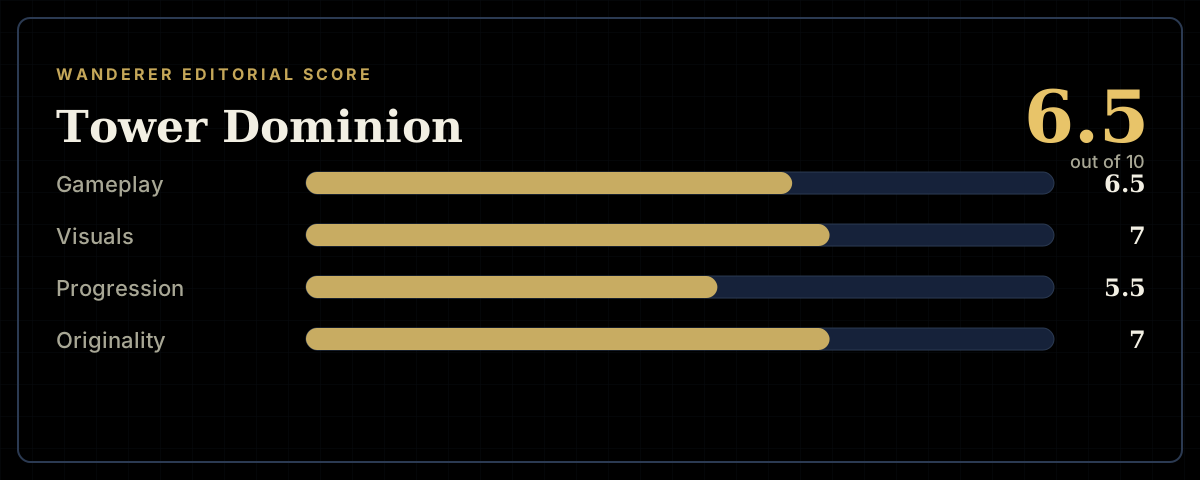
How the review scores each part of the gameWanderer Editorial -
The short versionWanderer Editorial