Game review
TIS-100
8 / 10
- Developer
- Zachtronics
- Publisher
- Zachtronics
- Released
- 20 July 2015
- Platforms
- Windows, macOS, Linux
- Genre
- Engineering Puzzle
- Monetisation
- One-time purchase. No DLC, no in-game purchases.
- Players
- Single-player, with global solution histograms
The short version
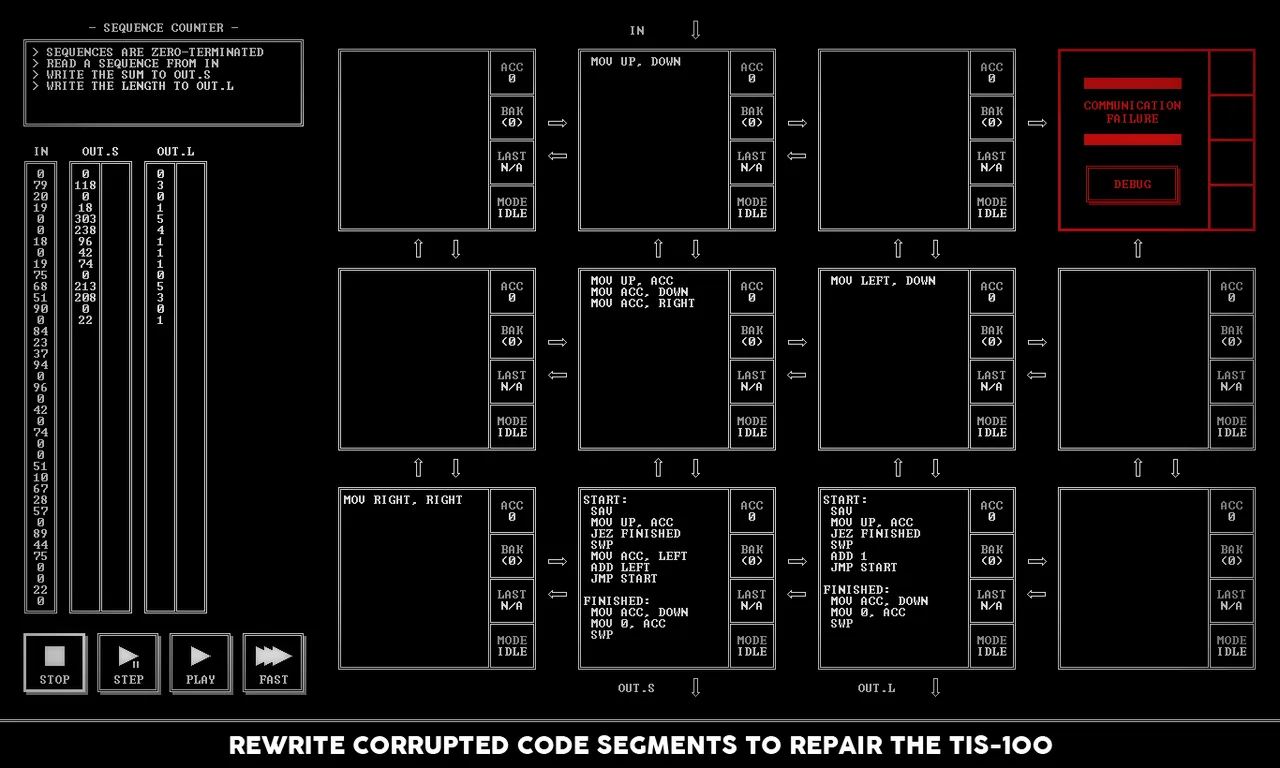
A corrupted 1970s-style computer sits in front of you. You repair it by writing assembly across a grid of tiny nodes, each holding a handful of instructions and two registers, passing values to its neighbours. That's the entire game — no story mode, no gentle onramp, no concessions.
It's also the cheapest thing Zachtronics made at NZ$10.49, and at **96.9% positive across 3,101 English reviews** it's the second-best-rated of the five engineering puzzlers I've assessed today. The reason is on its own store page, which describes it as "the assembly language programming game you never asked for" — nobody arrives expecting a tutorial, so nobody is let down by its absence.
Biggest strengths
- A perfectly clear, perfectly honest premise, executed without compromise
- Genuine optimisation depth with cycle, node and instruction histograms
- The cheapest Zachtronics game by a wide margin — a third of its siblings' price
Biggest weaknesses
- Nodes have no room for comments, which reviewers find genuinely limiting
- Several puzzles ask for things the architecture resists rather than suits
- Essentially no onboarding — if you don't know assembly, you're on your own
Who it's for: Programmers who want a pure constraint puzzle, and anyone curious what assembly feels like who's willing to be thrown in. Not a teaching tool — the game is upfront about that.
Our recommendation: Buy it. At NZ$10.49 it's the cheapest way into this studio's work, and its reputation for brutality is honestly earned rather than a marketing accident. If you like it, Opus Magnum and SHENZHEN I/O are the natural next steps.
8 / 10
Five engineering puzzle games in one day has produced one clear finding, and TIS-100 is the proof of it.
| Game | Store promise | English rating |
|---|---|---|
| Turing Complete | "Learn CPU architecture with puzzles" | 94.8% |
| SHENZHEN I/O | Build circuits for a Shenzhen employer | 94.4% |
| EXAPUNKS | Hack to survive, 1997 | 94.7% |
| TIS-100 | "the assembly language programming game you never asked for" | 96.9% |
| Opus Magnum | Build beautiful machines | 97.1% |
The harshest, ugliest, least accommodating game in the set rates second-highest — and it's the one whose own store page opens by telling you nobody wanted it.
That isn't a coincidence. Turing Complete promises to teach and 57 of its hundred negatives say it doesn't. TIS-100 promises nothing, delivers nothing it didn't promise, and its players are correspondingly content. Expectation-setting is doing real work in these numbers.
What it is
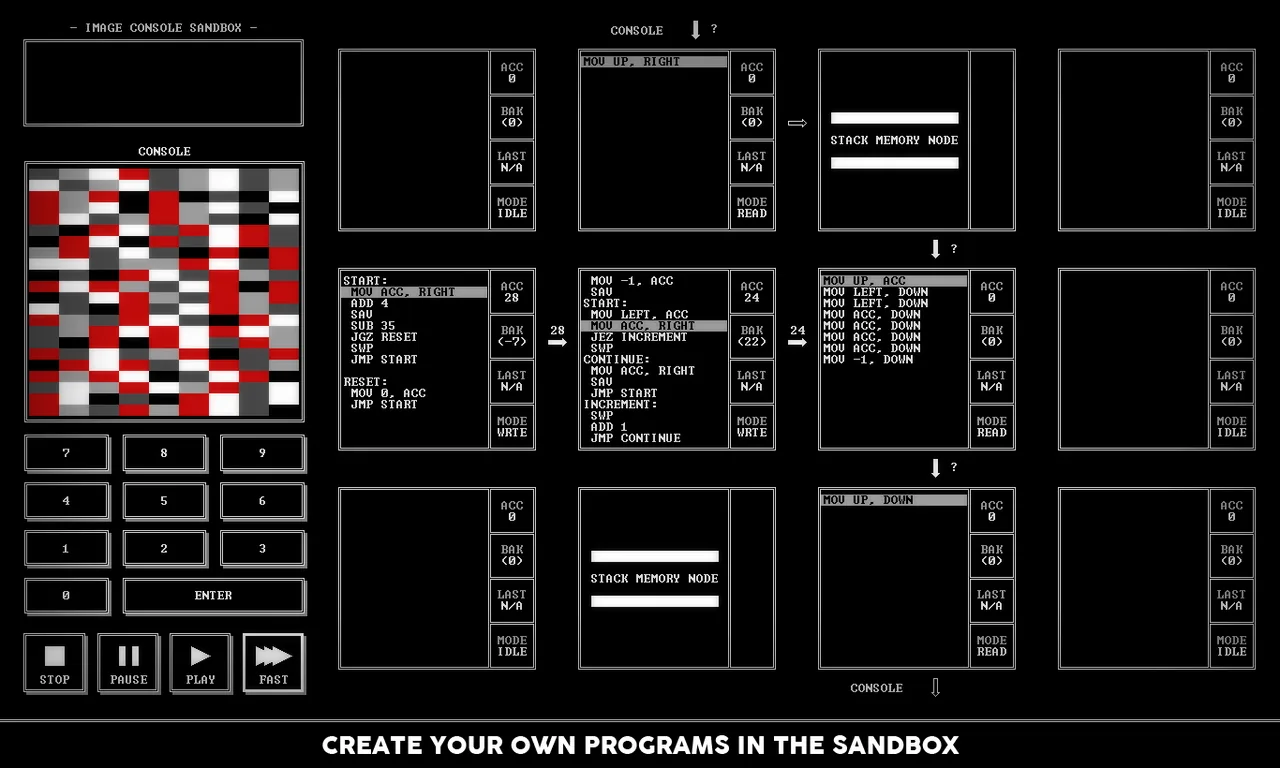
A fictional 1970s computer, corrupted, presented as a grid of nodes. Each node holds a handful of assembly instructions and two registers, and can only pass values to its immediate neighbours. You repair the machine by writing programs that move data through this cramped mesh.
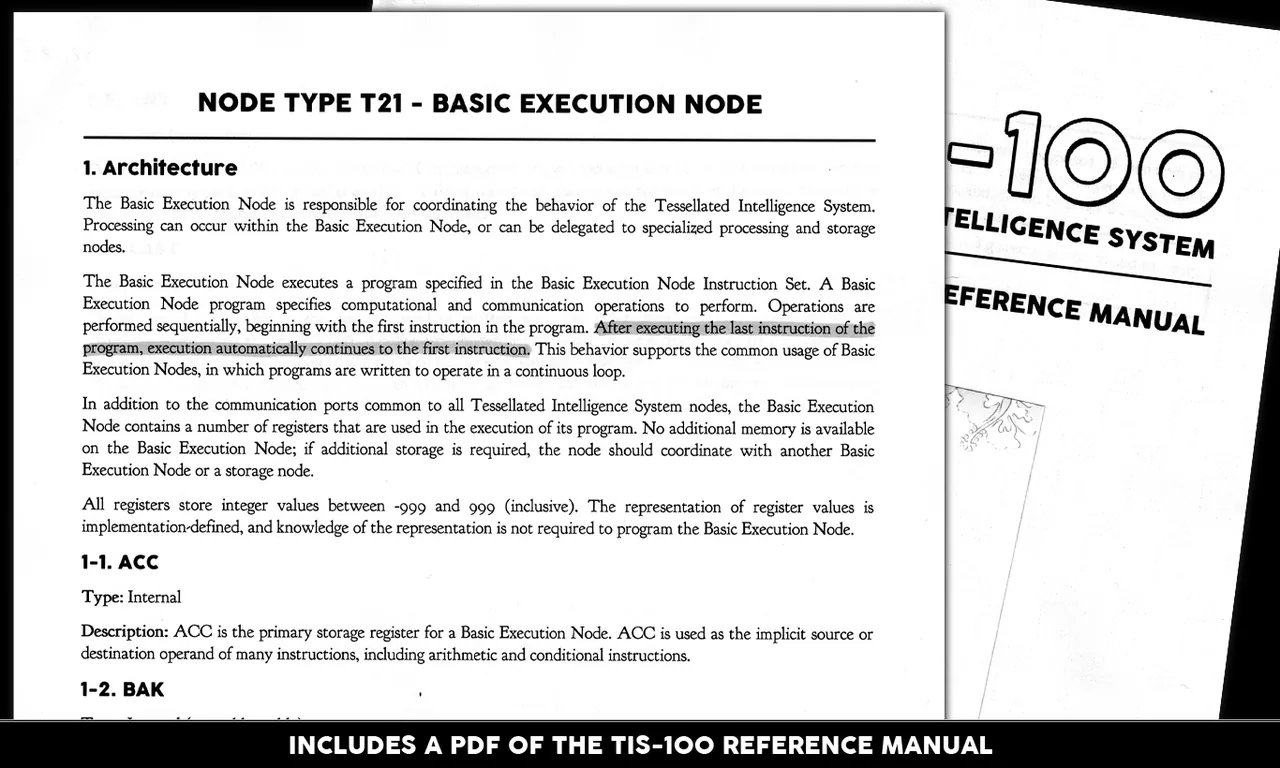
There's no scene-setting beyond a manual written as a period technical document, and the "story" arrives as scattered fragments you decode. It's atmospheric in an unusually restrained way — this is a game whose entire aesthetic is a monochrome terminal and a PDF.
And it's NZ$10.49, a third of what EXAPUNKS or Turing Complete cost.
What its critics say
I read 97 English negatives — effectively all of them. Programming appears in 42, the manual in 23, difficulty in 16.
Two complaints have real substance.
No comments. The most-upvoted negative, at 110 votes from an experienced programmer, lists it first: "There is no space to write any comments." In a game where you're reading back your own dense assembly hours later, that's a genuine ergonomic limitation rather than a stylistic one.
Puzzles that fight the machine. A 23-hour reviewer at 103 votes makes the sharper argument: "tis-100 presents a very interesting architecture, [but] almost all of the puzzles are trying to do something that doesn't fit said architecture. Instead of feeling like you're using the machine well, you just get annoyed."
That's the same family of criticism I found in EXAPUNKS — difficulty arising from restriction rather than from the problem — and it's the fairest thing said against this whole studio. Whether wrestling an unsuitable tool is satisfying or merely tiring is the question that decides all five of these games for a given player.
The third theme is onboarding, at 15 mentions of learning and 11 of tutorials. A 38-vote reviewer: "if you are a noob and don't already know assembly language don't get it! They have almost 0 'getting started' help." True — though unlike Turing Complete, this game never suggested otherwise.
Reading the dates
The negatives are front-loaded: 14 in 2015, 15 in 2016, 20 in 2017, then single digits every year since. Checking weights rather than counts, the 2015–17 group carries a median of 5 votes against 2 for 2024–26, so the early cluster is genuinely substantial and the recent trickle is light. That's ordinary decay for an eleven-year-old game, not a decline.
Recent English reviews sit at 95 of 100 positive with a 12.3-hour median.
The achievement curve tells the familiar story: 10 achievements, the most common held by 90.5% of players — nearly everyone starts — but the median by 7.1%, and the rarest by 1.2%.
The critics' median playtime is 2.2 hours, second-lowest of the five after EXAPUNKS. People work out fast whether this is for them.
The verdict
TIS-100 earns an 8, level with SHENZHEN I/O and behind only Opus Magnum in today's set.
It's the purest expression of what this studio does: a single constrained idea, no padding, no concessions, and an optimisation loop that keeps giving as long as you keep caring. At NZ$10.49 it's also comfortably the best value of the five.
It isn't higher because the missing comment support is a real ergonomic failure, because several puzzles genuinely do fight their own architecture, and because the presentation is austere even by the standards of a genre that isn't known for warmth.
Buy this one first if you're curious about Zachtronics and unsure whether the genre suits you. It's the cheapest test, and the most honest about what it's asking.
Pros and cons
Pros
- A perfectly clear, perfectly honest premise, executed without compromise
- Genuine optimisation depth with cycle, node and instruction histograms
- The cheapest Zachtronics game by a wide margin — a third of its siblings' price
- Strange, effective atmosphere delivered almost entirely through a printed-style manual
- Cross-platform on Windows, macOS and Linux, complete with no DLC
Cons
- Nodes have no room for comments, which reviewers find genuinely limiting
- Several puzzles ask for things the architecture resists rather than suits
- Essentially no onboarding — if you don't know assembly, you're on your own
- Critics' median playtime is 2.2 hours; the bounce rate is high and fast
- Austere to the point of visual monotony
Screenshots
-
TIS-100Image: Zachtronics via Steam -
TIS-100Image: Zachtronics via Steam -
TIS-100Image: Zachtronics via Steam -
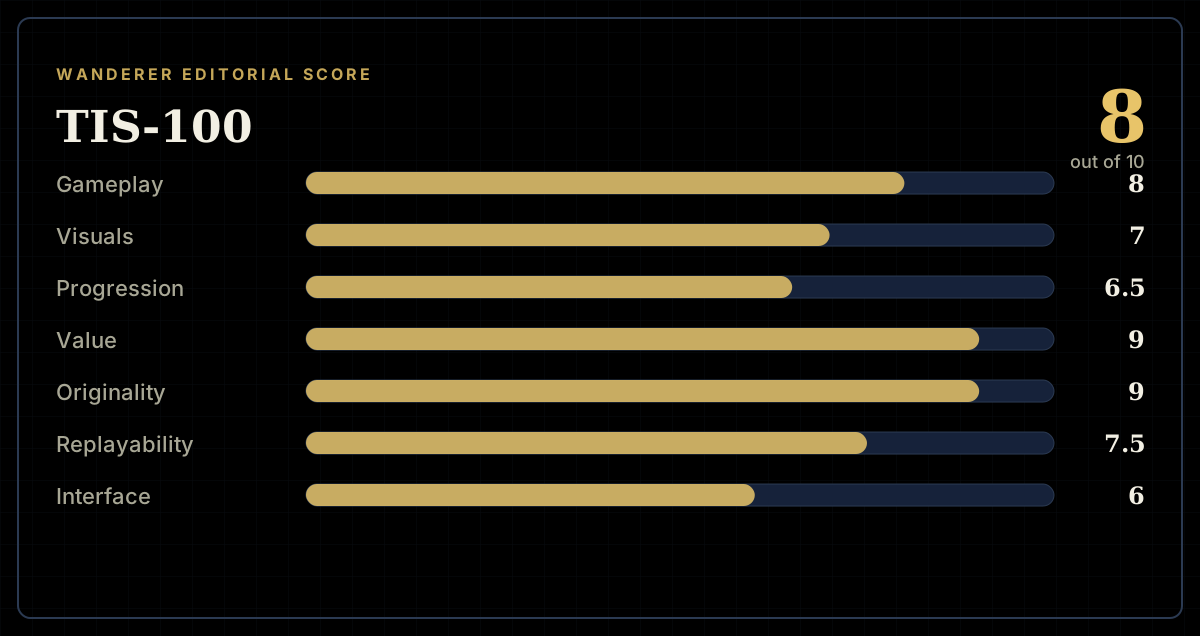
How the review scores each part of the gameWanderer Editorial -
The short versionWanderer Editorial