Game review
EXAPUNKS
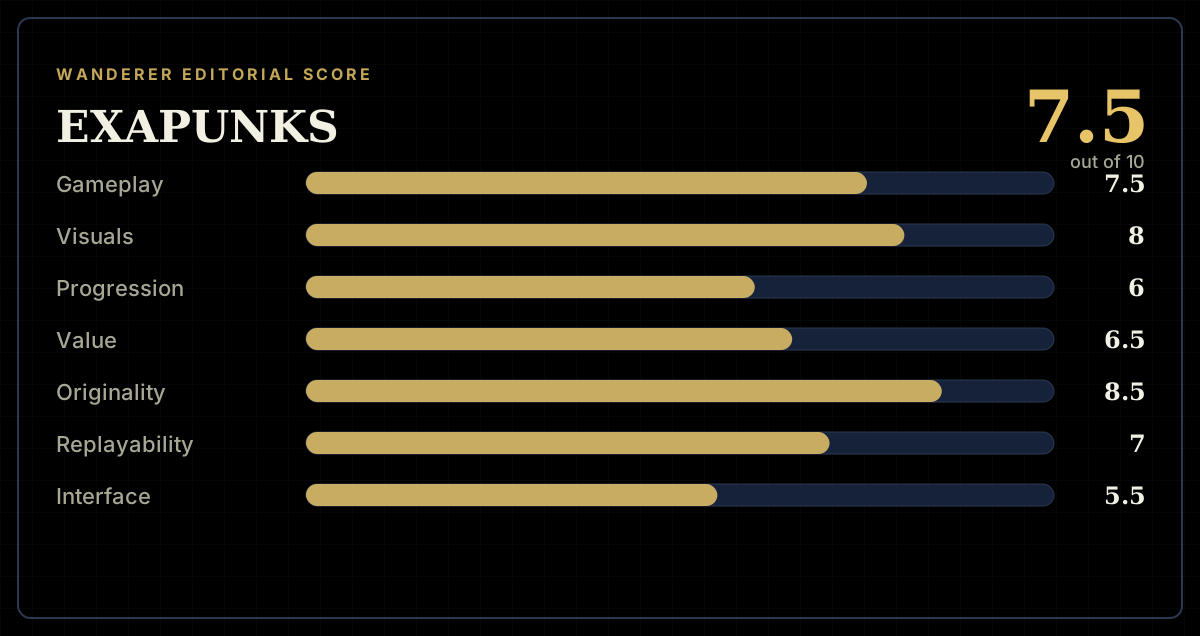
7.5 / 10
- Developer
- Zachtronics
- Publisher
- Zachtronics
- Released
- 22 October 2018
- Platforms
- Windows, macOS, Linux
- Genre
- Engineering Puzzle
- Monetisation
- One-time purchase. No DLC, no in-game purchases.
- Players
- Single-player, with global solution histograms
The short version
It's 1997, you have a disease that turns your body into machinery, and the only supply of the drug comes from hacking. You write programs for little agents called EXAs, send them into networked systems, and make them steal, rewrite and destroy. The presentation — zines, a printable comic, a soundtrack on tape — is the best-realised of any Zachtronics game.
The puzzles are the argument. **Programming appears in 41 of the 83 English negatives and the manual in 30**, and the sharpest criticism is that difficulty comes from artificial restriction rather than the problem: as one 51-vote reviewer puts it, the instruction set is "limited to create 'challenge'" and this one "pushes that a-bit-fa[r]".
Biggest strengths
- The strongest presentation in the studio's catalogue — zines, comics, a full 1997 aesthetic
- Genuinely clever network puzzles once the language clicks
- Solution histograms driving optimisation long past the first working answer
Biggest weaknesses
- Difficulty often comes from what the language forbids rather than the problem itself
- Constant alt-tabbing to an external manual instead of in-game reference
- Won't teach you to program, and doesn't claim to — but many buyers expect it to
Who it's for: People who already program and enjoy squeezing solutions through a deliberately narrow instruction set. Not a place to learn — its own reviewers say so plainly.
Our recommendation: Buy it if you loved SHENZHEN I/O and want more of that specific discomfort. If you're new to Zachtronics, start with Opus Magnum — a 36-vote reviewer here makes exactly that case, and I agree with them.
7.5 / 10
This is the fourth Zachtronics-style engineering puzzle I've reviewed today, and the four together finally explain each other. So let me start with the review that does it best — a 36-vote negative from 2020:
Until Opus Magnum, I came to terms that Zachtronics games just weren't for me. They felt too much like work, they were tutorialised horribly and there was just too little effort made to make it less like simple programming. Then Opus Magnum came out, and I thought that they finally made the jump…
EXAPUNKS is the studio going back. Where Opus Magnum is spatial and visual and beautiful to watch, this is text, registers and jump labels — closer to SHENZHEN I/O, and for a narrower audience still.
The design argument
Programming appears in 41 of the 83 English negatives — I read all 83, which is effectively the complete critical record — and the specific complaint is sharper than "it's hard".
A 51-vote reviewer in 2025 frames it precisely: this is "a PUZZLE which happens to use a programming-language to solve it BUT — like TIS and Shenzhen before it — the instruction set/registers/execution model are limited to create 'challenge'. I like 'challenge' but I feel this one pushes that a-bit-fa[r]."
A 35-vote reviewer is blunter: "Every puzzle is effectively, 'how am I going to code around the fact that I can't write strings to registers, declare variables, or have no cat/grep or if/then equivalent?'"
That's a real distinction and worth thinking about before buying. In a good programming puzzle the difficulty lives in the problem. Here a great deal of it lives in the tool — you're not asking "how do I solve this" so much as "how do I express this in a language designed to make expression awkward." Some people find that exhilarating. Enough don't that it's the defining complaint.
The manual problem, again
Manual and PDF appear in 30 of the 83 negatives, and where SHENZHEN I/O's issue was completeness, EXAPUNKS' is friction. A 21-vote reviewer: "The game constantly makes you alt-tab out to read the manual, instead of having information integrated into the game. Yeah I get it's retro, it's also annoying."
Six of the hundred most recent reviews still mention the manual, so it hasn't stopped being a talking point.
I'd note this is a deliberate aesthetic choice rather than an oversight — the 1997 framing is the whole point, and the game ships a genuinely lovely printable zine to support it. But a design that requires leaving the game to play the game will cost some players, and interface scores a 5.5 for it, the lowest of the four.
What it does better than any of them
Atmosphere. This is the studio's best-realised world by a distance: a decaying 1997, hacker zines with real articles, a comic you can print, a soundtrack presented as a cassette, and a complete playable card game tucked inside. The disease framing gives the puzzles a reason to exist that none of its siblings bother with.
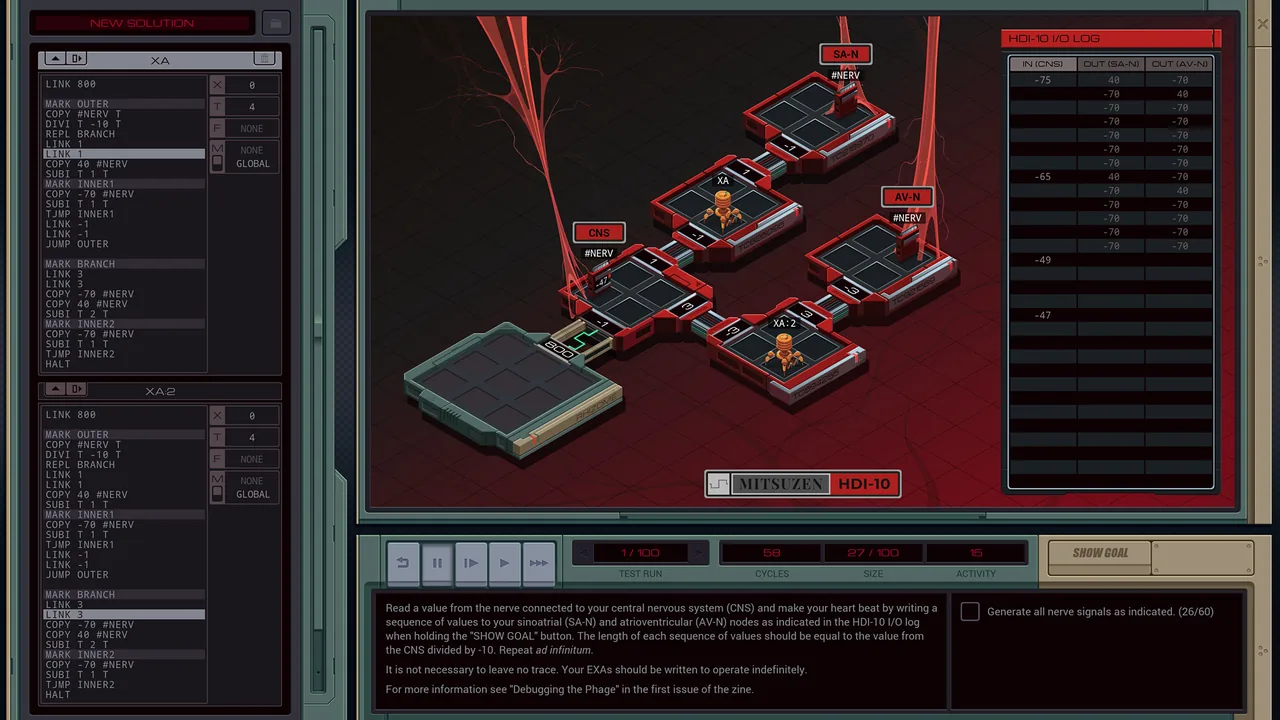
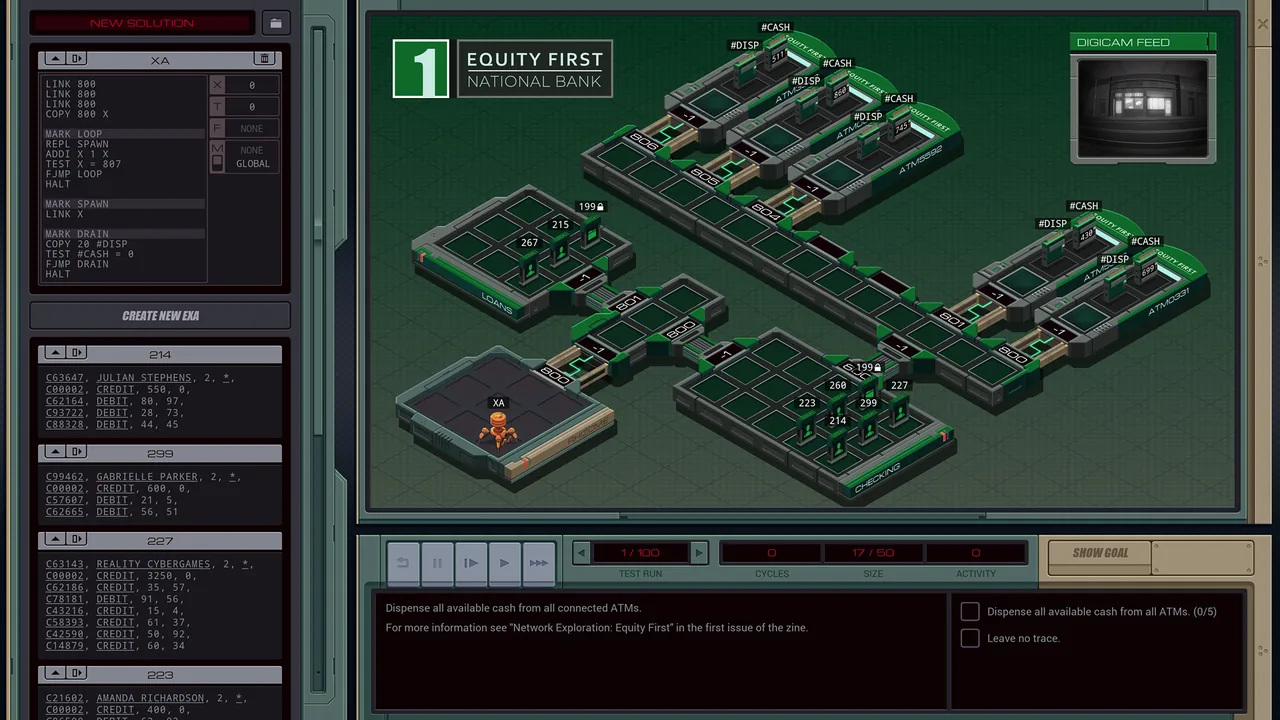
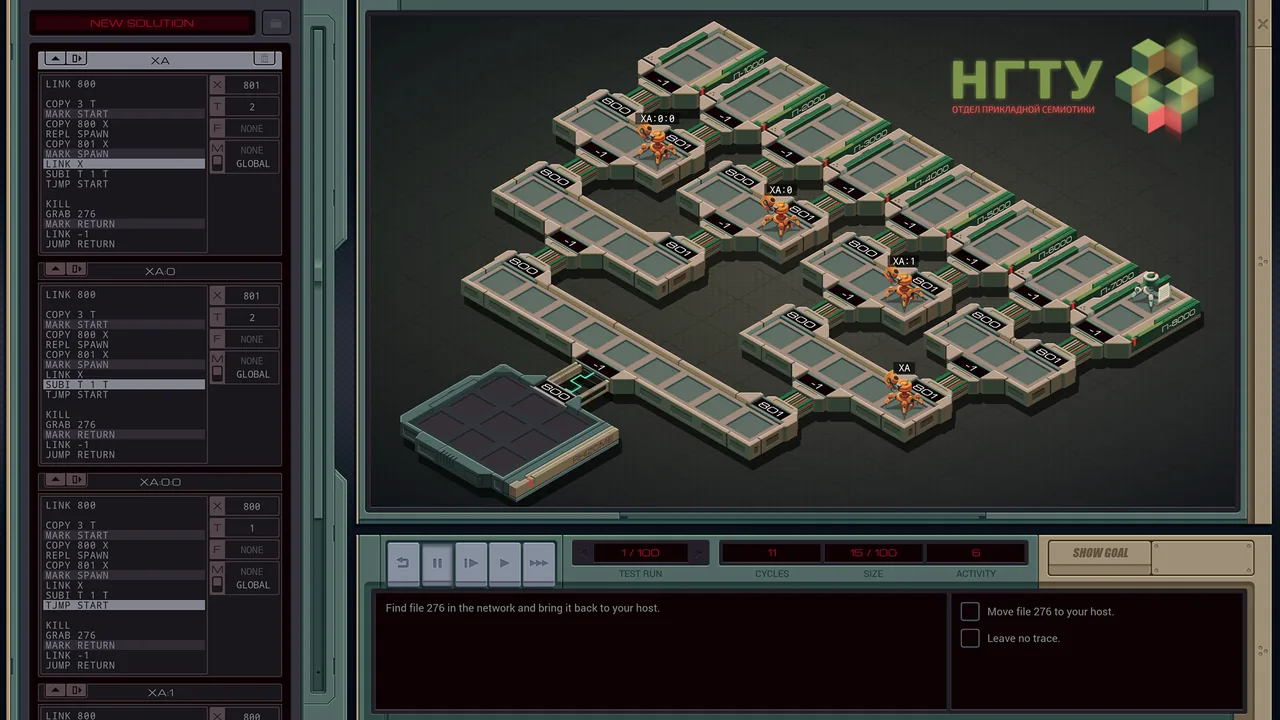
And when the language clicks, the network puzzles are genuinely satisfying — sending EXAs through hostile systems, coordinating them, watching a solution run.
The numbers, and one that stands out
Recent English reviews sit at 93 of 100 positive with a 23.8-hour median — so the people who stay, stay properly.
But the critics' median playtime is 1.1 hours, the lowest of the four games and by a wide margin (SHENZHEN I/O 4.6, Opus Magnum 7.0, Turing Complete 6.2). That's the clearest signal in the corpus: people who don't get on with EXAPUNKS work that out almost immediately, usually in the first hour.
Achievements agree it's punishing: 16 in total, the most common held by 29.3% of players and the median by 4.1%.
The verdict
EXAPUNKS earns a 7.5. As a piece of world-building it's the studio's finest work, the puzzles are clever, and it's complete and cross-platform with no monetisation attached.
It lands at the bottom of today's engineering-puzzle group — level with Turing Complete, below SHENZHEN I/O at 8 and Opus Magnum at 8.5 — because its difficulty leans hardest on restriction, its reference material lives outside the game, and its audience is the narrowest of the four. NZ$28.99 is also the most any of them asks except Turing Complete.
Buy it third, after Opus Magnum and SHENZHEN I/O. If you bounce in the first hour, the data says you're unlikely to be persuaded later.
Pros and cons
Pros
- The strongest presentation in the studio's catalogue — zines, comics, a full 1997 aesthetic
- Genuinely clever network puzzles once the language clicks
- Solution histograms driving optimisation long past the first working answer
- Includes a complete, playable card game as a side activity
- Cross-platform on Windows, macOS and Linux, with no DLC
Cons
- Difficulty often comes from what the language forbids rather than the problem itself
- Constant alt-tabbing to an external manual instead of in-game reference
- Won't teach you to program, and doesn't claim to — but many buyers expect it to
- Critics' median playtime is 1.1 hours; a lot of people bounce almost immediately
- NZ$28.99 for the narrowest audience of the studio's puzzle games
Screenshots
-
EXAPUNKSImage: Zachtronics via Steam -
EXAPUNKSImage: Zachtronics via Steam -
EXAPUNKSImage: Zachtronics via Steam -
How the review scores each part of the gameWanderer Editorial -
The short versionWanderer Editorial