Game review
SpaceChem
8 / 10
- Developer
- Zachtronics
- Publisher
- Zachtronics
- Released
- 2 March 2011
- Platforms
- Windows, macOS, Linux
- Genre
- Engineering Puzzle
- Monetisation
- One-time purchase with one optional extra. No in-game purchases.
- Players
- Single-player, with global solution histograms
The short version
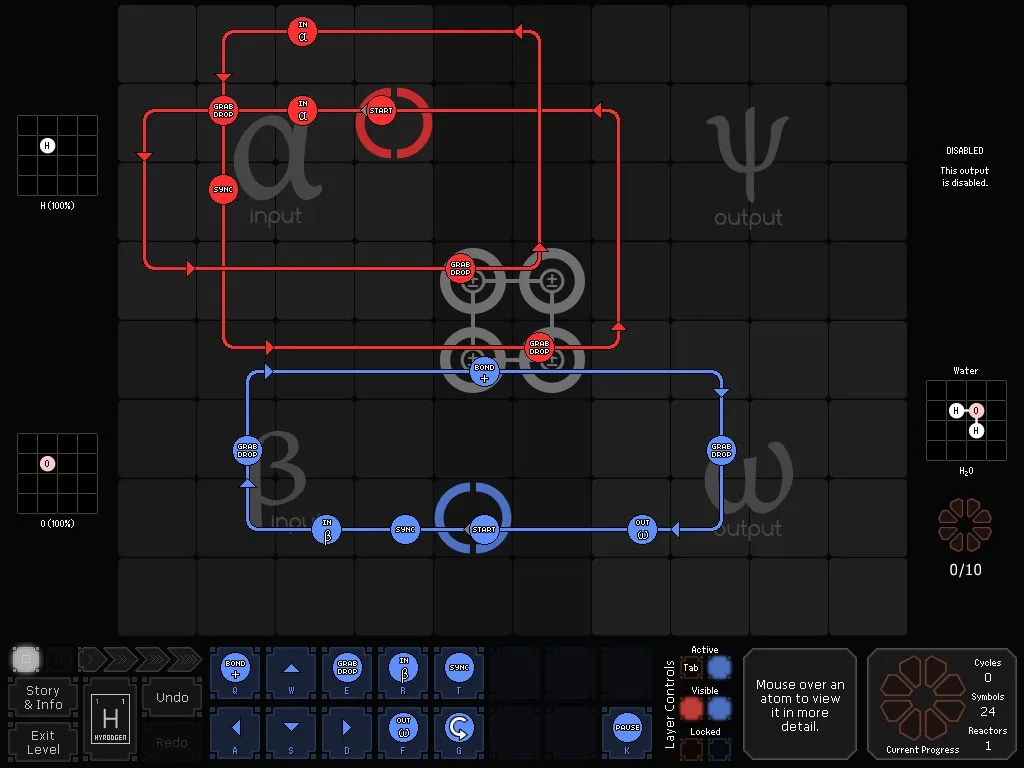
Two waldos trace looping paths around a grid, picking up atoms, bonding them, rotating them and dropping the results into an output. Do it wrong and they collide. SpaceChem invented the optimisation-puzzle genre that six other games in this library now belong to, and it did it in 2011.
It's also the lowest-rated of those seven at **93.5% positive in English** — and reading all the criticism, that's a story about being first rather than being worst. Tutorial complaints run higher here than anywhere else in the set, and the most-upvoted negative isn't hostile at all: "Due to its extreme complexity, SpaceChem will never be a title for everyone… Clearly, it was not made for me."
Biggest strengths
- Genuinely invented a genre — everything else in this set descends from it
- Concurrency as a puzzle: two waldos that must never collide is a superb core idea
- Solution histograms that turn every working reactor into a starting point
Biggest weaknesses
- The weakest onboarding in the set — tutorial complaints are its most common criticism
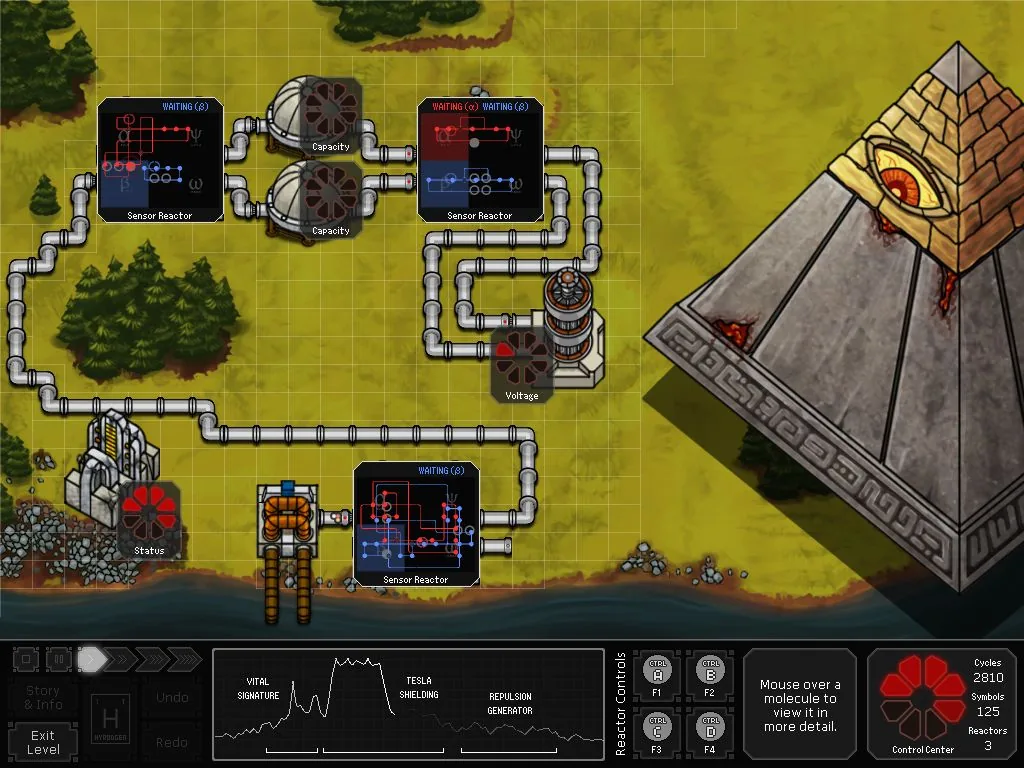
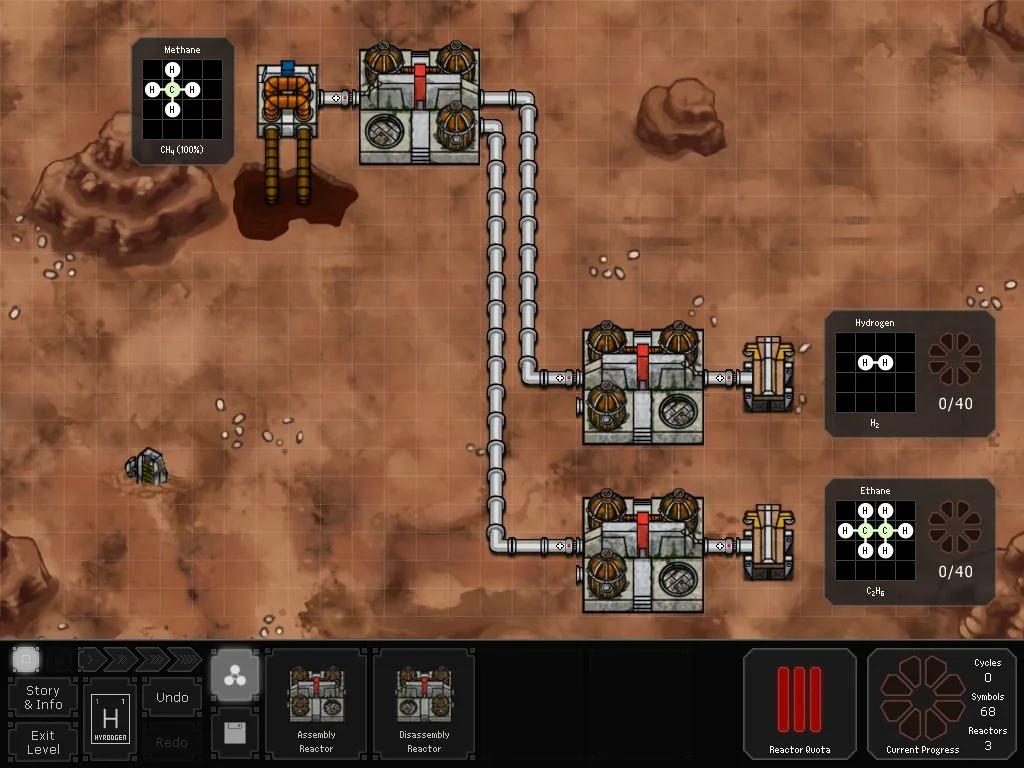
- Visually dated even by the studio's austere standards
- Difficulty escalates sharply and unforgivingly after the opening levels
Who it's for: Anyone curious where this genre came from, and anyone who wants concurrency as a puzzle. Start with Opus Magnum if you want the refined version; come here for the original.
Our recommendation: Buy it — NZ$14.75 for a genuinely foundational game is easy value, and the optimisation loop still works. Expect a steeper, less friendly on-ramp than anything the studio made afterwards.
8 / 10
This is the seventh engineering puzzle game I've reviewed today, and the one all the others were descended from. It's also, by Steam's numbers, the least liked of them.
| Game | Year | English rating | Price |
|---|---|---|---|
| Opus Magnum | 2017 | 97.1% | NZ$28.99 |
| TIS-100 | 2015 | 96.9% | NZ$10.49 |
| Infinifactory | 2015 | 95.0% | NZ$35.99 |
| Turing Complete | 2021 | 94.8% | NZ$30.99 |
| EXAPUNKS | 2018 | 94.7% | NZ$28.99 |
| SHENZHEN I/O | 2016 | 94.4% | NZ$21.99 |
| SpaceChem | 2011 | 93.5% | NZ$14.75 |
Being first is expensive.
What it invented
You control two "waldos" — pincers that follow looping instruction paths you draw on a grid. They pick up atoms, bond them, rotate them, and drop the results into outputs. The two waldos run simultaneously, which means the real problem isn't chemistry at all: it's concurrency. Two things moving on independent loops that must never occupy the same square.
That's a genuinely brilliant central idea, and it's why originality scores a 9.5. Every game in the table above is a variation on the question SpaceChem asked first: given a constrained machine and a required output, what's the most elegant thing you can build — and then, how much smaller can you make it?
The histograms were here too, plotting your cycles and symbols against everyone else's.
Why it rates lowest
Not because it's bad. Reading all hundred of its most-helpful negatives, two things stand out.
The on-ramp is the weakest in the set. Tutorial appears in 16 of a hundred negatives — the highest rate of any of the seven — with explanation and learning adding another 13. The studio hadn't yet worked out how to teach its own ideas, and later games handled it better; Opus Magnum in particular teaches almost wordlessly.
The criticism is mostly self-selection, not complaint. The most-upvoted negative, at 134 votes, is gracious: "Due to its extreme complexity, SpaceChem will never be a title for everyone. Too deep and articulate for casual players… Clearly, it was not made for me." The second, at 84 votes, opens "It's not a bad game, but you should think carefully about whether or not you are the target audience."
That's the same shape I found in SHENZHEN I/O, whose 905-vote top negative also recommended the game. In this genre, a low score frequently means "wrong audience" rather than "poor game" — and across seven titles today, that pattern has held remarkably well.
A fair criticism that is specific: it looks its age. Visuals score a 6.5, the lowest of the set. And Linux or macOS problems appear in 7 negatives spread from 2013 to 2021, so cross-platform support has been imperfect for most of its life.
Reading the dates
Negatives cluster in 2014–2015 — 37 of the hundred — but that group carries a median of 3 votes, and the 2022-onward group just 2. Neither cluster is weighted enough to represent an event; this is ordinary spread across fifteen years rather than a moment where something went wrong.
Recent English reviews sit at 94 of 100 positive, with a median playtime of 15.6 hours. The critics' median is 2.7 — the familiar fast-bounce pattern of the whole genre.
Achievements are punishing but not extreme: 20 in total, the most common held by 35.9% of players and the median by 8%.
The verdict
SpaceChem earns an 8, level with TIS-100 and SHENZHEN I/O.
It's a foundational game — the concurrency puzzle that an entire genre grew out of — and at NZ$14.75 it remains one of the cheapest ways to find out whether this kind of thinking suits you. Fifteen years later the core still works.
It doesn't score higher because the studio's later work simply teaches better, looks better and respects your time more, and because a 2011 interface is a 2011 interface. That's not a criticism so much as an observation about progress: SpaceChem's biggest problem is the six games it made possible.
Play Opus Magnum first if you just want the best one. Play this if you want to see where it came from — and it's worth seeing.
Pros and cons
Pros
- Genuinely invented a genre — everything else in this set descends from it
- Concurrency as a puzzle: two waldos that must never collide is a superb core idea
- Solution histograms that turn every working reactor into a starting point
- Cheap and complete, with cross-platform Windows, macOS and Linux builds
- Still holds up mechanically fifteen years on
Cons
- The weakest onboarding in the set — tutorial complaints are its most common criticism
- Visually dated even by the studio's austere standards
- Difficulty escalates sharply and unforgivingly after the opening levels
- Occasional Linux and macOS problems reported across its life
- Critics' median playtime is 2.7 hours — a lot of people bounce early
Screenshots
-
SpaceChemImage: Zachtronics via Steam -
SpaceChemImage: Zachtronics via Steam -
SpaceChemImage: Zachtronics via Steam -
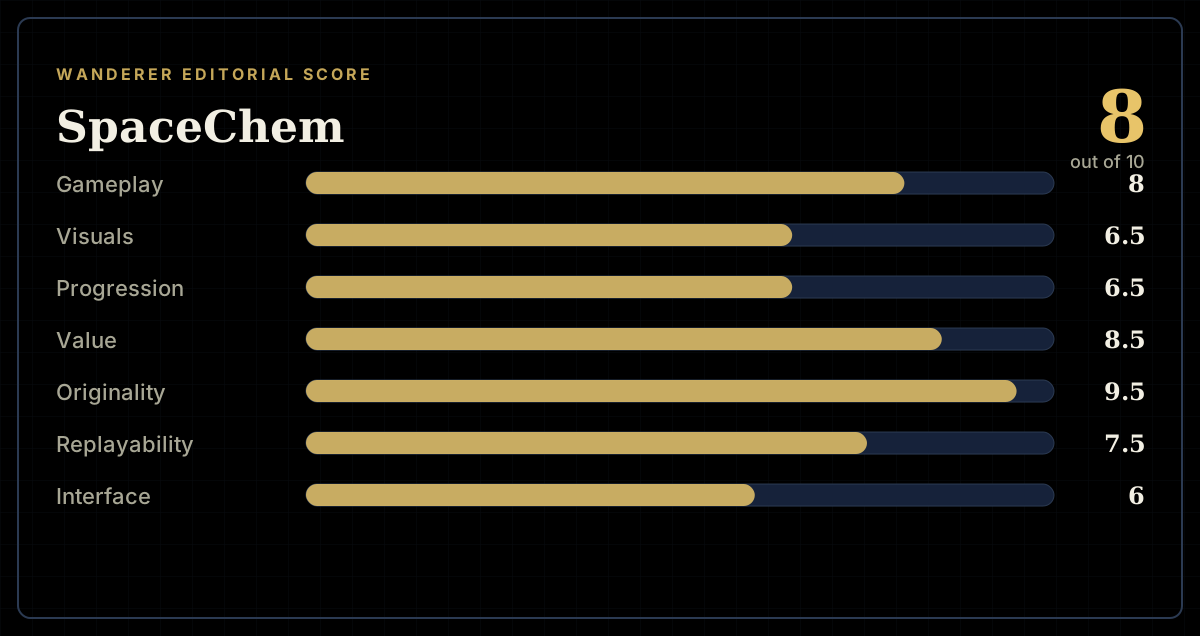
How the review scores each part of the gameWanderer Editorial -
The short versionWanderer Editorial