
Game review
This Is the Police 2
5.5 / 10
- Developer
- Weappy Studio
- Publisher
- THQ Nordic
- Released
- 31 July 2018
- Platforms
- Windows, macOS, Linux
- Genre
- Crime management strategy hybrid
- Monetisation
- One-off purchase, no in-game currency, ads or gameplay-affecting purchases
- Players
- None; single-player only
The short version
This Is the Police 2 expands on the noir crime-boss management premise of its predecessor with a genuine, ambitious addition: a full turn-based tactical combat layer sending your officers into actual firefights rather than resolving them behind the scenes. Reviewers are split close to evenly on whether that expansion pays off — several praise the new depth directly, describing a richer, more replayable game than the original, while a comparably sized group argues it slows the pacing to a crawl and dilutes a formula that worked better when it stayed focused on dispatch management. What both camps tend to agree on is more specific and more fixable: an opening stretch of long, forcibly-paced cutscenes that can only be skipped in large, all-or-nothing chunks rather than incrementally, several documented bugs (some patched, at least one persisting reports of soft-locking a run through random events), and mechanics explained once during onboarding with no way to revisit that explanation later. The excellent voice cast, led by returning talent from The Longest Journey and the Duke Nukem series, remains a genuine strength throughout.
Biggest strengths
- A genuinely ambitious expansion of the original's formula, adding full turn-based tactical missions rather than resolving conflicts abstractly
- Excellent voice acting throughout, led by Sarah Hamilton (The Longest Journey) and Jon St. John (Duke Nukem), drawing praise even from reviewers critical of other aspects
- A continuation of Jack Boyd's story from the first game gives series fans real narrative closure on his fate
Biggest weaknesses
- A long, slow opening stretch of forced cutscenes can only be skipped in large, all-or-nothing chunks rather than incrementally, and cutscenes forcibly pause if the game window loses focus
- Reviewers are close to evenly split on whether the new tactical combat layer improves the game or dilutes its original dispatch-management focus, with several describing the added systems as disconnected from each other rather than unified
- Mechanics are explained once during onboarding with no in-game way to revisit that explanation, a specific complaint from multiple reviewers who found themselves lost later without a reference
Who it's for: Fans of narrative-driven management sims who specifically want more tactical combat depth than the original This Is the Police offered, and players patient enough to sit through a slow, cutscene-heavy opening. Less suited to fans of the tighter, dispatch-focused original looking for a direct continuation of that specific formula, or anyone who wants full control over skipping story content.
Our recommendation: Worth it for players specifically excited about the tactical-combat expansion; approach with caution if you loved the first game primarily for its tighter management focus, since a substantial share of the game's own audience feels that focus got lost here.
5.5 / 10
This Is the Police 2 picks up the noir crime-management premise of its predecessor and pushes it further: sheriff Lilly Reed teams up with fugitive Jack Boyd, holdover protagonist of the first game, to keep order in the cold border town of Sharpwood while running her department, managing morally compromised officers, and now — new to this entry — commanding them directly through turn-based tactical missions when situations turn violent. Released in July 2018, it landed at a Mixed 63.5% positive across 1,365 English reviews, a score that, read closely, reflects a genuinely divided reception rather than simple mediocrity across the board.
An ambitious addition that splits its own audience
The single biggest design decision — adding full tactical combat rather than resolving violent encounters abstractly as the original did — draws praise and frustration in close to equal measure. One enthusiastic reviewer, self-described as loving XCOM 2 and LA Noire, calls the combination "fantastic," specifically praising how the resource management, tactics, and crime-drama elements come together. Another reviewer frames the sequel as "a step up from the original" while still noting real room for polish. Set directly against that is an equally confident opposing view: one reviewer states plainly "It's fiddlier, slower, and more frustrating" than the first game, and a separate detailed review argues the new systems don't cohere: "Too many mechanics that don't really work together... caps, shops and missions all feel disconnected, like they don't really tie into each other or form a clear system." A third, more blunt review (translated from Russian) puts it memorably: the first game was "a hundred times better," killed here by "these stupid tactical missions" despite conceding the visuals remain excellent. This is a real, substantive design disagreement among the game's own fans, not one side simply being wrong.
A slow start nearly everyone agrees on
Regardless of where reviewers land on the tactical-combat question, criticism of the game's opening pacing is close to universal. One reviewer describes an introduction "so long and boring that I genuinely thought it wouldn't progress until I skipped it," adding a specific, checkable usability complaint: "You can't skip in small steps, just massive chunks." Another reviewer frustrated by the same stretch asks directly, "why are the animations are so slow," citing a letter-writing scene early in the game as an example of pacing dragging well past what the content justifies. A further specific technical annoyance compounds this: cutscenes are reported to forcibly pause playback if the game window isn't the active focus, an odd design choice for lengthy story sequences players might reasonably want to leave running in the background.
Real, if incomplete, post-launch fixes
The developer's own patch history shows genuine, fast post-launch attention: within the first month, Weappy Studio shipped fixes for a serious bug that blocked the first investigation entirely on Chinese and Japanese language settings, a bug causing cops to get permanently stuck after tactical missions, and later a fix for an "End Turn" bug that caused turns to skip unexpectedly during combat. That's a real, responsive early support cycle addressing serious, specific problems. What it doesn't appear to have addressed, based on a detailed review posted well after these patches, is a separate complaint that certain random events can soft-lock a promising run entirely — this review found no patch note specifically matching that description, so it's reported as a real, detailed, but unconfirmed-as-fixed reviewer account.
A cast that keeps the material grounded
Whatever side of the design debate a reviewer lands on, voice acting draws consistent praise across the sample. Sarah Hamilton (Sheriff Lilly Reed) and Jon St. John (Jack Boyd) anchor the noir tone convincingly, and multiple reviewers specifically credit the performances for keeping them engaged through stretches of gameplay they otherwise found frustrating — a genuine strength that survives the broader disagreement about the game's mechanical direction.
A tutorial that only happens once
A more specific, structural complaint recurs across several reviews regardless of their overall verdict on the sequel: the game explains its systems once, during onboarding, with no in-game reference to return to later. One detailed reviewer states the frustration precisely: "some mechanics and details of the game are explained once and never again. I couldn't find a section to revisit these." For a game layering dispatch management, resource allocation, shop systems, and turn-based tactics on top of each other, a one-time explanation with no glossary or help menu to fall back on is a specific, avoidable gap — the kind of thing a patch could realistically address without touching the larger, more contested question of whether the tactical layer belongs in the game at all.
A refreshingly restrained monetisation model
One thing worth stating plainly in the game's favor, since it's a real point of contrast with plenty of management games at a similar scope: This Is the Police 2 is a single, one-off purchase with no in-game currency, loot boxes, or paid shortcuts of any kind, matching the original's approach. None of the reviews gathered for this piece raise monetisation as a complaint in either direction, which in a genre where premium currencies and time-savers have become common is itself worth noting as a quiet, uncontroversial strength rather than assuming it by default.
Verdict
This Is the Police 2 is a real, ambitious attempt to deepen its predecessor's formula, and whether that attempt succeeds depends heavily on what a given player wanted more of — reviewers who craved tactical depth are largely satisfied, while reviewers who loved the original's tighter, dispatch-focused loop frequently feel it's been diluted. What's less debatable is a slow, rigidly unskippable opening and a handful of real bugs, some fixed quickly and at least one still reportedly unresolved. Go in aware of the specific trade-off being made, and lean on the strong voice cast to carry you through the parts that don't land.
Sources: Steam store page and appdetails API (release date, pricing, platform data); Steam's aggregate review data (query_summary totals, English-language sample); individually read user reviews across languages, both positive and negative, sorted by helpfulness and recency; Steam's global achievement statistics API; Weappy Studio/THQ Nordic's own partner-events patch notes from launch in July 2018 through several bugfix and balance updates that same year.
Pros and cons
Pros
- A genuinely ambitious expansion of the original's formula, adding full turn-based tactical missions rather than resolving conflicts abstractly
- Excellent voice acting throughout, led by Sarah Hamilton (The Longest Journey) and Jon St. John (Duke Nukem), drawing praise even from reviewers critical of other aspects
- A continuation of Jack Boyd's story from the first game gives series fans real narrative closure on his fate
- Reviewers who click with the expanded scope describe genuinely improved replayability over the more linear original
- The developer shipped multiple real bugfix patches addressing serious issues (a language-blocking bug, an end-turn skip bug, cops getting permanently stuck) within weeks of launch
Cons
- A long, slow opening stretch of forced cutscenes can only be skipped in large, all-or-nothing chunks rather than incrementally, and cutscenes forcibly pause if the game window loses focus
- Reviewers are close to evenly split on whether the new tactical combat layer improves the game or dilutes its original dispatch-management focus, with several describing the added systems as disconnected from each other rather than unified
- Mechanics are explained once during onboarding with no in-game way to revisit that explanation, a specific complaint from multiple reviewers who found themselves lost later without a reference
- At least one detailed, recent review reports random events that can soft-lock a promising run, a more serious complaint than ordinary difficulty and one this review could not confirm was ever specifically patched
- Achievement data shows a real but moderate engagement curve, with most late-game milestones held by under 20% of the playerbase, consistent with reviewer reports of the tactical missions becoming a slow, frustrating wall for a meaningful share of buyers
Screenshots
-

This Is the Police 2Image: THQ Nordic via Steam -

This Is the Police 2Image: THQ Nordic via Steam -

This Is the Police 2Image: THQ Nordic via Steam -
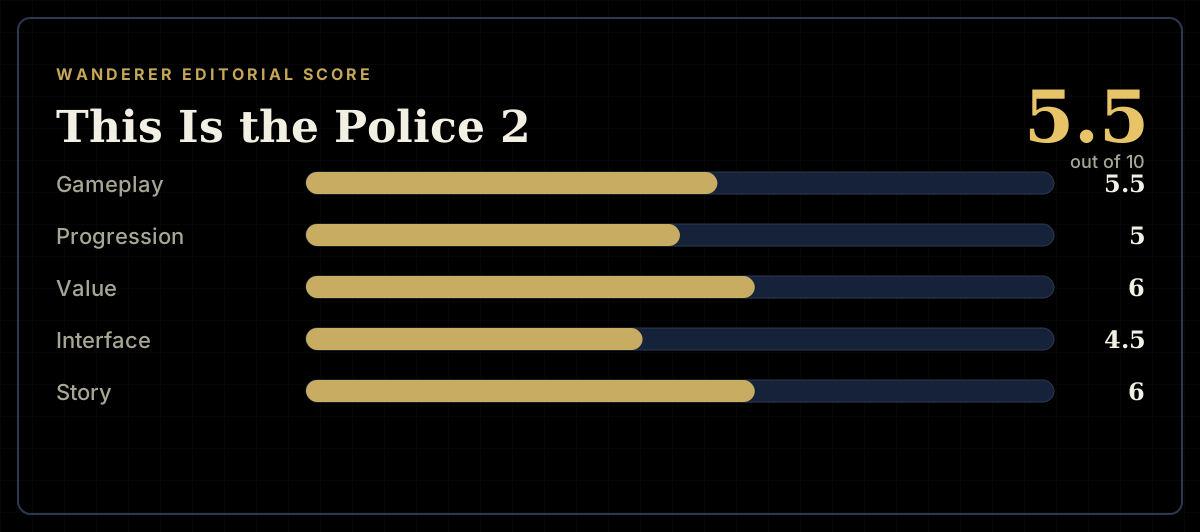
How the review scores each part of the gameWanderer Editorial -
The short versionWanderer Editorial