Game review
Corsair Cove
8 / 10
- Developer
- Limbic Entertainment
- Publisher
- Hooded Horse
- Released
- 31 July 2026
- Platforms
- Windows
- Genre
- City Builder / Colony Sim
- Monetisation
- One-time purchase, no in-app purchases, no DLC at launch. Listed at NZ$59.99 with a 25% launch discount bringing it to NZ$44.99 — checked 5 August 2026.
- Players
- Single-player only
The short version
Corsair Cove's answer to the flat-land problem every city builder has is to let you build up the cliffs — pathways, ziplines and production chains stacked vertically until your pirate haven looks like something that grew rather than something that was planned. It works, it's beautiful, it runs well, and it shipped finished, which in 2026 is nearly a feature in itself. The ship combat bolted to the side of it is a turn-based card-and-dice affair with no animation, and the logistics layer asks for more manual wiring than it should. Neither sinks it. Both keep it off a nine.
Biggest strengths
- Vertical building is a genuine idea, not a gimmick — cliffsides, hilltops and stacked platforms make the spatial puzzle feel new in a very well-worn genre
- Ziplines, bridges and connector systems for moving goods around a three-dimensional settlement are the most satisfying part of the design
- Shipped polished: performance, UI clarity and voice acting all draw specific praise, and a notable number of reviewers single out the fact that it isn't Early Access
Biggest weaknesses
- Ship combat resolves as turn-based card and dice rolls with no animation to speak of; even positive reviews call it the weakest part, and it's a strange omission in a pirate game
- Logistics require manual wiring — assigning storage and a runner per building — which becomes busywork rather than decision-making as the settlement grows
- Pathing and roads interact awkwardly with the verticality, which is the cost of the game's best feature
Who it's for: City builder and colony sim players who want production chains with a fresh spatial twist, Tropico and Anno veterans looking for something warmer than Frostpunk, and anyone who has wanted a pirate settlement game that takes the settlement half seriously. Not for players who came for naval battles — those are the thinnest part of the game.
Our recommendation: Worth full price if you play this genre, and an easy buy at the launch discount. Give it more than the hour that most of its negative reviewers did, because the systems don't interlock until the second or third production tier. If ship combat is the thing you're buying for, wait and watch the patch notes instead.
8 / 10
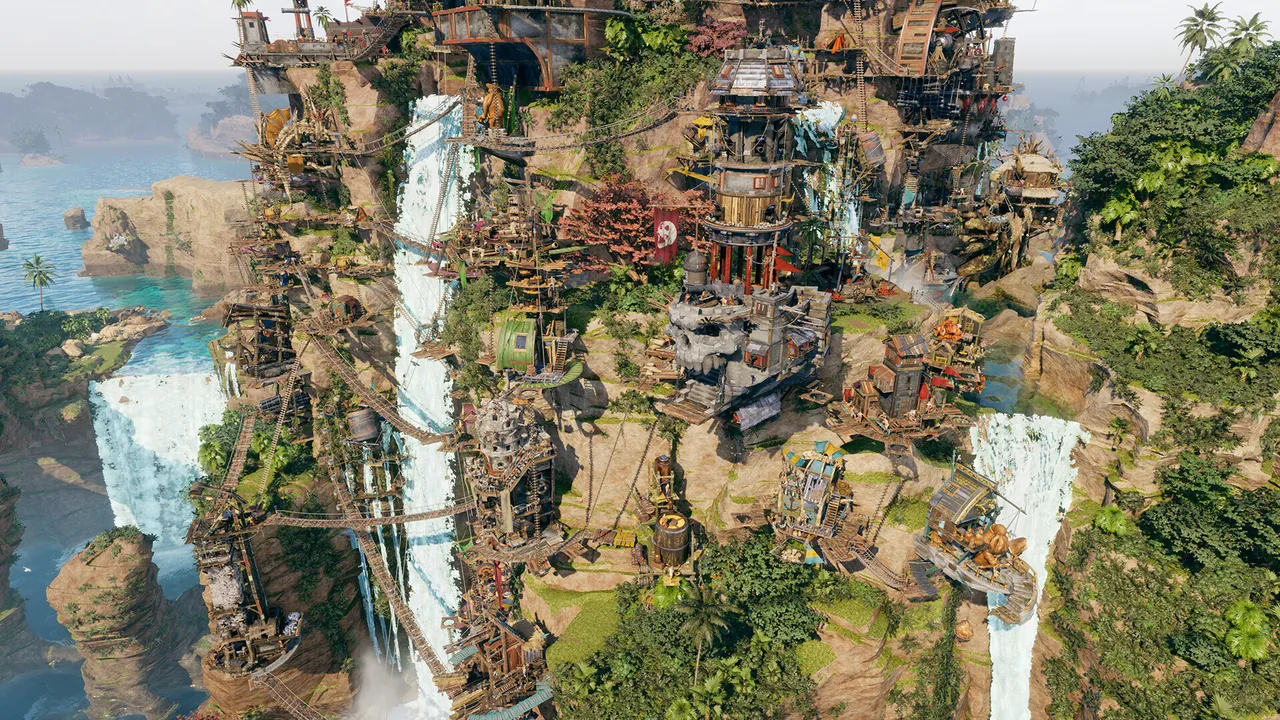
Every city builder eventually runs into the same wall: you run out of flat ground. Most solve it by giving you more flat ground. Corsair Cove solves it by letting you build up the cliff — pathways bolted to sheer rock, platforms cantilevered over the water, ziplines carrying rum barrels from a distillery two hundred feet above the pier that needs them.
It's the best structural idea the genre has had this year, and it comes from a team that knows what it's doing. Limbic Entertainment built Tropico 6; Hooded Horse published this one; and the result is a launch that a striking number of its own reviewers describe, unprompted, with a phrase you don't see often in 2026 — that it shipped finished.
Thinking tall
The pitch is straightforward. You wash up on a deserted island with a wrecked ship and the crew who survived it, and you build the last safe harbour of the Golden Age of Piracy before the Crown stamps it out. Living quarters, taverns, piers, cannon foundries, defensive works. Production chains that turn raw material into spyglasses, pistols and cannons. Thousands of pirates, eventually, all of whom need feeding, housing and keeping cheerful.
What makes it feel different is that the third dimension is load-bearing. Scarce flat land isn't a constraint you work around, it's the puzzle — every inch of usable surface, horizontal or otherwise, is somewhere a building could go if you can get goods to and from it. Bridges, ziplines and connectors do that work, and the pleasure of the game is watching a settlement that looks architecturally implausible turn out to function.
The presentation carries it. The art is warm and readable rather than grimy, the voice acting in the tutorial gets specific praise, and the performance reports are unusually good for a launch — players on mid-range hardware describe it running maxed out without complaint. The interface draws compliments too, which for a production-chain game is not a small thing: this genre lives or dies on whether you can see what's broken.
There's a story campaign and a free mode, and the free mode is the better structure for repeat play since it lets you pick your own unlock order rather than following the script.
Where the wiring shows
Two things stop this being a straightforward nine.
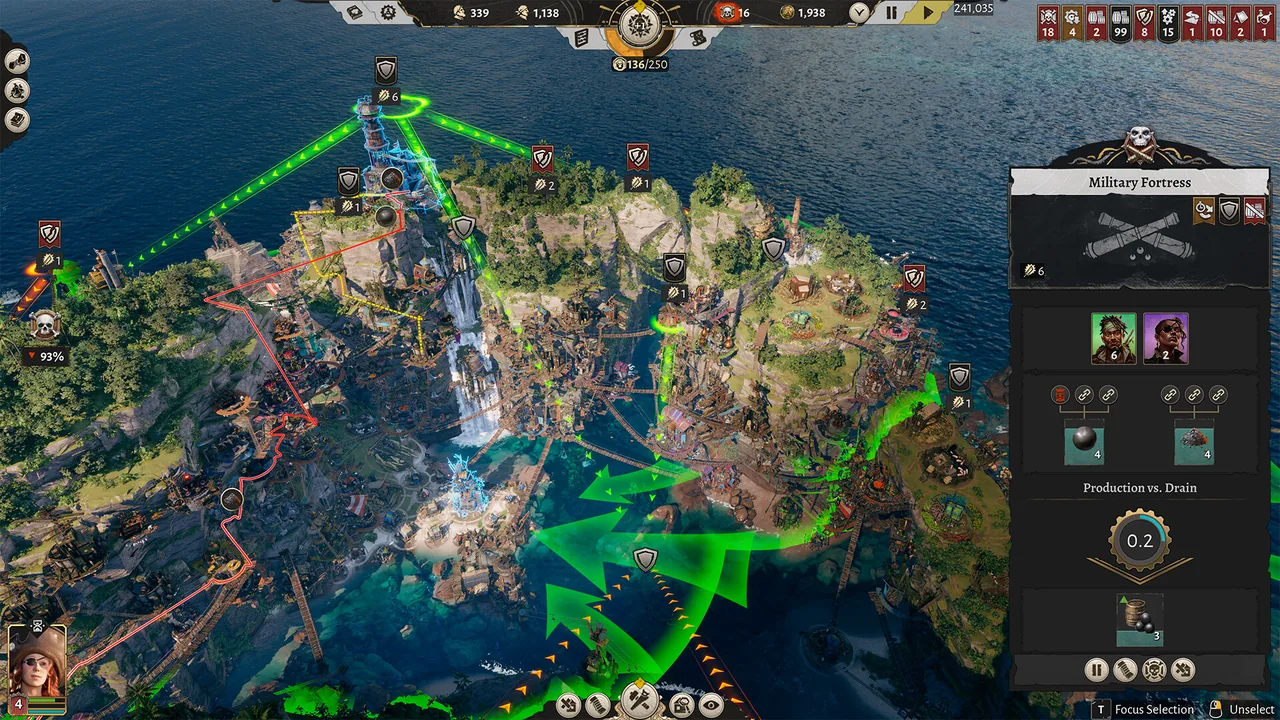
The first is logistics micromanagement. Buildings need materials, and getting materials to them means assigning storage and a runner, per building, by hand. Early on that's a decision. By the time you're running a settlement of any size it's a chore list, and the most articulate negative review in the corpus — from a Tropico veteran, no less — argues that the pirate theme ends up drowned out by warehouse management. That's overstated, but it's pointing at something real: the game asks you to wire the plumbing rather than design the city, more often than it should.
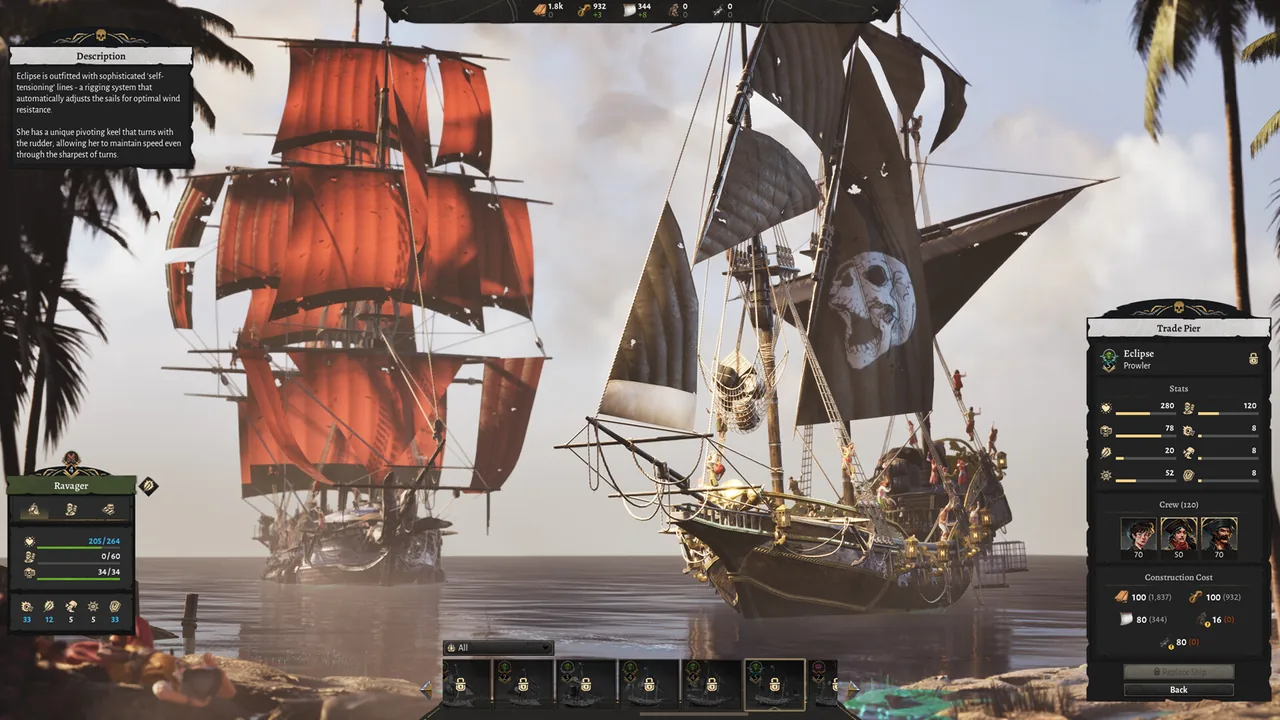
The second is combat, and it's the odd one. Corsair Cove sends you out to raid islands and fight the Crown's fleets, and those encounters resolve as turn-based card-and-dice exchanges with essentially no animation. Ships sit there. Numbers happen. Even the enthusiastic reviews call this the weak point — one describes it as a missed opportunity to deliver the pirate fantasy the rest of the game is drenched in, which is exactly right. For a builder, "the combat is abstract" is a survivable criticism. For a pirate builder, it's the one place you'd expect the budget to go.
To be fair about the scale of it: this is a city builder first and the naval layer is a subsystem, not a mode. But when the marketing leads on raising a fleet and taking on the Crown, players who buy for that half are entitled to feel short-changed.
Reading the score honestly
The Steam page says 87.6% of 1,305, which is a strong launch, holding steady rather than sliding as the review count has grown through the first week. Two things are worth knowing before you weigh it.
First, the playtime split is still real, even a few days on. The English negative reviews have a median playtime of around 4-and-a-half hours; the positives run closer to 12, with a good number past 20 and some past 40. That doesn't make the criticisms invalid — a game that loses a meaningful slice of players within the first few sessions has a real onboarding problem, and the reported launch bugs, including a story-campaign blocker, plainly contributed. But it does mean the negative sample skews toward earlier impressions, while the positive sample is made of people who got to the point where the production chains start interlocking. In this genre that difference matters enormously.
Second, a visible slice of the negative reviews aren't about the game's systems at all — they object to the presence of women and non-white characters among the crew and captains. Readers weighing that 89% should know that some of the dissent is arguing about casting rather than design, and adjust for it in whichever direction they see fit.
Verdict
Corsair Cove is the most interesting thing to happen to city-builder geometry in a while, wrapped in a theme that mostly earns itself, released in a state that its own community keeps remarking on. If you liked the resource-pressure of Farthest Frontier or the puzzle-box production chains of Against the Storm, the vertical twist here is worth the ticket on its own — and it's a considerably sunnier proposition than Frostpunk if you want systems without the moral vice.
Buy it if you build cities. Approach it knowing the naval half is a placeholder for a fantasy the rest of the game keeps promising, and that the first hour undersells everything after it. Eight out of ten, with the two missing points sitting almost entirely in the ships.
Players who like watching a settlement grow but would rather it kept growing while they're away from the desk may also enjoy Wanderer.
Pros and cons
Pros
- Vertical building is a genuine idea, not a gimmick — cliffsides, hilltops and stacked platforms make the spatial puzzle feel new in a very well-worn genre
- Ziplines, bridges and connector systems for moving goods around a three-dimensional settlement are the most satisfying part of the design
- Shipped polished: performance, UI clarity and voice acting all draw specific praise, and a notable number of reviewers single out the fact that it isn't Early Access
- Production chains are legible and escalate at a good pace, with a free mode that lets you set your own unlock priorities alongside the story campaign
- Art direction is warm and readable, and it runs well on mid-range hardware
Cons
- Ship combat resolves as turn-based card and dice rolls with no animation to speak of; even positive reviews call it the weakest part, and it's a strange omission in a pirate game
- Logistics require manual wiring — assigning storage and a runner per building — which becomes busywork rather than decision-making as the settlement grows
- Pathing and roads interact awkwardly with the verticality, which is the cost of the game's best feature
- Launch bugs are real if not widespread: visual glitches, cutscene issues and at least one story-campaign blocker reported in the first days
- The pirate fantasy lives mostly in the theming; underneath it this is a warehouse-and-runner logistics game, which not everyone signed up for
Screenshots
-
Corsair CoveImage: Hooded Horse via Steam -
Corsair CoveImage: Hooded Horse via Steam -
Corsair CoveImage: Hooded Horse via Steam -
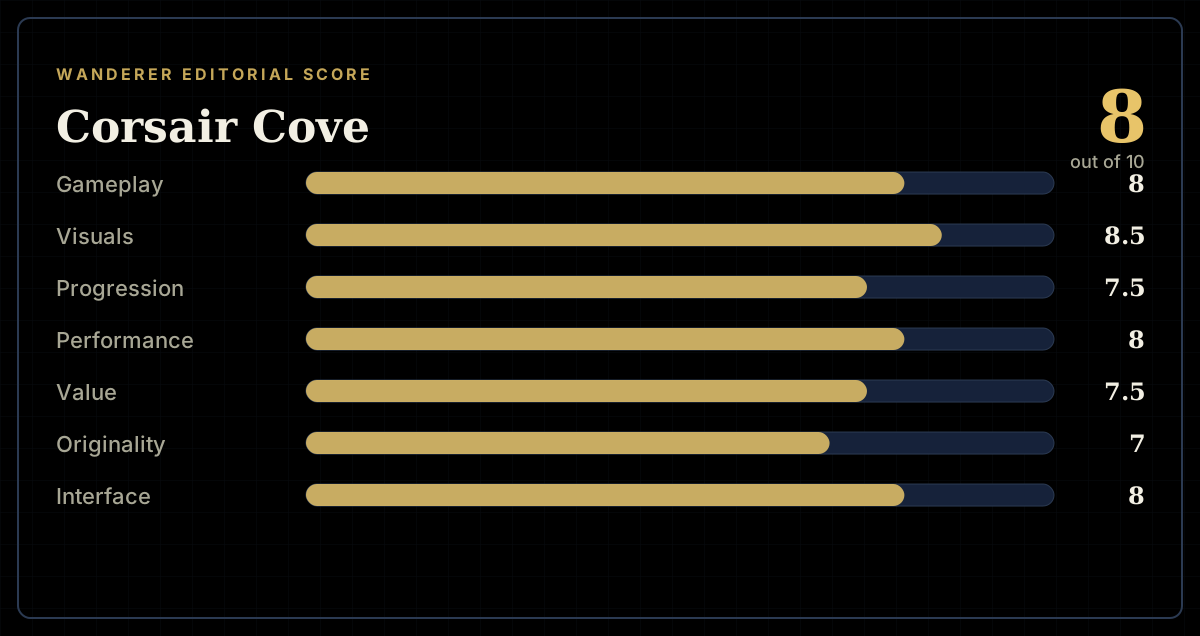
How the review scores each part of the gameWanderer Editorial -
The short versionWanderer Editorial