Game review
Frostpunk
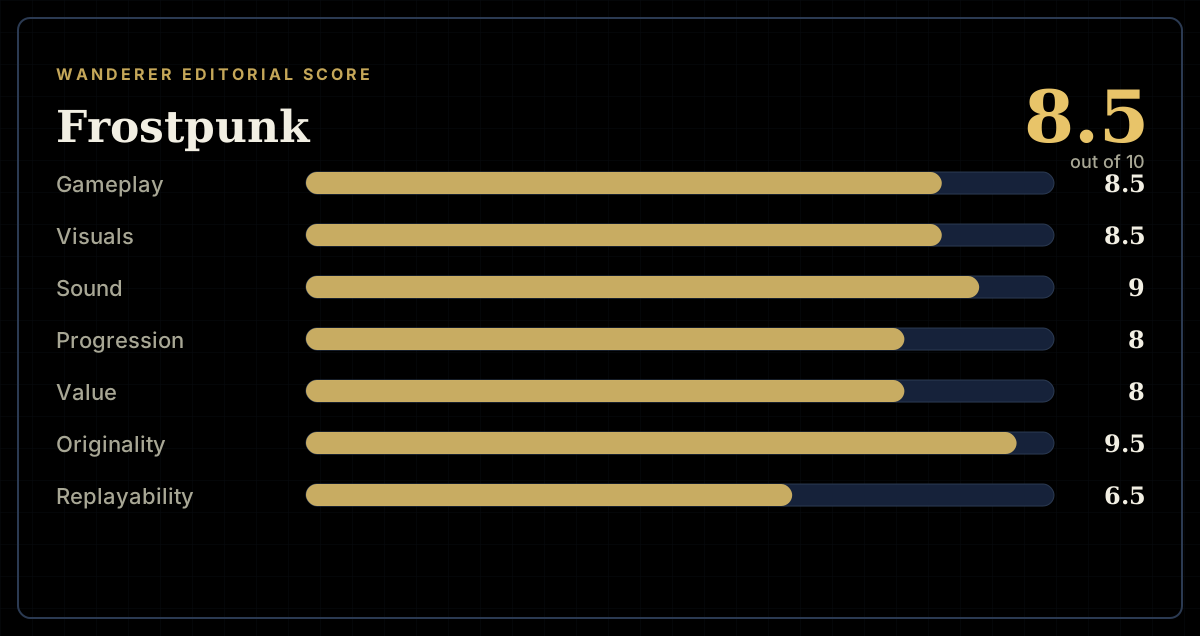
8.5 / 10
- Developer
- 11 bit studios
- Publisher
- 11 bit studios
- Released
- 24 April 2018
- Platforms
- Windows, PlayStation 4, Xbox One
- Genre
- Society Survival / City-Building Strategy
- Monetisation
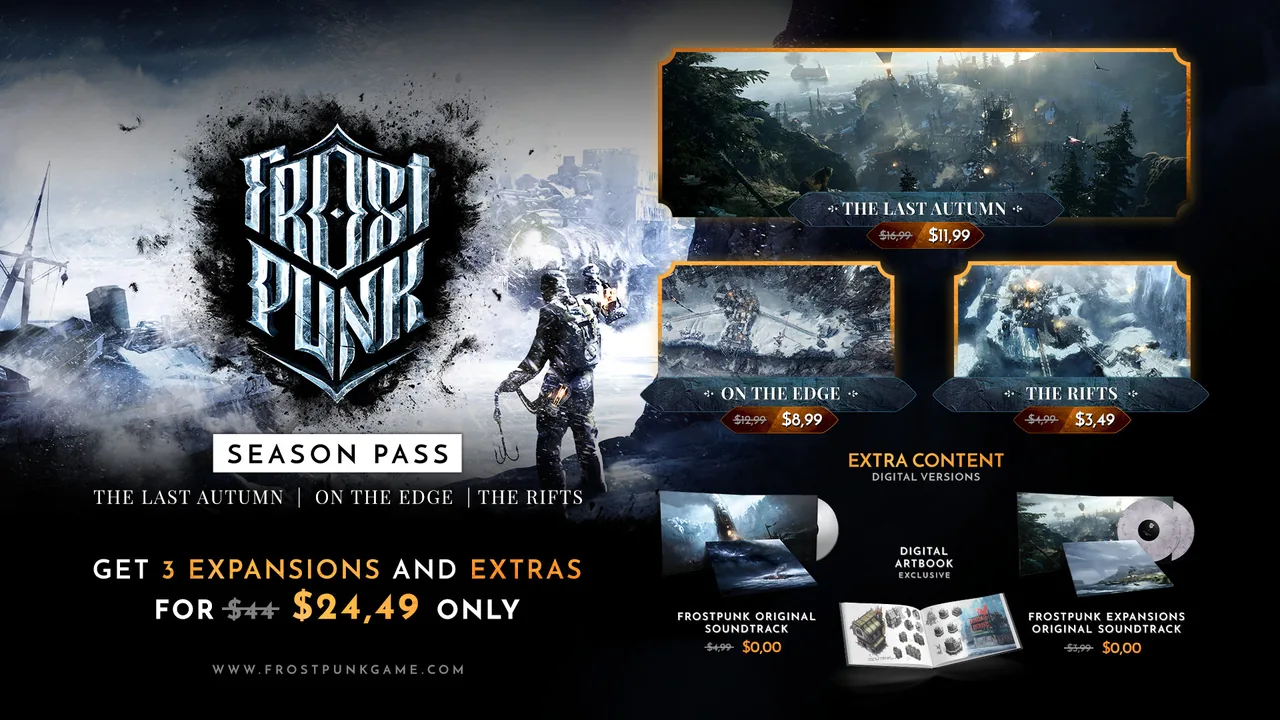
- One-time purchase, plus three optional paid scenario expansions (The Rifts, On The Edge, The Last Autumn); no ads, no subscription, no in-game currency
- Players
- Single-player only
The short version
Frostpunk puts you in charge of the last city on Earth, wrapped around a coal generator that is the only thing standing between your people and a frozen death, and it turns every management decision — how many hours the children work, whether the sick get treated or triaged, which law buys you heat at the cost of dissent — into a decision you have to actually own. Nothing else in the city-builder space commits this hard to making the numbers feel like consequences, and the first time the generator's temperature dial and your citizens' Discontent meter both start climbing at once, it produces a kind of tension the genre almost never reaches.
The problem is that Frostpunk's scenarios are built more like puzzles than sandboxes, and the game's own achievement statistics back up what its long tail of negative reviews keep saying: once you've solved a scenario, solving it again mostly means executing the same build order faster. The DLC and Endless modes exist specifically to answer that complaint, and by the numbers most owners never reach them.
Biggest strengths
- The Book of Laws forces genuinely uncomfortable trade-offs — child labour versus a shrinking workforce, extended shifts versus injuries — and the game never tells you which choice was right
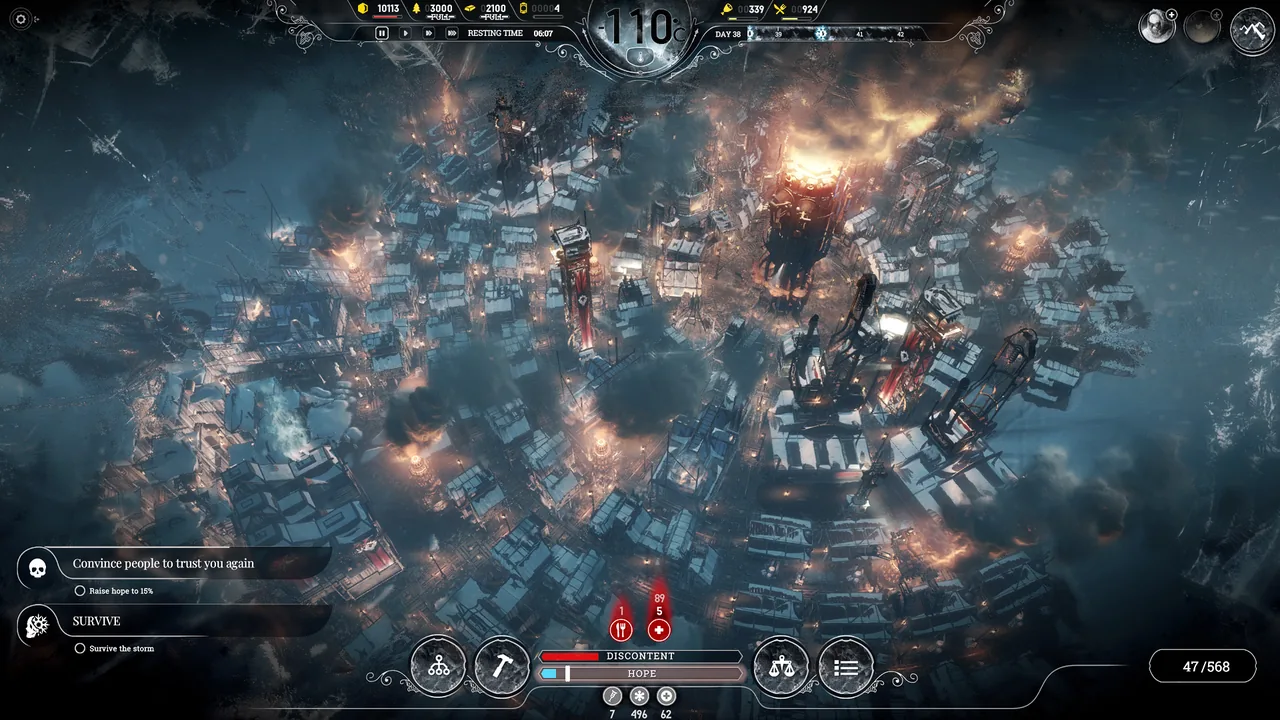
- The generator's heat radius, the Hope and Discontent meters, and the daily temperature drop all pressure the same decisions simultaneously, so there's rarely a single easy lever to pull
- The score is one of the most consistently praised elements across eight years of reviews, with music that shifts as storms and cold snaps hit the city
Biggest weaknesses
- Once a scenario's opening puzzle is solved, replaying it tends to mean re-executing a known build order rather than discovering a new one — a complaint that shows up across reviews from launch week through 2026
- Global achievement data backs that up starkly: the most-earned achievements across the whole 115-achievement list sit under 50%, and the ones tied to the paid scenario expansions and Endless mode's harder marathon lengths mostly sit under 5%, meaning most owners never see that content
- Some difficulty spikes come from a single scripted storm or crisis event rather than the player's own city-management mistakes, which a share of negative reviews read as trial-and-error rather than fair challenge
Who it's for: Strategy and management players who want a game that makes them uncomfortable with their own decisions, and anyone curious about the "society survival" subgenre this game effectively invented. Less suited to players who want a relaxing city builder or one they can freely experiment in without being punished for it.
Our recommendation: At its current sale price this is close to a mandatory purchase for strategy fans who haven't played it; even at full price it's a fair one for a roughly 15-25 hour genre landmark. Go in expecting to lose the first attempt at every scenario, and expecting the second attempt to feel less like discovery and more like execution.
8.5 / 10
The first time Frostpunk's generator temperature and your city's Discontent meter climb at the same time, on the same night, with no resource left to spend on either problem, is the moment the game tells you what kind of strategy title it actually is. It isn't really about heat output or workshop counts, not underneath. It's about the law you're about to sign that will fix one problem by making the other one worse, and the fact that the game never confirms whether you made the right call. Eight years after launch, that specific feeling is still the thing 11 bit studios' city builder does better than almost anything that has tried to copy it since.
A generator, a book of laws, and no good options
Frostpunk drops you into the last city on Earth, built in a ring around a coal-burning generator in a world gone permanently, catastrophically cold. The core loop looks familiar at first: place buildings, assign workers, research technology, manage resources. What makes it different is that every one of those systems is wired directly into two meters that never stop moving. Hope measures whether your people still believe the city survives; Discontent measures whether they're about to stop taking orders from you. Almost every decision that helps one of your practical problems — coal shortage, food shortage, a wave of frostbite injuries — costs you against one or both of those meters, and letting either one hit its limit ends the game regardless of how efficient your economy looks on paper.
The mechanism that ties it together is the Book of Laws, a slow-drip tech tree of political and social decisions rather than buildings. Do you let children work, and in which jobs? Do the sick get treated in an infirmary or does the city just accept the losses? Do you extend working hours past what's safe, and do you back it with a public whipping post when workers refuse? None of these choices come with a clearly correct answer stapled to them — the game just tells you the immediate resource effect and leaves the human cost to you. That's a genuinely rare thing for a management game to commit to, and it's the reason Frostpunk gets compared to political simulations and moral-choice narrative games as often as it gets compared to other city builders.
The puzzle underneath the sandbox
Where the design gets more contested is in how repeatable that tension actually is. Frostpunk's main scenarios — A New Home chief among them — are built around a specific escalating sequence of crises, arriving in a mostly fixed order, that push your city toward a small number of workable responses. The first time through, that structure is invisible; it just feels like the world getting worse and you scrambling to keep up. The second time through a scenario, once you know which storm is coming and when, the tension that made the first run gripping tends to collapse into optimisation — get the workshop up by day nine, sign the law by day fourteen, and the moral weight of the choice fades into a checklist. Reviews have made this exact complaint since the week Frostpunk launched in April 2018, and they're still making it in reviews posted this year: this is a puzzle box wearing the clothes of a sandbox, and once you've solved the puzzle there's limited reason to solve it again the same way.
11 bit studios clearly knew this, because the answer they shipped is Endless mode and three paid scenario expansions — The Rifts, On the Edge and The Last Autumn — each swapping in a different city, crisis and law set to sidestep the "I already know what's coming" problem. The trouble is the game's own global achievement data shows how few players actually get there. Across Frostpunk's full 115-achievement list, the most commonly earned achievements — tied to the free base scenario — sit in the 40-50% range. Once you look at achievements tied to the paid expansions or to Endless mode's longer marathon lengths, almost every one sits under 10%, and the hardest Endless marathon lengths sit at roughly 1%. Read plainly, that's a game whose most interesting long-term content is being seen by a small fraction of the people who own it — which lines up exactly with what the "replaying this is just executing a known solution" reviews describe as the reason they stopped.
Difficulty that sometimes feels aimed at you, and sometimes at the dice
A second, related complaint runs through Frostpunk's negative reviews across every year of its life: some of the game's toughest moments come from a single scripted storm or story event landing on a city that had no realistic way to prepare for it, rather than from the player's own mismanagement. That's a harder critique to settle than the replayability one, because scripted crises are also exactly what makes the narrative land — a randomly generated cold snap wouldn't carry the same weight as a specific, authored one. But it does mean a meaningful share of players describe losing a 30-plus-hour save to a single event they couldn't have reasonably foreseen, and "I lost because the game ambushed me" reads very differently from "I lost because I made a bad call," even when the mechanical outcome is identical. Frostpunk asks you to treat every failure as a lesson about your own decisions; not every failure actually is one.
What still gets universal praise
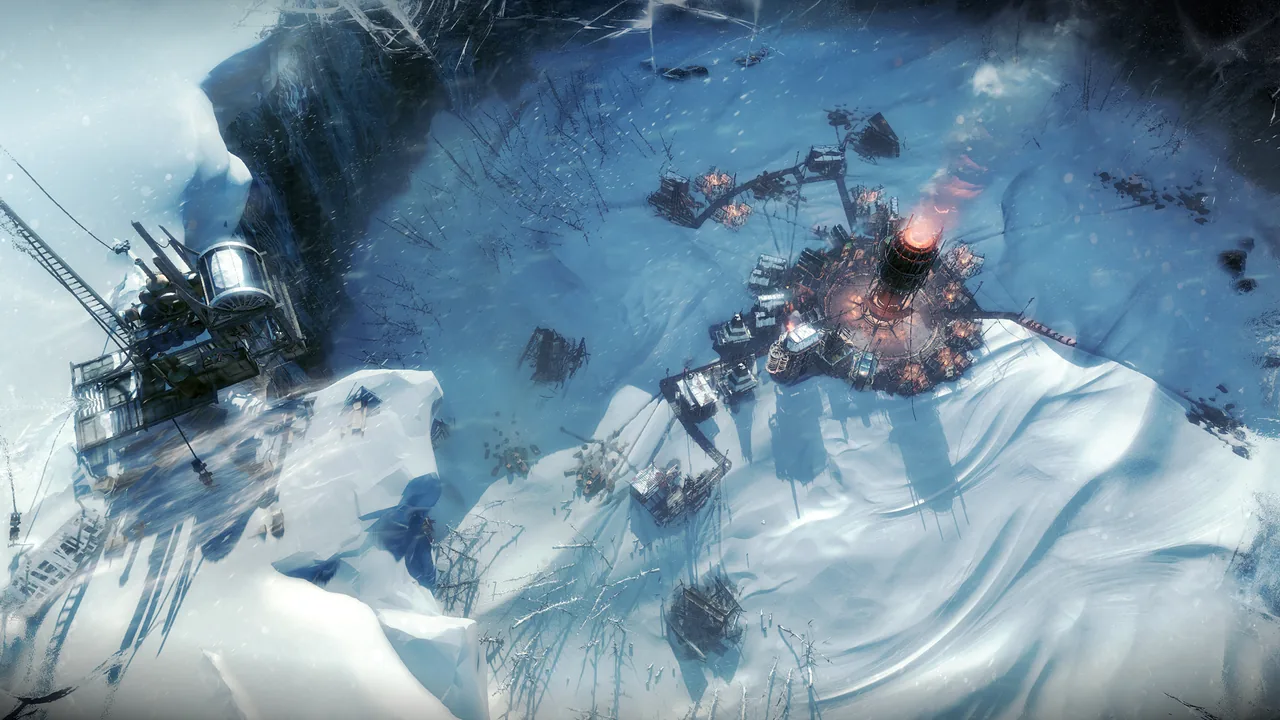
Two things draw consistent, specific praise across the entire eight years of reviews, and neither is in serious dispute. The first is the score — a soundtrack that tracks the city's condition closely enough that players still single it out by name years after finishing the campaign, with storms and crisis moments getting their own musical weight that a purely ambient score wouldn't attempt. The second is the art direction: an isometric city choked in steam, smoke and long shadows, built entirely around the idea that the generator at its centre is both the only source of warmth and the thing slowly poisoning everyone huddled around it. Frostpunk looks and sounds like exactly the kind of losing fight it's simulating, and that atmosphere is doing real work independent of whichever side of the replayability argument a given player lands on.
Price, DLC and what you're actually buying
There's very little to complain about on value. Frostpunk is a one-time purchase with no ads, subscriptions or premium currency, and its Steam listing was showing an 85% discount at the time of checking — NZ$6.53 against a NZ$43.59 list price on 3 August 2026, with the three scenario expansions discounted down to roughly NZ$1.50–2.50 each in the same sale. Even outside a sale, a genre-defining 15-to-25-hour campaign for around NZ$44 is a fair trade by current strategy-game pricing, and the expansions are proper scenario-length content rather than cosmetic add-ons. A persistent Steam Community myth claims 11 bit studios promised "all future DLC will be free" and then broke that promise — what the studio actually announced in 2018 was a roadmap of free content for that year specifically, which it delivered in full, before later expansions were sold separately. It's worth knowing the accusation exists in a lot of negative reviews, and worth knowing it doesn't hold up against what was actually said.
Final verdict
Frostpunk earns its Very Positive reputation on the strength of something few management games attempt: making resource numbers feel like moral weight, backed by a Book of Laws that never lets you feel good about a decision that worked. That first playthrough of a scenario, not knowing what's coming and improvising anyway, is genuinely one of the strongest experiences the genre has produced. What keeps this from the very top of the scale is that the design is closer to a scripted puzzle than a true sandbox, and the game's own achievement numbers confirm that most owners never get far enough past the first solved puzzle to see what else it built. An 8.5 is the honest score for a genre landmark with real, well-documented replayability limits — not a knock severe enough to argue against buying it, especially at its current price, but a real one worth knowing before the second playthrough.
Players who want a similarly harsh colony-management challenge with more room to build your own solutions, rather than solve a scripted one, should look at Going Medieval, where the crisis comes from the terrain and your own choices rather than an authored script. And anyone drawn to the idea of a world that keeps making demands on your time and judgement even when you're not actively managing it might find something familiar in Wanderer, where progression keeps moving in the background instead of stopping the moment you log off.
Pros and cons
Pros
- The Book of Laws forces genuinely uncomfortable trade-offs — child labour versus a shrinking workforce, extended shifts versus injuries — and the game never tells you which choice was right
- The generator's heat radius, the Hope and Discontent meters, and the daily temperature drop all pressure the same decisions simultaneously, so there's rarely a single easy lever to pull
- The score is one of the most consistently praised elements across eight years of reviews, with music that shifts as storms and cold snaps hit the city
- A single one-time purchase with no ads, no premium currency and no live-service structure — everything the base game promises is playable offline, indefinitely, for one price
- The oppressive isometric art direction, all smoke, steam and long shadows across the snow, gives the city a genuine sense of a losing fight against its environment
Cons
- Once a scenario's opening puzzle is solved, replaying it tends to mean re-executing a known build order rather than discovering a new one — a complaint that shows up across reviews from launch week through 2026
- Global achievement data backs that up starkly: the most-earned achievements across the whole 115-achievement list sit under 50%, and the ones tied to the paid scenario expansions and Endless mode's harder marathon lengths mostly sit under 5%, meaning most owners never see that content
- Some difficulty spikes come from a single scripted storm or crisis event rather than the player's own city-management mistakes, which a share of negative reviews read as trial-and-error rather than fair challenge
- The game only really opens up in its second half, and a rough tutorial means several early reviews describe bouncing off before the core tension takes hold
- Small UI text and dense management screens are a recurring complaint on Steam Deck and smaller displays, even though the game runs well there technically
Screenshots
-
FrostpunkImage: 11 bit studios via Steam -
FrostpunkImage: 11 bit studios via Steam -
FrostpunkImage: 11 bit studios via Steam -
How the review scores each part of the gameWanderer Editorial -
The short versionWanderer Editorial