
Game review
The Wraith Train: Illusory Domain Review
6.5 / 10
- Developer
- Siming Studio
- Publisher
- Siming Studio
- Released
- 30 August 2026
- Platforms
- ["Windows"]
- Genre
- Adventure
A Journalist, a Night Train, and a Realm Built From the Dead's Regrets
The Wraith Train: Illusory Domain casts the player as journalist Li Yuanzhe, who boards the overnight express K104 and wakes mid-journey into a nightmare. An anonymous group chat starts pushing life-or-death survival rules to his phone, red-uniformed attendants patrol the carriages without rest, and fellow passengers begin vanishing one by one. To survive, the player has to push deeper into a warped version of the train forged from the unresolved obsessions of the dead, piecing together scattered clues and buried memories to uncover what's actually happening. It's a small, self-published debut from Siming Studio, released at a striking $3.99, and it belongs to a specific and fast-growing niche on the Chinese storefront scene: the "AI film-game," an interactive movie built entirely from AI-generated visuals, characters, and dialogue rather than filmed actors — a fact the developer states plainly and that reviewers discuss openly as one of the game's defining, and most divisive, characteristics.
The structure will be familiar to anyone who's played rule-based horror games in the vein of the "规则怪谈" (rule horror) subgenre popular in Chinese horror fiction: survival hinges on obeying a set of cryptic, seemingly arbitrary instructions that turn out to carry real narrative and mechanical weight. Reviewers describe the rules as more than set dressing — following, questioning, or breaking them meaningfully changes what happens to the player and the other passengers, turning the moment-to-moment loop into a genuine logic puzzle rather than a simple point-and-click horror walk.
An AI-Generated Cast That Splits Its Audience Right Down the Middle
The most consistently discussed aspect of The Wraith Train, positive and negative alike, is exactly how its cast and setting were made. Multiple reviewers explicitly confirm the game uses no live actors at all — every scene, character, and line of dialogue is AI-generated — and reactions to that choice vary enormously. Several reviewers argue the approach actually works in the game's favor here specifically because it's a horror title: AI generation lets Siming Studio produce elaborate, otherworldly imagery, ghostly effects, and warped train-carriage environments that would be difficult or costly to achieve with practical sets and makeup, and more than one reviewer says the uncanny, slightly-wrong quality of the AI faces amplifies rather than undercuts the story's dreamlike dread.
Other reviewers are considerably harder on the same choice. A detailed critical review from a reviewer who says this is the 95th "AI film-game" they've evaluated calls the visual quality inconsistent and closer to free AI-generated short-drama content than a purchased game, singling out stiff facial animation, awkward scene transitions, and a general "AI feel" that becomes more noticeable the longer a play session runs. A separate negative review says the mismatch between character mouths and dialogue becomes actively unpleasant after the first couple of chapters, and criticizes the plot for feeling disjointed as a result — describing a moment where an item handed to one character inexplicably turns up in the hands of an antagonist later with little explanation given. Both camps agree on one thing: whether a player enjoys this game hinges heavily on how much the AI-generated presentation bothers them personally, more than on any single mechanical complaint.
Rules, Clues, and a Loop Mechanic That Rewards Failure With a Second Chance
Where reviewers across the spectrum find more common ground is in the moment-to-moment puzzle structure. Progression is built around collecting carriage logs and fragments of the dead's memories, cross-referencing them against the group chat's rules, and using that information to make choices that carry real consequences for which passengers live, which die, and which ending the player ultimately reaches. Several reviewers specifically praise a design touch where failing and reaching a "bad" ending doesn't simply stop the game — instead, the player loops back to the start of the train journey again, which multiple reviewers call a clever mechanical match for the story's own themes of being trapped and repeating a cycle until the truth is uncovered.
The game supports multiple main endings plus additional hidden endings, and reviewers who pursued full completion describe genuine incentive to replay through different rule interpretations and choice paths. That said, a recurring complaint is that the narrative itself runs on a single, largely linear track beneath its branching endings, which one detailed review says limits how deeply any individual character — including the marketed-heavily red-uniformed attendant antagonist — actually gets developed. A few reviewers wanted an earlier scene establishing how the various passengers ended up on the same train together, arguing it would strengthen the "fate" theme the rest of the game leans on.
Launch Bugs, Forced Online Play, and a Softlock or Two
The Wraith Train's roughest edges are technical rather than creative. Several reviewers describe a genuinely difficult launch: a day-one patch meant to fix early bugs reportedly wiped players' already-watched video progress, forcing them to sit through previously completed scenes again with no option to skip. A separate reviewer flags a persistent completion-percentage bug where the game shows less than 100% explored even after every available path has been finished, and another describes a late-game click-and-hold interaction that can stall indefinitely, blocking further progress entirely until the player restarts. A specific evidence-submission puzzle involving USB drives is also reported to soft-lock if the wrong combination of items is selected, requiring a restart to recover. On top of the bugs, the game requires a persistent internet connection to play at all, which multiple reviewers flag as a concern given how many small studios in this space have shut down abruptly, potentially leaving a purchased game unplayable down the line.
To Siming Studio's credit, at least one reviewer who reported an audio-looping bug directly to the developer says the team responded quickly and moved to fix it, and it's the studio's first release — a debut title from a new team working in a genre still actively figuring out its own conventions.
Verdict
The Wraith Train: Illusory Domain is a cheap, ambitious, and genuinely divisive horror debut that leans fully into its identity as an AI-generated interactive movie rather than hiding from it. Its rule-based survival structure is tighter and more consequence-driven than its bargain price suggests, and the loop-on-failure mechanic is a smart thematic fit for a story about being trapped and forced to relearn the truth. But the AI-generated presentation that defines the game is also its most polarizing element — atmospheric and effective for some reviewers, distractingly uncanny for others — and a rough, bug-riddled launch involving wiped progress, a stalled late-game interaction, and a persistent online requirement holds it back from being an easy recommendation regardless of how a player feels about the AI question. For horror fans curious about where AI-generated interactive fiction currently stands, and willing to tolerate some real technical rough edges for a very low asking price, there's a genuinely interesting, if imperfect, ride here.
Pros:
- Rule-based survival mechanics carry real narrative and story-branching weight
- A loop-on-bad-ending structure that thematically reinforces the story's own premise
- Multiple main and hidden endings reward replaying and re-examining the rules
- Extremely cheap asking price relative to its scope and completion time
- Developer has responded quickly to at least some reported bugs since launch
Cons:
- AI-generated visuals and dialogue read as distractingly uncanny to a meaningful share of players
- A rocky launch included a patch that wiped players' video progress with no skip option
- At least one late-game interaction and one item-based puzzle can soft-lock and force a restart
- Requires a persistent internet connection to play at all
- Underlying narrative is largely linear, limiting character depth despite the branching endings
Screenshots
-

A family moment inside one of the train's illusory domainsImage: Siming Studio -

The red-uniformed attendant who patrols the trainImage: Siming Studio -
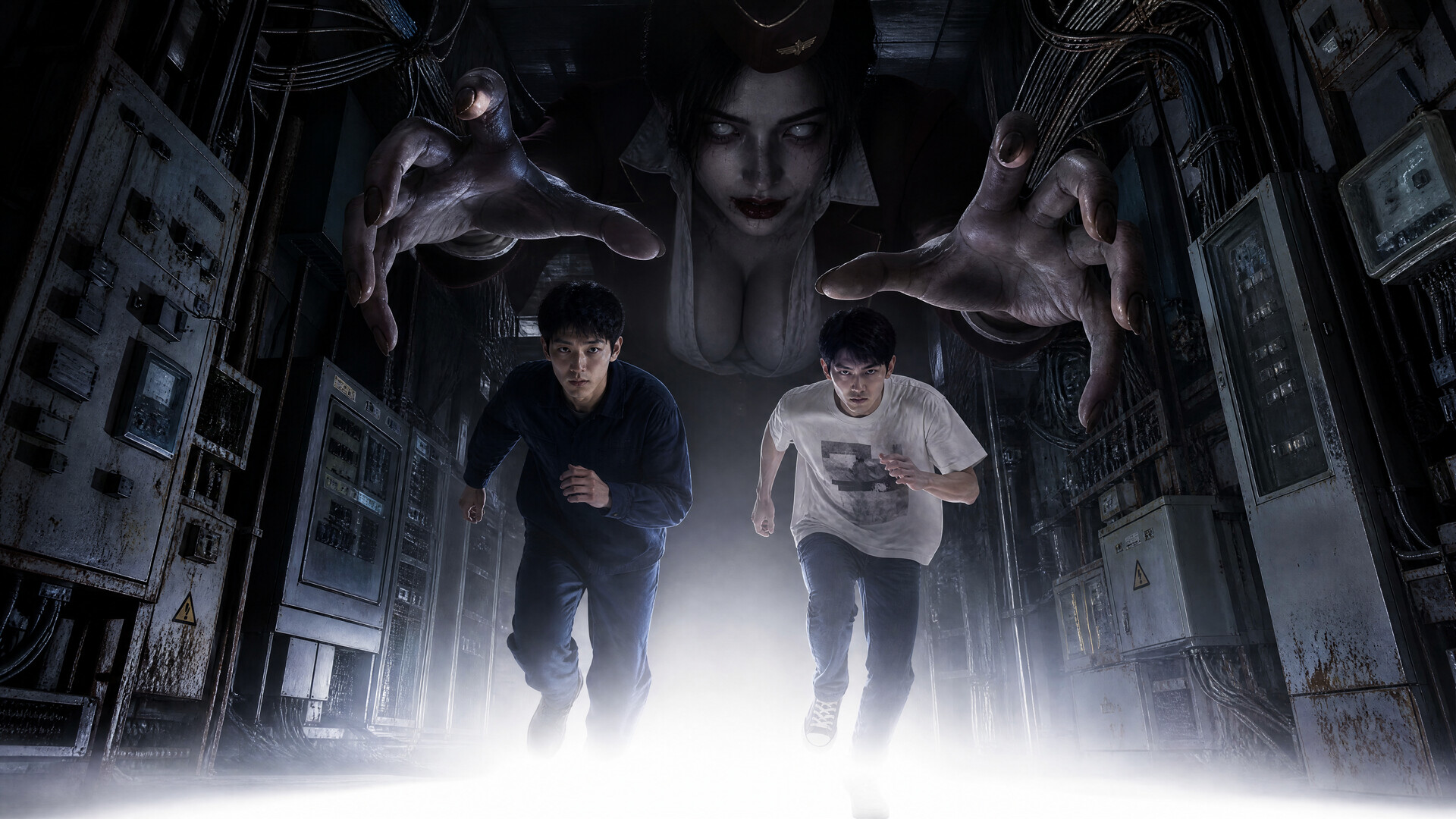
Fleeing down a carriage as the train's horror closes inImage: Siming Studio -
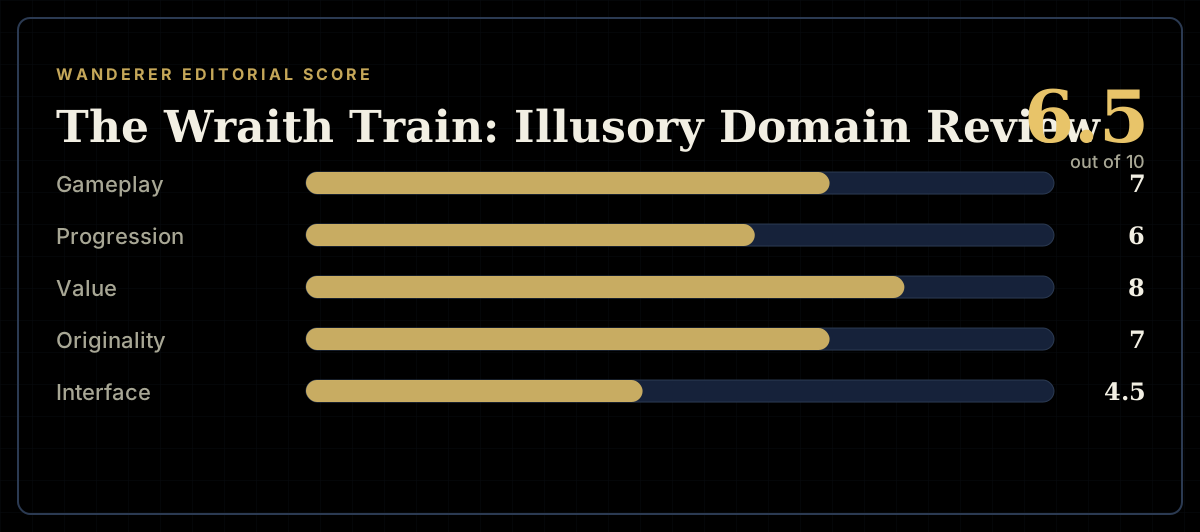
How the review scores each part of the gameWanderer Editorial -
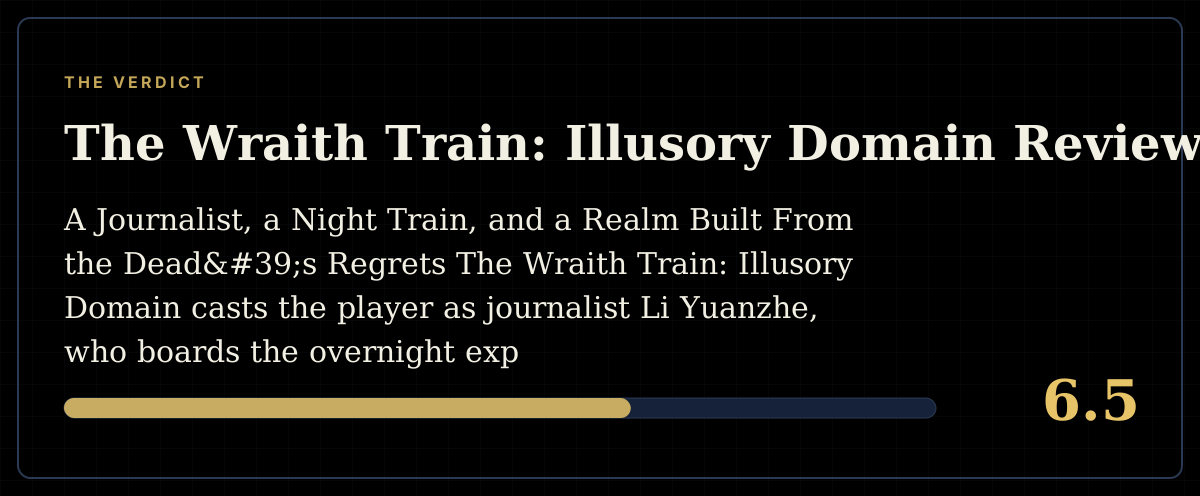
The short versionWanderer Editorial