Game review
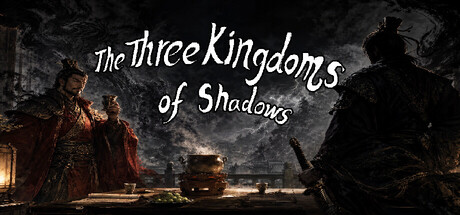
The Three Kingdoms of Shadows: Xuzhou Review
7.5 / 10
- Developer
- 鹏砚
- Publisher
- 鹏砚
- Released
- 12 August 2026
- Platforms
- ["Windows", "macOS"]
- Genre
- Strategy
Liu Bei as a Puppet Ruler, Not a Destined Hero
The Three Kingdoms of Shadows: Xuzhou reframes a familiar chapter of the Romance of the Three Kingdoms around a specific, cynical premise: Liu Bei doesn't inherit Xuzhou as an established hero, he's installed as Tao Qian's successor by local power blocs led by Chen Deng and Mi Zhu precisely because they believe he's inexperienced enough to control. Steam's own store description frames the goal directly — "prove them wrong" — and one detailed review confirms the game builds its entire structure around that reversal: "Liu Bei may technically govern Xuzhou, but the player must gradually turn ceremonial authority into genuine political power." That's a more specific and better-motivated framing than most Three Kingdoms strategy games bother with, where the setting is usually just an excuse for large-scale warfare rather than a character-driven political struggle.
Governance, Conflicting Counsel and a Vote-Based Law System
The core loop is built from clicking through static location screens to talk to characters, issue commands, and manage resources, stamina and two competing local factions. One review lays out the mechanical texture clearly: "each location is just a static screen with occasional character images that you can click on to talk to them," with actions gated by a stamina meter that forces rest periods, and free saving that removes most risk from experimenting with choices. Laws and decrees form a distinct system on top of that: each proposed law affects specific outcomes — one reviewer cites "honest trade, which brings higher store prices, or you can focus on farming and gain coins" — and factions vote on new laws based on how well the player has courted them, tying political maintenance directly into legislative progress rather than treating faction standing as a passive stat.
The game's most distinctive system, according to the more detailed review sample, is how it handles advice from Liu Bei's subordinates: rather than every adviser pushing toward the same goal, the player has to weigh conflicting recommendations and judge which serves Liu Bei's actual interests, reinforcing the conspiracy-driven premise that the factions around him have their own agendas. Military conflict is comparatively lightweight by contrast — battles are resolved by selecting one of three generals and adjusting soldier and money sliders to hit a target win percentage, sacrificing tactical depth in favour of keeping the political and administrative layer as the game's real focus.
Two Routes: Faithful History or a Hidden Occult Hegemony Path
The "Shadows" in the title refers to Yin — shadow, occult, eerie — folklore that runs beneath the historical strategy layer as entirely optional side content. Reviews and the store page agree the main campaign itself is not a horror game: ordinary governance and warfare stay grounded in real Three Kingdoms history, while investigating the stranger side stories can eventually unlock a hidden "Hegemony" route that diverges from the historical chronicles altogether. The developer has added a Horror Content Filter setting specifically to suppress jump-scare visuals for players who want the political simulation without the eerie material, which is a considerate accommodation for a genre crossover that could easily have alienated strategy-focused players instead. This two-path structure ties replayability to curiosity rather than a menu choice, rewarding players willing to chase down the occult threads rather than simply offering an alternate ending as a toggle.
An Ambitious System Stack With an Honest AI-Assets Disclosure
The developer has been transparent about one specific production detail: a small amount of AI-generated material has reportedly been used for placeholder sound effects, in-game assets and promotional illustrations, with plans to replace it gradually with original handmade work, while the core assets themselves are stated to be handmade. That's a disclosure worth stating plainly for anyone weighing the purchase, and it's notably more forthcoming than many small studios manage on this specific issue. Set against that, the review sample is candid that the game's presentation "may be modest compared with larger strategy productions" — this is a text- and static-screen-heavy political sim, not a visually lavish one, and the ambition sits in its interlocking systems (factional politics, conflicting counsel, legal votes, resource management, warfare, and optional supernatural investigation) rather than in production values. The same review flags the obvious risk of that ambition: if advisers turn out too easy to read, or one policy consistently proves superior to the rest, much of the intended political tension could collapse rather than sustain itself across a full playthrough.
Historically Dense, and Openly Not for Everyone
Both English-language reviews sampled agree on one caveat: this is a game built for players who already care about, or are willing to learn, Chinese Three Kingdoms history and its cast of named factions and figures. One reviewer states it plainly — "since it deals with Chinese history, you won't get much out of it if you're not familiar with the characters" — while also crediting the localisation itself as competent, noting "there's quite a lot of text, and it's nicely translated." That's a fair trade-off to go in aware of: the game rewards genre and setting enthusiasts specifically, rather than trying to onboard newcomers with simplified stakes or characters, and reviewers accustomed to political-simulation and alternate-history strategy games rate it as a focused, distinctive entry rather than another generic Three Kingdoms warfare title.
Verdict
The Three Kingdoms of Shadows: Xuzhou earns its "Shadows" framing honestly, building a political-intrigue strategy game around Liu Bei's rise from manipulated outsider to genuine ruler rather than defaulting to large-scale battles for their own sake. Its law-voting, conflicting-adviser and dual-route systems give it real mechanical personality, its AI-asset use is disclosed rather than hidden, and its NZ$11.25 single-purchase price carries no monetisation concerns. The trade-offs are real too — modest production values, lightweight combat resolved through sliders, and a strong assumption of prior interest in Chinese history — but for strategy fans specifically drawn to political simulation and alternate-history storytelling, it's a distinctive, well-reviewed pick rather than a compromise purchase.
Screenshots
-
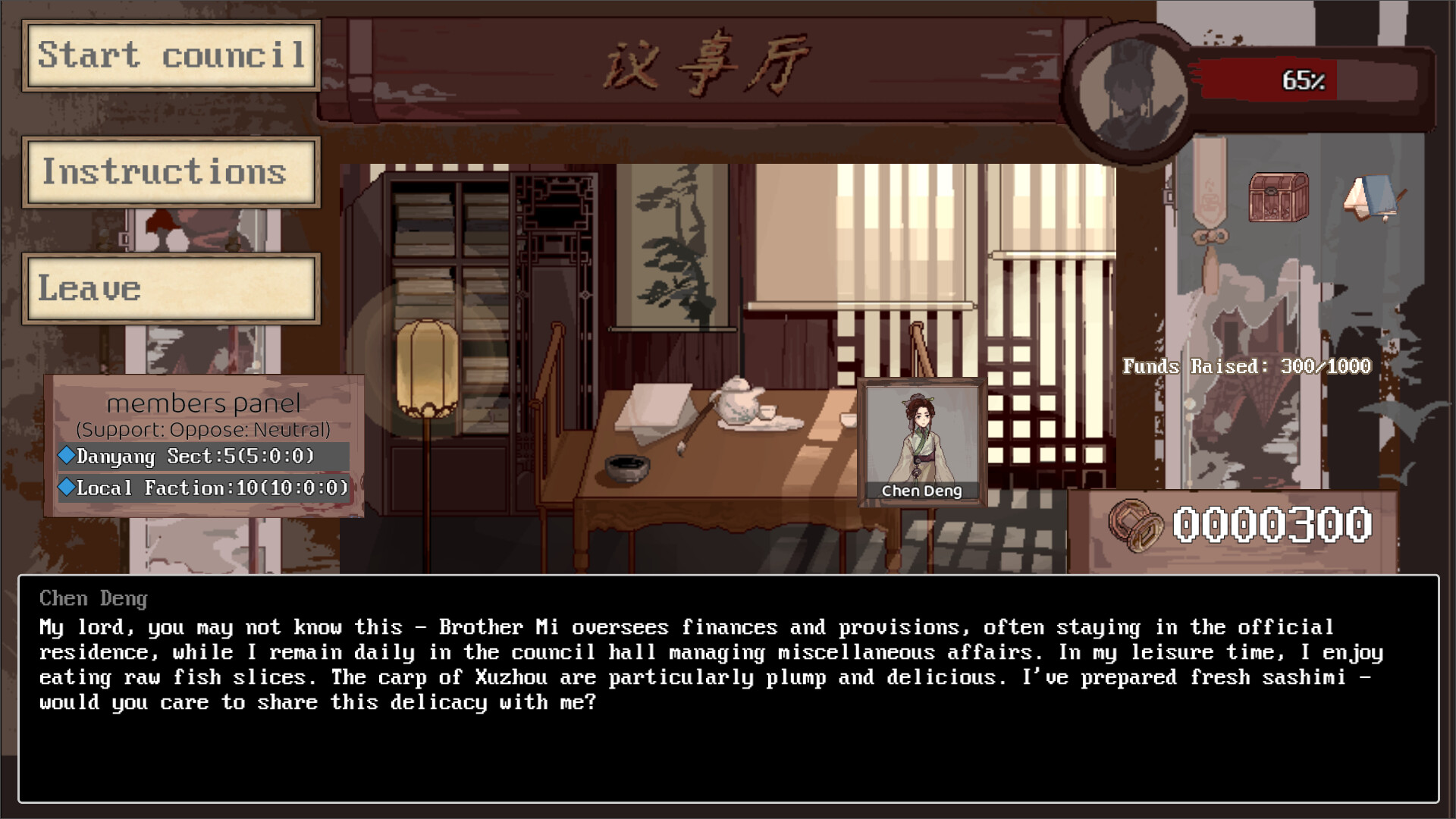
Chen Deng offers counsel in the council hall, one of several static locations where advisors can be consultedImage: 鹏砚 via Steam -
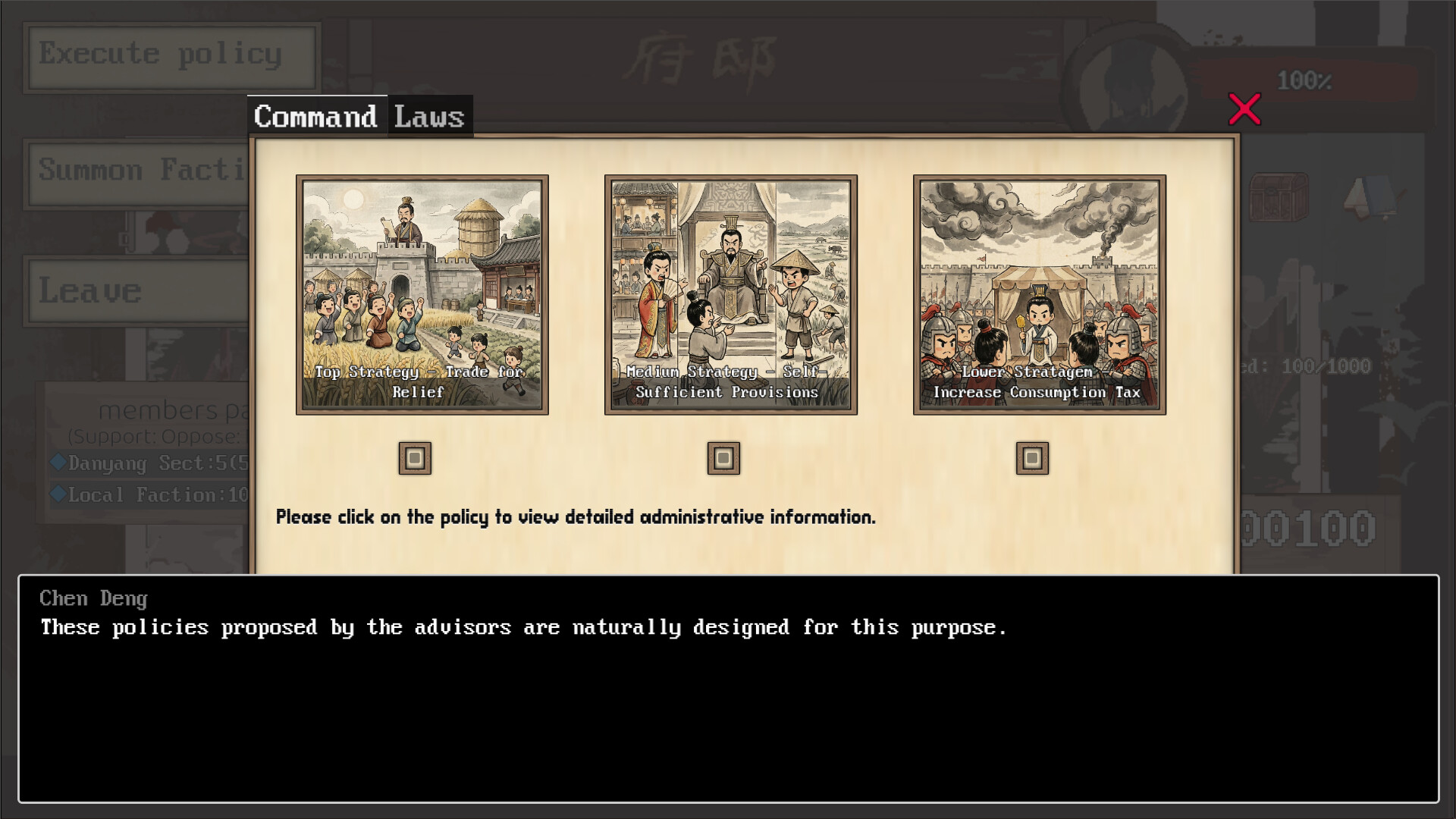
Choosing between competing law proposals is one of the game's core political-management systemsImage: 鹏砚 via Steam -
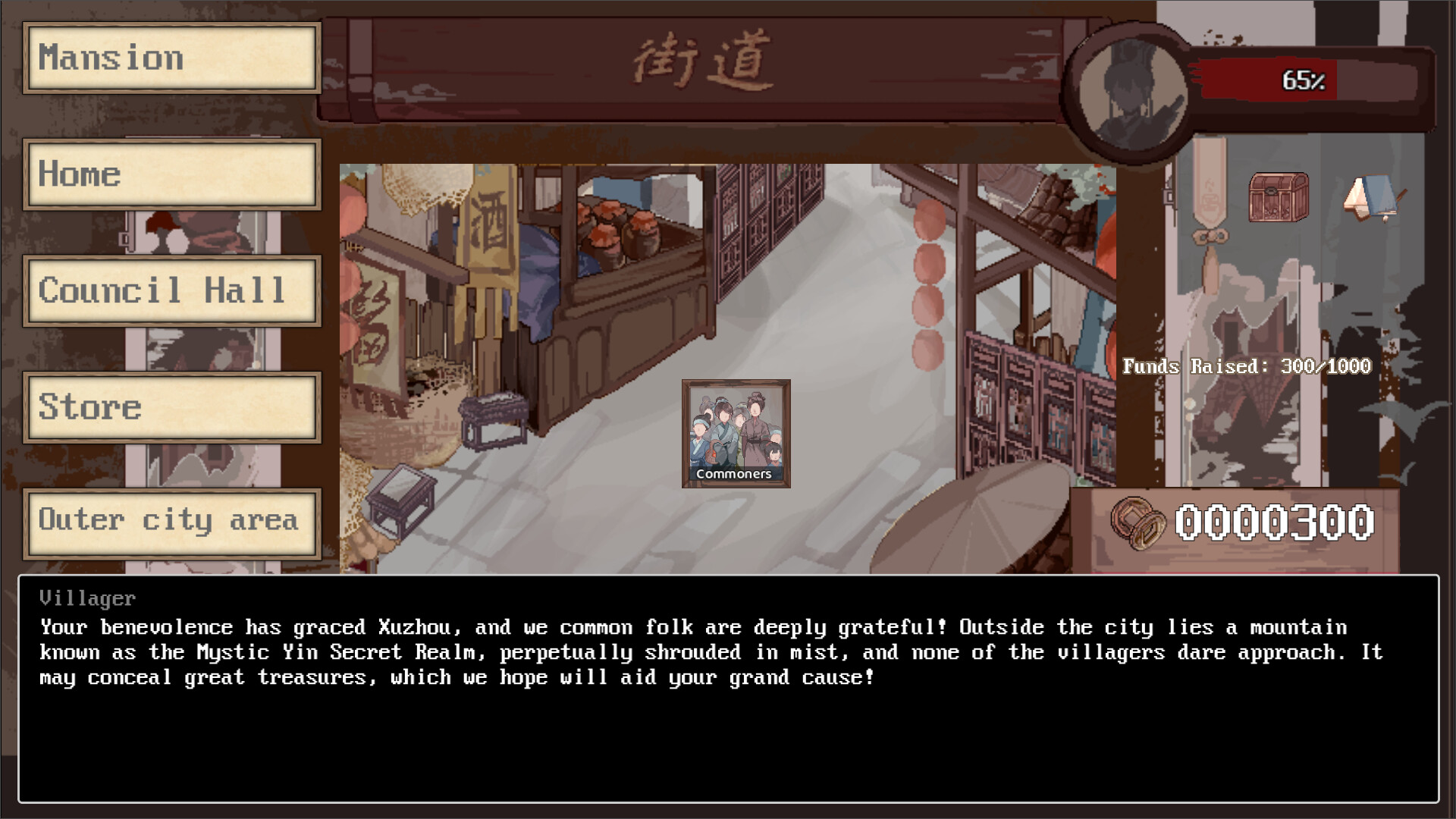
A villager hints at the mist-shrouded Mystic Yin Secret Realm, one entry point into the game's optional occult side contentImage: 鹏砚 via Steam