
Game review
The Test: Reality Check
4.5 / 10
- Developer
- Randumb Studios
- Publisher
- Randumb Studios
- Released
- 24 February 2025
- Platforms
- Windows
- Genre
- Adventure, Casual, Indie, RPG, Simulation
- Players
- Single-player
The short version
Biggest strengths
- A genuinely affecting, personal closing experience that a meaningful share of players describe connecting directly to real mental-health struggles and ongoing therapy work
- A well-established, returning fanbase for the wider anthology series who consistently describe past entries hitting emotionally in ways generic personality quizzes don't
- Thoughtfully worded, probing questions that at least some reviewers say still provoke genuine self-reflection despite this entry's other shortcomings
Biggest weaknesses
- Widely and specifically corroborated use of generative AI artwork replacing the series' previously distinctive, hand-made pixel art style, explicitly contrasted by multiple reviewers against the developer's own demonstrated capability with real art in earlier entries
- Multiple returning fans describe this entry's questions as repetitive and derivative relative to prior installments, offering little that feels new within the series
- At least one reviewer argues the entire "experience, not a game" framing is a pretentious repackaging of a fairly generic online personality quiz sold at a price point well above what similar free quizzes charge
4.5 / 10
A series built on genuine emotional impact, tested by its latest entry
The Test: Reality Check is the newest installment in an ongoing anthology of atmospheric, psychological-simulation "experiences" that frame themselves as deep, probing personality tests rather than conventional games, promising to surface answers to questions players have kept hidden from themselves. Based on the available English-language review sample of 611 reviews — 591 positive, 20 negative, landing at an Overwhelmingly Positive rating — the wider series has clearly built real, sincere emotional resonance with a devoted audience over multiple entries, and that resonance shows up again here for a meaningful share of players. "My Gifted Word is Unity. This game... to the developers, this game hit me extremely hard. I have just recently been going to therapy to get through a bunch of things I have been going through for years, and on a whim I played this game to see what else it may say. I won't lie... it said things to me that I have been genuinely running from for a long time. I sat here and actually cried," one reviewer writes, describing exactly the kind of unguarded, personal reaction this series' fans consistently report.
A separate reviewer frames the series' recurring appeal in similarly sincere terms: "The final message touched into an area I'm currently working on with my therapist. These games always feel like they are in my mind asking the questions I'm scared to answer. I always appreciate the messages of the Test games." That degree of genuine, specific emotional testimony recurs often enough across this review sample that it deserves to be taken at face value rather than treated skeptically — whatever this specific entry's shortcomings, the underlying format clearly works as intended for a real, invested audience.
A well-corroborated AI-art controversy specific to this entry
Set against that emotional goodwill, the single most consistent and most damaging criticism in this review sample concerns a specific, dateable change: the replacement of the series' previously distinctive, hand-crafted pixel art with what multiple independent reviewers identify as generative AI artwork. "As much as I like this series, I was very disappointed by the use of AI images. The past games have clearly shown this studio is fully capable of using real art for their games and the old pixel art style looked way better," one reviewer writes, making the specific point that this isn't a studio without artistic capability falling back on AI out of necessity, but a demonstrated regression from previously delivered original work.
A separate, more detailed reviewer connects the art change to a broader shift in the writing's tone and quality: "The AI generated images, the weirdly edgy Hazbin Hotel-esque writing, and the jarring tonal shifts were very different and off-putting compared to the previous games. Honestly, it played like someone fed the previous games into ChatGPT and told it to spit out another short installation in the series as a quick cash grab attempt." A third reviewer describes their own process of discovering the change mid-playthrough: "After playing the game (and noticing something about the art was off...) and inspecting the description I learned that this game uses A.I tools to help make the artwork of this game," framing the realization as a genuine, unwelcome surprise rather than something clearly disclosed upfront. This degree of independent, specific, consistently-worded agreement across many separate reviewers is a strong, credible signal of a real production change, not an isolated unverified accusation.
Notably, not every critical reviewer frames the shift in purely hostile terms. One more measured reviewer writes: "I did not hate this game, but I certainly think it had less of an impact and some shortfalls. Firstly, it's glaringly obvious that the art in this game is made from generative AI if you follow where the details do and don't end" — confirming the same underlying observation while landing on a gentler overall assessment, suggesting the AI-art complaint reflects a genuine, widely-noticed change rather than a small group's fixation.
A series some longtime fans feel is running out of new ground
A separate, related complaint concerns content freshness within the wider series rather than the art specifically. "Been playing all the games from The Test series since the first one and I've always loved every single one of them. However, the last two games previous to this one had felt a bit short a simple, they felt like they lacked some substance. But playing this game now just made me reach the conclusion that this series is not what it used to be anymore," one long-time fan writes, framing this entry as the continuation of a decline rather than an isolated misstep. A separate reviewer identifies the same fatigue more specifically: "it doesn't bring anything new that we haven't seen at least 3 times. And I heavily disliked the likely use of AI, as other reviewers have mentioned. I would recommend one of the previous games" instead.
One reviewer's blunter framing is worth including directly as the sharpest form of the value critique in this sample: "The credits say that this isn't a game, it's an 'experience.' That should tell you most of what you need to know about the mindset of the developers. This is a generic online personality test except that it costs five dollars." That's a pointed, dismissive take, but it's worth weighing against the substantial number of reviewers describing genuinely specific, personal emotional impact — the fair reading is likely that the format works powerfully for players who engage with it sincerely and openly, while reading as thin or gimmicky to those who don't connect with its introspective framing.
Where this leaves it
The Test: Reality Check continues a series with real, demonstrated power to affect players on a genuinely personal level, and that core strength still shows through for a meaningful share of this entry's reviewers. What holds this specific installment back, by wide and specific agreement, is a well-corroborated shift to generative AI artwork replacing the series' previously distinctive hand-made style, paired with a sense among longtime fans that the underlying questions and structure are becoming repetitive across entries. Worth approaching primarily as an emotional, introspective experience for players already invested in the series' format and willing to overlook its current art direction; newcomers curious about the anthology would likely be better served starting with one of the earlier, more consistently well-regarded installments instead.
Pros and cons
Pros
- A genuinely affecting, personal closing experience that a meaningful share of players describe connecting directly to real mental-health struggles and ongoing therapy work
- A well-established, returning fanbase for the wider anthology series who consistently describe past entries hitting emotionally in ways generic personality quizzes don't
- Thoughtfully worded, probing questions that at least some reviewers say still provoke genuine self-reflection despite this entry's other shortcomings
- A very low asking price for a short, single-sitting experience
Cons
- Widely and specifically corroborated use of generative AI artwork replacing the series' previously distinctive, hand-made pixel art style, explicitly contrasted by multiple reviewers against the developer's own demonstrated capability with real art in earlier entries
- Multiple returning fans describe this entry's questions as repetitive and derivative relative to prior installments, offering little that feels new within the series
- At least one reviewer argues the entire "experience, not a game" framing is a pretentious repackaging of a fairly generic online personality quiz sold at a price point well above what similar free quizzes charge
- Reported jarring tonal shifts and writing choices described by at least one longtime fan as feeling notably different in voice from the series' earlier, more consistent tone
- No Steam achievement system exists, and no replay structure beyond a single guided playthrough
Screenshots
-

The Test: Reality CheckImage: Randumb Studios via Steam -

The Test: Reality CheckImage: Randumb Studios via Steam -

The Test: Reality CheckImage: Randumb Studios via Steam -
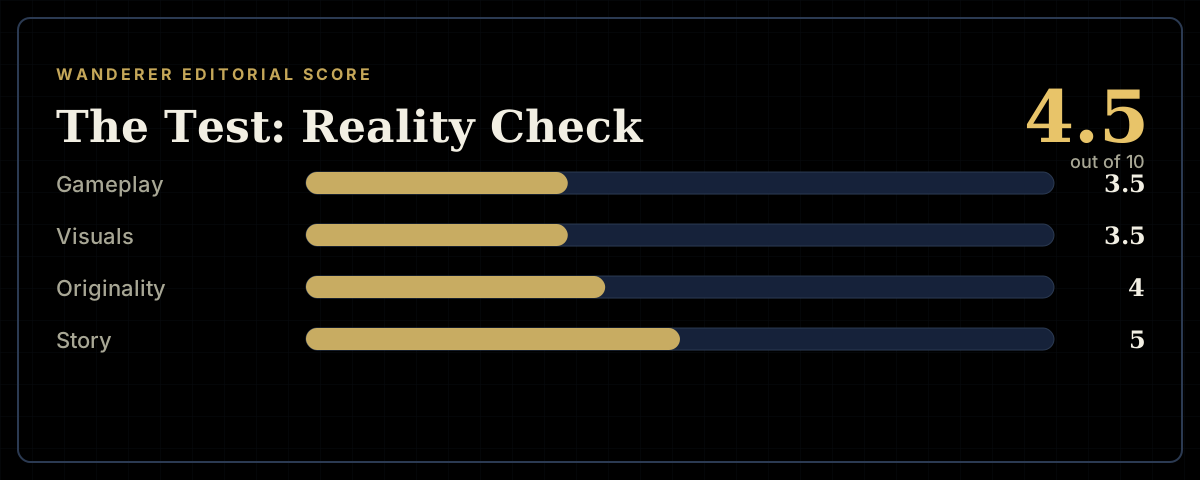
How the review scores each part of the gameWanderer Editorial -
The short versionWanderer Editorial