Game review
The Rumble Pit Review
7 / 10
- Developer
- Elliott Faucheux
- Publisher
- Elliott Faucheux
- Released
- 17 September 2026
- Platforms
- ["Windows"]
- Genre
- RPG
A Thirty-Third Consecutive Launch Without a Single Review
The Rumble Pit released on Steam on 17 September 2026 and has zero user reviews at the time of writing, extending this stretch's run of unreviewed launches to thirty-three. It's a particularly unfortunate case of the pattern this stretch keeps surfacing: a single developer's clearly thought-through, mechanically dense passion project, priced at just NZ$4.79, sitting entirely unnoticed only days after launch. The store page for this one is unusually candid and specific about its own design philosophy, which makes for one of the more confidently written pitches in this entire review run. This review is built entirely from the developer's own store page description, not from verified play.
You Prepare. The Fight Decides Itself.
The Rumble Pit's central conceit is stated as plainly as possible on its own store page: "You control nothing once a fight starts." Every tactical decision — who goes into a fight, what gear they carry, which talents they've committed to — happens beforehand, and combat itself resolves automatically once it begins, turning every loss into what the developer calls "a sentence about what you should have planned for." That's a meaningfully different structure from most tactical RPGs, which usually let a player intervene mid-fight to salvage a bad pull. Removing that safety net puts the entire weight of the game on the preparation phase, which is a genuinely bold design bet: it only works if the prep systems are deep and legible enough that losses feel like the result of a real planning mistake rather than an unlucky dice roll the player had no way to see coming.
Ten Classes, Sixty-Node Talent Trees, and a Real Choice to Commit To
The class roster spans ten options — Warrior, Ranger, Priest, Paladin, Ninja, Cleric, Orc, Druid, Mage, and Duelist — and each one splits into two mutually exclusive paths, meaning a Paladin built to hold the front line can never also be built to heal. The talent trees themselves are described as graphs rather than simple bonus lists, with sixty nodes per tree gated so that a node only opens once its parent has been mastered, and a hard cap of thirty points meaning no single character can ever unlock the whole tree. That's a genuinely committed build-diversity structure: with five adventurers active at once and each capable of specialising down one of two incompatible paths, the roster-building puzzle becomes about which halves of which trees actually complement each other, rather than simply stacking whichever talents look strongest in isolation.
Twelve Dungeons, and an Escalation That the Game Warns You About
The overall structure runs from a reassuring starting crypt full of skeletons through increasingly strange and specific locations — a gardening robot loose in a wood, an airless mining station, an inn whose guest ledger carries uncomfortably familiar names — before culminating in a twelfth location, the Pit itself, explicitly described as a place that "does not get cleared." An official screenshot of one dungeon, the Eternal Glacier, shows exactly how far that transparency goes: the preview screen states the map's blizzard hazard drains 4% of everyone's health every three seconds throughout the fight, names the boss Frostheart's specific attacks with exact damage numbers and timers, and lists the precise loot on offer, all before the "Build the Party" button is even pressed — a genuinely unusual level of up-front numerical disclosure for a dungeon a player hasn't yet entered. Clearing each of the first eleven dungeons for the first time adds a permanent fixture to the player's home camp — an anvil, a portcullis, a new table — which the developer frames as the game's only real progress report, a deliberately understated alternative to quest-log checklists or experience bars. Beyond the main structure, three distinct combat formats — a two-minute Arena duel for testing builds, a five-round Gauntlet where health carries over between fights, and the full narrative Dungeon runs with bosses who state their own rules up front — give the preparation-heavy core loop several different time investments to slot into.
A Levelling Curve With a Deliberate Ceiling, Then Nightmare Mode
The store page is explicit that the main campaign, running from level 1 to 30, is designed to actively guide the player: the game's own thread names the next dungeon and reveals its menu piece by piece so that "no wall, no grind" interrupts the pacing. Once that campaign ends, Nightmare mode replays the entire game at the level cap with no further guidance, explicitly positioned as the mode where build quality actually gets tested. That two-tier structure — a guided on-ramp followed by an unguided, harder replay of the same content — is a sensible way to make a talent-tree system built for genuine build diversity actually pay off, since the guided campaign alone likely wouldn't demand enough specialisation to reveal whether a given talent combination is actually strong. At NZ$4.79 with no in-app-purchase category and the developer's own description stating plainly that there is "nothing more to buy," the entire package is a fixed, one-time cost regardless of how much of the level 1-to-30-then-Nightmare structure a player ends up exploring.
Verdict
The Rumble Pit is a confidently scoped, single-developer tactical RPG that commits hard to its central bet — hands-off, automatically resolving combat that lives or dies entirely on the depth of its preparation systems — and backs that bet with genuinely substantial class, talent, and escalating-dungeon structures for a NZ$4.79 release. Its biggest open risk is exactly the one the design invites: if the automated combat resolution ever feels arbitrary rather than legible, the entire "your losses are your fault" framing collapses, since a player can't learn from a fight they had no ability to read or influence once it started. A launch this carefully described going entirely unreviewed after only a few days is a genuine surprise, and this assessment rests entirely on the developer's own description rather than anyone's actual playthrough.
Screenshots
-
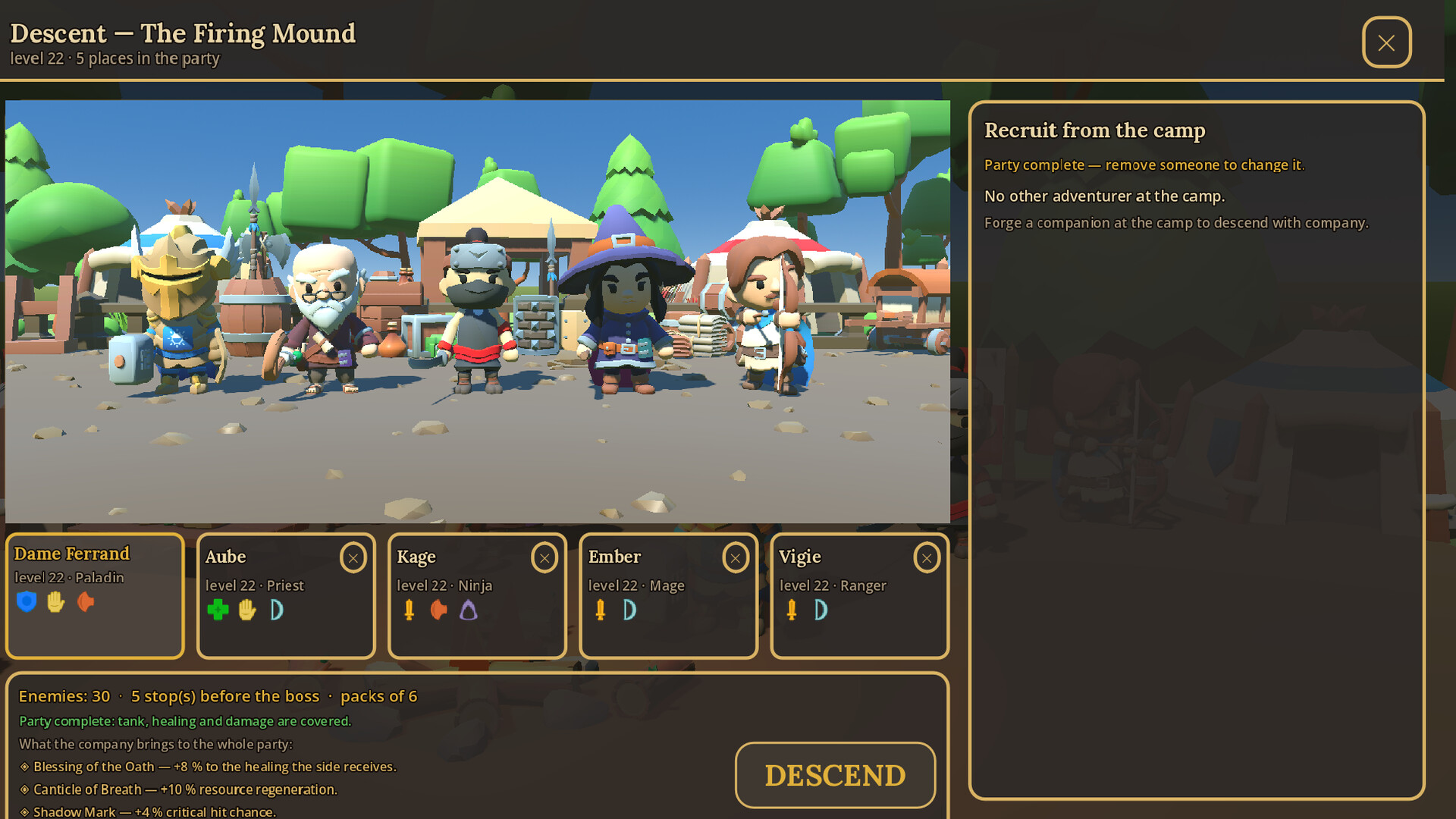
The pre-fight camp screen, where the entire run's outcome is decided before a single blow is struckImage: Elliott Faucheux via Steam -
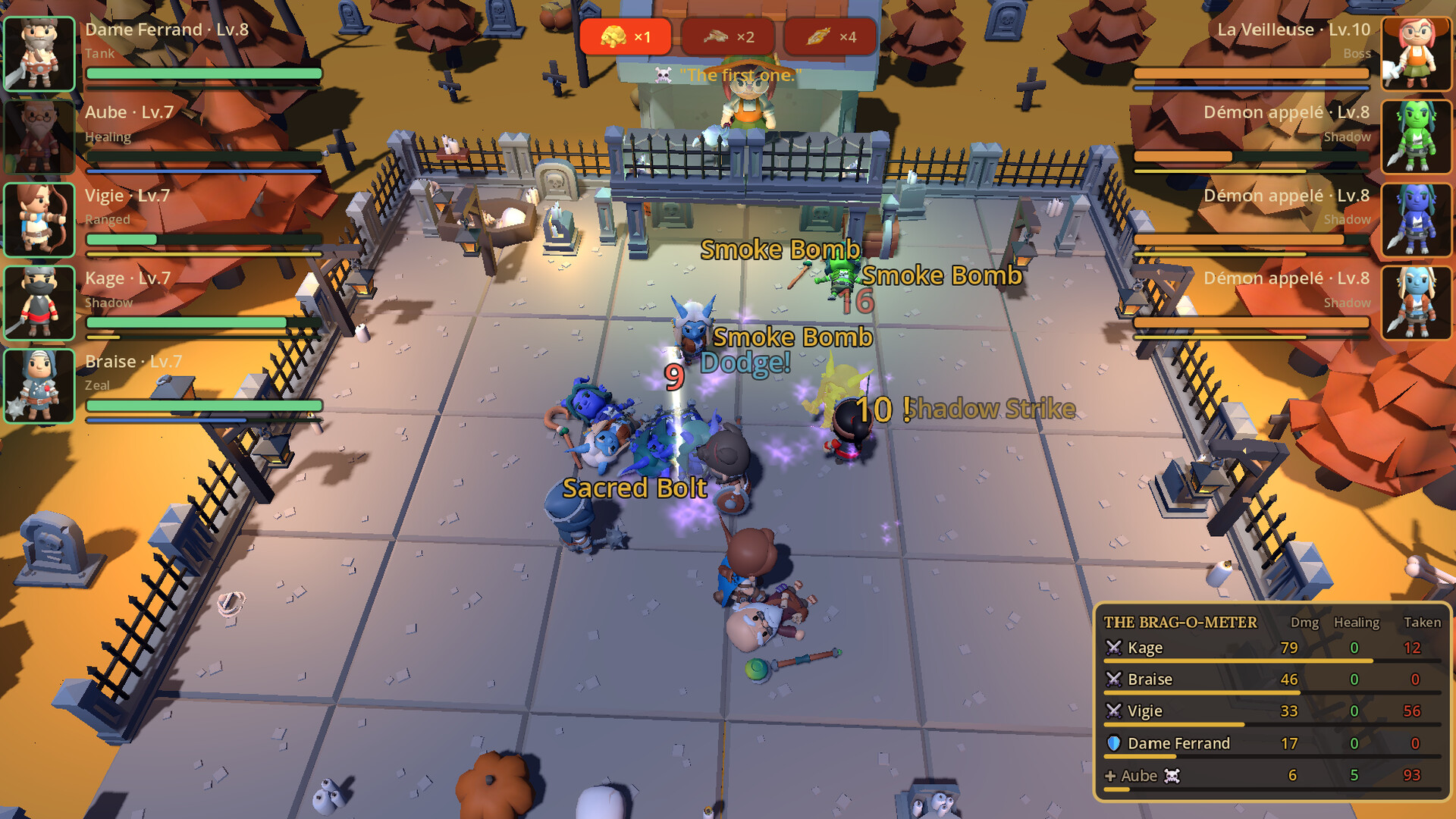
A boss fight resolving on its own, tracked through floating ability names and a live damage-and-healing leaderboardImage: Elliott Faucheux via Steam -
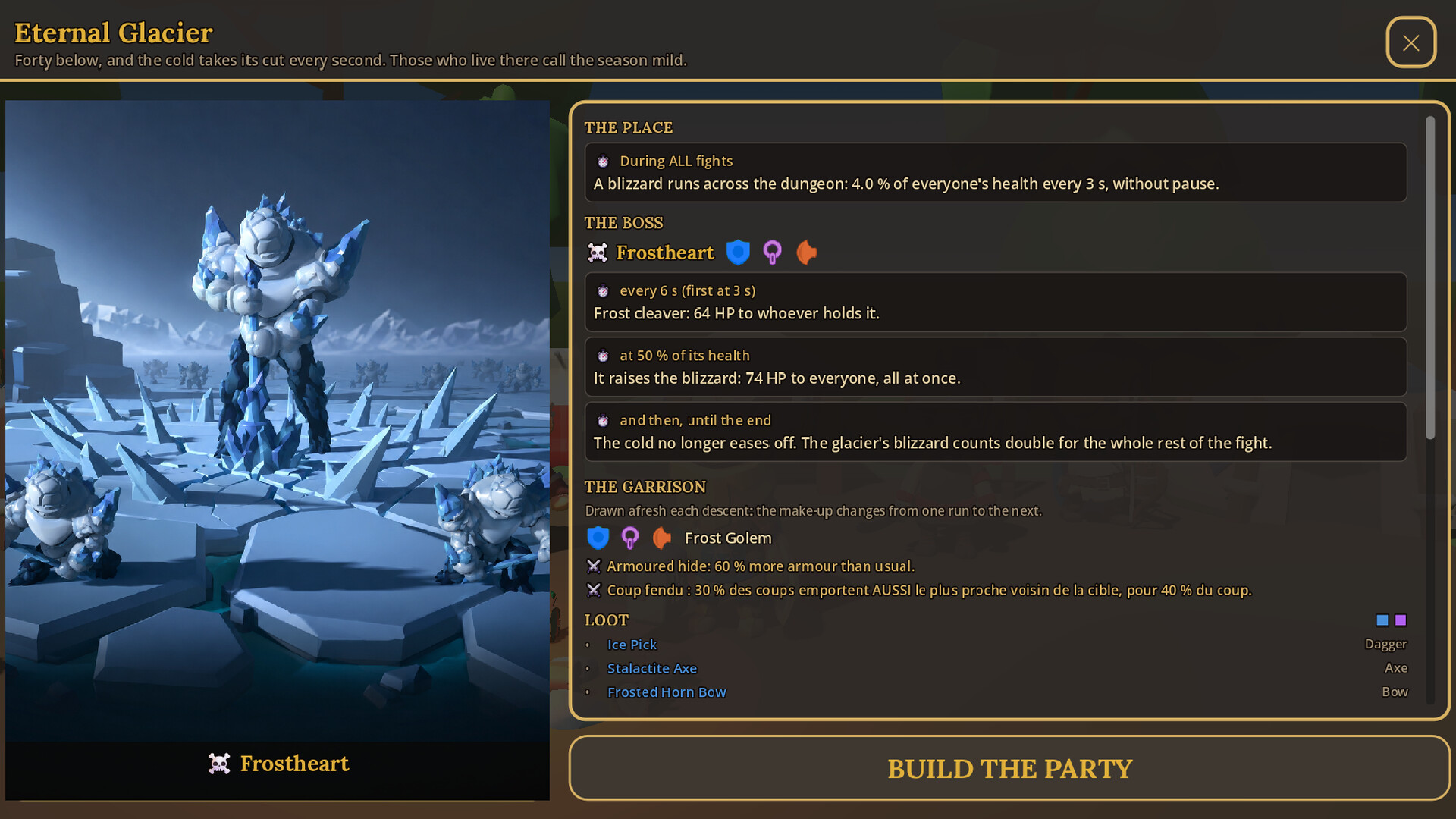
A dungeon's boss mechanics and hazards disclosed in exact numbers before the party is even builtImage: Elliott Faucheux via Steam