
Game review
The Occupation
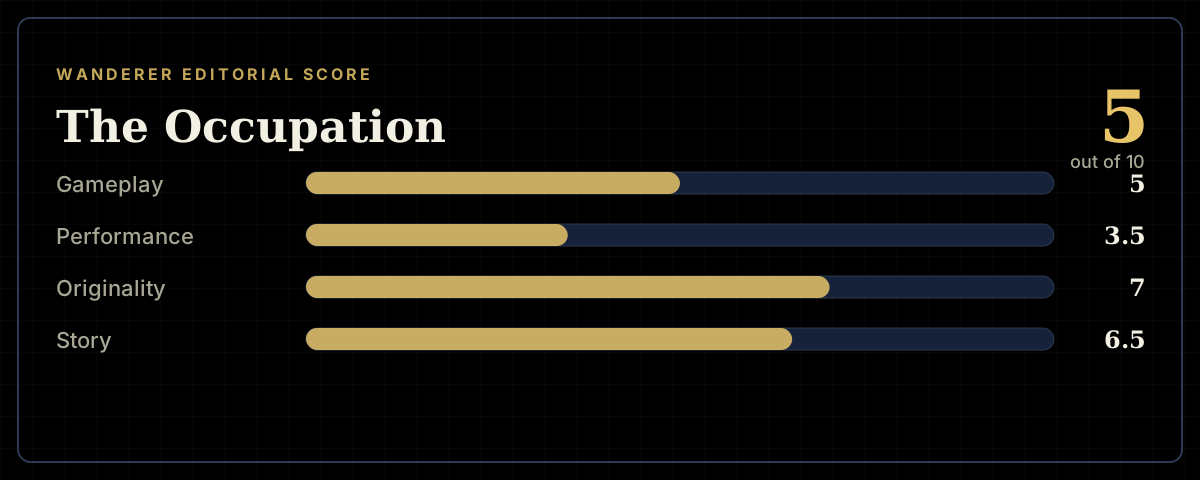
5 / 10
- Developer
- White Paper Games
- Publisher
- Balor Games
- Released
- 5 March 2019
- Platforms
- Windows
- Genre
- Adventure
- Monetisation
- Paid, no in-app purchases found
- Players
- false
The short version
The Occupation puts players in the shoes of a journalist with four real-time hours to investigate a controversial anti-terrorism bill before a hard deadline, gathering evidence, sneaking through restricted areas, and making irreversible choices under genuine time pressure. Its concept and atmosphere draw real, specific praise for tension and level design, but a chapter-only save system combined with a documented string of game-breaking bugs meant many players lost significant progress to crashes and stuck states — a technical failure serious enough to define the game's reputation as much as its ideas do.
Biggest strengths
- A genuinely distinctive real-time structure, compared favourably by reviewers to Jordan Mechner's The Last Express, where the game's clock keeps advancing whether or not the player is making progress
- Real, specific tension and atmosphere that engaged reviewers describe as "unparalleled," aided by detailed environmental design and a fictional but well-realized late-1980s British political setting
- A compelling core concept blending Dishonored-style stealth and immersive-sim systems with detective work and journalistic evidence-gathering, distinct from most stealth games' combat-first framing
Biggest weaknesses
- A severely criticised save system that only checkpoints between chapters rather than more granularly, meaning a crash or stuck state can cost well over an hour of real-time progress in a single incident
- Multiple independently reported game-breaking bugs, including NPCs blocking doorways and objectives, black-screen freezes requiring a forced quit, and at least one specific mechanic (evidence "leads") buggy enough to actively prevent story progression
- No option to skip or fast-forward previously seen dialogue and cutscenes, a significant frustration for any replay or recovery from a bug-forced restart
Who it's for: Immersive sim and detective-fiction fans who specifically want a real-time investigation structure, and who are prepared for real technical risk even after post-launch patches.
Our recommendation: A genuinely interesting idea worth experiencing if the bugs have since been resolved for your setup — but verify current stability before committing, given how severely they affected the game's early reputation.
5 / 10
What it is
The Occupation drops players into a fictional 1987 Britain on the edge of political crisis, playing a journalist granted four real-time hours of access to a building at the center of a controversial anti-terrorism bill investigation, tasked with gathering evidence, interviewing staff, and making choices before a hard, ticking deadline. Developer White Paper Games builds the experience around a combination of immersive-sim stealth — sneaking through restricted areas, avoiding security, manipulating the environment — and detective-style evidence gathering, with the game's clock advancing in real time regardless of whether the player is making meaningful progress. One reviewer draws a specific, apt comparison to Jordan Mechner's 1997 adventure The Last Express for that real-time structural conceit, a genuinely uncommon design choice that few games since have attempted with this level of commitment.
It released on 5 March 2019 at NZD 36.99, published by Balor Games. Its 133-review English corpus sits at a Mixed 67.7% (90 to 43) — a score that, on close reading, reflects a genuine and severe technical problem rather than disagreement about the underlying design's merit.
A concept and atmosphere reviewers genuinely admire
Reviewers who engage with the game's ideas in depth are consistently impressed by what it's trying to do. "The tension is unparalleled, the world realised in incredible detail, the story very engaging, and the level design delightfully twisty," writes one reviewer, despite also describing the save system as "daft" in the same review — a pairing that captures the corpus's central tension well. Another describes the core loop as "a nice mix of Dishonored ImSim stealth, detective work and walking simulator mechanics," while a third specifically credits the game for creating real stress without relying on combat: "you're not Corvo Attano" with an arsenal of lethal and non-lethal tools, just a journalist working against a clock, making the stakes of every decision to investigate one lead over another feel genuinely consequential.
A save system and bug list severe enough to define the reputation
Set against that praise is a wave of specific, detailed, and severe technical complaints that dominate the corpus's negative reviews. The most consequential is the save system itself: multiple reviewers report that saves only occur between chapters rather than at finer intervals, meaning any crash, freeze, or stuck state can erase a full hour or more of real-time progress in one incident. "A game breaking bug took me to a black screen that I couldn't leave, unless I quit the game," writes one reviewer, who lost an hour of unsaved progress as a direct result and explicitly declined to replay it. Another independently reports a comparable experience, with a non-player character "walking through gates" and getting stuck in a doorway, blocking progress until the situation resolved itself or forced a restart. A third describes a specific evidence-gathering mechanic — central to actually completing story "leads" — as buggy enough to directly prevent progression, and notes with real frustration that "the developers never fixed some of these obvious bugs" even well after launch.
It's worth noting, in fairness, that at least one detailed account reports real improvement over time: a reviewer who had struggled with frequent bugs and crashes reports that patch 1.4.0 resolved the issues they'd previously encountered, with their final chapters playing "flawlessly." That's a meaningful data point suggesting the game's technical state may have genuinely improved since launch, even if it can't undo the reputation those early, severe bugs created within the review corpus that still exists today.
Other specific complaints
Beyond the headline technical issues, reviewers raise smaller but still concrete complaints: no option exists to skip previously-seen dialogue or cutscenes, a real frustration for anyone forced to replay a section after a bug-induced restart. Movement speed is described by one reviewer as "absurdly slow," compounding the frustration of repeated sections. And the security AI meant to create stealth tension is described by multiple reviewers as "borderline braindead," allowing players to bypass systems that were clearly designed to be a meaningful part of the challenge.
What the achievement data confirms about abandonment
The Occupation's achievement completion rates are unusually low across the board even by the standards of a difficult or niche game — the single highest-completed achievement sits at just 15.1%, with the rest clustered well below 10%. That's a meaningfully flatter, lower ceiling than this lane typically documents even for genuinely hard games with steep late-game achievement cliffs; here, even relatively early or straightforward milestones fail to clear much more than one in seven owners. Read alongside the detailed bug reports above, that data point supports a specific conclusion rather than a vague one: a substantial share of players who bought The Occupation appear to have stopped playing relatively early, quite plausibly because of the exact save-loss and progression-blocking bugs multiple reviewers describe in detail, rather than because the underlying story or mechanics failed to hold their interest.
Why the real-time structure raises the stakes of its own bugs
It's worth connecting the game's central design conceit directly to why its technical problems land so much harder than they might in a different kind of game. A real-time, ticking-clock investigation structure is inherently unforgiving of interruption — the entire point is that time pressure creates meaningful stakes for every choice about where to look and who to talk to next. When a bug forces a restart from the beginning of a chapter, it doesn't just cost the player mechanical progress, it undoes the specific, time-pressured decisions that gave that playthrough's investigation its own particular shape and tension. That's a uniquely bad interaction between an ambitious design choice and a fragile technical foundation: the more interesting and distinctive an idea The Occupation's real-time structure is, the more painful it becomes to lose a run to a bug, which likely explains why reviewers who clearly admire the concept still describe the technical issues in such frustrated, personal terms rather than treating them as a minor inconvenience.
Verdict
The Occupation pursues a genuinely distinctive, ambitious idea — real-time investigative journalism under a hard deadline, blending stealth and detective mechanics in a way few other games attempt — and the reviewers who experienced it working as intended describe real, memorable tension as a result. But a chapter-only save system combined with a documented history of severe, progress- destroying bugs defined much of its early reception, and while at least one account suggests later patches meaningfully improved stability, this is a game worth approaching with real caution about its current technical state before committing significant time to a single playthrough.
Pros and cons
Pros
- A genuinely distinctive real-time structure, compared favourably by reviewers to Jordan Mechner's The Last Express, where the game's clock keeps advancing whether or not the player is making progress
- Real, specific tension and atmosphere that engaged reviewers describe as "unparalleled," aided by detailed environmental design and a fictional but well-realized late-1980s British political setting
- A compelling core concept blending Dishonored-style stealth and immersive-sim systems with detective work and journalistic evidence-gathering, distinct from most stealth games' combat-first framing
- At least one detailed account reports a 1.4.0 patch resolving most of the bugs that had previously plagued their playthrough, suggesting meaningful post-launch improvement over time
Cons
- A severely criticised save system that only checkpoints between chapters rather than more granularly, meaning a crash or stuck state can cost well over an hour of real-time progress in a single incident
- Multiple independently reported game-breaking bugs, including NPCs blocking doorways and objectives, black-screen freezes requiring a forced quit, and at least one specific mechanic (evidence "leads") buggy enough to actively prevent story progression
- No option to skip or fast-forward previously seen dialogue and cutscenes, a significant frustration for any replay or recovery from a bug-forced restart
- AI is described by multiple reviewers as "borderline braindead," making the stealth systems trivially easy to bypass rather than genuinely tense on replay
- Achievement completion rates are very low across the board (the single highest achievement sits at just 15.1%), consistent with a large share of players not finishing the game at all
Screenshots
-

The OccupationImage: Balor Games via Steam -

The OccupationImage: Balor Games via Steam -

The OccupationImage: Balor Games via Steam -
How the review scores each part of the gameWanderer Editorial -
The short versionWanderer Editorial