
Game review
Draugen
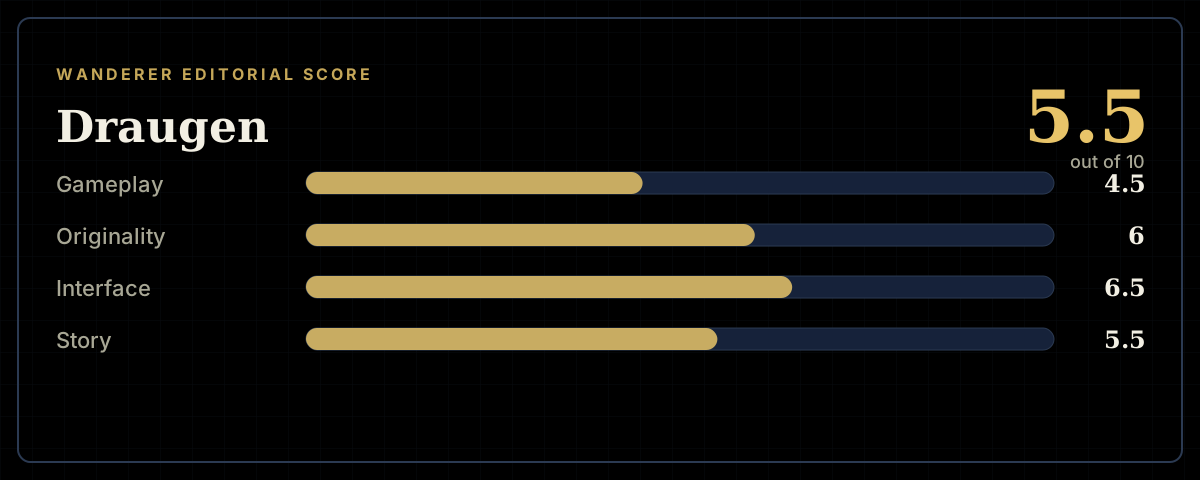
5.5 / 10
- Developer
- Red Thread Games
- Publisher
- Red Thread Games
- Released
- 29 May 2019
- Platforms
- Windows
- Genre
- Adventure
- Monetisation
- Paid, no in-app purchases found
- Players
- false
The short version
Draugen sends American scholar Edward and his ward Alice into the abandoned Norwegian coastal village of Graavik in search of Edward's missing sister, and for most of its roughly three-hour runtime it's a confident, beautifully composed mystery walking-sim. Then it ends, deliberately declining to resolve most of what it spent that time building — a choice a large share of its own reviewers experience as a genuine betrayal of the mystery genre's basic promise, while a smaller, equally articulate group argues that ambiguity was the point all along.
Biggest strengths
- Genuinely stunning environmental art and architecture, consistently described by reviewers as looking like a real West-coast Norwegian village rather than a generic period backdrop
- A strong, evocative soundtrack and sound design that reviewers credit with sustaining tension and mood throughout
- Well-realized period detail for 1920s Norway, woven into the environment itself rather than delivered only through dialogue or text
Biggest weaknesses
- A dominant, widely repeated complaint that the ending leaves major questions unanswered, delivering what one reviewer calls "a mystery without a resolution"
- The central plot twist is described by multiple reviewers as predictable well before it's revealed, undercutting the mystery's central tension
- A detailed review argues the game's own marketing — specifically the phrase "unearth the darkness" — oversells the mystery and horror elements relative to what the finished game actually delivers
Who it's for: Walking-sim and slow-burn mystery fans who are comfortable with — or specifically want — a story that raises questions it has no intention of fully answering.
Our recommendation: Worth it for the atmosphere and setting at a discount; think carefully before paying full price for a mystery that a large share of players say doesn't actually resolve.
5.5 / 10
What it is
Draugen, from Red Thread Games (creators of Dreamfall Chapters), sets its first-person mystery in 1923 in the fictional Norwegian coastal village of Graavik. Playing as Edward, an American scholar searching for his missing sister Betty, and accompanied throughout by his young, absent-minded ward Alice, players explore an eerily deserted settlement — the village's residents seem to have vanished under circumstances tied to the title itself, a "draugen" being a figure from Norwegian folklore. The game structures itself as a classic slow-burn walking simulator: reading environmental clues, uncovering documents and letters, and following the geography of the village to piece together what happened, with light puzzle-solving and no combat or true action mechanics standing between the player and the story.
It released on 29 May 2019 at NZD 28.99, and its 978-review English corpus sits at a Mostly Positive 73.3% (717 to 261) — a score that, on close reading, reflects a genuinely sharp and specific disagreement about one particular design choice rather than broad, diffuse dissatisfaction with the game as a whole.
What almost everyone agrees on
Presentation draws close to universal praise across the corpus, regardless of how a given reviewer ultimately feels about the story's resolution. "The level designers and artists made a beautiful scenery. It is breathtaking," writes one otherwise critical reviewer, specifically wishing they could "take a walk here in VR." Another calls the game "visually stunning," crediting "a great sound track and the engaging talent" of its voice performances even while ultimately disappointed by other elements. Multiple reviewers independently praise the specific period accuracy of the village's architecture and objects, describing it as recognisably drawn from real 1920s Norwegian coastal design rather than a generic period-piece backdrop. This is, by wide agreement, a genuinely well-crafted piece of environmental storytelling on a technical and artistic level.
The ending problem
Where the corpus splits sharply is on what that beautifully constructed mystery actually resolves into. "Just when you get into it, the game ends. WHAT? It's a mystery without a resolution," writes one reviewer, capturing a sentiment echoed constantly across the negative and lukewarm reviews: "there are no answers to any questions." A separate, detailed review makes an even more specific complaint about how the game was marketed, arguing the phrase "unearth the darkness" led them to expect a genuine mystery-horror experience rather than what they found, and that this mismatch between promise and delivery is the core of their disappointment rather than the ambiguity itself being inherently wrong. Several reviewers also report seeing the central twist coming well in advance, undercutting the tension the slow-burn pacing is meant to build toward.
Set against this is a real, articulate defence from reviewers who see the ambiguous, unresolved ending as consistent with — rather than a betrayal of — what a walking sim like this is trying to do. "Predictable? Pretty much, yes. But since when is that necessarily a bad thing?" writes one, arguing directly that "this game was never about how its story ends," and that judging it by a conventional mystery's need for resolution misreads its actual ambitions. That's a legitimate reading many walking sims share as a genre convention, but it's clearly not one every player signed up for going in, and the split in this corpus suggests Draugen didn't do enough to signal that expectation clearly before the ending arrives.
Value for a short experience
Length compounds the disappointment for several reviewers rather than standing as a separate complaint. At roughly three hours for a full playthrough, one detailed review explicitly calls the game "bad value for money" even discounted, while another wishes the explorable area "was at least twice this big," noting the map's clever layout and slower walking pace only partially disguise how small the actual explorable space is. That's a fair, specific criticism distinct from the ending debate — even reviewers who found the atmosphere worth the price on its own terms tend to frame that as true only at a reduced cost, not at the full asking price.
What the achievement data adds
Draugen's 13 tracked achievements split cleanly into two distinct bands, and that split is useful for understanding how the game is actually experienced in practice. Eight achievements tied to core story beats — arrival, key narrative turns, and the ending itself — sit in a tight, high band from 65.7% up to 90.9%, confirming that the overwhelming majority of players who start the game see it through to its conclusion. That's consistent with reviewer reports of a short, linear, hard-to-get- lost-in experience: whatever frustration exists with the ending, it isn't because players are bouncing off early or failing to finish. The remaining five achievements, tied to more optional content — specific conversations, exploring particular areas, or engaging with side details — sit much lower, between 6.1% and 18.3%. That gap suggests a real, if modestly sized, layer of optional depth exists beyond the main critical path for players willing to explore more thoroughly, even if the main story most players experience is the short, direct route the majority of reviews describe.
The Edward and Alice dynamic
Beyond the mystery plot itself, several reviewers single out the relationship between Edward and Alice as a genuine strength worth engaging with on its own terms, somewhat separate from the central missing-persons plot. Their dynamic — an American scholar and his younger, more free-spirited ward navigating an unfamiliar, unsettling place together — gives the slow walking-sim pacing something to anchor itself to beyond pure environmental curiosity, and the voice performances behind both characters draw specific praise even from reviewers otherwise disappointed by the plot's resolution. For a game this reliant on sustained first-person exploration without traditional gameplay systems to fall back on, a well-written central relationship matters more than it might in a more mechanically dense title, and it's one of the few elements of Draugen that draws praise from critics and fans of the ending alike.
Verdict
Draugen is a technically accomplished, atmospherically confident walking sim that asks its players to accept an ending that deliberately withholds resolution — a choice that lands as thoughtful ambiguity for some and as a genuine letdown for a larger share of its audience. The environmental art, sound design and period detail are worth experiencing on their own merits regardless of which camp a given player falls into, but anyone specifically drawn in by the promise of a mystery with answers should adjust their expectations, or their price point, accordingly.
Pros and cons
Pros
- Genuinely stunning environmental art and architecture, consistently described by reviewers as looking like a real West-coast Norwegian village rather than a generic period backdrop
- A strong, evocative soundtrack and sound design that reviewers credit with sustaining tension and mood throughout
- Well-realized period detail for 1920s Norway, woven into the environment itself rather than delivered only through dialogue or text
- A genuinely engaging build-up across its first two acts, with several reviewers reporting real investment in the central mystery before the ending arrives
Cons
- A dominant, widely repeated complaint that the ending leaves major questions unanswered, delivering what one reviewer calls "a mystery without a resolution"
- The central plot twist is described by multiple reviewers as predictable well before it's revealed, undercutting the mystery's central tension
- A detailed review argues the game's own marketing — specifically the phrase "unearth the darkness" — oversells the mystery and horror elements relative to what the finished game actually delivers
- An unusually short runtime (roughly 3 hours) for its asking price, with at least one detailed reviewer calling it poor value for money even on sale
- Comparisons to genre benchmarks like What Remains of Edith Finch and Everybody's Gone to the Rapture are frequently unfavourable, with reviewers calling the writing comparatively "bland" despite the strong presentation
Screenshots
-

DraugenImage: Red Thread Games via Steam -

DraugenImage: Red Thread Games via Steam -

DraugenImage: Red Thread Games via Steam -
How the review scores each part of the gameWanderer Editorial -
The short versionWanderer Editorial