
Game review
The Mildew Children
6 / 10
- Developer
- The Growing Stones
- Publisher
- Valkyrie Initiative
- Released
- 17 April 2024
- Platforms
- Windows
- Genre
- 2D adventure/visual novel hybrid
- Monetisation
- One-time purchase, no DLC or microtransactions
- Players
- Single-player only
The short version
The Mildew Children follows a young witch and her sisters in a village populated only by children, bound by savage pagan traditions and a macabre ritual meant to save their home. This review's sample confirms the striking art style, atmosphere, and world-building have won real, passionate devotion, particularly among reviewers with an affinity for Slavic folklore and pagan themes, but a consistent negative-review theme describes tedious pacing, unresolved plot threads, and a "good" ending several reviewers found practically impossible to reach without external help.
Biggest strengths
- The art style and overall atmosphere earn consistent, passionate praise, with reviewers repeatedly describing a genuinely unsettling, folk-horror aesthetic built without relying on jump scares
- The world-building and pagan-folklore premise are specifically credited by multiple reviewers as unusually well-realised, with several noting particular resonance for players with Slavic or Central European cultural background
- Dialogue-based mini-games and quick-time events during conversations are credited by several reviewers as a welcome way to stay engaged during otherwise dialogue-heavy stretches
Biggest weaknesses
- A consistent negative-review theme describes the pacing as slow and tedious, with multiple reviewers specifically citing extended stretches of walking and dialogue without clear progression or payoff
- Several reviewers describe the plot and dialogue as unclear or poorly resolved, with one specifically noting that by the game's end, players are often "just making random choices" without understanding the consequences
- This review's own achievement-data check corroborates a difficult path to the best outcome directly: the "good ending" achievement sits at just 12.1% completion, consistent with reviewer reports that reaching it requires obscure, easily-missed steps
Who it's for: Fans of dark, text-heavy visual novels and Slavic folklore-inspired horror looking for a slow, atmospheric read; not a fit for players wanting fast-paced gameplay or a clearly telegraphed path to a satisfying ending.
Our recommendation: Worth a purchase for readers specifically drawn to unsettling folk-horror atmosphere and dense world-building, with the expectation of slow pacing and a genuinely obscure route to the best ending.
6 / 10
The Mildew Children follows Kyrphel, a young witch, and her sisters through a village populated entirely by children bound to savage pagan traditions, working toward a macabre ritual meant to save their home. This review's sample confirms the atmosphere and world-building have won real, passionate devotion — and identifies a consistent, specific complaint about how tedious and unresolved the journey there can feel.
An atmosphere reviewers describe with real passion
Praise for the game's mood and world-building is consistent and specific across the sample. "If you like Paganism, the Occult, and immersive, well-thought out world-building and you enjoy a good read, this game is a no-brainer. The art and atmosphere is beautiful and the writing is stellar," one reviewer writes. Another highlights the horror approach directly: "There is no jump scares and the horror is based on unsettling atmosphere which permeates the story from the very beginning and till the end." A third reviewer notes something specific about the audience this resonates with most: it appears especially popular "with people of Slavic or Central European heritage/ancestry," suggesting the folklore is drawn from real, specific cultural sources rather than a generic dark-fantasy pastiche.
A consistent complaint about pacing and resolution
Set against that atmosphere, this review's negative sample raises the same complaint repeatedly. "I simply cannot recommend to anyone to invest 6 hours in this game, considering how slow and tedious it is. Nothing is explained, nothing is resolved, the story is unpolished and by the end of the game you're just making random choices in the dialogues," one reviewer writes. Another agrees: "Lots of walking and empty talks. The characters' behavior is annoying, the variability of some answers is a choice between equally toxic answers. The plot is clumsy and drawn out." That level of consistent, specific frustration — even from a small negative sample — suggests a real structural pacing problem rather than a matter of differing taste.
A specific, obscure path to the best ending
Multiple reviewers separately flag how difficult the game's best outcome is to reach without external guidance. One detailed reviewer describes needing to "memorize meaningless poems" and "take pictures of the text" to progress certain puzzles, calling the good ending "difficult, and impossible" to reach intuitively. This review's own check of Steam's achievement data supports that account directly: the good-ending achievement sits at just 12.1% completion, a steep drop from 66.6% for simply finishing the first chapter, consistent with a genuinely obscure, easily-missed path to the best outcome.
Specific complaints about voice and translation quality
Beyond pacing, several reviewers raise a distinct, specific concern about the game's audio and localisation quality. "Voice acting is so bad I can't even force myself to play it," one reviewer states bluntly. Another separately notes: "the speech patterns in the game are incredibly strange, making it difficult to comprehend." That's a specific, checkable production concern distinct from the broader pacing and plot-resolution complaints, and worth flagging directly for players sensitive to translation and voice-acting polish.
What the update record confirms
Steam's own partner-events feed shows genuinely sustained investment from both developer and publisher: 35 documented posts span a 2023 demo period through the April 2024 launch and continue with added voiceover work, expanded language localization, and a nomination in an "Outstanding Visual Style" award category, confirming ongoing support well past the initial release. That level of continued attention suggests a small, dedicated team still actively promoting and refining the game years after launch.
A thoughtful, self-aware mixed reaction worth quoting
One detailed reviewer offers a genuinely balanced, self-reflective account worth quoting at length for its nuance. "Playing it I had many thoughts on what I love about it, but also on what I would like to see made differently. I have strong feelings about the game's pacing, the overuse of various emotions and tension-adding systems, or the rather static, continuous vibe spanning over the final third of the game," they write. That's a specific, structural critique of the game's back-third pacing distinct from a blanket "it's slow" complaint, and it suggests the pacing issues raised throughout this review's sample may concentrate especially in the game's later stretches rather than being evenly distributed across its full length.
Presentation quirks some found genuinely awkward
At least one detailed reviewer breaks down the visual presentation specifically, offering a more critical read than the broader atmospheric praise found elsewhere. "That subtitle is basically how I'd sum up the visual presentation of The Mildew Children in one word... Take, for example, a typical snapshot of the gameplay as you're exploring... it looks like char[acters]" move or render in an unusual, stiff way. That's a specific technical observation about animation and presentation distinct from the broader "beautiful art style" praise found elsewhere, suggesting the game's static illustrations and character portraits land more successfully than its in-motion exploration segments for at least some players.
Final verdict
The Mildew Children succeeds at building a genuinely striking, specific atmosphere rooted in pagan folklore, and this review's sample confirms real, passionate devotion to its art and world-building, particularly among readers drawn to its cultural source material. But a consistent negative-review theme describing tedious pacing, unresolved story threads, and an obscure, easily-missed path to the best ending describes real friction between the game's ambitions and its execution. Readers specifically drawn to dark, folklore-inspired visual novels should find real value here; anyone wanting a tightly paced, clearly resolved story should temper expectations accordingly.
Pros and cons
Pros
- The art style and overall atmosphere earn consistent, passionate praise, with reviewers repeatedly describing a genuinely unsettling, folk-horror aesthetic built without relying on jump scares
- The world-building and pagan-folklore premise are specifically credited by multiple reviewers as unusually well-realised, with several noting particular resonance for players with Slavic or Central European cultural background
- Dialogue-based mini-games and quick-time events during conversations are credited by several reviewers as a welcome way to stay engaged during otherwise dialogue-heavy stretches
- The soundtrack and sound design are repeatedly singled out as a genuine strength, contributing meaningfully to the game's unsettling mood
- Steam's own partner-events feed documents sustained, ongoing support, including added voiceover work, expanded language localization, and a nomination in an "Outstanding Visual Style" award category, confirming continued investment well past launch
Cons
- A consistent negative-review theme describes the pacing as slow and tedious, with multiple reviewers specifically citing extended stretches of walking and dialogue without clear progression or payoff
- Several reviewers describe the plot and dialogue as unclear or poorly resolved, with one specifically noting that by the game's end, players are often "just making random choices" without understanding the consequences
- This review's own achievement-data check corroborates a difficult path to the best outcome directly: the "good ending" achievement sits at just 12.1% completion, consistent with reviewer reports that reaching it requires obscure, easily-missed steps
- At least one reviewer raises a specific, unusual complaint about needing to memorize in-game poems and photograph on-screen text to progress certain puzzles, describing this as an unnecessarily obtuse mechanic
- Multiple reviewers describe the English voice acting and translated dialogue as awkward or difficult to parse, a specific quality concern distinct from the story or pacing complaints raised elsewhere
Screenshots
-

The Mildew ChildrenImage: Valkyrie Initiative via Steam -

The Mildew ChildrenImage: Valkyrie Initiative via Steam -

The Mildew ChildrenImage: Valkyrie Initiative via Steam -
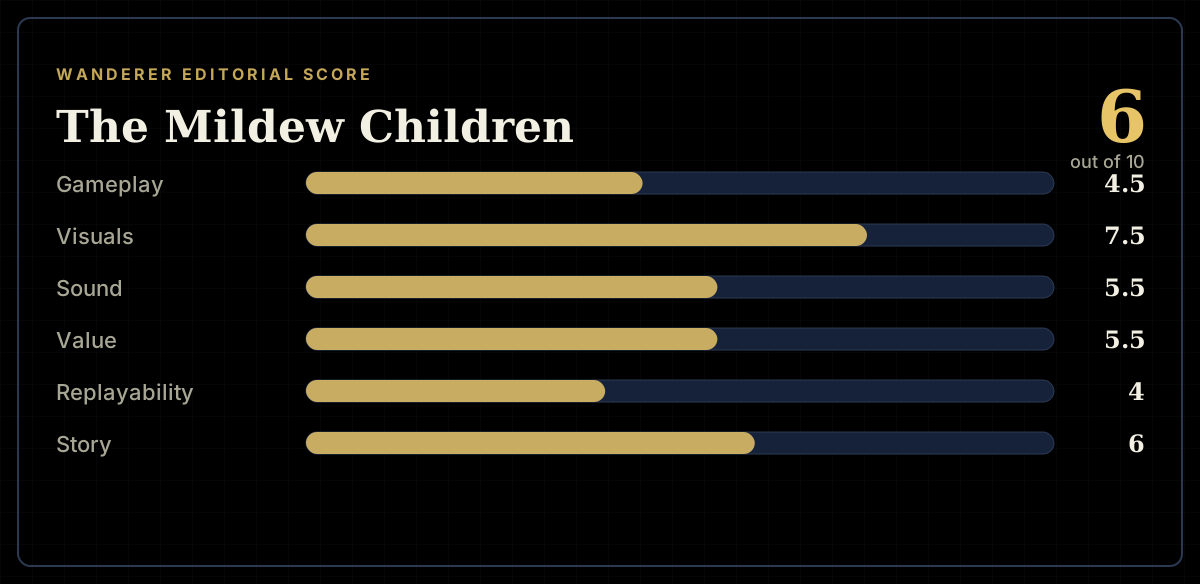
How the review scores each part of the gameWanderer Editorial -
The short versionWanderer Editorial